Further to my posts about Stuart Reid, Dr John Casey and Dr Raymond Edwards,
I've been challenged on part of what I've said about Dr Edwards' embittered booklet '
Catholic Traditionalism', by Richard Brown, CTS' Sales and Marketing Manager. So here is a full-length treatment.
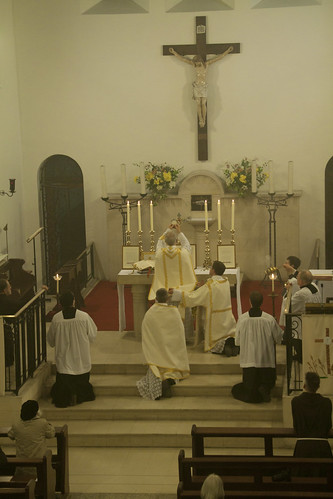
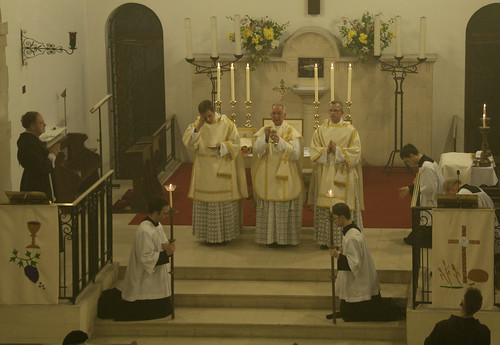
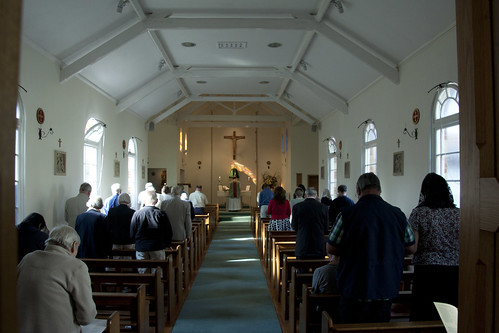
In 2007 the Holy Father, in his Motu Proprio Summorum Pontificum, acting as the Church's Supreme Legislator, ruled that the Traditional Mass, and everything else contained in the 1962 Missal, Breviary, and other liturgical books of that date, had never been abrogated, and could therefore be used by any priest of the Latin Church without special permission. He explains his motivation for doing this as being twofold: to enable 'reconciliations in the heart of the Church', and because of the intrinsic value of the 'former liturgical tradition', which he summarised with the notion of 'sacrality'. It is this sacrality which has attracted so many to these traditions, he says; the resulting body of Traditional Catholics (for want of a better term) has created a pastoral situation calling for the freer availability of the Extraordinary Form; it is this sacrality which means that the Extraordinary Form should be made more freely available for the good of the whole Church.
The paragraph I have just written is obviously true: whether people like it or not, that is plainly set down in Summorum Pontificum and the accompanying Letter to Bishops. Dr Raymond Edwards, author of the CTS booklet 'Catholic Traditionalism', seems not only incapable of grasping these points but determined to obscure them and even to frustrate the Pope's intentions. That is, at bottom, what I have against this booklet.
On p3 he describes the legal status of the 1962 Missal in terms which totally cloud the important point, that it was never abrogated. He never once, in over 70 pages, concedes that the EF has value, that this value attracts people to it, and makes it worth preserving, beyond referring in passing to the value of both forms of the Mass. And as far as reconciliation goes, he throws mud at every party in the tragic conflict over the liturgy, and attributes the most base motives to every action, in a way hardly calculated to facilitate the modus vivendi which the Holy Father wishes to establish, let alone the delicate negotiations between the Vatican and the SSPX. As I have said before, if the CTS loves the Church it should withdraw this disgraceful booklet from publication. It is, in any event, now seriously out of date.
Edwards makes a number of factual errors and dubious historical claims. The Chartres pilgrimage does not take a week (p44); Vatican II does not infallibly condemn supercessionism (p61)—or anything else; the changes to the time of celebration of the Easter services were not the most important changes made to them in the 1950s (p10). Edwards' errors in his obsessively detailed history of the SSPX would be tedious to enumerate. These are not my central concern, however, which is the general spirit of this booklet.
He says, on p31, 'It is not my business here to adjudicate between competing versions of liturgical history, or offer a considered verdict on the theological points at issue.' But that is exactly what he has spent the previous 25 pages doing. His critique of Cardinal Ottaviani's objections to the prototype New Mass are superficial and patronising, and render incomprehensible the concessions (which Edwards notes) made to this critique in the revised General Instruction of the Roman Missal. But contrary to Edwards' repeated assertion, it is not this kind of critique of the 1970 Missal which first and foremost attracts people to the Church's earlier liturgical traditions, but, as the Holy Father notes, their palpable value: their beauty, their theological richness, their sacrality. To this massive fact, Edwards is willfully blind. Instead he casts around for every possible bad reason for people's attraction to the Old Mass. As well as the theological arguments which he believes he has rebutted, there is:
a 'defensive "ghetto" mentality' p27
'fondness for dressing up' p31
connection with 'hard right' and anti-semitic politics p58
In addition to these positive reasons, if one may call them that, there are the negative reasons represented by the deficiencies of the progressive party in the Church, about which Edwards had even more to say:
the 'notorious' English translation of the Missal currently in use (p21) which lacks 'accuracy and theological completeness' p22 (and is also 'woefully deficient' p37)
celebration facing the people, which Edwards assures us 'is the result of a prevalent fad, or deliberate misunderstanding' p24
'deficiencies in priests' liturgical formation' p24
'wanton destruction of liturgical furnishings' amounting to 'something akin to Mao's Cultural Revolution' p25
'seminary formation in chaos' and 'the collapse of catechesis' p25
a 'fondness for horrible fabrics and simplistic symbolism' in vestments p32
Edwards does not limit his bile to wide groups: named or identifiable individuals get it too. On the traditional side, the SSPX is tarred with every old canard about French extremism possible, a set of accusations patently irrelevant to the English speaking world. Edwards has gone to extraordinary lengths to find quotations or references which will lessen the reputations of Archbishop Lefebvre, Bishop Williamson, and even Fr Laguerie of the reconciled Institute of the Good Shepherd (p58), and the reconciled Fraternity of St Vincent Ferrer (p43). He accuses the (also reconciled) Sons of the Holy Redeemer of 'shrill polemic' (p38: particularly rich coming from him).
On the non-traditional side Archbishop Bugnini is dismissed as 'prolix' and self important (p12: again, pots and kettles come to mind), and as well as the Maoist tendencies of some Church authorities noted above we hear that 'several [bishops] in Great Britain' have imposed 'unreasonable and unnecessary conditions' on priests using the Motu Proprio (p30).
Edwards condemns the conspiracy-theory tendency of the SSPX, but indulges a fondness for such theories himself: that Levebvre was a hidden hand behind the Ottaviani Intervention (p18), that Derek Warlock was a hidden hand behind Cardinal Heenan's implementation of the liturgical reforms (p14), and that Archbishop Bugnini was sent away from Rome by shadowy, unnamed enemies (p12).
The point I wish to make is not about the truth or falsity of these claims, but about the appropriateness of this polemic and speculation in this booklet. Just at the moment when Traditionalists and their various historical opponents are having to learn to live with each other, to share churches, to cooperate in parish life and in Catholic institutions of all kinds, is this spewing of vitriol in all directions really what we need? Wouldn't it be better, as well as more historically accurate, to admit at this point that these old divisions were caused by Catholics who were sincere, intelligent, and serious, but who came to different conclusions about the needs of the time, and the implications of timeless theological and liturgical principles?
I have been taken to task for saying that Edwards says nothing about the quiet work of the Latin Mass Society within the structures of the Church. Yes, we are mentioned on p34, and in less a page and a half our existence is acknowledged. This means we get about the same space as the Sedevacantists (pp64ff). Is this proportional? Does this reflect reality, particularly in England? The SSPX gets 19 pages. The international Una Voce movement gets a single, inaccurate sentence (p35).
Edwards appears to believe that the question of the status of Judaism after the proclamation of the New Covenant is central to Traditionalism. Saying 'I have no wish to dwell on this point" (p62) he dwells there for no fewer than nine pages (60-64 and 70-75). This is an interesting question (about which Edwards has no expertise), but it has nothing to do with the attachment of Traditionalists to the Traditional Mass, and to suggest otherwise does everyone a disservice. Of the documents of Vatican II most discussed in traditional circles, Nostra Aetate (covering Judaism) would not even necessarily make the top three. These would be, I would say, Sacrosanctam Concilium, Dignitatis Humanae, and Gaudium et Spes. The latter two are not even mentioned in the booklet. It is Edwards, not Traditionalists, who has an obsession.
What is perhaps more central is the connection between the liturgical changes and the general crisis in the Church. As I have noted, it is not abstract theological considerations which, in almost all cases, attract people to the Traditional Mass, but the experience of the Mass. The importance of the liturgy for the Church is, however, affirmed strongly by Vatican II and Cardinal Ratzinger famously said that the 'collapse of the liturgy' is a prime cause of the 'crisis in the Church'. Edwards spends much energy arguing against this claim (p25 and passim). The suggestion seems to be that it is not a legitimate view for Catholics to take. But why should we, or the CTS, prefer the opinion of Raymond Edwards to that of Pope Benedict XVI? And why is he so concerned to rule out what is evidently the view of respected authorities?
Exactly the same is true of his lengthy discussion of the canonical status of the SSPX. He says he disagrees with 'some prominent clergy' (p45), later identified as including Cardinal Castrillon Hoyos, then Prefect of the Pontifical Commission Ecclesiastical Dei, which actually has oversight of the issue. Edwards thinks the Cardinal is wrong. But why should anyone care what Raymond Edwards thinks? He is not even a canonist. The booklet has become a vehicle for his personal, amateur speculations.
Overall it is perfectly clear that the CTS would never consider doing such a hatchet job on any other authorised movement within the Church. Even groups outside the Church, described in CTS booklets, could expect a more even-handed appraisal. Pope John-Paul II described the desire of some Catholics for the Old Mass as a 'legitimate aspiration': Edwards gives absolutely no acknowledgment of this legitimacy. If he hates us (and apparently everyone else) so much, why on earth was he asked to write the booklet?


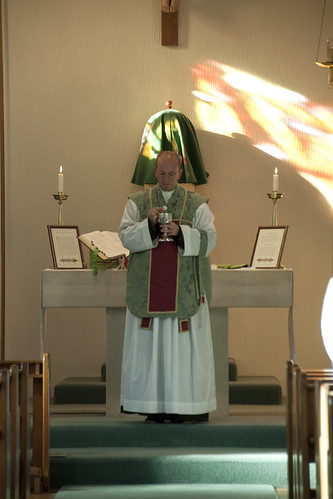
I have written enough on this overheated polemic. But was it really impossible for the CTS to show the picture on the front cover to anyone seriously involved in the traditionalist scene, to identify the priest in it? It is, of course, Fr Armand de Malleray FSSP.
- Posted using BlogPress from my iPhone
 It is still possible to book places at the Evangelium Conference taking place at the Oratory School near Reading, 5th – 7th August 2011, for young adults (18-35).