Monday, May 11, 2026

A year of Pope Leo: me in Ad Vaticanum

I've written for the first time in the new Catholic news website, Ad Vaticanum.

It begins:

The first question for the Catholic press about a new pope is inevitably where he sits on the ideological spectrum: will he support readers’ causes and punish their opponents? Popes are complicated figures, however, and do not arrive neatly labelled.

The first indication of the Holy Father’s ideological allegiance came before his election, when the journalist Edward Pentin encountered Austin Ivereigh and Fr James Martin SJ in a street in Rome. It was a moment when Cardinal Prevost’s handling of a clerical abuse case in his former diocese in Peru was being discussed in the media, and Ivereigh was upset about this. The encounter, which is described on Pentin’s Substack, suggested that two of the best-known supporters of Pope Francis regarded Prevost as “their man”. His election a few days later was indeed welcomed by many who had been looking for a “continuity candidate” to continue the work of Pope Francis.

Read it all there; there's no paywall.

Support the Latin Mass Society

Wednesday, April 29, 2026

Walsingham Pilgrimage: call for singers

148-_C3A6133 


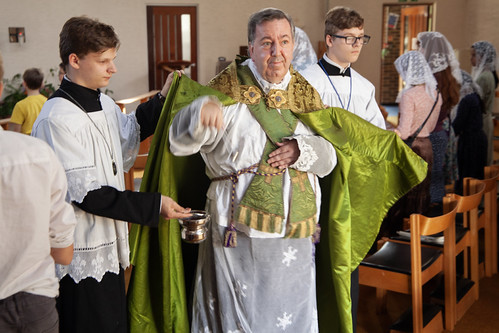
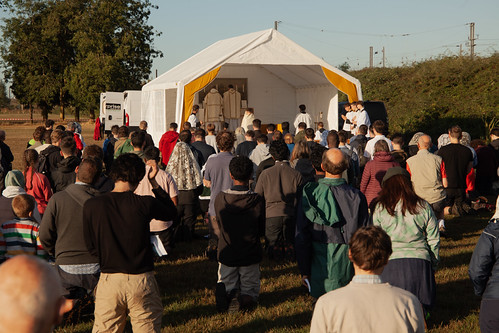
Booking is now open for the LMS Walking Pilgrimage to Walsingham; the 2026 dates are Thursday 27 to Sunday 30 August 2026, and the 'early bird' discount applies until Pentecost Sunday, 24 May.

But before we can welcome 200+ pilgrims, we need to be able to look after them. We need volunteers! Today I am going to talk about singers.

8ea34ba0-e1ab-43d7-bfd9-ff04ef9a7323

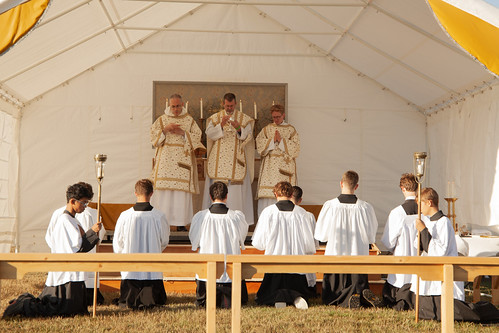
Good Music, along with good food, may be said to power the pilgrimage in its natural aspect. But unlike the food, however good, the music has a significance at the supernatural level as well, because it can also be prayer.

It will be no surprise for readers to hear that a lot of prayers are said on the pilgrimage. Pilgrims are divided into 'chapters' which are small enough for people to hear instructions from the front to the back, with the help of megaphones, and also for collective prayer. When we say the Rosary, we sing it: we have settings of the Hail Mary in English, Latin, and French. We also sing the Litanies of Our Lady, of the Saints, of St Joseph, and of the Sacred Heart. In addition, we sing many popular chants, such as the O filii et filiae (though we sing it better than the guys in the link), vernacular hymns, and when the going gets tough, even some patriotic songs.

We believe the singing is very important and go to a lot of trouble over it. We have a book of all the chants and hymns, often with the music (and other useful prayers and information), the Vademecum Peregrini, which everyone has, and every chapter has a cantor.

Tuesday, April 28, 2026

Farewell to the Hereditary Peers

I have marked the occasion of the final disappearance of the hereditary peers from the UK's House of Lords with this defence of the hereditary principle.


This is the conclusion:

I have a high regard for democracy, because unless it is unusually corrupt, it makes possible the eviction of unpopular ruling parties without bloodshed, and that counts for a lot. Democratic institutions are regarded as having legitimacy, and elected officials who promised particular things when campaigning for votes are regarded as having a “mandate” to implement them. These are good things which help political systems to function and to overcome all kinds of challenges. But this all works because of the western political tradition, which attributes legitimacy to these things. This tradition is reasonable, but it is not necessary. Things could be done in different ways, and in different times and places they have been done in different ways.

The Homeric tradition regards a warrior elite as having the mandate to rule: perhaps it makes sense that those prepared to die for their community should rule it, and it may make for an efficient and just political system. Other communities, living in other circumstances, may focus on a religious elite, or an intellectually, culturally, or economically preponderant class of one kind or another, as natural rulers. If it works for them, it is not for us to criticise it.

The hereditary principle is characteristic of a pre-modern political system, but if it was reasonable then, there is no sense in which it is in principle wrong now. The test of its legitimacy, in fact, is the degree to which it is part of the political tradition of a community. The hereditary House of Lords has been part of Britain’s, and England’s, political system for at least 800 years, so the case for it is pretty conclusive. 

Read the whole thing there (paywalled).

Support the Latin Mass Society

Monday, April 20, 2026

Book launch for biography of Michael Davies: photos

IMG_2666

This was a splendid occasion in the St Wilfrid Hall at the London Oratory, addressed by the author, Leo Darroch.

You can buy the book from the LMS here. You can see a review of it by me on the Catholic Herald here.


IMG_2677 


Support the Latin Mass Society

LMS Spring Latin Course: photos

IMG_2660

This year, for the first time ever, the LMS is having not one but two Residential Latin Courses, on in April, that has just taken place, and one that will run from Monday 29 June to Saturday 4 July.

Both are taking place this year in the Carmelite Retreat Centre at Boars Hill, near Oxford.


All are courses are taught in small groups arranged by students' level of knowledge, so all are welcome: complete beginners and more advanced students. The Traditional Mass is celebrated each day. There are big discounts for students, and even bigger ones for clergy, religious, and seminarians: plus those intending to join seminary.

IMG_2652

Support the Latin Mass Society

Friday, April 17, 2026

Oxford Pilgrimage 2026

IMG_1522

The annual LMS Oxford Pilgrimage in honour of the Catholic martyrs who died in the city will take place on 

Saturday 17th October, with Mass in Blackfriars at 11am

This will be followed by a procession from Carfax to site of the Castle gallows at 2pm, returning to Blackfriars for Benediction.

IMG_1492

IMG_1541

Support the Latin Mass Society

Thursday, April 16, 2026

Review of Michael Davies biography, and other recent work

For the Catholic Herald, I have written a review of Leo Darroch's biography: Michael Davies: Defender of Catholic Tradition,


and also a review of a very different book: Inversion, a collection of essays written by homosexuals disaffected by the direction their movement has taken. In the review I argue that this movement arose out of the Protestant society of the industrial age, and compare the role of marginalised groups
in pre-industrial Catholic societies. As I write, 'Perhaps a society creates the dissidents that it deserves.'

My review of the Michael Davies biography begins:

Michael Davies (1936-2004) was from the 1970s until his death the foremost lay advocate of the Traditional Latin Mass (TLM). His books, particularly the trilogy Cranmer’s Godly Order, Pope John’s Council, and Pope Paul’s New Mass, were an enormous influence on a generation of Catholics attached to the TLM, and set the terms of the debate. He rejected the extreme claims made by some, that the reformed Mass was invalid or that recent popes were not real popes, and when he died he was praised by Cardinal Joseph Ratzinger. Nevertheless his support for the Traditional Mass and the traditional teachings of the Church were uncompromising.

Leo Darroch’s biography starts with Davies’ early life. He was born into a Protestant family with Welsh roots, and attended a Grammar school. Instead of doing National Service he joined the regular Army, and served in Malaya. Back in civilian life he became a Catholic, married Maria Milosh, a Yugoslavian teacher who had been studying in England, and became a teacher himself. The young Davies had a growing family and was devout, conscientious, and intelligent, but those who met him in the 1960s would have had little reason to imagine that he would devote the second half of his life to writing, speaking, and campaigning about the Church’s teaching and liturgy, with unrelenting industry and very little earthly reward. It is interesting to ask what radicalised him.


Support the Latin Mass Society

Tuesday, March 31, 2026

LMS Walsingham Pilgrimage: booking open!

IMG_1327

Booking is open for this year's LMS Walking Pilgrimage to Walsingham! There is an 'early bird' discount until Pentecost!


We will gather in Ely on Thursday 27th August, walk on Friday, Saturday, and Sunday (30th) of the August Bank Holiday weekend.

Please consider volunteering! Volunteers get a discount or come for free. We need cooks, drivers, marshals, singers, first aiders, photographers and someone to do social media. Email walsinghampilgrimage@lms.org.uk

Monday, March 30, 2026

Annunciation at SS Gregory & Augustine

IMG_2504

Fr John Saward celebrated a lovely High Mass in SS Gregory & Augustine's, Oxford, the the feast of the Annunciation.

IMG_2494

Mass was accompanied by the Ensemble Res Sacra, who regularly accompany these feast-day Masses. They had a particular treat for us this time, singing pieces by Paolo Papini (d.1603), who was maestro di cappella at Ospedale di Santo Spirito in Sassia, Rome, recently discovered by Dr. Naomi Barker, Senior Lecturer in Music with the Open University. 

In addition, they sang rarely-heard Mass by Giovanni Animuccia, who was Palestrina's successor and predecessor at the Cappella Giulia. 

Support the Latin Mass Society

Sunday, March 29, 2026

On Cardinal Parolin's letter to the French Bishops

Me in the Catholic Herald.

A key paragraph.

The importance of this kind of solution, and its appropriateness, is further clarified. It is important because the current situation represents a ‘painful wound’. Blame for this wound is not assigned to anyone; perhaps it is best to see it simply as the unfortunate outcome of history, including some very recent history. On a casual reading, the ‘wound’ metaphor might seem to refer to the division implied by the mere fact that there are two rival liturgical rites, but if Pope Leo is concerned about a practical solution to help those attached to the older form, this can’t be what he means. The wound that concerns the Holy Father is one that can be healed by ‘generous’ inclusion of those attached to the Vetus Ordo, suggesting that what he had in mind is their current deep unhappiness, in feeling excluded from the Church’s pastoral care. Pope Leo is calling for the bishops to understand the sensitivities of those attached to the Vetus Ordo, and having come to that understanding, respond to this sensitivity by making provision for the celebration of this liturgy.


Support the Latin Mass Society

Saturday, March 28, 2026

The Traditional Mass at Magdalen College Oxford

IMG_2556

The Resonantia Consort accompanied a Missa Cantata in the chapel of Magdelen College celebrated by Fr Daniel Lloyd of the Ordinariate, who is parish priest of the nearby parish South Hinksey.

IMG_2536

Thursday, March 05, 2026

Francis Thompson, angels, and science

The angel of Gethsemane
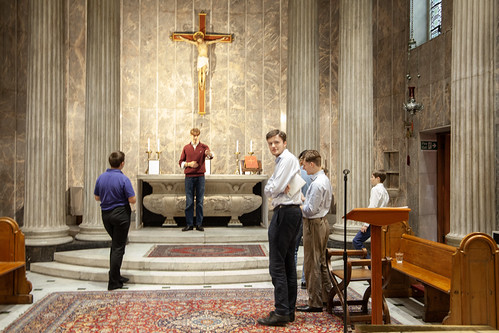
My article for the Catholic Herald begins:

The Catholic mystic and poet Francis Thompson died of tuberculosis in 1907, and one of his best-known poems, ‘In No Strange Land’, was not published until the following year. It evokes the glory of God’s creation, which most of us cannot perceive, a theme we find in many Christian poets.

A key passage:

The older worldview is sometimes described as ‘enchanted’, and it is said that the spell was broken by the Scientific Revolution, which explained things that could not previously be explained except by reference to supernatural causes. The suggestion, essentially, is that, in the medieval worldview, natural events were ascribed to miraculous or magical causation through ignorance. This is a distortion of the facts, however. Medieval, and indeed ancient, astronomers described the movement of the stars and planets in great detail, and were able to predict conjunctions and eclipses; they were similarly well versed in other laws of nature. They distinguished the effects of these things from miracles, which are brought about directly by God and which go beyond the workings of these laws.

The medievals nevertheless saw the workings of nature in the context of God’s creation. This was reinforced by a number of features of medieval science (to use an anachronism), notably the way it looked for explanations in terms of agents (living or not), rather than, as modern scientists do, seeing the natural world as a succession of events, each causing the next. The agents which cause things, on the medieval view, are perfectly natural; but at the same time we can more easily take a personal view of them, and even invoke them, or their guardian angels, in prayer.

Support the Latin Mass Society

Thursday, January 01, 2026

Towards a Theology of Liturgical Reconciliation: launch and panel discussion 12th February

St Mary's University Press has published the proceedings of a conference on liturgical reconciliation: testimonies, theolgians' responses and the ensuing discussions, with contributions from Fr Dominic White OP, Rev. Dr Liam Hayes, Canon Dr Robert Gibbons, Prof. Medi Volpe, Archpriest Paul Elliott, and Sr Marie Trainar.

 The Latin Mass Society sponsored the publication of this book, and is now sponsoring a London book launch for it.  Joseph Shaw has written a short contribution to it.

The launch will include a panel discussion, with the editor, Fr Dominic White OP, joined by Fr Michael Lang of the London Oratory, Matthew Hazell and Dr Joseph Shaw.

The launch will take place in the St Wilfrid Hall of the London Oratory, on Thursday 12th February. 

Free admission: please register here.
Doors open at 6:30 pm; the discussion should begin at 7 pm.


Support the Latin Mass Society