Thursday, November 07, 2013

General Absolution is a danger to souls

Relics of St Ivo of Chartes, patron saint of lawyers
If you receive General Absolution without an intention to confess your sins individually to a priest, in the normal way (including the sins you had in mind when receiving General Absolution), you will not receive sacramental absolution.

I explained this in my post about Mgr Basil Loftus' scandalous article on General Absolution (using scandal in its technical theolgical sense, of leading others to sin, as well as in the usual sense); a commenter called 'Sebastian' suggested that the practical consequences might not be as bad as I suggested. If people go to a service of General Absolution in good faith, and do not know, because they are not told, about the need to intend to confess their sins in individual confession, and do not so intend, Sebastian suggested they'd get sacramental absolution anyway.

This is because of Can. 144 §1.: "In factual or legal common error and in positive and probable doubt of law or of fact, the Church supplies executive power of governance for both the external and internal forum."

This boils down to: "If you're dumb but not evil, that's okay."


This is what canon 144 says:

§1. In factual or legal common error and in positive and probable doubt of law or of fact, the Church supplies executive power of governance for both the external and internal forum.
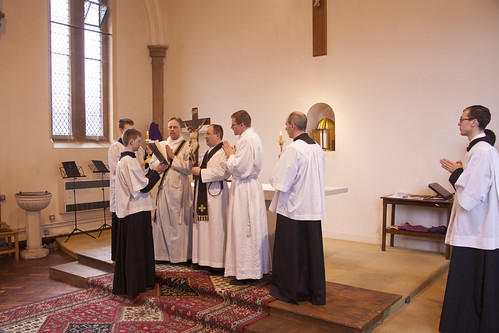
IMG_2248
The crucifix lifted up in the Good Friday liturgy (the FSSP in Reading)
I promised to come back with a proper canonical response, and I now can. I asked Mgr Gordon Read, the Latin Mass Society's National Chaplain and also our Canonical Advisor, a trustee of the Canon Law Society of Great Britain and Ireland and, as they say, the Real Deal when it comes to understanding canon law.

One of the points of addressing Loftus' painful ramblings is the chance to air these sorts of issues, and I'm grateful to Sebastian for raising a technical but very important question. Nevertheless, he is mistaken.

Mgr Read writes:

It is misconceived to describe the requirement as a 'legal condition'. Integral confession is part of the Church's doctrine as enunciated at Trent even if spelled out in the form of a legal requirement in this canon. The exceptions referred to in canon 144 do not apply to the exercise of sacramental power as such but jurisdiction or executive power as is made clear by the references in §2. If a priest hears confessions without faculties to do so then the Church supplies them but only in common error. It must not be a simple misunderstanding on the part of an individual but one that anyone would reasonably fall into....

Canon 962 §1 requires for validity not only proper disposition but also that the penitent be resolved to confess in due time the grave sins that cannot now be confessed. Clearly awareness of this requirement depends on both general instruction and if possible the announcement of it on the occasion of its administration (canon 962 §2). Where the person is inculpably ignorant of this requirement and so believes their sins have been forgiven I would suggest that what is applicable is the moral impossibility mentioned in canon 960. Should they later become aware of this requirement then the obligation revives. Clearly this is not the same as making use of this form of the sacrament in order to avoid having to mention grave sin since this is supine or affected ignorance.


Canon 960 tells us:
Individual and integral confession and absolution constitute the only ordinary means by which a member of the faithful conscious of grave sin is reconciled with God and the Church. Only physical or moral impossibility excuses from confession of this type; in such a case reconciliation can be obtained by other means.
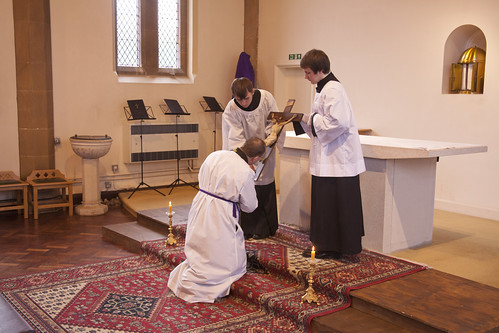
IMG_2251
The crucifix venerated on Good Friday.
The other means here are things like a perfect act of contrition, acts of penance, and the apostolic indulgence in the hour of death.

The intention to go to individual confession not a merely legal condition, it is not a matter of 'executive power or governance', it is absolutely necessary to make General Absolution work sacramentally, like the intention to marry in marriage and to baptise in baptism. If you are ignorant inculpably that is tough luck. If your contrition was real but imperfect, as is often the case, sacramental absolution would have freed you from your mortal sins; anything else will not.

Yes of course God's mercy can use other means, and I've just mentioned what they might be. But we mustn't run away with the idea that therefore it doesn't matter, that God will look down and say this person is no less sincere than another who's had sacramental absolution, and so his mortal sins must be washed away. Because to say that is to say that the sacraments make no difference. That the priest who stays in his confessional all afternoon, or indeed the priest who risks imprisonment, torture, and death to bring people absolution in time of persecution, make no difference, that if they didn't bother those penitents, who through no fault of their own were without confession, would be fine, they'd be no worse off. And come to that those people who never heard the Gospel, because St Francis Xavier hasn't yet squandered his heart and soul in bringing it to the teeming millions of India and China, they'd be fine because it wasn't their fault, St Francis made no difference, he was not God's instrument in saving anyone. And while we're at it Christ's death on the Cross makes no difference, because if it hadn't happened God is such a softy he's have let us all into heaven anyway.

No, God is not a softy, not like that, because that takes all meaning from human life, it takes away all the significance of human efforts and struggles and sacrifices, and God has not placed us in a meaningless liberal universe, but into one where there is work to do, where the good we do has consequences for good and the evil has consequences for evil.

God's Mercy does not consist in pushing His Justice aside, it consists in giving us the chance to satisfy His Justice, through the merits of Christ, applied through the sacraments. That is why we have a missionary mandate, to bring the sacraments to people. As Pope Paul VI said (Evangelium nuntiandi 5):

It is the duty incumbent on her [the Church] by the command of the Lord Jesus, so that people can believe and be saved. This message is indeed necessary. It is unique. It cannot be replaced. It does not permit either indifference, syncretism or accommodation. It is a question of people's salvation.
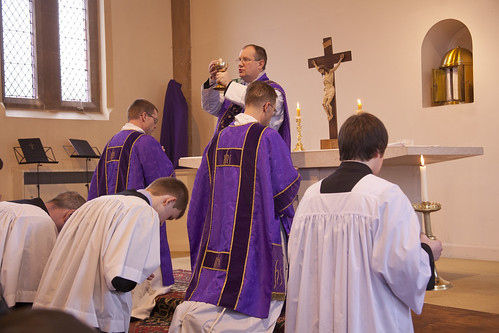
IMG_2261
The Blessed Sacrament, made possible by Christ's sacrifice on the Cross, on Good Friday.
Yes, it made a difference.

Wednesday, November 06, 2013

The worst survey in the world

The survey in preparation for the Extraordinary Synod on the Family, which we are all invited to fill in, contains no fewer than forty questions. I started to fill it in but ran out of time; others have said it has taken them an hour and a half or two hours. It is the worst-designed survey I have ever seen. Someone should learn something from its deficiencies, so here are a few. Taking for granted, obviously, that it is absurdly long, to the point that very few people are going to be able to plough through it.

Total number of Catholic marriages taking place in England and Wales. The peak is 1968.
There are fewer Catholic marriages today than at the eve of the Great War a century ago.

It is not exactly an opinion poll; complaints about bringing democracy into doctrinal matters are not quite right. Many questions are factual.

1. Question 4a: Is cohabitation ad experimentum a pastoral reality in your particular Church? Can you approximate a percentage?

Other questions ask for an analysis of a problem, or a proposed solution.

5. Question 3e: What specific contribution can couples and families make to spreading a credible and holistic idea of the couple and the Christian family today?

Both categories of question are problematic, however, since both call for types of expertise which the person filling in the form is unlikely to have. Parish priests filling it in might be expected to have something useful to say about pastoral strategies, and parents about raising children in the Faith, but some questions are appropriate only for a social scientist, or someone who has done a study of diocesan initiatives.

3. Question 1c: How widespread is the Church's teaching in pastoral programmes at the national, diocesan and parish levels? What catechesis is done on the family?

Frankly, I don't have a clue. I could try to find out on the internet, but what would be the point of that? Presumably the people writing the survey can do that for themselves. 'Pastoral programmes' are something the ordinary Faithful are not involved with. If they are any good, they would have some beneficial effect without drawing attention to themselves. If they are bad, they will absorb the energies of the parish busybodies in endless meetings. What I do know is that Church teaching on the family is not preached, it is not taught in Catholic schools, and it is not found (much) in the kind of educational materials I sometimes browse in St Paul's bookshop. That's what I know as a layman, but that's not what they've asked.

Some questions are factual to the point that it is absurd to be asking them at all.

2. Question 4b: Do unions which are not recognized either religiously or civilly exist? Are reliable statistics available?

1. Question 6a: What is the estimated proportion of children and adolescents in these cases, as regards children who are born and raised in regularly constituted families?

Why are they asking us? Can't they look it up for themselves? What happens when they get varying answers: are they going to take an average, or just find out what the truth is?

Then there are the questions with pretensions to philosophical profundity.

1. Question 2a: What place does the idea of the natural law have in the cultural areas of society: in institutions, education, academic circles and among the people at large? What anthropological ideas underlie the discussion on the natural basis of the family?

Try asking that down the pub. Here, mate, you're a non-Catholic, what anthropological ideas underlie your discussions on the natural basis of the family? I don't say: ordinary Catholic are too stupid or uneducated to answer this question. I say: as someone with a DPhil in philosophy, I couldn't begin to answer it, certainly not in the comment box of an on-line survey, and I struggle to comprehend even what they are asking. (I think it must be a loaded question: what if people don't think the family is 'natural'?) I don't think many bishops or theologians would be able to give a useful response, and I am quite sure the people collating the results won't understand the question or the attempted answers. In fact, I don't think the people asking the question knew what they really meant. The question is a monumental waste of energy.

There are lots and lots of very open-ended questions about what is or could be done, pastorally.

3. Question 3c: In the current generational crisis, how have Christian families been able to fulfil their vocation of transmitting the faith?

4. Question 3d: In what way have the local Churches and movements on family spirituality been able to create ways of acting which are exemplary?

1. Question 8a: Jesus Christ reveals the mystery and vocation of the human person. How can the family be a privileged place for this to happen?
Catholic marriages per 1000 of the Catholic population.
After a post-war rush, the rapid collapse began in 1968.
Well, how long have you got? Someone filling this in could write a whole essay, or indeed book, on any of these questions, and I wonder whether anything short of a book-length treatment is going to be any use. The problem is that there are no widely accepted categories of answers for people to choose between; it's not like a question about whether there should be more tax and government spending or less, or whether immigrants make a contribution to the community or something. The person filling in the form would need to find words to describe the different things going on, before giving an assessment of them. More helpful questions might be: Does using the Penny Catechism lead to a tick-box attitude to the Faith? Does the Neo-Catechumenate strategy of separating age groups undermine the family? Is the love of parents for each other an education for the children in Christ's love of the Church? But then you'd have to ask many more such questions to explore all the things going on, and whether they were helpful or not.

Most worrying of course are the questions which seem to be aimed at getting people to say that the teaching and discipline of the Church needs to be loosened somehow.

4. Question 1d: To what extent — and what aspects in particular — is this teaching actually known, accepted, rejected and/or criticized in areas outside the Church? What are the cultural factors which hinder the full reception of the Church’s teaching on the family?

4. Question 4d: In all the above cases, how do the baptized live in this irregular situation? Are they aware of it? Are they simply indifferent? Do they feel marginalized or suffer from the impossibility of receiving the sacraments?

5. Question 4e: What questions do divorced and remarried people pose to the Church concerning the Sacraments of the Eucharist and of Reconciliation? Among those persons who find themselves in these situations, how many ask for these sacraments?

6. Question 4f: Could a simplification of canonical practice in recognizing a declaration of nullity of the marriage bond provide a positive contribution to solving the problems of the persons involved? If yes, what form would it take?

7. Question 4g: Does a ministry exist to attend to these cases? Describe this pastoral ministry? Do such programmes exist on the national and diocesan levels? How is God’s mercy proclaimed to separated couples and those divorced and remarried and how does the Church put into practice her support for them in their journey of faith?

These questions all present divorced and remarried couples as a problem for the Church, a problem created and sustained by all this rigid teaching and discipline. At one level, of course, this is true. But it is also true that the existence of such couples, not being able to receive the sacraments, is the flip side of a positive and attractive teaching which helps to sustain Catholic families.

Catholic marriages as a percentage of all marriages in England and Wales.
The peak is 1960, the eve of the campaign against the Church's
teaching on birth control.

Furthermore, it is the only kind of testimony to the seriousness of the Church's attitude to marriage which is ever going to be noticed by the secular world. It is a form of witness, a form which, like most effective forms, is given only at the cost of great sacrifice, a witness to the indissolubility of marriage, to a world which rejects this. The world knows that the Catholic Church, in spite of everything, joins men and women in an indissoluble bond of marriage, that it is not just talk when we say 'What God has joined, let not man put assunder'. Catholic couples know that they have something precious which they will lose if they go off with someone else. Remarried couples know that they need to get themselves right with God, however difficult this may be.

So this is a real problem with the survey. It could ask:

Would super-fast marriage tribunals rubber-stamping annulments cause scandal and undermine the teaching of the Church? Would this have a disastrous effect on couples struggling to maintain their marriages in a hostile environment?

Would turning a blind eye to divorced and remarried couples receiving Communion send the signal that the Church has given up on sexual morality? Would this have a disastrous effect on young people struggling to live in light of the Church's teaching in a hostile environment?

But it doesn't.

Pictures: statistics from the Latin Mass Society's research into Catholic Directory statistics.

Tuesday, November 05, 2013

Sunday Mass and a Christening at Blackfen

IMG_5072

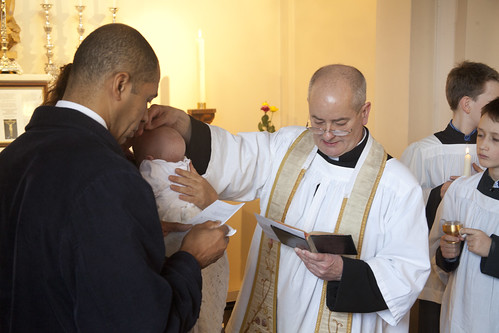
On Sunday I was at Our Lady of the Rosary, Blackfen, for Fr Tim Finigan's regular Sunday Sung EF Mass, which was followed by a Vetus Ordo Baptism, and blessing of the mother 'after childbirth', 'churching'. Fr Tim has posted about it too. 

IMG_5079

Our Lady of the Rosary is still one of a very small number of places where there is a Sung Mass every Sunday. The FSSP in Reading, the Institute in New Brighton in the Wirral, St Bede's, Clapham Park, and the Birmingham Oraotry are I think the only other places in England and Wales. Only in these places will you see the Asperges (top photo) every Sunday, the blessing of the congregation with holy water before Mass starts; this is only done on Sundays.

IMG_5082

Below, the catechumen is being anointed with chrism; he is held by his godmother. The traditional Baptism places the godparents at the centre of the ceremony, they are not just witnessing it, but make the candidate's responses. What do you seek from the Church of God? Faith! What does Faith offer you? Eternal life!

IMG_5123

The mother's blessing, like the child's baptism, starts at the church door and draws her inwards, in this case to the communion rails where she is sprinkled with holy water. Fr Finigan has a cunning brass device for doing this, which you can see in this picture.

IMG_5134

A little celebration afterwards in Our Lady of Rosary's substantial parish hall and bar.

IMG_0940

Thou who through holy baptism hast granted Thy servant remission of sin and newness of life, cause the light of Thy countenance, Lord, to shine ever in his heart. Keep the shield of his faith unscathed against every assault of his foes; keep clean and unblemished the garment of incorruption that he has put on; by Thy favour keep unbroken upon him the seal of the Holy Ghost; and as Thou art rich in mercy, deal gently with him and with us. Amen.

Monday, November 04, 2013

FIUV and Latin Mass Society in Rome this week!

This weekend is the General Assembly of the International Federation Una Voce, which takes place every two years. Mass and Vespers (and Benediction) have been arranged from before the start to after the end of the GA; the music has been sponsored by the Latin Mass Society which has arranged a pilgrimage to Rome to coincide with the General Assembly: it starts before and ends after it.

Some of the celebrants are still to be confirmed, but as you will see Cardinal Brandmüller and Archbishop Pozzo, are among them. Cardinal Castrillón Hoyos will be speaking at the Open Forum.

The Casa Maria Immacolata is the venue for the General Assembly itself, and where most delegates are staying; it is located on the Via Enzio (28), near the Vatican: map here.

Everyone is welcome to attend our Masses and other liturgies, and also to attend the 'Open Forum' on Sunday afternoon: highlighted below.


Foederatio Internationalis Una Voce

XXI General Assembly,
9th and 10th November 2013.
Casa Maria Immacolata, Rome.
Via Ezio 28, 00192 Roma.

Thursday 7th November. 
18.00 hrs.  Vespers and Benediction: Casa Maria Immacolata Convent chapel.
Music
Magnae Deus potentiae Gregorian chant
Magnificat septimi toni Gregorian chant
Ave verum  Fauré
Organ: Le banquet céleste  Messiaen


Friday 8th November. 
Commemoratio SS. Quatuor Coronatorum Martyrum

10.00 hrs. Solemn MassCasa Maria Immacolata Convent Chapel
Music
Missa VIII (De Angelis)
Organ: Méditation pour orgue Duruflé


16.30 hrs. Solemn Vespers and Benediction. St Peter’s Basilica, Chapel of the Choir
With His Eminence Walter Cardinal Brandmüller
Music
Caelestis urbs Jerusalem Gregorian chant
Magnificat primi toni Palestrina
Ave verum Elgar
Organ: Fuga sopra il Magnificat, BWV 733 Bach


Saturday 9th November.
Dedication of the Archbasilica of the Saviour (the Lateran).

08.00 hrs. Solemn Mass.   St. Peter’s Basilica, Chapel of the Choir
Celebrant: Mons Pablo Colino

Music
Kyrie ‘Le Roy’ Taverner
Mass  ‘The Western Wind’ Taverner
Bone Pastor Tallis, arr. Terry
O nata lux Tallis
Credo III
Organ: Toccata in C, BWV 564 Bach

18.00 hrs. Solemn Vespers and Benediction. Casa Maria Immacolata Convent chapel
With His Excellency Archbishop Guido Pozzo
Music
Caelestis urbs Ierusalem Gregorian chant
Magnificat sexti toni Vecchi
Ave verum corpus Byrd
Organ: Elévation, Op. 22 Villette


Sunday 10th November
[XXIII Sun after Pentecost] Dominica V quae superfuit post Epiphaniam

10.00 hrs. Solemn Mass.  Casa Maria Immacolata Convent Chapel
Celebrant: Mons Gordon Read

Music
Mass for Four Voices Byrd
Panis angelicus Franck
Rosa Mystica Fauré, arr. Knowles & Turchetta
Asperges, Credo III
Organ: Suite Médiévale (Prélude: Asperges me) Langlais


14.00 – 17.00 hrs.  Open Forum. Conference Hall, Casa Maria Immacolata
Guest Speakers:
His Eminence Dario Cardinal Castrillón Hoyos,
Fr Cassian Folsom, OSB, (The Monastery of San Benedetto, Norcia)
Fr William Barker, FSSP
Canon Gilles Guitard, ICRSS


18.00 hrs. Solemn Vespers & Benediction: Casa Maria Immacolata Convent Chapel.
Music
Lucis creator optime Washington
Magnificat Tone 1 à 4 Viadana
Ego sum panis vivus Byrd
Organ: Suite Médiévale (Acclamations: Christus Vincit) Langlais


Monday 11th November.
S. Martini Episcopi et Confessoris
09.00 hrs. Solemn  Mass.  St. Peter’s Basilica. Choir of the Chapel.
Music
Coronation Mass Mozart
Exsultate Jubilate (Alleluia) Mozart
Ave Verum Mozart
O sacrum convivium Messiaen
Organ: Apparition de l’église éternelle Messiaen

Sunday, November 03, 2013

Two Masses for All Souls

IMG_5021

Yesterday I attended two Sung Traditional Masses for All Souls, one in Milton Manor, in the morning, and one in the Catholic Chaplaincy of Oxford University.
IMG_1808

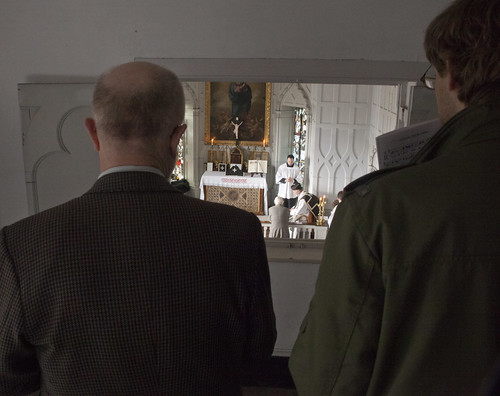
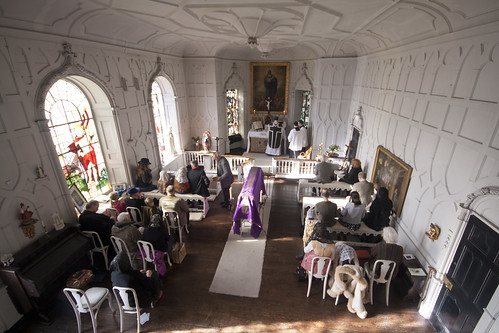
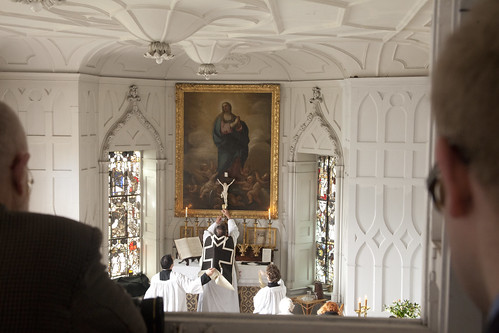
Mass in Milton Manor was celebrated by Fr John Hunwicke of the Ordinariate, and accompanied by the Schola Abelis and the Newman Consort (chant and polyphony respectively), and the small chapel was full, with about 40 people in attendance in total. We sang from an interesting choir loft, a sort of room with windows opening into the chapel.

IMG_5045

The superb 'Strawbery Hill Gothic' chapel will be celebrating the 250th Anniversary of its dedication next year.

  IMG_5065

We managed to arrange a catafalque so we could have the Absolutions at the end of Mass. These are the prayers, and sprinkling with Holy Water and Incensing, which is given to the coffin in a Funeral, which can be given in the absence of a body by an empty catafalque to represent it. For All Souls, it represents all the Souls of the Faithful Departed.

IMG_1811

In the Chaplaincy, Fr Daniel Seward of the Oxford Oratory celebrated the first public Sung Mass in the Extraordinary Form ever, in the Chapel of St Thomas More (which is a modern chapel). It was attended by fifty people, mostly students of course, and accompanied with Chant and Polyphony by a small group of student singers. I am delighted that the Extraordinary Form has in this way taken its place in the liturgical life of the Oxford Catholic Chaplaincy. Thanks are due to Fr Simon Bishop SJ, the University Catholic Chaplain, for facilitating this Mass.

I didn't take any photographs of the Mass but this image of the Altar some time before Mass started has a great symbolic value. This Extraordinary Form of the Roman Rite is celebrated at this Altar.

Saturday, November 02, 2013

Pray for the dead this November

I was struck by this lovely stained glass window captured by Fr Lawrence Lew OP; click on the photo or see his photostream here. It comes from St Chad's Cathedral, Birmingham.

Libera Animas Omnium Fidelium Defunctorum

Pray for the dead! We'll all be dead one day, and we won't think a moment of the living's time wasted if spent on the souls in Purgatory. November is their month.

This week - every day until the 8th - a Plenary Indulgence can be gained for the Faithful Departed by saying prayers for them in a cemetery, upon the usual conditions: communion within a couple of days, confession within a week, and prayers for the Holy Father. Don't miss you chance!

Friday, November 01, 2013

Part time priests: a liberal fantasy

IMG_4878
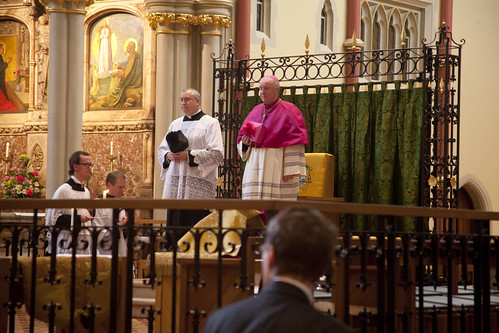
Bishop Philip Egan pauses to pray before the Altar, before Mass starts
One of the hoariest suggestions from Catholic liberals has been the idea of part-time priests, ordained for a specific community, the one in which they live. Or rather, the other way round: seeing a community lacks a priest, the bishop just ordains some suitable member of it. Frequently this is coupled with the idea that the community proposes or nominates this individual, who of course may be married. Sometimes the enthusiasm for the idea that communities have a right to a priest suggests to the more far-gone progressive that ordination is not, after all, necessary.

Here's a typical bit of advocacy for the idea, provided by our old friend Mgr Basil Loftus, in his Catholic Times column of 13th October.

Surely a priest growing out of a congregation has many advantages over one parachuted in from outside. A home-grown 'Massing-priest' would be in no doubt as to his place in the communicability - one with all the baptised, serving them in a particular way. ... He would have earned their place in their esteem. He would not bring in extraneous priestly conventions or styles of living.

IMG_4882
The Bishop stands before his throne.

In dealing with this kind of thing it is natural to distinguish the theological core of the proposal and the surrounding issues, both intended and non-intended consequences. In terms of sacramental validity it is of course possible for a bishop to ordain a man who has undertaken only the kind of part-time training a permanent deacon might have, or a bit more, and he might have a dispensation to be ordained while married. (In passing it is worth noting that in it would appear that the part-time priest is envisaged as having less connection with the diocese, less training, and less commitment, than permanent deacons do now.) And he might be ordained on the understanding that he not be at the bishop's beck and call, and just celebrate Mass where he happens to live. But to assess the proposal is not just a matter of asking whether various dispensations or unusual circumstances would impinge on sacramental validity. We have to ask what understanding of the priesthood is at work here.

One way in here is to ask whether this 'Massing priest' is going to exercise spiritual paternity over his community, to hear confessions, to administer the Sacrament of the Sick, to prepare people for the sacraments, to receive converts. These are all essential elements of the pastoral priestly role, he's not just saying Mass in a chantry chapel like the Massing-priest of the Middle Ages, nor is he doing some academic or administrative job like many priests in the 1950s. These are awkward questions, because if the answer is 'no' then the community is not really being served, but if the answer is 'yes' the idea that all that needs to happen is the bare fact of ordination after some kind of Open University course breaks down. Even a small community will generate pastoral and spiritual challenges for which proper training is essential, and will generate a volume of work vastly in excess of Sunday mornings. Indeed, small, isolated communities can be particularly hard work, as whatever priests are available have to share out the even more isolated populations in between the villages, on small islands, in places with no roads, and so on. The more easily available a priest is, in these situations, the more work for him will present itself. And help from other priests and the diocese centrally is a long way away. Like Mgr Loftus, I have experience of these kinds of places. A missionary priest out on his own needs more, not less, training than a priest in a city parish.

IMG_4903
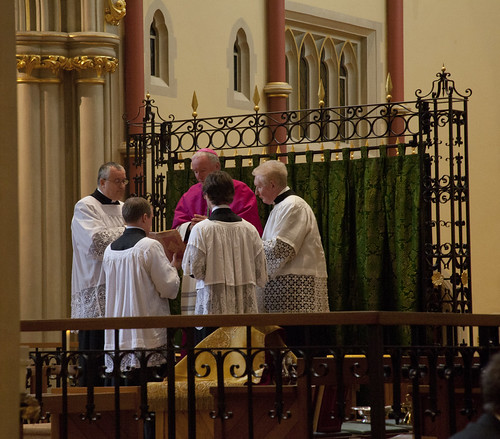
The Bishop reads one of the liturgical texts, while it is proclaimed by the celebrant.

That is a hint of the problem, but the problem is deeper. It is about the nature of the priesthood, and the priest's relationship with his bishop and his community. The priest is conformed to Christ in a special way: this is reflected, in West by celibacy. He is part of the bishop's family in a special way: he takes a vow of obedience to him. He is committed to his community in a special way: he will be required to give an account for all of their souls on the Day of Judgement. A priest is not just a handy person who can say Mass, as the village plumber or postman is handy. He is the shepherd who gives his life for his flock: or should do so.

IMG_4919
The Bishop blesses the Deacon, who is about to proclaim the Gospel.

It may seem that if there is no resident priest and some retired priest like Mgr Loftus (heaven help us) has to drive vast distances to say Masses, the community has no pastor in the sense I am talking about, so there is no reason not to replace one unsatisfactory situation with a less unsatisfactory one, a resident part-timer with a limited brief. But there is a reason: the first is an unsatisfactory situation, the second is an attack on the theology of the priesthood. If you undermine the priesthood, in the Faithful's understanding, you will of course eliminate any chance of the vocations which can really solve these pastoral problems. To an extent, of course, this has already happened.

I don't think that this idea is going anywhere; it has been kicking around for long enough and has never been taken seriously in Rome. Ideas like this, however, are going to get the dust blown off them under the present Pontificate, even if only by liberal newspaper columnists like Loftus, so it is as well to remind ourselves why they are not going to work.

IMG_4995
The Bishop gives the final blessing.
Pictures: Bishop Egan presides at Mass in the Extraordinary Form in his Cathedral, Portsmouth, last weekend. More here.