Showing posts with label Transferred Holy Days. Show all posts

Friday, September 01, 2017

Epiphany and Ascension restored to their proper days

IMG_9920
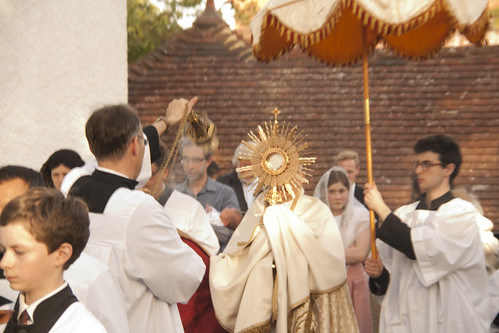
Corpus Christi Procession in Oxford: on the correct day
As I've noted before, the 2006 decision of the Bishops Conference of England and Wales to celebrate Ascension, Corpus Christi, and Epiphany onthe nearest Sunday in the Ordinary Form is the most unpopular one I can think of in my experience. Letters in the press and blog posts criticising it appear year after year. The few who defended the decision when it was first made long ago gave up trying to respond. It is good to see the bishops are big enough to recognise that they made a mistake, although it is also true that there has been a big turnover of the Conference in the last eight years, and ironically enough today's announcement is accompanied by the news of the death of Cardinal Cormac Murphy O'Connor, the architect of the original decison: requiscat in pace.

Here is the Bishops' Decree. We can now set our sights on restoring Corpus Christi to its proper date, and reversing the decision of 1984 to move the celebrations of all the Holy Days to Sunday when they fall on a Saturday or a Monday (except Christmas). At any rate, it seems we'll have a few more years to advertise the fact that if you want to attend Corpus Christi on its 'particular day' (as the CDW expresses it) you'll have to go to the Traditional Mass.

Thursday, April 21, 2016

Ascension and Bach: another lost opportunity

J.S. Bach
Another meeting of the Bishops' Conference of England and Wales, and another missed opportunity to restore Ascension, along with Epiphany and Corpus Christi, to the days they have occupied for umpteen centuries, the days they are celebrated in St Peter's in Rome, and the days they are celebrated even by many non-Catholic Christians. And to the days they are celebrated in the Extroardinary Form of the Roman Rite.

On Sunday 8th May, Oxford Bach Soloists are doing something rather fun: they are singing the two Cantatas written by J.S. Bach for the Sunday after Ascension. Bach wrote masses of cantatas for liturgical use, and they correspond to the liturgical calendar, with references to the readings and proper prayers. He did this for the German Lutherans, and the German Lutherans had essentially the same calendar, the same readings, and even many of the same prayers, as the ancient Latin Missal. The same is true of the Book of Common Prayer, where, with the odd theological tweak, you'll see Cranmer's translations of ancient Latin collects on the very same days as they are used in the Extraordinary Form.

Tuesday, January 19, 2016

On the feast of the Circumcision

The other day, Pope Francis visited a synagoge.

Near the beginning of the video of the visit (below) an old Jewish man greeted the Pope and then says to him: "Senta, siccome Lei un grande ricostruttore, perché non mette "la circoncisione" un altra volta nel calendario come... quando ero ragazzino, è una buon'idea, non? Sarebbe per noi..." 

"Look, since you're a great rebuilder, why not put The Circumcision once again into the calendar as it was when I was a little boy? It's a good idea, don't you think? It would be for us..."

The re-naming of the feast of 1st Jan is one of the odd and unsatisfactory things about the 1962 Calendar. Unsatisfactory, because the solution they came up with in 1962 - renaming the 'Circumcision', 'the Octave of Christmas', didn't satisfy the reformers only a few years later, when it was renamed 'the Feast of the Holy Mother of God'. It is the only one of the ten Days of Obligation listed in Canon law where the name is different in the 1962 Calendar and the 1970 one.

Tuesday, January 12, 2016

Epiphany in Oxford

IMG_9976

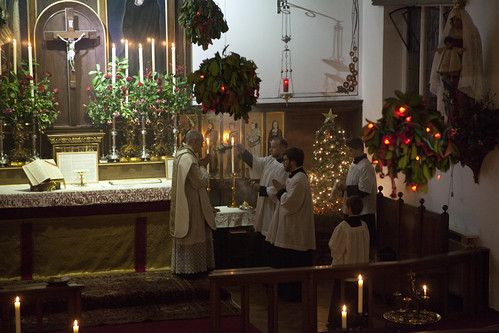
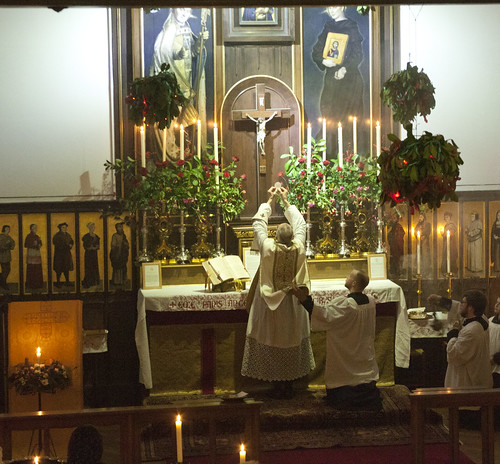
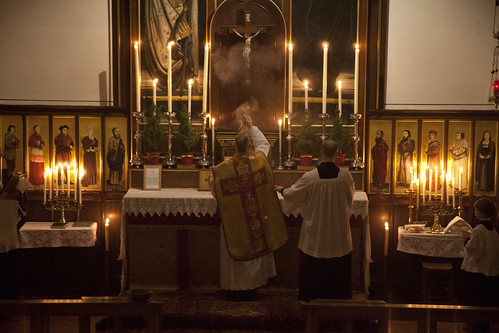
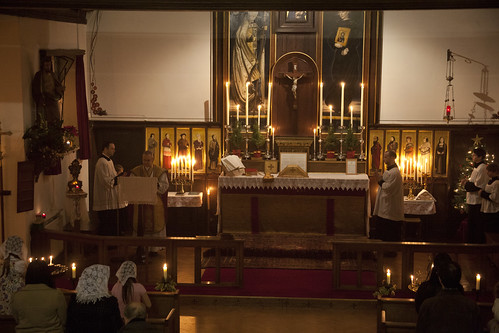
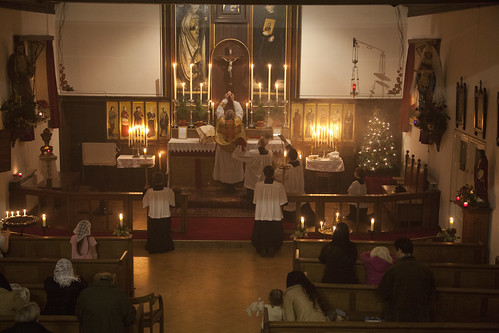
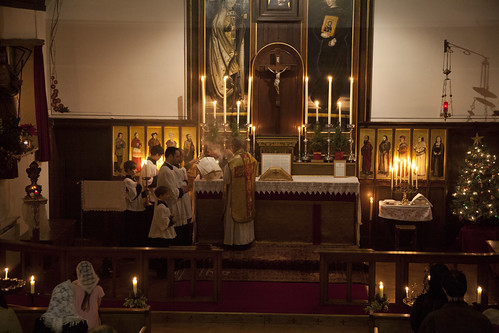
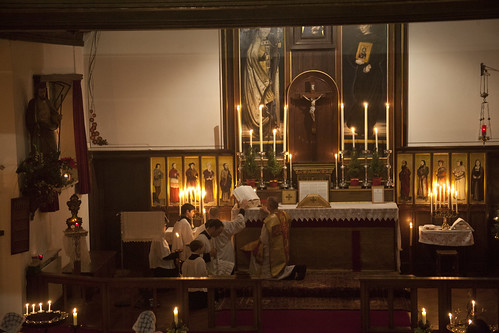
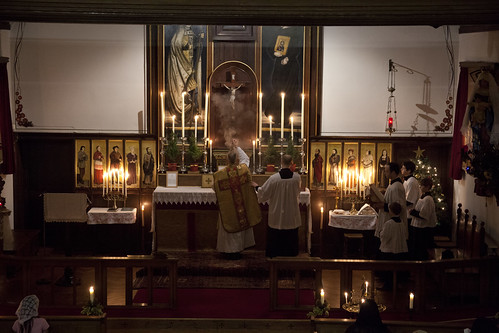
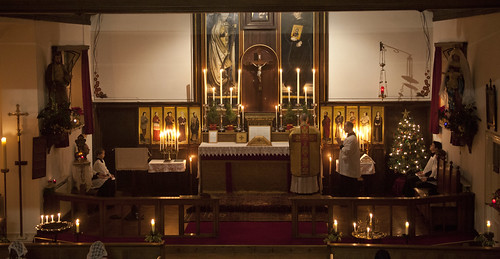
I thought I'd post some photos of the Sung Mass I attended for the feast of the Epiphany, one of the Holy Days it is the privilege of those attached to the Traditional Mass to attend on the proper dates.

IMG_9983

In terms of encouraging people to try the EF, and in generating controversty, the Bishops' 2009 decision to move the Epiphany, Ascension, and Corpus Christi to the nearest Sunday is truly the gift that keeps on giving. I read that the Bishops are reconsidering the matter. But then I heard that two years ago as well. We shall see.

Saturday, January 11, 2014

Transferred Holydays: Postscript on External Solemnities

IMG_6066
The Epiphany: celebrated on 6th Jamuary, as it has been since the 4th century.

This post follows two others on the wider topics: on the importance of having 'days of precept' in the week and on the significance of the traditional dates.

Following the submission of a dubium by the Latin Mass Society, Monsignor Camille Perl, Vice President of the Pontifical Commission Ecclesia Dei, replied as follows, in a letter dated 20th October 2008, Protocol N. 107/97.

‘1. The legitimate use of the liturgical books in use in 1962 includes the right to the use of the calendar intrinsic to those liturgical books.
‘2. While in accordance with Canon 1246 §2 of the Code of Canon Law the Episcopal Conference can legitimately transfer Holydays of obligation with the approbation of the Holy See, it is also legitimate to celebrate the Mass and Office of those feasts on the days prescribed in the calendar of the liturgical books in use in 1962 with the clear understanding that, in accordance with the legitimate decision of the Episcopal Conference, there is no obligation to attend Mass on those days.


‘3. Thus, in accordance with nn. 356-361 of the Rubricae Generales Missalis Romani of 1962, it is appropriate to celebrate the external solemnity of Holy Days on the Sunday to which they have been transferred by the Episcopal Conference, as has been customary in many other countries hitherto.’

This is the response which made possible the continued celebration of Epiphany on 6th January, and the Ascension and Corpus Christi on their proper Thursdays, in the Extraordinary Form. It also applies when Holy Days get moved from Saturday or Monday to the Sunday. The essential point is that the only effect of the bishops' action, as far as the Traditional Mass goes, is to remove the precept to attend Mass on the traditional dates.

Point 3 makes reference to the 'external' celebration of a feast: the celebration of a feast on a day other than its proper day. This is essentially the same as the celebration of a Votive Mass. In many places priests celebrating the EF on the Sunday nearest 6th Jan will celebrate the Mass of the Epiphany. The possibility of doing so is unaffected by the changes in the Ordinary Form. It may seem more appropriate to do this in light of those changes, because (in a bi-ritual parish) the Ordinary Form Masses will be of the feast, and since there was no obligation to attend Mass on the proper day, more people than otherwise will not have made it to Mass that day. That is a matter for the celebrant to decide.

What we do need to keep in mind is that thinking it is a good idea to celebrate an external solemnity of a feast is not the same as being bound to celebrate the feast because the date has been moved. The difference is not just one of obligation.

1. On the old day - 6th Jan, for example - in the EF the feast (of Epiphany or whatever) must  be celebrated. These are all First Class feasts; it would not be licit to celebrate any other Mass. In the Ordinary Form, the feast may not be celebrated. It has become a ferial day. It may be possible to celebrate an appropriate Votive Mass, for example of the Blessed Sacrament on the day-formerly-known-as-Corpus-Christi. But there is no Votive Mass of the Epiphany or the Ascension.

2. On the Sunday, only one Mass of the feast may be said. In the (unlikely) case of two public EF Masses being said in a church on the Sunday closest to 6th Jan, only one could be an external celebration of the Epiphany. The other(s) would have to be the Mass of the Sunday, which is, after all, the Mass proper to the day.

3. There are certain small differences in the Mass with an external solemnity, as with other Votive Masses. For example, Votive Masses of the Blessed Sacrament use the Mass formulary of Corpus Christi, but the Sequence is omitted. Similarly, it is omitted when celebrated on the Sunday.

4. Another difference is one of class: Epiphany is a first class feast; the external solemnity is only 2nd Class. It can therefore be said on a Second Class Sunday. An external solemnity cannot, however, be said on a First Class feast. First Class feasts on Sundays are unlikely to clash with these external solemnities, but the principle is an important one.

5. The celebration of an external solemnity requires justification. The disruption to the proper order of the liturgical calendar is allowed - yes - but only for a good reason. The good reason must be that large numbers of the Faithful would not otherwise be able to celebrate the feast. It is not just an ad libitum option, like the choice of Votive Mass on a ferial day.

The EF is actually quite used to the repetition of Masses. Last evening I attended Low Mass and (in accordance with the rules) it was the Mass of the Epiphany again. On Ferial days priests often repeat the Mass of the previous Sunday: this is especially useful if the Sunday has been replaced by an important feast. I know, however, that it has been irritating to many people who have made the effort to attend these particular feast days in the EF on a weekday, and who probably won't go to a ferial Mass during the following week, to be deprived of the 'Sunday withing the Octave' every year for no good reason. Celebrants need to balance this consideration against the desire to provide the feastday Mass for those who didn't make it.

I really hope that, after the Bishops' meeting after Easter, we can stop worrying about all these issues, except perhaps in the more manageable cases of the transferal of OF celebrations from Saturdays and Mondays to Sunday. Please, again, say a little prayer that this may be so.

Transferred Holy Days, 3: the obligation

IMG_6065
The celebrant at Epiphany solemnly proclaiming the dates of the movable feasts of the year. 
One of the arguments made in the Position Paper on Holy Days published by the Una Voce Federation is that having a formal precept, an obligation to attend Mass, makes it easier for people to attend Mass.

It is simple, really. If it is impossibly difficult, for any reason, to get to Mass on a day of precept, you don't commit a sin if you don't go. It is not an obligation which causes anyone a real problem. On the other hand, the precept is useful not only in establishing good habits and stimulating our devotion, but in dealing with those in authority over us. Employers, school and college superiors, prison governors, and all kinds of state entities will, very naturally, take a request to make some kind of provision to allow a Catholic to attend Mass on a particular day more seriously if the Catholic says that it is a matter of religious obligation, and not just a matter of personal preference.

Sometimes employers, those organising school timetables, and the rest will find it impossibly difficult to allow Catholics to go to Church on a particular day. That's life: no one is going to hell for that reason. But when there is something which can be done to make it possible, which is, say, mildly inconvenient, they will do it if it is important for the Catholic, and not if it is not important. I'm simply assuming these individuals are reasonable human beings. How are they going to judge what it is important, and what isn't? The best thing to show them is a list of Days of Obligation issued by the officially recognised religious authorities for one's faith, in this case the Bishops of England and Wales.

It is not, however, just a matter of being reasonable. The law has something to say about this as well. In the European Convention on Human Rights, Article 9 reads as follows:
1. Everyone has the right to freedom of thought, conscience and religion; this right includes freedom to change his religion or belief and freedom, either alone or in community with others and in public or private, to manifest his religion or belief, in worship, teaching, practice and observance.
2. Freedom to manifest one’s religion or beliefs shall be subject only to such limitations as are prescribed by law and are necessary in a democratic society in the interests of  public safety, for the protection of public order, health or morals, or for the protection of the rights and freedoms of others.

This applies not only to government bodies but private persons, such as employers. In applying this article, courts distinguish obligatory and non-obligatory ‘manifestations’ of a religion.

Thus, the English Courts have ruled that Sikhs have the right to wear the ‘Kara’, a bracelet,[1] and female Muslims a Hijab,[2] at school. In the latter case the Courts ruled explicitly that the Hijab can be considered as a ‘requirement’ of the Muslim faith. By contrast, a Christian who wished to wear a cross with her uniform lost her case against her employer,[3] although this was later overturned by the European Court of Human Rights (in September 2012). The English Courts based their decision, in part, on the fact that ‘there is no mandatory requirement of the Christian Faith that a Christian should wear a Crucifix.’[4]  Again, in finding against a Marriage Registrar who refused to register same sex Civil Partnerships, the Court of Appeal based its decision in part on their finding that ‘her view of marriage, ...was not a core part of her religion.’[5] Though the factual basis of these findings can be questioned, the fact remains that Courts do take into account whether any particular practice of religion is a ‘requirement’ of the religion or is merely a personal religious practice.

To summarise, in removing religious obligations from Catholics, the bishops are not making our lives as Catholics easier. Those obligations never bound to the point of making life seriously difficult. No, the bishops are making our lives harder: it makes it harder for us to live the devotional life we want to.


[1] The dispute between a Sikh schoolgirl, Sarika Singh, and Aberdare Girls’ School in South Wales: Watkins-Singh, R (on the application of) v Aberdare Girls’ High School & An or [2008] EWHC 1865(Admin) (29 July 2008)
[2] Begum v Denbigh High School [2006] UKHL 15
[3] Nadia Eweida, who was sacked by British Airways for wearing a cross on her uniform in 2006, lost her Employment Tribunal and subsequent Appeal case, where she alleged Religious Discrimination and breach of Human Rights: Eweida v British Airways Plc [2010] EWCA Civ 80 (12 February 2010). This was overturned by the European Count of Human Rights in Eweida and Others v. The United Kingdom - HEJUD [2013] ECHR 37 (15 January 2013).
[4] Chaplin v Devon & Exeter NHS Trust, ET Case No: 1702886/2009, and Eweida v British Airways [2010] EWCA Civ 80
[5] Ladele v London Borough of Islington [2009] EWCA Civ 1357


IMG_6071

Friday, January 10, 2014

Transferred Holy Days, 2: the dates

IMG_6063

 The dates of the Church's major feast days are in no way random. They have deep historical and cultural roots, and immense theological significance. The Church uses the calendar to teach us things, and the means she employs include the intervals between feast days.

Thus, most obviously, the Ascension is 40 days after Easter. 40 is the time of waiting we find in the Old and New Testament. Moving the feast of the Ascension not only obscures this, but mucks up the interval between the Ascension and Pentecost: nine days, a novena of preparation for the Holy Spirit to descend.

Corpus Christi is on a Thursday after Easter because it recalls the mystery of Maundy Thursday. The symbolism is destroyed if it is moved to Sunday.

Epiphany is the Twelfth Day of Christmas: it can't be moved without damage to all the cultural associations this has. It is the primary feast of Christmas for many Oriental Churches. It was celebrated on 6th of January by the Emperor Julian in the year 360. This is pretty well as far as detailed records go back for many aspects of the liturgy. To move it is surely an act of barbarism.

SS Peter and Paul, 29th June, which gets shunted to Sunday if it falls on Saturdays and Mondays, is not only extremely ancient but it a vital link with the Orthodox. Bl Pope John Paul II used to celebrate it with the Ecumenical Patriarch.

All Saints suffers the same fate despite the fact that it is inseparably related to Halloween before it and All Souls after it.

Perhaps we should be grateful that the other Holy Days of Obligation listed in the Code of Canon Law are not days of precept in England and Wales, so we can at least celebrate them on the days the universal Church has established for them.

The Octave Day of Christmas, 1st Jan: it would obviously be absurd to celebrate the Octave on a day other than the Octave, the eighth day. It would equally be absurd to move it away from a public holiday. In Catholic countries, feasts important in the nation's spirituality are frequently public holidays. Here we have a tailor-made public holiday, and it is still too much to suggest we go to Church to celebrate the feast, whether we call it the Circumcision or the Feast of Our Lady Mother of God.

The Immaculate Conception, 8th December, is exactly nine calendar months before the Feast of the Birthday of Mary, 8th September. How cool is that? The feast also represents an English contribution to the development of the calendar; it spread to the Continent from England (and other places) in the 12th century. It was called the 'Conception of Mary' until the dogma was defined in 1854.

The Assumption, 15th August, has been celebrated on that day since 7th century, and is a public holiday in Catholic countries around the world.

The Feast of St Joseph (Spouse of the Blessed Virgin Mary), 19th March, is seven days before the Feast of the Annunciation ('Lady Day') on 25th March.

In all these cases, of courses, these are the dates the Holy Father celebrates the feasts in the Vatican. Is it really too much to ask that Latin Rite Catholics in England be allowed to celebrate the most important feasts of the calendar in union with the Pope?

On the business of moving feasts from Saturdays and Mondays, it would surely be better, if the Bishops honestly think we are too feeble to attend Mass two days in a row, to remove the precept without moving the celebration of the feast itself, so those who want to and are able can attend Mass on the traditional day, and the sequence of Sundays is not disrupted unnecessarily. This is what they do in the United States, for example.

However, as I shall argue tomorrow, the precept itself is important.

IMG_6064
All kneel at the point in the Gospel of the Epiphany where the Magi kneel to the Christ child.

Thursday, January 09, 2014

Transferred Holy Days: 1st of a short series

IMG_6050
Mass of the Epiphany in SS Gregory & Augustine's, Oxford

Back in 2006 (remember that? seems an age ago) the bishops of England and Wales moved the celebration of the feasts of the Epiphany, Ascension, and Corpus Christi to Sunday. That leaves only SS Peter and Paul, the Assumption, All Saints, and Christmas Day, as non-Sunday Holy Days of Obligation in England and Wales.

Corpus Christi and the Ascension traditionally fall on Thursdays: Corpus Christi because it recalls Maundy Thursday, and the Ascension because it is 40 days after Easter Sunday (take note, Mgr Basil Loftus, it didn't happen on the same day). All the other days are on fixed dates, and can fall on any day of the week. Under the rules in England and Wales, if they fall on Saturday or Monday they are, again, moved to Sunday, with the sole exception of Christmas. This means that in some years Days of Precept all but disappear.

For example:
In 2009 SS Peter & Paul (29th June) fell on a Monday;
the Assumption (15th August) fell on a Saturday,
the feast of All Saints (1st November) fell on a Sunday.
The only day one needed to go to church apart from Sundays was Christmas Day.

In 2014 SS Peter & Paul (29th June) will fall on a Sunday and All Saints on a Saturday, leaving only the Assumption alongside Christmas as Days of Obligation.

The result is that the very concept of a Holy Day of Obligation, a 'Day of Precept', other than Sunday, has become as unfamiliar to many Catholics as days on which you can gain a plenary indulgence.

It is fair to say that this decision by the bishops has been the most unpopular that I can remember. It has been pointed out that the Days of Precept in the week were a unique opportunity for the celebration of the mysteries they mark in Catholic schools, where many of the pupils of course do not attend Mass on Sundays, even if nominally Catholic. Again, the moving of these feasts from their traditional days not only tears away the historical Catholic associations of the date, but in many instances takes us out of line with many non-Catholic churches (notably Lutherans and Anglicans), in some cases with the Orthodox (whose celebration of Epiphany eclipses Christmas itself), and even with popular culture. In 2010 the Church in England and Wales did not celebrate All Saints the day after Halloween. Because it was a Monday. The mind boggles.

The exception of course is with Masses celebrated according to the Extraordinary Form. Although the matter needed some clarification from the Roman authorities, what the Bishops' action has done is to remove the obligation to attend Mass on these days 'moved to Sunday' for whatever reason. So you can still go to Mass of the Epiphany on the 6th January, for example, if you find a church celebrating the Traditional Mass.

As well as seeking the clarification which allows this, the Latin Mass Society has made representations to the Bishops of England and Wales seeking the reinstatement of the obligation to attend Mass on the traditional dates. We have also pointed out the problem of moving feasts to Sundays if they fall on Saturdays and Mondays. Additional arguments for the traditional dates, and the obligation to attend Mass on those dates, can be found in the FIUV Position Paper on the subject, available here. In the next couple of posts I will say more about the importance of the dates, and about the importance of the precept: the obligation to attend Mass,

I hope all readers of this blog will say a quick prayer for wisdom on the bishops' part when they discuss this again after Easter this year.

IMG_6060

Thursday, November 15, 2012

Holy Days and Civil Rights

Today I'm publishing the latest Position Paper, number 13 in the series, this one is about Holy Days of Obligation. Go over there to read it.

Here I'm publishing separately Appendix C, to draw it more to people's attention, since I think it warrants it. Probably most people reading this will agree that for Holy Days to be moved to Sunday, as three of them were by the English and Welsh Bishops in 2006, was a mistake: they are important feasts, and celebrating them on their proper days is an essential part of taking them seriously. The situation since then, with most of the remaining ones moving to Sundays when they fall on Saturday or Monday, is that there are now so few Holy Days of Obligation on weekdays that the very concept of the Holy Day is in danger of being lost from the consciousness of the average Catholic.

But here is a quite different argument. If you are Catholic employee, if you are at school, or if you are enjoying Her Majesty's hospitality in one of her prisons, by moving the celebrations to Sunday, or removing the obligation to attend Mass, the bishops are making it much harder for you to make the case to your colleagues and superiors that you be allowed to attend Mass, a few times a year, during the week. The bishops may say: we mustn't be too hard on Catholics, they have busy lives, let's not require they go to Mass on too many days. By doing this they are not making life easier: they are making it harder for Catholics to get to church when they might want to.

I have run this argument past lawyers specialising in this field, and I am very grateful for their help. If there are any mistakes here, they are mine. But the basic idea - with variations for those wishing to appeal to the US First Amendment and those wishing to appeal to Article 9 of the European Convention on Human Rights - is sound.
IMG_8649
A celebration of the Feast of Epiphany on 6th January, SS Gregory & Augustine's, Oxford
Appendix C: Holy Days and Rights Legislation


The right of religious freedom enshrined in international law, treaties, and national constitutions, typically creates a non-absolute right of religious believers to follow the teachings of their religion, most obviously in relation to worship. Since for practical purposes this right has often to be balanced against the convenience of others, it is natural for courts and others to give greater weight to the religious observances which are most important to the believer, and to look to official religious bodies for guidance as which observances are really important. We will illustrate the point briefly with regard to two important jurisdictions: the United States of America, and England and Wales, subject as it is to the European Convention on Human Rights and the European Court of Human Rights.

In the Constitution of the United States of America, the First Amendment is as follows:
Congress shall make no law respecting an establishment of religion, or prohibiting the free exercise thereof; or abridging the freedom of speech, or of the press; or the right of the people peaceably to assemble, and to petition the Government for a redress of grievances.
Since 1947 this obligation has been extended to the States, as well as the Federal Government.[1] A relevant precedent was set in 1963, that a Seventh Day Adventist should not be deprived of unemployment benefit on account of refusing to work on Sundays.[2] Under a Federal statute,[3] the Federal Government must justify actions which ‘unduly burden acts of religion’ by a ‘compelling interest’, even if the action in question does not target religious practice.

In the European Convention on Human Rights, Article 9 reads as follows:
1. Everyone has the right to freedom of thought, conscience and religion; this right includes freedom to change his religion or belief and freedom, either alone or in community with others and in public or private, to manifest his religion or belief, in worship, teaching, practice and observance.
2. Freedom to manifest one’s religion or beliefs shall be subject only to such limitations as are prescribed by law and are necessary in a democratic society in the interests of  public safety, for the protection of public order, health or morals, or for the protection of the rights and freedoms of others.
This applies not only to government bodies but private persons, such as employers. In applying this article, courts distinguish obligatory and non-obligatory ‘manifestations’ of a religion.

Thus, the English Courts have ruled that Sikhs have the right to wear the ‘Kara’, a bracelet,[4] and female Muslims a Hijab,[5] at school. In the latter case the Courts ruled explicitly that the Hijab can be considered as a ‘requirement’ of the Muslim faith. By contrast, a Christian who wished to wear a cross with her uniform lost her case against her employer.[6] The Courts based their decision, in part, on the fact that ‘there is no mandatory requirement of the Christian Faith that a Christian should wear a Crucifix.’[7]  Again, in finding against a Marriage Registrar who refused to register same sex Civil Partnerships, the Court of Appeal based its decision in part on their finding that ‘her view of marriage, ...was not a core part of her religion.’[8] Though the factual basis of these findings can be questioned, the fact remains that Courts do take into account whether any particular practice of religion is a ‘requirement’ of the religion or is merely a personal religious practice.

For both the United States and England and Wales, and other jurisdictions with similar legal principles, it follows both from these legal considerations, and also from the more general culture which they foster, that attempts by the Church to make life easier for Catholics by minimising their obligations, or by making them more flexible, can have the paradoxical result that Catholics will find it harder to observe the practices in question. Furthermore, since the strongest obligations have the most chance of making a difference to the practices of large employers, schools, universities, and prisons, the less demanding the Church becomes, the less impact she can expect to have on public culture.  For bishops’ conferences to decide that a Holy Day of Obligation is no longer a day of obligation has secular legal implications for the Civil rights of Catholics, as well as arguably reducing the spiritual benefits of Holy Days, and their important role in stimulating and defending a distinctive and strong Catholic Culture. 

[1] The precedent was set by the case Everson v. Board of Education in 1947.
[2] Sherbert v. Verner, 1962
[3] The Religious Freedom Restoration Act, 1993
[4] The dispute between a Sikh schoolgirl, Sarika Singh, and Aberdare Girls’ School in South Wales: Watkins-Singh, R (on the application of) v Aberdare Girls’ High School & An or [2008] EWHC 1865(Admin) (29 July 2008)
[5] Begum v Denbigh High School  [2006] UKHL 15
[6]  Nadia Eweida, who was sacked by British Airways for wearing a cross on her uniform in 2006, lost her   Employment Tribunal and  subsequent Appeal case, where she alleged Religious Discrimination and breach of Human Rights: Eweida v British Airways Plc [2010] EWCA Civ 80 (12 February 2010).
[7] Chaplin v Devon & Exeter NHS Trust, ET Case No: 1702886/2009, and Eweida v British Airways [2010] EWCA Civ 80
[8] Ladele v London Borough of Islington [2009] EWCA Civ 1357