Monday, October 04, 2010

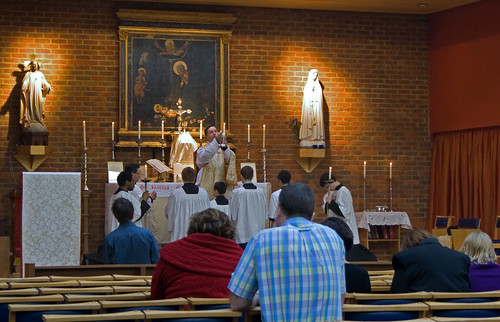
Burke: no altar girls at the Traditional Mass

In the preface to a book about the Motu Proprio Summorum Pontificum, Archbishop Raymond Burke, Prefect of the Apostolic Signatura (the Church's highest court), refers to lay readers, Extraordinary Ministers of Holy Communion, and female altar servers:

As such, out of respect for the integrity of the liturgical discipline within the Roman Missal of 1962, these more modern modifications are not observed in the extraordinary form.

It is particularly to be noted, he writes, that the while the inclusion of females in these roles is often regarded as tremendously significant, even in the New Mass this is a matter of concession, not right. Such things are not a matter of the 'rights of the baptised'.

Update: here's a translation (h-t NLM) of a bigger chunk of the text:

In the second chapter of his commentary, Weishaupt answers a number of practical issues that arise regarding the implementation of Summorum Pontificum and result from recent changes to the discipline of the celebration of the sacraments, such as e.g. those regarding female altar servers or lay people who perform the ministry of lectors or extraordinary ministers of Holy Communion. To answer these questions , the commentary correctly applies two general canonical principles.

The first principle requires that liturgical norms, which were in force in 1962, are to be diligently observed for the celebration of the Extraordinary Form of the Roman Rite, for these norms protect the integrity of the Roman rite as contained in the Missal of Blessed John XXIII. The second principle states that the subsequent liturgical discipline is only to be introduced in the Extraordinary Form, if this discipline affects a right of the faithful, which follows directly from the sacrament of baptism and serves the eternal salvation of their souls.

The application of these two principles to the cases mentioned leads to the conclusion that neither the service at the altar by persons of the female sex nor the exercise of the lay ministries of lector or extraordinary minister of Holy Communion belong to the basic rights of the baptized. Therefore, these recent developments, out of respect for the integrity of the liturgical discipline as contained in the Missale Romanum of 1962, are not to be introduced into the Extraordinary Form of the Roman rite. The commentary presents here in an impressive manner that the mutual enrichment of both forms of the Roman rite is only possible if discipline peculiar to each of the two forms is accordingly carefully observed.

Tuesday, September 28, 2010

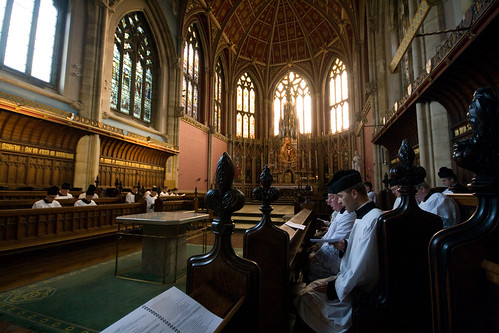
Dates for Ushaw Conference announced

Our next Priest Training Conference in St Cuthbert's Seminary, Ushaw, Co. Durham, will be later in the year than the others have been, because of the late date of Easter.
2010 04 16_5739

It will be 8th to 13th August.


Don't let the location put you off, it is near Durham which is on the main train line. Durham is a truly wonderful historic city - a world heritage site, a stunning Norman Cathedral and Castle. The priests usually have a little outing there during the Conference.

Ushaw College itself has a breathtaking chapel and quite exquisite chapels for private Masses; really, there is nothing like it. See lots of photos here.
2010 04 16_5738
More details to follow; expressions of interest please to

info@lms.org.uk

Sunday, September 26, 2010

Chant and early polyphony

I'm still away, but here is something very unusual, and wonderful, from my local Oxford singers.


The Schola Abelis singing at the LMS Pilgrimage to Our Lady of Caversham, on the Ember Saturday of Lent.

This is the Introit, Intret oratio mena, followed by the Kyrie of La Messe de Nostre Dame by Guillaume de Machaunt.

For more on the Mass see here.

Saturday, September 25, 2010

Pope Benedict in the UK: the Mission of the laity

Hyde Park, Saturday 17th September

"Here we see Newman's fine Christian realism, the point at which faith and life inevitably intersect. Faith is meant to bear fruit in the transformation of our world through the power of the Holy Spirit at work in the lives and activity of believers.

"No-one who looks realistically at our world today could think that Christians can afford to go on with business as usual, ignoring the profound crisis of faith which has overtaken society, or simply trusting that the patrimony of values handed down by the Christian centuries will continue to inspire and shape the future of our society.

"We know that in times of crisis and upheaval God has raised up great saints and prophets for the renewal of the Church and Christian society; we trust in his providence and we pray for his continued guidance. But each of us, in accordance with his or her state of life, is called to work for the advancement of God's Kingdom by imbuing temporal life with the values of the Gospel.

"Each of us has a mission, each of us is called to change the world, to work for a culture of life, a culture forged by love and respect for the dignity of each human person.

"As our Lord tells us in the Gospel we have just heard, our light must shine in the sight of all, so that, seeing our good works, they may give praise to our heavenly Father."
- Posted using BlogPress from my iPhone

Pope Benedict in the UK: on Ecumenism

Friday 17th Sept At Lambeth Palace

"At the same time, we Christians must never hesitate to proclaim our faith in the uniqueness of the salvation won for us by Christ, and to explore together a deeper understanding of the means he has placed at our disposal for attaining that salvation. God "wants all to be saved, and to come to the knowledge of the truth" (1 Timothy 2:4), and that truth is nothing other than Jesus Christ, eternal Son of the Father, who has reconciled all things in himself by the power of his Cross. In fidelity to the Lord's will, as expressed in that passage from Saint Paul's First Letter to Timothy, we recognize that the Church is called to be inclusive, yet never at the expense of Christian truth. Herein lies the dilemma facing all who are genuinely committed to the ecumenical journey."

At Westminster Abbey

"We are all aware of the challenges, the blessings, the disappointments and the signs of hope which have marked our ecumenical journey. ... We know that the friendships we have forged, the dialogue which we have begun and the hope which guides us will provide strength and direction as we persevere on our common journey. At the same time, with evangelical realism, we must also recognise the challenges which confront us, not only along the path of Christian unity, but also in our task of proclaiming Christ in our day. Fidelity to the Word of God, precisely because it is a true Word, demands of us an obedience which leads us together to a deeper understanding of the Lord's will, an obedience which must be free of intellectual conformism or facile accommodation to the spirit of the age".


- Posted using BlogPress from my iPhone

Friday, September 24, 2010

Residential Gregorian Chant Course: dates announced

I am pleased to announce:

The Gregorian Chant Network
will be holding its second 3-day training weekend, in 2011,
to be directed by Colin Mawby
, the composer and former Director of Music at Westminster Cathedral,
with the assistance of Nigel Kerry, of the Church of Our Lady and the English Martyrs, Cambridge.


8-10th April, at the Oratory School,
Reading RG8 0PJ


View Larger Map
2010 04 10_5585

Beginners and advanced groups, sung Mass each day, Sung Compline, Vespers, Benediction and other devotions, courtesy of the St Catherine's Trust Family Retreat taking place alongside the course.
2010 04 09_5718
See: www.gregorianchantnetwork.org
Email: chantnetwork@gmail.com

See here for a report of last year's course.

Pope Benedict in the Uk: on Ecumenism

Friday 17th Sept At Lambeth Palace

"At the same time, we Christians must never hesitate to proclaim our faith in the uniqueness of the salvation won for us by Christ, and to explore together a deeper understanding of the means he has placed at our disposal for attaining that salvation. God "wants all to be saved, and to come to the knowledge of the truth" (1 Timothy 2:4), and that truth is nothing other than Jesus Christ, eternal Son of the Father, who has reconciled all things in himself by the power of his Cross. In fidelity to the Lord's will, as expressed in that passage from Saint Paul's First Letter to Timothy, we recognize that the Church is called to be inclusive, yet never at the expense of Christian truth. Herein lies the dilemma facing all who are genuinely committed to the ecumenical journey."

At Westminster Abbey

"We are all aware of the challenges, the blessings, the disappointments and the signs of hope which have marked our ecumenical journey. ... We know that the friendships we have forged, the dialogue which we have begun and the hope which guides us will provide strength and direction as we persevere on our common journey. At the same time, with evangelical realism, we must also recognise the challenges which confront us, not only along the path of Christian unity, but also in our task of proclaiming Christ in our day. Fidelity to the Word of God, precisely because it is a true Word, demands of us an obedience which leads us together to a deeper understanding of the Lord's will, an obedience which must be free of intellectual conformism or facile accommodation to the spirit of the age".


- Posted using BlogPress from my iPhone