Showing posts with label Islam. Show all posts

Tuesday, December 19, 2017

Islam and the Extraordinary Form

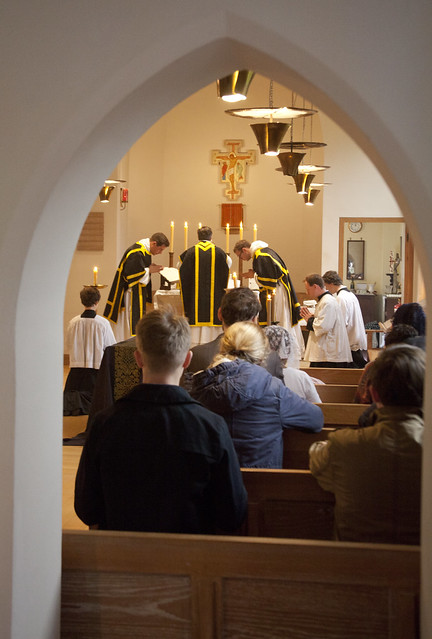
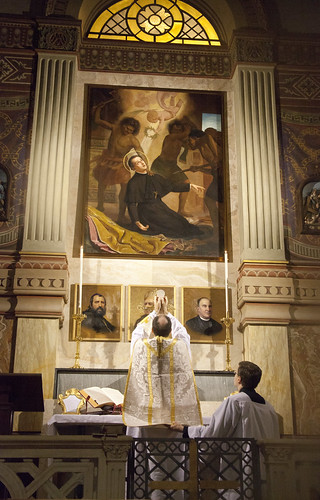
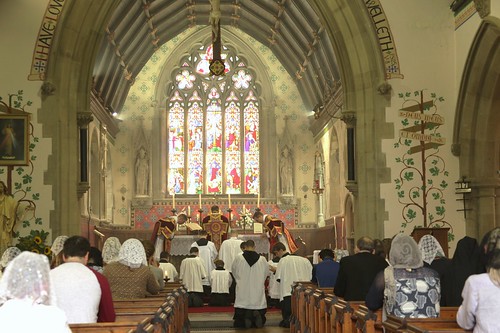
IMG_0873
A glimpse of a transcendant mystery.
Today I am publishing a new Position Paper from FIUV, on the subject of Islam, on Rorate Caeli. Go over there to read it in full.

It sets out a very simple argument which seems difficult to deny. It goes like this.

1. Engagement with Islam (whether with a view to mutual understanding or evangelisation) is facilitated by common ground with Islam. The more common ground one has, whether cultural or theological, the better one can talk productively with people of other religions.

2. There is a great deal more common ground between Islam and that aspect of Catholicism exemplified by the Traditional liturgy, than there is between Islam and what is manifested by the reformed liturgy. In this, the Traditional Catholics are close to the situation of the ancient Christian churches in majority-Muslim countries.

Monday, June 05, 2017

Islamic terrorism: What can we do?

IMG_9319
Fr Mark Withoos celebrates a Low Mass in the church of
the Domus Australia, under a picture of St Peter Chanel, a
a French Marist priest brutally killed in Tonga in 1841. He is
the protomatyr of Oceania.
Reposted from August 2016
------------------------------------------

I wrote the below shortly after the killing of Fr Jaques Hamel, but for various reasons it's publication has been delayed until now.

The brutal murder of Fr Jaques Hamel in Normandy is the culmination of an extraordinary period of violence, even allowing for the tendency of the media to get into a rut of similar news stories. Even as an attack on a Catholic priest or a Catholic church, it was not as isolated as one might hope, since minor acts of violence are not usually reported nationally or internationally, but this represents a new low. The movement behind these attacks is not going to dissipate quickly on its own, and it is perfectly possible, indeed probable, that this kind of thing, at some level of intensity, is going to become part of our lives in the West, in the way that it is part of the lives of our Christian brothers in Pakistan, Egypt, Malaysia, and many other places.

To say that these events are meaningless, irrational, or incomprehensible, is not a way of understanding them: it is a way of refusing to understand them. In truth, they are none of those things. They are the logical outcome of an ideology which says that a Muslim can redeem a far-from pious life by attacking, abusing, terrorising and killing non-Muslims, or Muslims who fall below the ideology’s standards. The attacker’s own death can even be seen as a bonus, as it is imagined that he or she will immediately attain the promised, supernatural reward. There is no need for any close organisational connection between those bitten by this ideological bug, or training, or special equipment, although some of the recent attackers had some or all of these. In the words of Fr Hamel’s killer, Adel Kermiche: “You take a knife, you go to a church, you make carnage, bam!”

It is a type of terrorism which is significantly different from those we have experienced in the recent past, but it is not entirely without modern European precedent. A parallel is offered by the anarchist assassins of the late 19th century. Like the Islamists, they emerged from a milieu (in their case, of left wing radicalism) in which most people, most of the time, lived fairly normal lives, and certainly weren’t constantly in danger of murdering people. Out of this milieu a few individuals got the super-radical bug, deciding that only assassinations were going to achieve their political goals. All they needed was an easily-obtained pistol or some dynamite; since they were careless of their own survival, they were very difficult to stop. Their ‘propaganda of the deed’ encouraged both admiration and imitation. Just as secular ideology inspired history’s greatest acts of mass-murder, so, in its day, it has inspired suicidal terrorism. It must be admitted, however, that there were only ever relatively tiny numbers of such assassins, and they generally chose only very specific targets.

I don’t have the expertise to offer specific policy suggestions in the face of this challenge, but I’d like to make two general observations about our response, the response of the target, Western societies, to the latest pattern of outrages.

The first thing to note, since it is being (apparently) denied by some, is that violence, and other forms of coercion, is certainly part of the solution. It is sometimes possible to stop unjust violence non-violently, but generally speaking it requires violence. I’m talking about violence and coercion by the forces of law and order, and occasionally private self-defence. Christ chose not to use violence to defend himself against the unjust actions of the public authorities of his own day; it is perverse to interpret this as undermining the right of public authorities to use violence justly. States may not neglect the necessary, violent, means to defend the populations which they are supposed to be governing. The state has the right and duty to employ violence, up to and including the right to kill, in war and in police action, for the sake of public peace. Public officials who refuse to defend the public by just and necessary means are not being noble; whether or not they are motivated by cowardice, they are doing grave wrong. Citizens and voters won’t put up with inaction, and nor should they. As far as the aggressors are concerned, a failure to use violence to oppose them is seen, correctly, as a sign of moral weakness, a sign that this is a society wide open to demolition.

So, within the limits of justice, we should support state action aiming to give effective opposition to terrorism. The danger of injustice here makes it all the more important to support just measures, or at least (if we disagree about their effectiveness), to make it clear that we do not regard them as unjust. If things get really bad, our societies are going to need to hear voices making a distinction between killing unjust aggressors and killing the innocent. If we have opposed every measure taken against terrorism, however mild and common-sensical, up to that point, no one is going to listen to us when they really need to.

A second, related, thing to note is that, while the cultural self-hatred of some on the political left is not a direct cause of terrorism, it is certainly making the situation worse. This goes beyond its manifestations in public policy. Outsiders see in the West a society which does not believe in itself, in its own values. As a society we suffer from the low self-esteem of the classic victim of bullying. In philosophical terms, there has been a move, over a number of centuries, from the substantive values of Christianity and classical culture, towards empty formalism. Instead of saying: ‘this is true’, ‘this way of life has value’, or ‘this work of art is good’, modern Westerners want to say: ‘nothing is true or false’, ‘only the choice between ways of life can be called good’, or ‘any purported work of art is good if they artist says so’. We can maintain for a little while a community of people committed to the notion of choice and the power of the individual to invent himself and set his own goals, but eventually people will ask: ‘If nothing substantive is true or good, why should choice or self-invention be true and good?’ There being no answer to this question, the whole thing turns out to be an empty charade. Even before the final, post-modern implosion of Western culture, there is nothing here for the soul to feed upon, there is nothing of substance to give society common values, there is nothing worth defending or promoting. People who possess nothing they regard as worth defending are not going to be very vigorous in its defence.

Here, there is something which can be contributed by people who still believe in something, something wholesome and historically rooted. Self-doubt and self-flagellation, even when offered by Christians, has nothing to offer the West; these are things already widespread in our societies. What we can offer is something substantive: that life, beauty, and God are real and have value, are worth something, and can give shape, discipline, and meaning to our lives. If Westerners really believed these things, and set themselves in their lives to live accordingly, then the Islamists would not be confronting such an easy and open target.

Support the work of the LMS by becoming an 'Anniversary Supporter'.
Friday, March 24, 2017

The Challenge of Islam: Part 1 - the end of secularisation

I was reminded of this post from July 2014 by a story in The Tablet about retired Major-General Tim Cross, an Anglican, who was in despair about the attitude at the Foreign Office that religion really couldn't be the real explanation of anything important in, say, Iraq. The message is sinking in, but very slowly.

The other posts in the short series this post introduced are:
2. Religious Liberty
3. Caught in the Critique of the Decadent West
---------------------------------

I've been reading up a little on the sociology of religion, and the latest stuff is no longer about the Secularisation Thesis: the inevitable secularisation of society. This was to do with the ideas of the Enlightenment, wider education, and prosperity, eroding religious belief, as expressed in that stupid poem by the over-rated Matthew Arnold, published in 1867.

The Sea of Faith
Was once, too, at the full, and round earth's shore
Lay like the folds of a bright girdle furl'd.
But now I only hear
Its melancholy, long, withdrawing roar,

As Linda Woodhead explains, in her Introduction to a collection of articles, the secularisation story no longer works. It only ever worked if you ignored the contrary evidence - such as the big revival of religious practice which started pretty well as soon as Arnold's lacrimose effusion came off the presses, and another even more impressive one in the 1950s - but now it is obvious that things simply aren't travelling in the right direction.

Woodhead explains how sociologists' faith in the secularisation hypothesis was shaken first by the Salman Rushdie affair. Rushdie's book The Satanic Verses was condemned by the Ayatollah Khomeini, who issued a 'fatwa' (ruling) against Rushdie, ordering that he be killed. This was in 1989. It made the sociologists realise that religion, or at least Islam, was actually stronger, in its ability to shape events, even in the West, than it had been before: it wasn't fading away in obedience to the Secularisation Thesis. And then, 22 years later, there was 9/11

If Western sociologists had been paying attention, they would have noticed the revival of Islamic practice and zeal with started in Egypt in the 1970s, and was continued by the Islamic Revolution in Iran in 1979, and has continued some more in the overthrow of a whole heap of secular-minded regimes across the Arab world in recent years. To give them due credit, however, sociologists like Woodhead have been more on the ball than Western politicians, who appear to have clung to the Secularisation Thesis right up to the last few months. I suspect many of have not abandoned it yet. The idea that all the Middle East needs is prosperity and education, and religious zealotry will dissipate, is still rattling around in the corridors of power. Do these people read the newspapers? Syria was a prosperous nation with a big, educated middle class. They've got money coming out of their ears in the Gulf. There are universities of international standard in Egypt. And guess what? It was as those universities that the Islamic revival began. It was there, not in the slums, where young women started to wear head scarves.

In truth, the Secularisation Thesis was kept on its shakey legs after the War not by the inevitable effects of education and prosperity, but by the Cold War. It was the resources poured into Communist and anti-Communist factions, by East and West, which made the world outside North America and Western Europe look as if it was focused on secular issues. Once that was out of the way, an awful lot of people have turned to traditional religious themes to assert their identity and culture and distinguish themselves from their colonial past. We are now living in a period in which radicalised Hindus are persecuting Muslims in India, radicalised Buddhists are persecuting Muslims in Burma and Sri Lanka, radicalised Sunni Muslims are persecuting Shia Muslims in Iraq, and Christians are being persecuted by pretty well everyone. It's not a pretty sight, but it's not secularisation.

Is victory for the homosexual lobby and 'reproductive rights' feminists at the United Nations around the corner? You've got to be joking. I follow the excellent Friday Fax, which covers the infinitely depressing machinations of the World Government in Waiting. The progressive lobby's breakthrough is always round the corner. They've got the western nations in their pockets, they have the procedures taped, they like to see aid money being used to buy votes. But things are not going their way. A horrible realisation should begin to dawn on them some time soon. We have a world-wide revival of traditional values on our hands.

To repeat, this has actually been going on at least since the early 1970s. And it is not just Islam. Even Christianity is benefitting: the Catholics of southern India and West Africa, pressure from Hindus and Muslims notwithstanding, have had a very good few decades, and the very visible presence of their priests in the West has more to do with the massive numbers of vocations they have than persecution. In China, too, Christianity is on the march, as the most vigorous alternative to Communism.

There is nothing inevitable about secularisation. The sociologists have now accepted this, and the politicians, eventually, will follow them. This reality will solve some problems, such as the prospect of a right to abortion being established in international law by some international mega-treaty, but obviously creates others. The punch-line of this blog post is simply this: in addressing the problems, which are very real and very pressing, let's not try to pretend that the Secularisation Thesis is true after all. And part of that pretence is the guff about Religious Freedom.

I've argued more than once that appeals to Religious Freedom, to defend the Church against militant secularists in the West, is a complete waste of time. It is even more of a waste of time when directed against non-Christian religious zealots. This is so blindingly obvious that it shouldn't need saying, but I am saying it because I can see the temptation to make this appeal in a recent speech by Lord (David) Alton. I'll address this in the next post.

Support the work of the LMS by becoming an 'Anniversary Supporter'.
Islam and the decadent West

IMG_9744
Reposted from the time of the Paris attacks, November 2015. Requiescant in pace.

---------------------------------

I've not had time to write anything about the terrible massacres in Paris. It was good to be able to attend a solemn Mass for the dead the day after the killings had taken place. Every Mass for the dead, and practically all traditional prayers for the dead, even if they are for the benefit of a specific person or group of persons, is also for 'all the Faithful departed'.

May they rest in peace. And may God protect us all from an unprovided death.

I've done a number of blog posts criticising the approach to understanding and tackling Islam taken by various people, notably the zealous Evangelical David Wood, and the American Syrian Catholic Robert Spencer. In the comments to one of these posts a reader recommended a book by a Jesuit who hails from the Levant, Samir Khalil Samir, which proved to be excellent. Samir has given a very interesting interview to Edward Pentin, in which he explores the way the West is seen from the Arab Muslim perspective, an important factor, obviously, in these attacks.

Here are some extracts:

Muslims know that modernity is coming from the West; this is a fact. Now they see the West as having lost its ethics, especially on sexual questions. They’re very shocked by what they see or hear. … So they say this comes from modernity. They want to reject the excesses and abuses of some principles, but end up rejecting the whole thing. The problem is that the West is responsible, without knowing it, of the reaction of the Muslim world.

...
When Muslims see that, they immediately recall that homosexuality is absolutely condemned in the Quran, with reference to the biblical Lot. See chapters 7: 80-81; 11: 77-82; 15: 58-74; 21: 74; 26: 165-166; 27: 54-55; 29: 28-30; 54: 33-34. In some cases, they were burned alive. Then the Muslims say, “Okay, the West is Christian, Christianity allows this, and so Christianity is not the true religion; it’s a false religion. And we want to be true, to stick to the Quran and to the tradition.”


This means we are partly, indirectly responsible for the fanaticism that is spreading more and more in Islam, as a reaction to the West — not only, but this also — and playing a role in the radicalization of Islam.
IMG_9748

Tuesday, November 29, 2016

Religious absolutism


Reposted from January 2015
-----------------------------------------------------

Some years I recall a fellow Oxford academic speculating about why Christianity and Islam, among world religions, were the ones used to justify the persecution of religious dissent. Perhaps, he suggested, it was because they were absolutist religions: they claimed an exclusive possession of the truth.

It wasn't clear how he imagined Hinduism and Buddhism worked; I fancy he was as ignorant about them as I was, and am. But it must have been a long time ago, because this conversation clearly predated the emergence, at least into the Western media, of militant Hinduism in India, and the persecution of Christians and Muslims by militant Buddhists in Sri Lanka and Burma.

So, so much for that idea. But the idea of religious absolutism has been wheeled out again in the wake of the Charlie Hebdo attacks. Some forms of some religions are incompatible with Western democracies, we hear, but most are fine, and the difference can be expressed by the idea of religious absolutism. Absolutist religions: bad. Non-absolutist religions: good, or, at least, ok.

Wednesday, August 24, 2016

Why they hate us


This has already done the rounds in the media, but I'd not seen one particular aspect pointed up. The slick propaganda magazine of the Islamic State (ISIS), Dabiq, has a chilling article entitled 'Why we hate you and why we fight you'. You can see this hideous publication here; the article starts on p30. They hate us, they say, for three reasons: for our Christianity, for our liberal secularism, and for Western foreign policy. They emphasise the point that the last issue is not the primary one.

To illustrate the West's secular liberalism they display a photograph of a pro-gay marriage demonstration. To illustrate the West's wrong-headed religious tradition they have a photo of... the Traditional Catholic Mass. The Altar Cards allow no room for doubt.

Monday, June 13, 2016

Will gays be told not to provoke Muslims?


After the Charlie Hebdo massacre, it looked like the whole world--except Barak Obama--rallied to the cause of free speech.

Obama was already getting ready for the next stage in the process of adjustment to the atrocity, however. This is to say that, really, free speech shouldn't be used to criticise Islam. At any rate, he has never used his own right of free speech to do such a thing.

Friday, June 12, 2015

Worries about Robert Spencer on Islam

IMG_0300
The celebrant blesses the deacon in preparation for the latter's proclamation of the Gospel
I've been reading some of the Catholic, Robert Spencer's books on Islam: The Complete Infidel's Guide to the Koran, The Truth About Muhammed, Inside Islam: A Guide for Catholics. (There are lots more.) The books are very informative, and Spencer has put himself on the line to say what is true, as he sees it, about a subject more afflicted by ferociously enforced taboos than any other. The back of one them informs us that he 'lives in a secure, undisclosed location'. But this post is about reservations I have about his approach.

One thing which should alert us to the problems I am going to discuss is Spencer's involvement, as co-founder of the organising group, the American Freedom Defence Initiative, with the Mohammed cartoon event in Texas at which two Muslims got themselves killed. The event, which offered a prize to the best cartoon of Mohammed and displayed the entries, had a predictable result: a murderous protest by a couple of local Muslims. Since the event was well guarded, it was the Muslims who ended up in the morgue; one of the security detail was also injured. This doesn't reflect well on Islam, but I fail to see the moral justification for making this kind of deliberate provocation. The glorification of free speech, and the carelessness about human life, are both very disturbing.


Sunday, May 24, 2015

More on segregated seating in Church


(A pre-scheduled post. Follow me on the Chartres Pilgrimage on Twitter: @LMSChairman )

Thanks to interactions on Twitter and in the comments of this blog, I've learnt a bit more on the history of seating in Catholic churches being segregated by sex. (For my previous post, see here.)

One of the things which has puzzled me about it is that, although recommended in the 1917 Code of Canon Law (Canon 1262.1), I've come across no literary references to segregated seating in churches. But I think that the practice was never re-established in Catholic churches in England after the Reformation; the disruption of having to worship in secret and so on caused the custom to disappear, and it was never something which people felt strongly enough about to make a special effort to restore. (I read in Archer's Two Catholic Churches that eyebrows were raised by some English Catholics at the restoration of such 'Italian' practices as the Asperges before Sunday Mass, in the early 19th century.)

As I've already mentioned, I myself have seen segregated congregations: in 1990, in the Cathedral of Tabora in Tanzania. At that time it wasn't practiced in the commercial capital, Dar es Salaam.

I've now heard from several people in Ireland who can vouch for it surviving in rural districts up to the time of Vatican II, and even later: the 1980s and 1990s. It is worth noting, as several did, that it wasn't enforced: like mantillas today, it just happened, where it was a custom, with the odd person in the wrong part of the church either through ignorance or out of conscious defiance.

Here's a blog post talking about segregation in a church in Nova Scotia, Canada, up to the time of the Council.

Thursday, May 07, 2015

Worries about the Secular Critique of Islam

Once upon a time The Spectator was a conservative publication, but there is nothing socially conservative about what Kate Maltby had to say on its website about the Labour Rally in Hodge Hill, Birmingham, from which Labour MP Sion Simon tweeted this image.

There can be no excuse for requiring women to sit separately at an event at which they’re supposed to use their brains as engaged citizens, not as sex objects or as baby machines. True, orthodox branches of both Islam and Judaism require men and women to sit separately in their religious services – one reason why I’m not planning to convert to either any time soon – on the grounds that proximity to the opposite sex may distract worshippers from meditating on God. As yesterday’s rally wasn’t a religious service, I can only conclude that rather than meditating on God, the organizers were anxious that no sexual thrill should distract the watchers from meditating instead on the noble figure of Tom Watson.

Wednesday, May 06, 2015

Worries about the Evangelical response to Islam

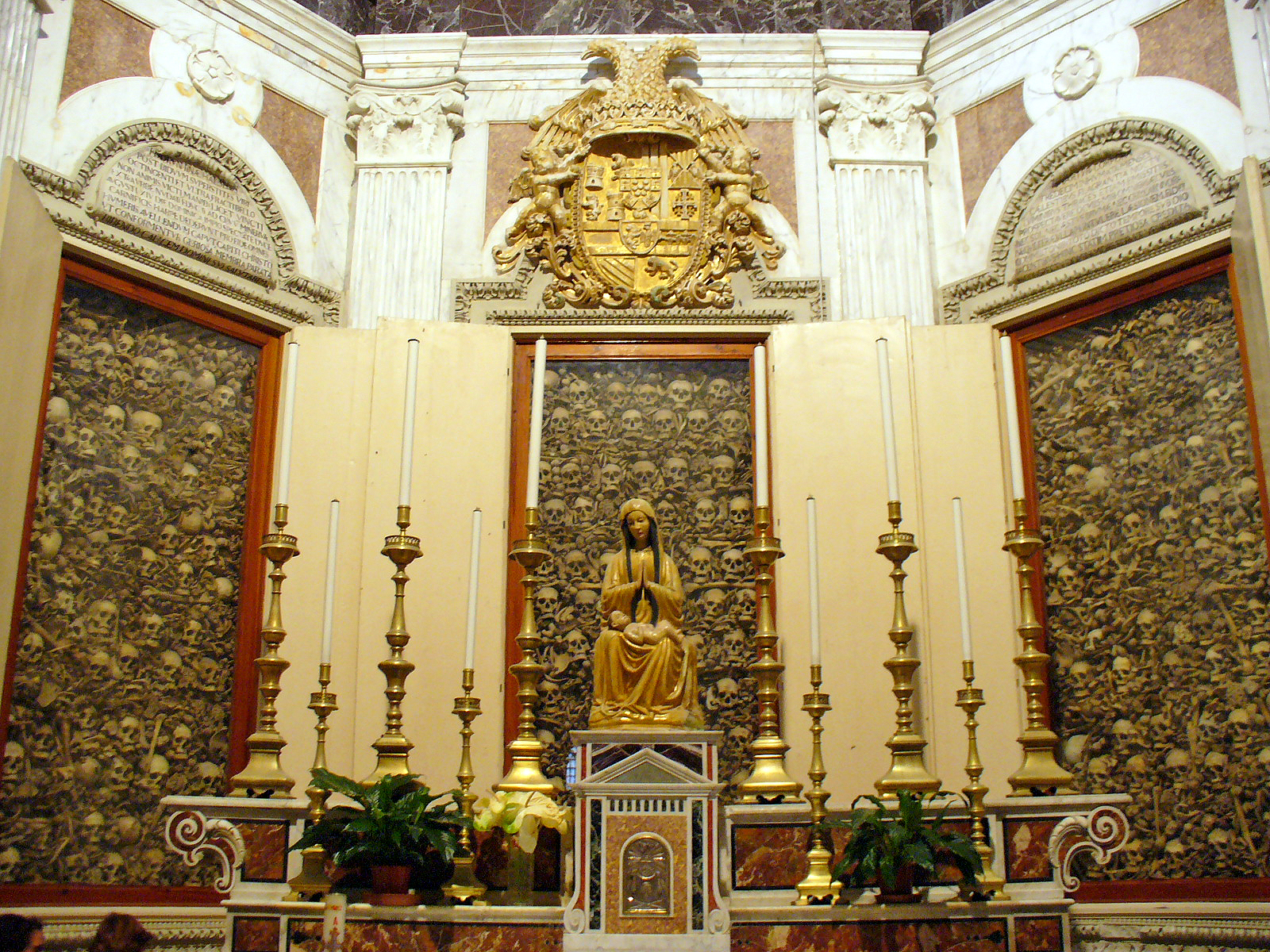
Bones of the recently canonised
matyrs of Otranto, victims of a
Muslim raid into Italy in 1480.
Just as a failure of mainstream politics to deal with Islam has contributed to the issue feeding non-mainstream politics, so the failure of mainstream religion, including Catholicism, to address Islam publicly, consistently, and honestly, has led to it becoming an issue in which more marginal figures can make a name for themselves. If you want to hear a Christian analysis or critique of Islam, it's not long before you find yourself looking at people like David Wood over at 'Answering Muslims.'

Wood has a lot of very interesting things to say about Islam, because he has on his team Muslim converts to Christianity who are well informed about Islam; for a taster of his work, start from this page. (I'd be equally interested in an Islamic rebuttal of his arguments, of course.) He doen't come across as a nutter, although his aggressive polemic makes me a bit uncomfortable. He is, however, an Evangelical. I think it is very tempting for conservative and traditionally-minded Catholics to take their cue from Evangelicals, who seem terribly well-organised, vigorous, and effective, so I think it is important to point out the problem.

The problem, in a nutshell, is that at least some of the arguments presented on Wood's website against Islam don't work, because they are based on Evangelical theology. In fact, he ends up criticising Muslims for what they get right: things they have in common with Catholics. Here are a few examples.

Thursday, January 22, 2015

Anglicans and ISIS revisited

The destruction wrought by ISIS (or ISIL) continues, and my post comparing the religious extremism of modern Islam with our own shameful past remains one of my most visited posts. But I'm certainly not the only one to have noticed the parallel. Here is Dominic Selwood today in the Telegraph:

It can only be a good thing that people are again thinking about [Thomas] Cromwell. Because as we look to the east, to the fanaticism that is sacking the cultural and artistic heritage of other ancient societies, we can all draw the same, inevitable conclusions about religious extremism in any age, whether Christian, Muslim, Jewish, Hindu, or Buddhist. None of it is pretty. All of it is real. And we, in England, are not in some way removed from it. We only have to survey the smashed up medieval buildings the length and breadth of the country, or contemplate Cromwell’s record of public beheadings and other barbarous executions.

Here is Michael Brenden Dougherty, some time ago, in The Week:

Convert, leave, or die. That's the trio of awful options ISIS is giving to Christians in Iraq. Sadly, there's an all-too-familiar ring to this ultimatum. These were the exact options given to all Catholic clergy in Ireland when England instituted the penal laws against Catholics several hundred years ago.

There have been others too of course.

Every analogy has dis analogous elements: otherwise it would just be the same thing. It's not the same thing. But the comparison should help us understand what is happening and make us a little less smug about the superiority of the West.

Support the work of the LMS by becoming an 'Anniversary Supporter'.
Sunday, January 18, 2015

Political Islam; Political Christianity

IMG_7509
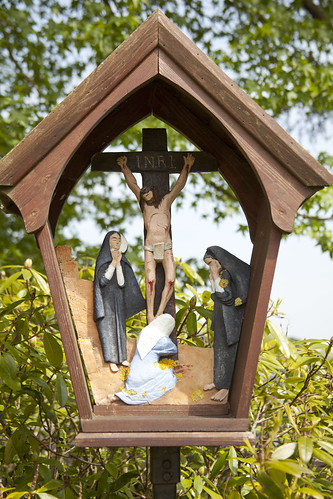
Christ died on the Cross: a scandalous end denied by Muslims.
One of the things which make secularists a bit green about the gills about Islam is the political implications of their faith endorsed by some of its adherants. I've even heard 'Islamism' defined as 'political Islam', and therefore as something bad. Most Muslims, we are then told, draw no political conclusions from their religion, they aren't Islamists.

I'm old enough to remember those innocent days of the 1980s and 1990s when Christianity without political implications was lambasted by the secular left as boring and irrelevant. What they wanted, of course, was an ally, perhaps in the form of Liberation Theology. The purely tactical (as usual) nature of the secularists' critique on boring old Catholic teaching about the need for individual repentance and metaphysical doctrines is revealed by their reaction when a religion appears to have political implications which they don't like. However, the cat's out of the bag. Religions without political implications would indeed be boring and (to that extent) irrelevant; all we need to add is that it is almost inconceivable that a minimally coherent and/ or longstanding religion should fail to have political implications.

Saturday, January 17, 2015

Opposing Islam with charity

IMG_7510
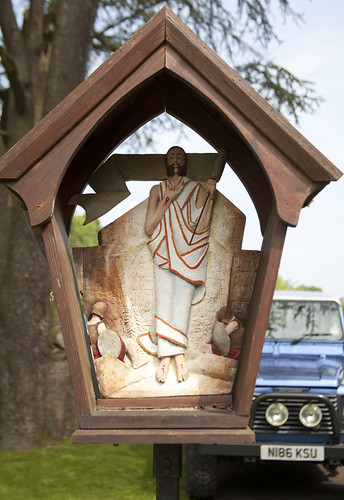
Christ triumphs over death: something denied by Muslims.
Over the last couple of months I've been looking at the archives of the 'Answering Muslims' blog, belonging to an Evangelical Christian, David Wood. (David Wood's mind-boggling conversion story video is worth viewing if you have a spare 30 minutes.) Wood has an impressive mastery of Islamic texts, including not just the Koran but the Hadiths and authoritative commentaries. It all gets quite complicated. He has taken the trouble to do what few Christians have done: with a decent grasp of the Islamic tradition, to subject it to relentless analysis and ridicule.

I'm not entirely comfortable with the ridicule bit; I think that he overdoes it on occasion, and I think it would be more effective sometimes if he just let the texts speak for themselves. But hey, he's American and he's addressing an unsophisticated audience, so perhaps we can't really expect him to use understatement and irony. (Note to American readers: the previous sentence is a JOKE. And so was that one.)

Whenever I hear secularists talking about the limits of religious freedom, I know that they are going to apply whatever they come up with more rigorously against Catholics than against Muslims, so, paradoxically, I am inclined to side with the Muslims more often than otherwise I would. Muslims shock secularists by having Muslim state schools with some kind of separation between boys and girls; I don't agree with Islamic attitudes to women but I certainly don't like to see the secularists imposing gender theory on Catholic schools. Muslims talk about converting the world, and the secularists have the heeby-jeebies; I don't think the world should or indeed can be converted by the methods historically used by Mohammed and many of his followers, but Catholics also want to convert the world: there's nothing wrong with that aspiration in itself. I am in Hamlet's position in relation to Laertes:
...by the image of my cause I see
The portraiture of his.


Monday, January 12, 2015

Hypocrisy and fallacy over censorship

Some of the arguments being made about censorship in the wake of the appalling Charlie Hebdo massacre are so silly and irritating that I want to say something about them.

The central claim of a lot of the response to the massacre is that the Freedom of the Press must be upheld: the 'right to offend'. What is hypocritical is the making of this claim, at least by implication, by leaders who do not allow the kind of freedom used, or misused, by Charlie Hebdo in their own countries. In the UK and the USA it is simply delusional to think that we have 'the right to offend'. Every week people lose their jobs for causing offense, often against Muslims, but also against Gay activists. Expressing any kind of religious conviction has become a sackable offence within the UK's National Health Service and many liberal American Universities. Admitting doubts about same-sex marriage can end your career in the secular world of internet companies, as Brandon Eich discovered. We have been moving sharply away from free speech in the Anglosphere for at least thirty years. And now we are all in favour of it? Gimme a break. As Norman Tebbit has written, now that our politicians have decided it is such a good thing, can we have it, please?

Friday, January 09, 2015

I am not Charlie

The Martyrs of Otranto, killed by Muslims in 1480;
canonised by Pope Francis in 2013
I confess that, as I read the background to the appalling massacre in Paris at the offices of the magazine Charlie Hebdo, I am inclined to agree with Bill Donohue (and Laurence England) in condemning both the killings and the unspeakable images which provoked it. Mohammed, and other religious figures living and dead of a range of religions, depicted, for example, in sexual poses. It is visual hate speech. It is an assault on the deepest values of millions of French citizens. And it has got nothing to do with argument, criticism, or the truth. It is mindless, bestial, even demonic. (Fr Ray Blake, who also takes this line, has put some anti-Catholic examples on his blog.)

The difficulty of pointing this out is the terrible crimes of the fanatics which responded to it. Cristina Odone said on Twitter that Donohue says the cartoonists were 'asking for it': a typical Twitter summary, which seemed to follow the click-bait headlines and not the content, as anyone who bothers to read him will realise. 

In fact there is no logical problem in condemning both the terrorists and the cartoons; nor does such a double condemnation imply a moral equivalence. The victims were innocent, in the sense that the killers had no right to kill them: a right one might derive from self-defence, or the right of a public executioner or a soldier of a legitimate state in a war. They may have thought they had a right, the Koran might be understood to give them a right, but that is false: they had no right, and what they did was murder. Premeditated murder like this is a sin crying out to heaven for vengeance. 

The Paris and other protesters, however, are not calling for vengeance, not even for the vengeance of heaven or the retributive punishment of the state. They are expressing solidarity with the staff of Charlie Hebdo and insisting on the right to continue to be as offensive as the magazine has been, in the future. The want to be able to continue with the most vile hate-speech against religious groups with impunity. They want to continue to be unjust, to cause pain, wantonly, as much as they please, against those they happen to dislike: religious believers. They have no such right. Most countries recognise this. Most countries would long ago have reined in Charlie Hebdo. Most countries, including this one, are right.

Of course we should be free to criticise Islam, and the call by some Muslims that criticism, in itself, should be forbidden, is chilling. The kinds of images Charlie Hebdo displayed, however, are not criticism, they are just vulgar abuse. They undermine the efforts of those who do want to engage in criticism, and they are in danger of pushing the law, in countries such as the UK, further and further in the direction of making any kind of criticism impossible. If the only test of what is acceptable is the reaction of the victim, then there is no distinction to be made between images of religious figures having unnatural sex and a sober analysis of a religious text's references to sex slaves. There is a difference: the former is an offence, not just against the artificially sensitive egos of professional complainants, but against any recognisable standard of taste and any reasonable principle of mutual respect, and the latter is not.

A lot of people are threatened and killed in the name of Islam. A bit of open analysis and criticism of Islam might serve a good purpose. The kind of vilification that Charlie Hebdo dished out, is pretty obviously going to make things worse. And so it has.

Postscipt: what does the Church teach about the freedom of the press?  Pius IX: 'that erroneous opinion, ... called by Our Predecessor, Gregory XVI, an "insanity," viz., ... that a right resides in the citizens to an absolute liberty, which should be restrained by no authority whether ecclesiastical or civil, whereby they may be able openly and publicly to manifest and declare any of their ideas whatever, either by word of mouth, by the press, or in any other way.' (Quanta cura 1864)

Support the work of the LMS by becoming an 'Anniversary Supporter'.
Saturday, November 22, 2014

The problem of censorship

IMG_9897
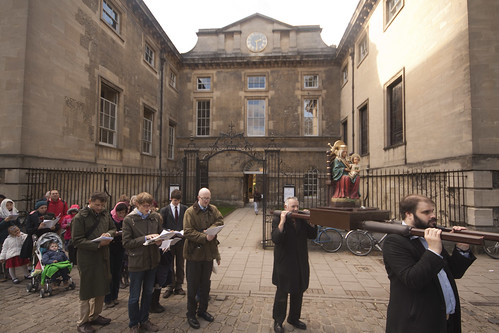
LMS Oxford Pilgrimage procession outside Worcester College.
Further to the extraordinary spectacle of an Oxford College, Christ Church, closing down a 'for and against' debate on 'abortion culture' set up by a student society, contributions to the discussion about censorship - for that is the name of the beast - have come in from the pro-abortion invitee, Brendan O'Neil in The Spectator, and Tim Squirrel, of all things the President of the Cambridge Union (a debating society), who thinks free speech and, as far as I can see, thought of all kind, should be suppressed, writing int the Cambridge student rag, The Tab.

Readers can go over there and see for themselves if I am exaggerating. Mr Squirrel tells us that, shock, horror, 'there are some individuals whose presence in a space can make people feel unsafe.' And, of course, 'universities are also our homes'. Ergo, the touchiest person in a University of over 10,000 souls should have a veto over every public conversation in the place - assuming this touchy person is touchy in a politically correct way. At least, Mr Squirrel has better be assuming that, or else disagreement between the touchy could lead to the exactly kind of debate Mr Squirrel is trying to suppress.

Thursday, August 14, 2014

Anglicanism and ISIS: a response to critics

I wasn't surprised that my post on Anglicanism and Islamic extremism caused a reaction. It seems, I particular, that a bunch of Anglican readers didn't like their 16th century predecessors being compared with Islamic militants, even if favourably.

Such comparisons, sadly for them, are inevitable: it is the New Atheists' bread and butter. (Eg Richard Dawkins: 'Religion causes wars.') What we, theists, need to do, as I've done in more than one post, is to try to demonstrate that the problem in the Middle East is not 'religion'. Perhaps my Anglican friends would rather stick their heads in the sand about this issue. But my approach has been to point out specific theological, sociological and political issues which are at work, and which we can see at work in other times and places where there was religious violence.

My post neither condemned nor justified the religious policies of Anglicans or indeed Catholics in the 16th century, or earlier or later. That's a separate question. That it happened, however: that's undeniable. To condemn ISIS and pretend we've never had any such problems of intolerance in nice cosy Europe is... What is it? I wonder if it is evidence of bigotry.

Ah, bigotry, bigot: what useful words. The way they are tossed about may make one think that anyone can use them of anyone, and thereby win the argument without further ado. But it is not so. Political Correctness has strict rules. Before you can claim the high ground, you have to 'check your privilege'. This means that a person from a culture historically oppressive to others can never cry 'bigot' against a person from a culture which has historically been oppressed by others. That's why it is so difficult for the PC brigade to criticise ISIS. And why Anglicans - of all people - are going to get nowhere crying 'bigot' against attempts to set the ISIS phenomenon into a wider historical context, which puts Anglicanism in a bad light. Tough, guys: if you disagree you are going to have to use reasoned argument.

Let's have another look at those pesky arguments.

Anglicanism in the 16th century tried directly to suppress not just preaching but private practice and belief.

The point is that it is not something which was going on in every persecution, nor has it been the policy of every Muslim government. If you look at the people burnt under Mary Tudor, they are activists: they preached, and they sometimes engaged in direct action like disrupting services, desecrating the Blessed Sacrament, or attacking priests. Ok, I'm sure we can all agree that they should have been allowed to attack priests with impunity yada yada, that's not the point. These sorts of people, sometimes with identical views, were flogged, put in stocks, imprisoned, fined, and occasionally executed under Protestant rulers. But the Protestants, especially Elizabeth Tudor, also imprisoned and executed people who were quietly practicing their religion in private. The family of Bl Thomas Belson were imprisoned after a search of their house revealed - horror of horrors - a copy of Dante's Divine Comedy. Priests were executed when a breviary, a pyx, or holy oils were found on them. It was an offence to own a rosary. There is a distinction to be made here. If it makes you uncomfortable, dear reader, then that may be a good thing.

Anglicanism was forced into more extreme positions by the existence of more extreme groups.

This is more of an plea of mitigation for early Anglicanism than anything else, but if readers are determined to be offended, that's their business I suppose. Puritans were annoyed that Charles I stopped signing the death warrants of captured Catholic priests - his Catholic queen stopped him. This wasn't the only cause of the Civil War, of course, but it didn't help. When the King lost his grip on power his hot Protestant enemies got through the backlog of imprisoned priests with wonderful speed. Later, the 1662 Prayer Book contained more than a dozen revisions to make it more acceptable to Puritans. I don't exactly blame them for attempting some kind of national reconciliation after the Civil War. But it didn't succeed.

Anglicanism has become the milk-and-water stuff we know and love today as a result of the areligious social elite which evolved under its watch.

This is just an historical observation: deny it who can. Would I rather they were still torturing Catholics to death, as they did to St Nicholas Owen? No, I would not. I don't, therefore, think this was entirely a change for the worse. To observe that it happened, therefore, should not be offensive to anyone. Again, to say that the theological content of mainstream Anglicanism has lost some of its sharp corners and hard edges is not exactly controversial.

Why it happened is a matter of considerable historical and on-going interest and importance, and the parallel with Islam is, I think, helpful to those who want to understand, and not just to shout 'bigot' from the sidelines. The long and the short of it is that a religion which regards the cultural endeavours of the elite (and come to that, of folk culture as well) as morally dubious, is going to have a tough time hanging on to that elite.

It doesn't follow that the religion is wrong, of course. There's a parallel here with the Old Testament, where in the time of the Kings the elite was sucked towards religious syncretism. Again, the elite today is attracted strongly to the position of accepting all kinds of sexual immorality, and abortion, as perfectly ok. In these cases religious authorities have to dig in their heels and resist.

What has happened in Protestant countries is that, having tried to reject too much, they have ended up rejecting too little. There is a parallel with Islam here too, though in the case of Islam the reaction to the ensuing decadence has been stronger. Other factors are at work here as well, to explain that.

And of course the Catholic Church has not succeeded in resisting secularision in historically Catholic counties. We need another explanation for that. Anyone who is paying attention on this blog will be aware that I am a Traditional Catholic, and there is a Traditional Catholic angle on this process; I will I expect go into that in a future post. Catholic secularisation is not, however, identical to Protestant, Islamic, or Jewish secularisation: the nature of the religion at the start of the process makes a difference. As always, we need to make distinctions.

Support the work of the LMS by becoming an 'Anniversary Supporter'.

Tuesday, August 12, 2014

To understand ISIS, look at Anglicanism

IMG_7227'

Update: I have responded to some of the comments on this post here.

Chalk and cheese, the Islamic militants of ISIS and Anglicans? Actually, they have a lot in common.

Remember that Anglicans were, on contemporary accounts, behind the most savage religious persecution in Europe at a time when standards were high: the 16th century.

Persecutions are tempered by political realities: you can't be too nasty to too large a section of your population, or you undermine the good will necessary to govern at all. ISIS are really pushing at the limits of what is possible, arousing the opposition of a lot of different people. The Anglicans did the same: their religious measures caused serious rebellions in the reigns of Henry VIII (the Pilgrimage of Grace), Edward VI (the Western Rising), and Queen Elizabeth (the Northern Rebellion), not to mention regular uprisings in Ireland. Their policies were the root cause of a horrible civil war in England, another one in Scotland, and a still more savage conflict in Ireland.

If anyone wants to say I'm being unfair, I'll say here right away that ISIS is definitely worse. I'm not interested in moral equivalence, but a conceptual parallel. Let me explain the parallels I have in mind, in three points.

Anglican savagery was based on the idea that Catholics were idolatrous, and toleration would bring the wrath of God down on the land.
IMG_7228'

Like ISIS, and unlike the usual 16th century Catholic way of dealing with Protestant minorities, persecution by Anglicans was aimed not at suppressing the public proclamation and promotion of a dissident faith, but at stopping the dissident population practicing their religion at all. They would search out secret chapels in private homes. They would imprison people or even execute them for having a rosary or Catholic devotional book in their possession. The first move of the movement was the destruction of Catholic shrines. This motivation makes the persecution much more savage and the persecutors much more intractable.

This is exactly what ISIS is doing and why.

Anglican persecutors were always terrified of being outflanked by more extreme groups.

From its inception Anglicanism was criticised for being too 'popish' by people who regarded a plain white surplice as unacceptable pomp and the sign of the cross at a baptism as unacceptable ritualism. Any deviation from the most pure form of Protestantism, and the most uncompromising opposition to Catholic toleration, was seized on by these groups, who in the English Civil War and in Scotland actually got the military upper hand, and meted out some persecution to the Anglicans themselves.

This fear is at work with Islamist groups as well: they are in a 'race to the bottom' with all kinds of set-ups as to who can be the most pure and extreme.

Why, then, did Anglicanism turn into the drippy nonsense we know today? A third point of parallel.

Anglicanism produces over time a cultural elite who don't take it very seriously.

Protestantism has as a foundational principle Luther's as-ever subtle and charmingly expressed dictum: Reason is a whore. The separation of Faith and Reason means that people interested in Reason - intellectuals of all kinds - are forced away from the Faith. The Protestant suspicion of religious art has the same effect on artists.

In the 18th century, people interested in ideas and in art were, as a result, not terribly interested in Anglicanism. They poured their considerable resources into country houses, but by the beginning of the 19th century people began to notice that the cathedrals and parish churches were falling down, and no one had bothered to build new ones for the new industrial centres. As a state church, Anglicanism was for a long time dominated by establishment types who didn't actually believe in all that much, whose successors are the liberals of today.

There was a religious revival in the 19th century, but Anglicans were faced with the possibility of reviving in two opposite directions: a Catholic direction, and in the direction of a reassertion of Protestant principles. Both of these tend to lead out of institutional Anglicanism.

The anti-rationalism of revivalist Protestantism is exactly paralleled by the anti-rationalism of revivalist Islam, which has the same problem. Having rejected reason and (great swathes of) art as a matter of fundamental theology, historically they have developed elites who aren't very pure in their interpretation of Islam. These elites are then overthrown by zealots. And the process starts again.

IMG_7229'

Pictures: Catholic martyrs from the windows of Belmont Abbey.

Support the work of the LMS by becoming an 'Anniversary Supporter'.

Sunday, August 10, 2014

How to respond to Islam: a reply to Geoffrey Sales

IMG_9354
Ladies wearing mantillas at the St Catherine's Trust Summer School in Wales
Over on 'All Along the Watchtower' the blogger Geoffrey Sales has done me the honour of responding, mostly positively, to my short series of posts about Islam. My argument concluded with the suggestion that, if we want try to make the point that we aren't part of the decadent West, which revivalist Muslims (not just the really crazy ones), and the rising Hindus, Buddhists, and Pentecostalists, quite rightly reject, then we could try restoring the use of head coverings by Catholic women in church.

This would signal a rejection of both decadent sexual mores and of the attack on the difference between the sexes.

Contemplate the likelihood of this happening any time soon, and you will glimpse the depth of the problem.

Geoffrey Sales, though, is having none of it. He remarks:

Best of luck with that one – bound to work, make ourselves look more like the Taliban rather than challenging Islam with the Gospel Truth.

One the one hand, as I indicated there is going to be huge resistance to the restoration of head coverings precisely because it is instinctively understood as a move away from sexual liberation and the like. But to resist it as because it is in some kind of tension with 'Gospel truth': this just seems bizarre. Sales is a Baptist. He knows as well as I do - surely - that women covering their heads in church is sternly commanded by St Paul (1 Cor 11:5). Was St Paul steering his congregation away from 'Gospel truth'? Those who founded the Baptist tradition insisted on head coverings for women in church: were they against 'Gospel truth'? Was everyone in the Christian tradition against 'Gospel truth' up until the 20th century?

What I can't help wondering is that, despite engaging with my general argument that the Christians of the West have made a great mistake in throwing their lot in with a set of Western values which, on any mainstream religious view, are grossly decadent, Mr Sales remains attracted by the idea that by becoming decadent, by leaving behind the Gospel message as our ancestors of all times until less than a century ago understood it (fifty years ago for Catholics), we've become more faithful to the 'real Jesus' or some tripe like that. That, in short, a bit of decadence is actually a good thing.

But let's examine what Mr Sales balks at: doing something which gives us something in common with the Taliban (and every practicing Muslim on the planet); in this, he says, we would be making a mistake, because we should be confronting them with the 'Gospel truth'. Where, in fact, the divergence of our customs with theirs has created an obstacle to mutual understanding, we should refuse to reconsider our customs. And this even when this rebellion against this formerly shared custom was in truth a rebellion against a shared understanding, a shared understanding to which we continue to pay lip service. We claim to reject sexual decadence; the Muslims look at our lifestyle, and even the clothing in which we worship God, and draw the perfectly correct conclusion that we may talk the talk but we don't walk the walk.

For we preach not ourselves, but Jesus Christ our Lord: so says St Paul (2 Cor 4:5). This is a saying sometimes seized on by the enemies of Tradition. In this case, the boot is on the other foot. The decadent customs of the West are so important to liberal Christians that they don't want to give them up, whatever the cost for evangelisation. These personal preferences have become more precious than the Gospel message.

Ah but no, Mr Sales might say: what we want to evangelise is a Protestant notion of a completely unincarnated Christian message, a message with no social manifestation, the unvarnished, spiritual, Jesus:

If the Spirit moves you, then you don’t need a head-covering to show it – though, of course, it might lead that way.


IMG_9452
Do you think they look like the Taliban? Neither do I. Receiving the 'first blessing' of
Fr Richard Bailey Cong Orat following Mass, at the Summer School.
As well as the sheer inconvenience and embarrassment of doing something which everyone can see flies in the face of the decadent Western lifestyle, there is always this kind of argument to fall back on. We don't want to do anything to show we love and honour God because what's important is that we love and honour God in our hearts - our Faith is purely spiritual. This argument needs only to be stated clearly to show its absurdity.

What strikes me is how often the Church has put herself in this situation.

We have a lot in common with the Orthodox, including the fundamental principles of our liturgical tradition. We don't formally deny those principles, but our worship - outside the places where the Traditional liturgy is celebrated - now looks utterly alien to them, because we have become embarrassed about those principles: the notion of the Mass as a sacrifice, the idea that it is offered to God and not to the congregation, the continuity of the liturgy with all times and places. Most Catholics, most bishops indeed, can't bear any more to worship in a way which actually shows we believe these things; we just write them down in a book and keep that book safely on a shelf, unopened.

We have a lot in common with evangelical Protestants, notably the very high honour Catholic theology gives to Scripture: the Bible as the inerrant Word of God, with a true Divine author, speaking to us today. But though the official documents still say that, we - as a whole, which is to say Catholics of the mainstream - can't actually bring ourselves to live like that, to talk like that, or to do our Biblical scholarship as if that were true. And so what we actually have in common with evangelicals, we hide, we pretend we don't believe.

Our embarrassment about the Tradition has cut us off from so much shared by non-Catholic Christians, and so much that is shared by non-Christian religions. Our modern customs, which appear so indispensable to so many Catholics today, obscure these opportunities for genuine dialogue and witness to the Gospel.

Fifty years ago it may have seemed more important to make ourselves less unacceptable to liberal Protestants  and the secular media, than to maintain some degree of mutual understanding and respect with non-Christians, with the Orthodox, and with 'biblical' Protestants. Now that calculation appears decidedly dated.
Support the work of the LMS by becoming an 'Anniversary Supporter'.