Showing posts with label Marriage & Divorce. Show all posts

Saturday, February 09, 2019

Sinners in the Queue for Communion

IMG_2634
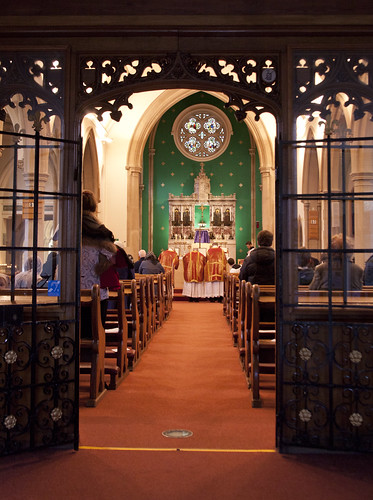
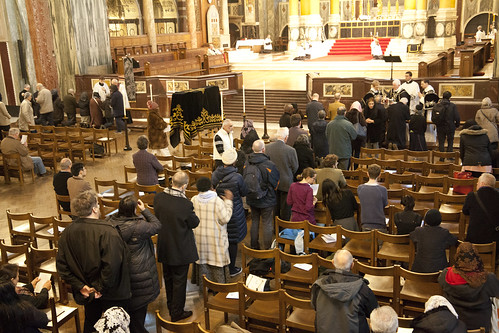
Queuing for Holy Communion in Westminster Cathedral at the LMS Annual Requiem
A lot of the acrimonious debate about Amoris Laetitia boils down to the question of Catholics in a state of grave sin wishing to receive Holy Communion. Such difficulties are not new to the Church, which has long included unjust rulers, men who have mistresses, people enjoying the fruits of crime, and such like. Indeed, in one respect the situation was more difficult in past centuries, because more people voluntarily excluded themselves from receiving, to such an extent that in the High Middle Ages most lay Catholics only received Communion once a year, on Easter Sunday.

So the question asked today was relevant: how can the Church both exclude Catholics in grave sin from Holy Communion, or foresee that they will exclude themselves, and still make them feel part of the Church’s liturgical life, a lifeline to the sinner who needs the grace of repentance?

The answer is that the Church has found many ways of doing this, ways which are not, in general, employed today. It is instructive to consider them.

The central point is a simple one: in past centuries, liturgical participation at Mass was not focused on the reception of Holy Communion.

Catholics willingly attended Masses at which they would not receive, in order to ‘hear Mass’. Peasants went to early Masses before starting work. Nobles would have a priest celebrate Mass at an altar in their bedroom before breakfast. St Margaret of Scotland attended three Masses, one after the other, each morning. The complex ceremonial, the use of Latin and (if the Mass was sung) chant and other music, made it a deeply spiritual experience.

What were they doing during these Masses? They were praying. They were uniting their prayers with those of the priest and of the Church. It was spiritual food for them.
The high point of these Masses was the Consecration. As time went on the moment of Consecration was surrounded with greater ceremonial (such as raising the Host for people to see), and all kinds of architectural and musical techniques were employed to give it greater visibility, emphasis, and dignity. There were indulgences for those who witnessed the elevation and said a short prayer: ‘My Lord and my God’. Those who saw Christ in the elevation felt that they had done something important that day.

Other things took place at a parish’s main Sunday Mass which further helped foster a sense of inclusion.

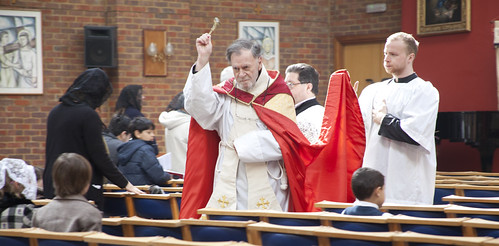
First, Mass began with the congregation being sprinkled with Holy Water (the ‘Asperges’).
Then, in many places the people participated in the ‘Kiss of Peace’ by kissing a metal or wooden object, a ‘pax’, which was passed from the priest to the server and then to each member of the congregation. This symbolized the Peace of Christ spreading out from the Altar, and the Consecrated Host present upon it at that point in Mass.

At the moment of the Priest’s Communion, people made a ‘Spiritual Communion’, a form of words summarizing their intense desire for Christ to enter their hearts.

At the end of Mass ‘Blessed Bread’ was distributed in some regions of Europe, and sometimes ‘Absolution Wine’. These made particular sense of the practice of fasting before attending Mass, even if one were not to receive Communion, and were sacramentals.

When Holy Communion was received by the whole community, in the Middle Ages, on Easter Sunday, those not receiving, whether villagers or kings, were shown up as sinners. This happened, however, only once a year: today, we have this problem every Sunday. In the past, when the faithful had began to receive Holy Communion more frequently, another practice developed which stopped the Communion line being such a public spectacle: Communion was given between Masses, or in private. Coupled with the practice of going to Communion monthly or fortnightly, after careful preparation, this made it impossible to tell if your neighbor was a regular communicant.

This last practice ended in the inter-war period. The kissing of the ‘pax’ and the customs of ‘Blessed Bread’ and wine died out, for the most part, in the centuries after the Council of Trent. A final idea worth noting, however, is this. Missionaries in Africa in the 20th century faced the problem that many non-Christian men well-disposed to Catholicism were impeded in their conversion by the fact that they had multiple wives. One approach to the problem was to encourage them to make a promise to be baptized before they died. This placed them in a clearly demarcated ante-chamber of the Church, and there could be no doubt, if one fell seriously ill, that those looking after him could baptize him validly even if he lost consciousness.

My purpose here is not to suggest that all these practice be revived, necessarily, but to point out that a little pastoral imagination could address the problems all acknowledge and which can otherwise look insuperable.


Support the Latin Mass Society

Tuesday, June 12, 2018

Can the Church forget doctrine?

Drinking the mythical waters of forgetfulness in the underworld: Lethe.
Reposted from October 2015
-----------------------------------------

At certain periods of history, one doctrine has been pushed to the fore either because it was needed to combat an issue of the day, because of its connection with a popular devotion, or because it was denied by heretics. Others have been pushed into the background. Being human, we can't focus on everything at once.

But there is something else, which is a doctrine disappearing from view because, although attacked by heretics, too many otherwise orthodox people are reluctant to defend and expound it. When these doctrines, and opinions which don't perhaps pertain to the Deposit of Faith but which are very authoritative, are mentioned, it can be a bit of a shock.

In researching the Position Paper on the Vulgate, I found a reference in a somewhat obscure official document published in 1994 to the ancient Greek translation of the Bible, the Septuagint, being made 'under divine inspiration'. I nearly fell off my chair. This is not, strictly, a teaching of the Church, but it is a pious opinion with considerable authority, taught particularly by the Greek Fathers of the Church. If it is taken seriously, then the policy of the Church since the 1940s to replace the ancient Latin translation of the Psalms, based on the Greek version, with new Latin and vernacular translations taken from the Hebrew, is fundamentally misguided.

Come back, 'valley of tears', valle lacrimarum: all is forgiven! You won't find that phrase in the reformed Office, the Novus Ordo Missal, or even the Knox translation of the Bible, when you look at Psalm 83.7 [84.6]. It is there in the Vulgate, and in the Greek, and in the ancient Gregorian chants: and, the Church is telling us, God wanted it there.

Thursday, June 08, 2017

Reacting to novelties in the Church

Reposted from March 2016
---------------------------------------------

IMG_0242
LMS Pilgrimage to Our Lady of Caversham. Come on in.
It must be a perennial truth about the Church, that to every issue some people will criticise what you do - whatever it is- as too 'soft', and others as too 'harsh'. Since Vatican II, this has gone from being a parlour game to a major industry, as those who have wanted to maintain the Faith in its integrity cheer themselves up by criticising each other for being either too accommodating of novelties, or too suspicious of them.

The 'circular firing squad' this easily becomes is not helpful to the cause, but the question, of how suspicious or accommodating one should be, is an important one and does need to be addressed seriously. Which new initiatives, new theological perspectives, new structures or new forms of worship, are perfectly ok, and which are not? Of the latter, which need to be criticised, where possible evaded (by not using them), or repudiated? Each initiative should in principle be treated on its merits, though the scale of the avalanche of new things since 1960 is itself open to critical assessment.

(Anyone afflicted by the thought 'Anything the Pope says must be ok' should, of course, read my posts about Papolatry, but can still follow the argument in this post by considering examples where the Pope had not actually mandated anything. In a number of cases Popes have condemned novelties, which have still spread through the Church, such as routine use of EMHCs, or General Absolution.)

The difficulty in most cases has been that the problem presented by the new things has been not that they contradict the teaching of the Church in a propositional way - only in seminaries and certain academic institutions have Catholics actually been asked to deny the faith in as many words. Rather, where the old version of whatever it is pointed towards the teaching, the new one points away. They are typically accompanied by official documents which are worded in such a way that they can be read, perhaps with a little effort, in accordance with the Church's teaching, and also read, with a little effort, in accordance with a new view which is not compatible with the teaching of the Church (although this may depend on ignoring some of the document in question).

Monday, January 16, 2017

Malta sinks

IMG_0592
'Weep not for me, but for yourselves
and for your children.'
In World War II, Malta was described as the 'unsinkable aircraft carrier'. Well, it has sunk now. The Bishops  of Malta (both of them) have stated that anyone in an irregular union who feels 'at peace with God' should not be excluded from Holy Communion or from Sacramental Absolution: at least, that's what they seem to say. Readers can judge for themselves.

If, as a result of the process of discernment, undertaken with “humility, discretion and love for the Church and her teaching, in a sincere search for God’s will and a desire to make a more perfect response to it” (AL 300), a separated or divorced person who is living in a new relationship manages, with an informed and enlightened conscience, to acknowledge and believe that he or she are at peace with God, he or she cannot be precluded from participating in the sacraments of Reconciliation and the Eucharist (see AL, notes 336 and 351).

Again:

there are complex situations where the choice of living “as brothers and sisters” becomes humanly impossible and give rise to greater harm (see AL, note 329).

I wonder what would happen of a priest decided that an adulterer had not undertaken a process of discernment with the requisite humility? If he'd had humility, but not 'love for the Church'? Or maybe that his 'search for God's will' was not, as required, 'sincere'? Would Archbishop Scicluna congratulate such a priest for his pastoral sensitivity?

Saturday, December 31, 2016

If the good guys win at the Synod

I first published this in October 2015. Events seem to have upheld my pessimism.

Farewell, the Year of Grace 2016! Hold onto your hats for 2017.

-----------------------------------------------------------
IMG_7834
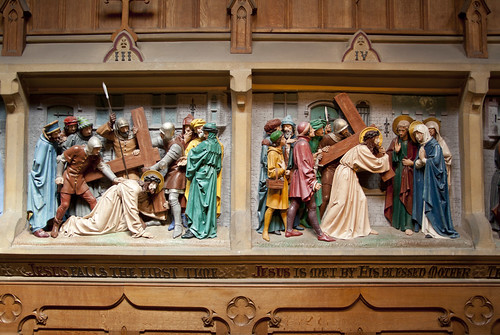
The Third Station: Jesus Falls the First Time.
The Fourth Station: Jesus is met by His Blessed Mother

I wasn't around for the Second Vatican Council and its immediate aftermath, but on the basis of what I've read about those years, I feel as if I am watching an action-replay.

One thing to remember about it is that the terrible things which happened after the Council came after the promulgation of documents which had been much tweaked in a conservative direction, documents which the more conservative bishops felt they could, after all, support, since they were quite capable of being read in a way consistent with traditional views. For example, it was quite late in the proceedings that one famous sentence of the document on liturgy, Sacrosanctum Concilium, assumed its final form:

'there must be no innovations unless the good of the Church genuinely and certainly requires them'

with the addition of the phrase 'genuinly and certainly', 'vera et certa'. With this in the document, what more could anyone ask?

All sorts of qualifying footnotes and subclauses went into the documents of the Council to acheive the consensus votes which were thought to be appropriate - and rightly so. But the disasters which befell the Church afterwards still happened.

Friday, April 15, 2016

The problem of divorce in the first place

IMG_0272
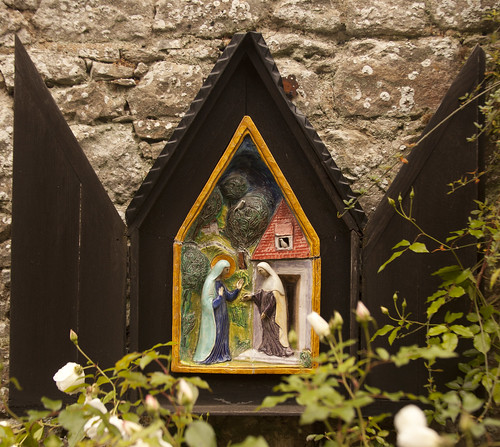
The Visitation. From the Rosary Walk at Aylesford Priory.
I, like many people, have been rather focused on the question of what happens after the divorce of a Catholic couple. There is a danger of allowing a very dubious liberal assumption to go unchallenged: that marital breakdown 'just happens', and when it happens it is by definition irreparable.

Catholics are not allowed to walk out on their spouses whenever they fancy. Knowing that this is the case puts one in a different frame of mind in dealing with marital problems. If this truth is not taught and understood, Catholic spouses, and their children, are exposed to the horrible problems of divorce as practiced in the secular world.

If you don't have a firm grip on the obligations of marriage, the obligation to maintain a common life - not walk out - the contribution of the teaching of the indissolubility of marriage is to make life more difficult, without any compensation. But that is exactly the situation we have. Marriage is indissoluble, we are told, but in practice the Church places no constraint on separation. In theory, the Church condemns separation except for a limited number of very grave causes; in theory, Catholics with marital difficulties should go to their bishop before seeking legal separation or divorce, to determine the justice of such a move. But no one wants to call unjust separation and divorce, and marital abandonment, what it is: a grave sin.

Friday, March 18, 2016

How to read the forthcoming Exhortation

IMG_9510
I will wash my hands among the innocent, and compass thine altars O Lord.
Everyone is talking about the Post Synodal Exhortation, so why not jump on the bandwagon? Here is some advice which almost everyone will ignore.

For now: Don't read speculation about the contents. It is a waste of time, it raises the blood pressure, and it will fill your head with preconceived ideas.

When it published, not everyone will have the time to read long documents. It may be very long; one of the things unofficially abolished by Vatican II was the art of brevity. Most people will read short extracts and commentary. When looking at these, or indeed when ploughing through the whole thing, bear in mind a few principles of exegesis.

1. The Pope can't change the teaching of the Church. No, really, he can't, not even a little bit, not even for the needs of the time, not even with the help of the Holy Ghost. He cannot change one jot or tittle, and anyone who tells you to stop believing what the Church has (really) taught up to some moment in the past, is inviting you to depart from the Church by heresy. Your interlocutor may claim the Pope rejects the old teaching, but, on this point, IT MAKES NO DIFFERENCE what the Pope says. Having the Pope with you in Hell will be no comfort at all - just ask Dante.

Wednesday, November 04, 2015

The Synod: fornication as a path to holiness

I've just read Bishop Schneider's excellent critique of the Synod's Final Relatio, paragraphs 84-86. Here I want to say something about paragraph 71, translated by Rorate Caeli.

71. The choice of civil marriage or, in several cases, simple cohabitation, is often not motivated by prejudice or resistance against the sacramental union, but from cultural situations or cultural contingents. In many circumstances, the decision to live together is a sign of a relationship that actually wants to navigate towards the prospect of stability. This will, which translates into a lasting bond, reliable and open to life can be considered a commitment on which to base a path to the sacrament of marriage, discovered to be God's plan for [the couple's] lives. The path of growth, which can lead to sacramental marriage, will be encouraged by the recognition of the distinguishing characteristics of a generous and lasting love: the desire to seek the good of others before their own; the experience of forgiveness requested and given; the aspiration to build a family that is not closed in on itself but open to the good of the ecclesial community and of the entire society. Along this route those signs of love that properly correspond to the reflection of God should be valorized into an authentic conjugal project.

I'm not going to go into who 'won' the Synod, what the Pope meant in his concluding remarks and post-Synod sermon, or the latest Sclafari interview. If we want public documents, whose wording has been pored over and voted on, this is quite enough. It is not a document with magisterial authority, but then none of the key moves in this game are about documents of magisterial authority.

Tuesday, October 06, 2015

To what do we stay faithful?

This is a very frightening time for faithful Catholics. As the teaching of the Church is questioned, we look for something to hold onto. But today's crisis is not about the denial of doctrinal formulas, so much as the evacuation of their meaning.

Pompous and boring as he is, Mgr Basil Loftus is an excellent illustration of the process. He avoids denying the classical formulations of the the truths of faith, but he evades their meaning. He creates a little structure of obfuscation which allows him to assert something in practice the opposite of the truth. Christ rose from the dead, but - says Loftus - he wasn't physically present after the resurrection, and the empty tomb is just distracting. Marriage is indissoluble, but a valid marriage can 'die'. Christ is in the Blessed Sacrament in some sense, but mercy requires us to hand out Communion like sweets, to everyone.

It isn't very convincing, but it doesn't need to be. The self-contradictory statements of today's liberals aren't the sort of thing which could sustain a living faith, or even the false faith of a false religion. That isn't what they are for. Their purpose is to allow people who did believe the truth to cease to do so with the minimum of heartache. That is the real danger, when these sorts of statements gain some kind of official recognition.

At the time of writing the precise outcome of the Synod is impossible to predict, but suppose it combined the annulment reforms we've already has with some of the ideas about 'mercy' vigorously floated by quite a few influential people, what would that mean? It would mean that the teaching of the Church that marriage was between one man and one woman, that the marriage between Christians was sacramental, and that it was indissoluble, would be proclaimed in some footnote or other to be unchanged. And yet for the sake of the marginalised, the victims, those unhappy people banging on the gates of mercy and justice, people will be able to write their own annulment decrees and, if they prefer not to do that, they will be able to remarry and receive Communion if they express (or can be taken to express) regret for past (if not present) sins. The Church's teaching will make no difference to the way we live. It will be as if it did not exist.

Observe the parallel. The teaching on the Real Presence, on Transubstantiation, has not been changed by the Church. But suppose we didn't hear about it in catechism classes or in sermons because that language is 'difficult', and suppose it were not reflected in the liturgy by any signs of reverence. What would happen? It is not that lots of people would adopt the incoherent position: that Christ is fully and substantially present in the Blessed Sacrament but that we don't talk about it and shouldn't genuflect or think twice about picking it up in our fingers. No: the problem is that the ordinary Catholic in the pew will stop believing it altogether, while a bunch of 'conservative' Catholics will tell us that there is no problem, really there isn't, because the traditional formula has never been contradicted formally by the Church, and, gosh, looky here, there's a footnote in this long document on the Vatican website in Hungarian which implies it is still true.

The situation just described is alarmingly close to the reality we have been living through for the past 40 years. There are, in fact, still signs of reverence in the Novus Ordo, for those priests who observe the rubrics; there has even been something of a revival of popular interest in the Blessed Sacrament, for reasons which I won't go into here. The massive loss of faith in the Real Presence among even church-going Catholics, then, has come about as a result of an only partial victory by the liberals. And so has the massive rate of divorce among Catholics.

A complete victory, at least for now, does not include an explicit repudiation of the traditional doctrinal formula, because the libereals want to keep with them the 'conservative' Catholics who will accept everything short of that. A complete victory, at least for now, means the complete eradication of the teaching's practical implications, without the denial of the formula. If we really believe in the indissolubly of marriage, it will naturally make a difference to the way we live. If it makes no difference, if it is prevented from making a difference, then, human nature being as it is, we will soon cease to believe it.

To return to the question of the title of this post, what are faithful Catholics presented with this situation, who want to remain faithful to the truth, to remain faithful to? Repeating the classical formula of the doctrine will not be enough, because it will be (semi-)officially regarded as compatible with a life, a practice, which gives the lie to the classical forumula as classically understood.

Staying faithful means not just talking the talk, but walking the walk. It means avoiding the accusation made by the prophets of the Old Testament, and again by Our Lord, of the lukewarm: not that they deny God, oh no. Rather, as Our Lord says, quoting Isaiah (29:13):

This people honour me with the lips, but their heart is far away from me.
Populus hic labiis me honorat, cor autem eorum longe est a me. (Mat 15:8)

His first hearers would immediately remember remember the next words of Isaiah:

they have feared me with the commandment and doctrines of men.
timuerunt me mandato hominum et doctrinis.

Are we going to follow the doctrines of men and honour God only with our lips?

This has implications for our private lives, but it must be more than that as well: our faith must be manifested publicly. As I've noted before on this blog, although the issue of marriage is supremely an issue for the laity, it is faithful priests and bishops who are going to be between the hammer and the anvil with the proposed new practices. Our faith as laity may find its public expression in our support for them.

Support the work of the LMS by becoming an 'Anniversary Supporter'.

Friday, September 25, 2015

'Call Mission Journey': Looking into the Abyss

For an astounding example of self-flagellation, the results of the survey commissioned by the Bishops of England and Wales on the family, The Call, the Mission and the Journey, takes some beating.

From a statistical point of view the survey is completely meaningless. Responses to a series of questions have been provided by a self-selecting group of people, partly online and partly offline. These have then been cherry-picked and collated by some functionary of the Bishops' Conference, and the result, with a little commentary, weighing in at 17,500 words, has been plonked on the web like an undigested potato.

Nevertheless, reading through it one hears the authentic voice of... middle class liberal Catholics aged between 50 and 70. We can be fairly specific about the age because almost all the references to children are to grown-up children and grandchildren. These are, in any case, almost the only people who would bother filling in a questionnaire of this sort, though many of them seem pretty annoyed about it.

'A number are critical of the way the questionnaire as a whole and this question [6] in particular were framed'

(Note the illiteracy, or at least the haste, of the functionary collating the responses.)

This splinter of the Church's demographic appears to be held in awe by the Bishops' Conference. Their opinions are apparently regarded as some sort of oracle, and the 'Bishops' response' (what bishops, I wonder?) is not exactly robust. It consists of a couple of pages of quotations from Pope Francis, a prayer, and a list of credal statements about marriage and the family which manages not to mention either indissolubly or sanctifying grace. Their approach appears to be inspired by Oscar Wilde:

'Ignorance is like a delicate exotic fruit; touch it and the bloom is gone.

Friday, September 18, 2015

What will we make of quickie annulments?

Here's another problematic aspect of the annulment reform.

Every now and then I hear some one has married following an annulment. I think, I expect most Catholics think, 'well, I'm glad they sorted that out properly'.

If someone told us of the circumstances of the annulment, and it sounded terribly dodgy, I would still try very hard not jump to the conclusion that the second marriage was in reality adulterous. I would say to myself: 'I don't have all the facts, I was not the judge in the tribunal.'

In a few years time we are all going to encounter cases of people who have had 'quickie' annulments. Assuming the reform proceeds, and until it is reversed, I suspect that few people will find it necessary to go through the 'ordinary' procedure. That is the way in the post-Conciliar Church: the exception is the rule. This appears to be the plan: the Holy Father himself has said the reform aims to help not just a few people at the margins, but rather -

"The enormous number of faithful who, despite wanting to look after their conscience, too often are turned aside by the juridical structures of the Church.”

Now when in a few years time we encounter a person who has had an annulment, we won't be able to quiet any misgivings by telling ourselves that it did at least go in front of a panel of canonical experts for serious discussion. Instead, what will we do? Will we just roll our eyes?

One of the consequences of the reform is that couples whose marriages really were invalid will be placed in the same category as any number of couples whose marriages have been annulled without any serious consideration. All of them, then, will be unable to get married again in a way which is genuinely publicly recognised. When they tell faithful Catholics they are licitly remarried, they will see rolling eyes.

This is very unjust for people who have, in some cases through no fault of their own, gone through the trauma of an invalid marriage and separation. But it won't be the fault of the people who roll their eyes; it will be the fault of the people in authority who refuse to consider petitions for annulment seriously, on their merits.

What we are going to end up with is a category of licit 'second class marriage': people of whom we say 'oh they remarried after an annulment.' It will be as if the Church were to recognise, alongside marriage, concubinage. The perception of the reality and indissolubility of first marriages will also be undermined, but nothing like as much as the reality of second 'marriages' following a quickie 'annulment'.

A second-class annulment will give couples only a second-class marriage.

The couples celebrating the possibility of 'getting married in the Church' after years of living in an 'uncanonical' situation will be the first to notice, sadly, the hollowness of their victory.

Support the work of the LMS by becoming an 'Anniversary Supporter'.

Wednesday, September 16, 2015

Annulment reform and the Kasper proposal

Back in the innocent days we had discussing Cardinal Kasper's proposals, the suggestion was that people be allowed to receive Holy Communion despite living in uncanonical situations. He said, in an interview, that he thought reform of the process of annulment wouldn't make a difference to all that many people. Instead, we had to take a different view of the new, adulterous, unions, which people who had left perfectly valid first marriages had contracted. (My post about it.) He said:

And the second is not a marriage in the same sense, but there are elements of it—the partners take care of one another, they are exclusively bound to one another, there is an intention of permanence, they care of children, they lead a life of prayer, and so on. It’s not the best situation. It’s the best possible situation. Realistically, we should respect such situations, as we do with Protestants. We recognize them as Christians. We pray with them.
Part of the motivation for this was, no doubt, a naive belief that the annulment process could only be twisted so far, but another, and perhaps a more powerful one, is the observation that many of the couples in illicit second unions do not want an annulment.

This may seem surprising, but it is true. I've encountered this attitude myself; here is Mgr Basil Loftus about it (criticising 'the often negative and harmful purported 'solution' of marriage nullity.'), and here is Cristina Odone (angered by 'the practice of annulment, where you could effectively buy the Church’s collusion in untying the marital knot.')

Tuesday, September 15, 2015

Worries about the arguments for annulment reform

IMG_0418
The Blessing of the Bride
In my last post, I summarised the arguments of the canonist Edward Peters on problems raised by the reform of the annulment procedures by Pope Francis' motu proprio Mitis Iudex.

I want to base my own reflections around two mutually inconsistent attitudes which are the hallmark of all too many reforms carried out in the Church since Vatican II, which appear to be present in this reform as well. (I wrote this post before reading Rorate Caeli's translation of excerpts from an article by Msgr. Pio Vito Pinto, the leader of the commission which crafted this reform; the article confirms my observations.)

The first is an impatience with the traditional approach to whatever the issue might be. In this case, the traditional approach places the burden of proof on the side of the validity of a marriage, which has the result that gaining an annulment takes on the appearance of a hurdling race. A petitioner has to prove that the marriage was void; he or she has to seek out grounds, and then evidence for those grounds, and then do it all over again with a second tribunal.

Where the system has been corrupted, of course, these obstacles may not be difficult to overcome, but the procedure still consists of overcoming them one by one. Where it has not been corrupted, then it remains a very real possibility that a petition will be refused even when the marriage is truly invalid, simply because it could not be proved to be invalid: in exactly the same way that a guilty man may walk free from from a criminal court for lack of evidence. But in the case of annulments, it does not appear to be a matter of erring on the side of caution, in that way that not imprisoning people without sufficient evidence counts as erring on the side of caution, but of erring on the side of bloodyminded intransigence. A refused petition is in most cases today a refusal to allow a couple married (or soon to be married) outside the Church to return to (or remain in) good standing and receive the sacraments. Isn't the very possibility of refusing a petition to a person in a marriage which is in reality invalid a horrifying one? Should we not err on the side of the invalidity of the marriages in front of tribunals?

No, of course not. Because the final result desired by petitioners is not, in fact, a declaration of nullity, in almost every case, but a valid marriage - a new one, that is, with a new partner. To place the burden of proof on the side of invalidity is to place a doubt on every single marriage on the face of the earth, including the marriage the petitioner wants to contract as soon as the decree is granted. It is, to this extent, self-defeating.

Monday, September 14, 2015

Marriage and annulment reform

Christ the Judge
The canonist Edward Peters has done a great service to the Church with his short series of posts on Pope Francis' reform of the annulment process, with the motu proprio Mitis Iudex.

First thoughts, including the abolition of second instance.

More thoughts, including worries about the effects of the reform.

Lengthy procedures in Argentina

More on the causing of unnecessary doubts about the validity of marriages

Unlike Roberto de Mattei, whose article on the subject can be seen on Rorate Caeli, Peters is not too worried about the abolition of the requirement of 'second instance'. Until now, declarations of nullity have had to be confirmed by another tribunal, which obviously adds to the time and expense of the process. The new rules make this unnecessary.

While I agree with de Mattei that the change is clearly moving things in the direction of taking less seriously the marriage bond, I can see Peters' point as well. Where the canonical procedure is weak, for whatever reason, adding another weak tribunal to the process may do little to help.

Peters identifies three aspects of the reform which really do worry him, and I urge readers to see what he says in detail. They are:

1. Making relevant to the way cases are heard, whether both spouses agree to seek an annulment. Why should it be relevant? The rule will encourage an attitude of conspiring between estranged spouses to get the desired result - or pressure by one on the other to agree, for the sake of a quick result.

2. The rag-bag list of reasons to allow an accelerated procedure, which includes issues related to grounds for nullity such as lack of discretion in making the vows, with issues utterly unrelated, such as 'brevity of marriage', and issues expressed in terribly vague terms. As Peters says, this is going to lead people to have doubts about the validity of their marriages who should not. ('Gosh, I was pregnant when we married; I'd be able to have a quickie annulment. Doesn't that mean there is something wrong with my marriage?')

3. The accelerated procedure itself, which can be undertaken by a bishop assisted by people without any training in Canon Law. Bishops may have the authority, by virtue of their office, to judge cases, but putting them personally in the hot seat without the support of experts is a recipe for disaster.

I want to devote another post to some reflections of my own on this topic.

Support the work of the LMS by becoming an 'Anniversary Supporter'.

Wednesday, June 24, 2015

Filial Appeal

(Reposted: now over 270,000 signatures)
Read it. Sign it. Spread the word. (Click on the image.)


Christ, the great Prophet, who proclaimed the Kingdom of His Father both by the testimony of His life and the power of His words, continually fulfills His prophetic office until the complete manifestation of glory. He does this not only through the hierarchy who teach in His name and with His authority, but also through the laity whom He made His witnesses and to whom He gave understanding of the faith (sensu fidei) and an attractiveness in speech so that the power of the Gospel might shine forth in their daily social and family life.
Lumen Gentium, 35


Support the work of the LMS by becoming an 'Anniversary Supporter'.

Friday, May 08, 2015

Filial appeal to the Holy Father on marriage

(Reposted)
Read it. Sign it. Spread the word. (Click on the image.)


Christ, the great Prophet, who proclaimed the Kingdom of His Father both by the testimony of His life and the power of His words, continually fulfills His prophetic office until the complete manifestation of glory. He does this not only through the hierarchy who teach in His name and with His authority, but also through the laity whom He made His witnesses and to whom He gave understanding of the faith (sensu fidei) and an attractiveness in speech so that the power of the Gospel might shine forth in their daily social and family life.
Lumen Gentium, 35

Support the work of the LMS by becoming an 'Anniversary Supporter'.

Wednesday, March 18, 2015

More from Loftus on the joys of divorce, fornication, and gay sex

IMG_0352

Loftus is on fine form in his Catholic Times column of 13th March 2015.

It is no use citing over and over again the spiritual perfection of a marriage in which every sexual act is open to conception. The reality is different. It's no use emphasising the complementarity of the two genders to men or women who find sexual intimacy repugnant if it is not with someone of their own gender.

Pope Francis said in his apostolic exhortation - The Joy of the Gospel - that "reality is greater than ideas". This applies not only to the sphere of economics, but to the whole of humankind's activity. And one of today's realities is that young people live together before or without getting married. And in many cases they guard their mutual faithfulness with a zeal which at least matches that of married couples.
....

The divorced and remarried are often not capable of leaving one another - or of living as brother and sister. Indeed in many cases consideration of the children would on its own make it morally wrong for them to leave one another, and since they are palpably not brother and sister, then for them to try to live as such in close domestic proximity could on its own bring about all the harmful psychological effects that flow from trying to live any kind of lie.
...

Don't bother trying to change or adapt the law - just do what realism rather than ideology demands, and for the rest trust in God's merciful understanding.

If there is some kind of liberal breakthrough at the Synod over remarried divorcees receiving Holy Communion, don't expect things to stop there. Loftus is perfectly correct to sense that once that principle is breached, the whole of moral theology will collapse like a pack of cards: gay sex, fornication, you name it. Why not add arson and murder? It won't be possible to refuse anyone Communion, it won't be possible to give any teaching on morality.

Saturday, February 28, 2015

Loftus: Ordinariate bad, gay marriage good

IMG_2493
Fr John Hunwicke of the Ordinariate of Our Lady of Walsingham, who seems to have
escaped from the Ghetto to give the SCT Family Retreat in 2013
Mgr Basil Loftus' weekly column in the Catholic Times (27th Feb 2014) is even more diffuse and rambling than usual.

The Ordinariate of Our Lady of Walsingham gets a quick kick.

It [Dignitatis humanae and Unitatis Redintegratio] leaves later measures, such as the accomodation of former Anglicans within the confines of some ghetto-like personal prelature, as a mere touchline distration...

The irony of citing Vatican II's Decree on Ecumenism to dismiss the importance of the Ordinariate, the most important ecumenical project of our generation, is lost on Loftus. He typifies the attitude that is in favour of ecumenism in theory, but is horrified when it actually works and brings unity about, even if only for a relatively small group.

Wednesday, February 04, 2015

Sklerocordia: hardness of heart and divorce

IMG_0856
The solemn proclamation of the Gospel at a Traditional Requiem Mass.
In Remaining in the Truth of Christ (the 'book of the five Cardinals' defending the Church's discipline on marriage), the biblical data on divorce is discussed by Fr Paul Mankowski SJ. He remarks laconically that today people who uphold Our Lord's teaching on divorce who are accused of being unmerciful, hard of heart, but Jesus tells us that the permission for divorce in the Mosaic law (a permission never made explicit, no more than a reference to the fact that people were divorcing):

'It was for your hardness of heart [Greek: 'sklerocordia'] that Moses gave this commandment.' (Matthew 19:8)

It was because Jesus wants to break through that hardness of heart, because he offers, to use the phrase of Ezekial (36:26) to replace our heart of stone with a heart of flesh, that he wants to put a stop to divorce, or at least the respectable re-marriage to another spouse which is the hard-hearted intention of most divorces.

One of the reasons that the Church is finding it difficult to hold the line on divorce is that, if we are honest with ourselves, the teaching on the indissolubility of marriage has not been presented with forcefulness for half a century at least. The Church is full of compassion for those who are going through marital difficulties, for the separated, for the divorced, and for the remarried. That is a good thing. But we aren't sent simply to weep by the sidelines; the Church is supposed to have some insight into human nature. What are these people told to do? Are they told that divorce and remarriage, as a solution for marital problems, overwhelmingly often has catastrophically bad consequences for both spouses and especially for the children? Are they told that the marriage vow imposes a sacred obligation to remain with one's spouse, that the grace of the sacrament will assist with the common life of marriage, and that infidelity is poison to the life of grace and to the marital relationship?

Monday, January 05, 2015

Paix Liturgique on Cardinal Sarah

IMG_9424
High Mass for the LMS in the Shrine Church of SS Peter & Paul & Philomena, with the ICKSP
in the Wirral.
The Paix Liturgique newsletter has a series of interesting comments from different people, including Nicola Bux and Bishop Schneider, on the appointment of Cardinal Sarah as Prefect of the Congregation for Divine Worship, here.

One is from me. Here it is. I was asked to say something about the challenge facing this Congregation, and its new Prefect.


"Under Pope Paul VI and Pope John Paul II, the Congregation issued a series of condemnations of some liturgical abuses, while simultaneously conceding defeat on others, such as the reception of Holy Communion in the hand, Communion under both kinds at large, Sunday celebrations, and female Altar servers. The supporters of liturgical propriety had the impossible task of defending a series of rules which were almost universally flouted, knowing that the Congregation could itself abandon them at any moment.