---------------------------------------------
It must be a perennial truth about the Church, that to every issue some people will criticise what you do - whatever it is- as too 'soft', and others as too 'harsh'. Since Vatican II, this has gone from being a parlour game to a major industry, as those who have wanted to maintain the Faith in its integrity cheer themselves up by criticising each other for being either too accommodating of novelties, or too suspicious of them.
The 'circular firing squad' this easily becomes is not helpful to the cause, but the question, of how suspicious or accommodating one should be, is an important one and does need to be addressed seriously. Which new initiatives, new theological perspectives, new structures or new forms of worship, are perfectly ok, and which are not? Of the latter, which need to be criticised, where possible evaded (by not using them), or repudiated? Each initiative should in principle be treated on its merits, though the scale of the avalanche of new things since 1960 is itself open to critical assessment.
(Anyone afflicted by the thought 'Anything the Pope says must be ok' should, of course, read my posts about Papolatry, but can still follow the argument in this post by considering examples where the Pope had not actually mandated anything. In a number of cases Popes have condemned novelties, which have still spread through the Church, such as routine use of EMHCs, or General Absolution.)
The difficulty in most cases has been that the problem presented by the new things has been not that they contradict the teaching of the Church in a propositional way - only in seminaries and certain academic institutions have Catholics actually been asked to deny the faith in as many words. Rather, where the old version of whatever it is pointed towards the teaching, the new one points away. They are typically accompanied by official documents which are worded in such a way that they can be read, perhaps with a little effort, in accordance with the Church's teaching, and also read, with a little effort, in accordance with a new view which is not compatible with the teaching of the Church (although this may depend on ignoring some of the document in question).
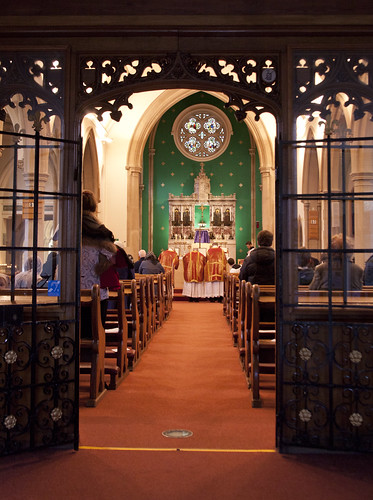 |
| LMS Pilgrimage to Our Lady of Caversham. Come on in. |
The 'circular firing squad' this easily becomes is not helpful to the cause, but the question, of how suspicious or accommodating one should be, is an important one and does need to be addressed seriously. Which new initiatives, new theological perspectives, new structures or new forms of worship, are perfectly ok, and which are not? Of the latter, which need to be criticised, where possible evaded (by not using them), or repudiated? Each initiative should in principle be treated on its merits, though the scale of the avalanche of new things since 1960 is itself open to critical assessment.
(Anyone afflicted by the thought 'Anything the Pope says must be ok' should, of course, read my posts about Papolatry, but can still follow the argument in this post by considering examples where the Pope had not actually mandated anything. In a number of cases Popes have condemned novelties, which have still spread through the Church, such as routine use of EMHCs, or General Absolution.)
The difficulty in most cases has been that the problem presented by the new things has been not that they contradict the teaching of the Church in a propositional way - only in seminaries and certain academic institutions have Catholics actually been asked to deny the faith in as many words. Rather, where the old version of whatever it is pointed towards the teaching, the new one points away. They are typically accompanied by official documents which are worded in such a way that they can be read, perhaps with a little effort, in accordance with the Church's teaching, and also read, with a little effort, in accordance with a new view which is not compatible with the teaching of the Church (although this may depend on ignoring some of the document in question).