Showing posts with label Universae Ecclesiae. Show all posts

Tuesday, May 14, 2013

Universae Ecclesiae and the Office: a reply to Mgr Wadsworth

Can priests mix and match the old and new Breviaries?

Mgr Andrew Wadsworth, very much a friend of the Traditional Mass (and the Latin Mass Society) and recently most famous as Executive Director of ICEL, and a key person in the preparation of the new translation of the 1970 Missal, raised an interesting question about wording of Universae Ecclesiae on the 1962 Office, in the comments on my post about our new translation of Universae Ecclesiae.
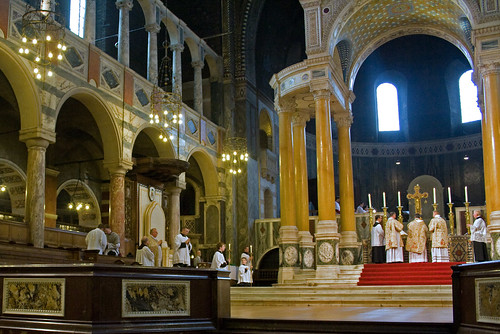
Mass15
Mgr Wadsworth was Assistant Priest to Bishop Arnold at the LMS' AGM Mass in 2009; he's on the left.
He wrote:

This project is an excellent idea and a real opportunity to consider how some of the provisions of this important document can be applied.

I'm not sure that your literal translation of para 32 supports the idea that those bound to the recitation of the office may use either one form or the other at whim. While we understand that it is always possible to fulfil this obligation by assisting at isolated celebrations such as Vespers, Compline, Matins or one of the little hours in either form, I think this clarifiction is actually to ensure that combinations of the two forms are not habitually used on a daily basis.

For instance, I would imagine that the injuction "quidem integre et Latino sermone" suggests that it is not licit for a priest to pray Office of Readings everyday from the Liturgia horarum and then to say the days hours from the Breviarium Romanum. In this way, the integrity of the day's office would be continually compromised and the basic principle of praying of the whole psalter rendered continually impossible (in either form). A person who is not obliged to the entire office obviously has greater liberty. 


The Latinists who prepared the translation have replied as follows.

Latinist number 1: My view is that each of the two interpretations is technically 'probable'; and that, accordingly, one can invoke the principle that a lex dubia does not constrain.

The idea that one might lawfully mix up the two uses is supported by Laudis Canticum of Paul VI, 1970, giving bishops the power to allow priests with age-related or other problems "Breviarium Romanum, quod antea in usu erat, sive ex toto siveex parte retinere". So, even if Mgr Wadsworth is right, all a priest who wishes to oscillate between the uses needs to do is to get a faculty from his bishop under the Pauline legislation!


Latinist number 2:

Universae ecclesiae, s. 32:

Omnibus clericis conceditur facultas recitandi Breviarium Romanum ....., et quidem integre et Latino sermone.

Vat trans: ...gives clerics the faculty to use the Breviarium Romanum in effect in 1962, which is to be prayed entirely and in the Latin language.


'Slavish' trans: To all clerics is granted the faculty of reciting the Roman Breviary of the year 1962 ....., and, what is more, entirely and in the Latin language.

The meaning of s. 32 depends on quidem. The force, to me, seems to be: “and indeed they may use it entirely and do so in Latin.” “May use”, because we are talking of a faculty, not a requirement. Quidem can mean “certainly” (L & S, II), and seems to be intended to remove any doubt that might exist whether clerics can use it all and nothing but, and are not required to say the occasional hour in the OF or in the vernacular. But it does not seem to stop clerics doing the latter if they wish.

Yet I concede that quidem (L & S, B.2) can accompany a qualificative or opposing thought: “but, yet, however”. In this case the clause could be interpreted in a restrictive sense- “it’s all, and in Latin, or nothing”.
“Quidem” is untranslated in the Vatican version, except perhaps by implication. “What is more” is intended to bring out the generosity of the concession, not to make it more restrictive – and this in a document whose entire purpose is surely to be generous. 

Latinist number 2: 
I am tempted to write “obviously” for “quidem”: - you don’t need some kind of extra permission to recite the whole thing in the EF rather than just part of it, or to use Latin rather than the vernacular, though (if you wanted) you could do part of it only, and in the vernacular. For this nuance, how about the Preface for Easter? - Te quidem Dne omni tempore sed in hoc... “Given that it is you, Lord, that we are talking about, it is “obviously” right that we preach you all the time, but all the more so now...”

Nevertheless, if I am wrong, and Mgr Wadsworth is right to suggest that the legislator wished to be restrictive, it seems to me that the legislator has not managed so to express himself (and then lex dubia non obligat). For he could very easily have been clearer: dummodo officium totius diei recitent integrum et solo Latino sermone, or the like.
Mgr Wadsworth’s point that a carte blanche to mix the EF and OF offices would compromise the integrity of the day’s office is reasonable enough. On the other hand a priest who daily says the EF mass and recites the OF office (or, for that matter, vice versa) would also be doing this – and this is certainly allowed by the legislator.

Friday, May 03, 2013

New translation of Universae Ecclesiae

I am delighted to announce the completion of a little project I've had in had for some weeks: a completely new translation of Universae Ecclesiae, the 2011 Instruction of the Pontifical Commission Ecclesiae Dei which clarifies and in some ways gives substance to the liberation of the Traditional Mass which Pope Benedict effected in 2007 with his Motu Proprio Summorum Pontificum. This is thanks to a lot of work by some very good Latinists - not me, I hasten to say!

This may sound desperately dull, but Universae Ecclesiae is the last word on the legal status of the Traditional Mass, the Extraordinary Form, and of the process by which we can ask for it. I suspect it will remain the last word, substantially, for a good while, partly because it did what was needed, and partly because Pope Francis has other priorities. This means that understanding this document properly is of particular significance.

And this is another chance to embarrass the Latinists of the Vatican who think they can fob us off with inaccurate or tendentious translations from the Italian version, or whatever it is they do, instead of giving us a faithful rendering of the Latin. I'd love to hear of a single example in this document, or of many others, when sloppy translation favours the cause of the Traditional Mass and those who wish to celebrate or attend it. It is not carelessness, it is a systematic bias.

I've put it on the LMS website, and created a pdf with the Vatican's translation, the Latin, and the literal translation, are side by side in parallel.

Here are some examples.

Vatican website:
'5. Many of the faithful, formed in the spirit of the liturgical forms prior to the Second Vatican Council, expressed a lively desire to maintain the ancient tradition.'

Literal translation:
'5. But quite a number of Christ’s faithful, imbued with the spirit of the liturgical rites prior to the Second Vatican Council, expressed a noteworthy desire to keep the ancient tradition.'

They weren't formed in those rites, necessarily - that suggests they grew up in them. Few trads today were: but they are imbued with them.

Vatican website:
8. The Motu Proprio Summorum Pontificum constitutes an important expression of the Magisterium of the Roman Pontiff and of his munus of regulating and ordering the Church’s Sacred Liturgy.[3] The Motu Proprio manifests his solicitude as Vicar of Christ and Supreme Pastor of the Universal Church,[4] and has the aim of:

Literal translation:
8. The Apostolic Letter Summorum Pontificum constitutes an important expression of the Magisterium of the Roman Pontiff, and of his munus of ruling, and of arranging the Sacred Liturgy,[3] and of his solicitude as Vicar of Christ and Pastor of the Universal Church[4]. The Letter itself has the aim of:

The Holy Father's gift of ruling is not limited to fiddling about with the liturgy, and that is not all that is at issue here. The Motu Proprio was not a piece of liturgical legislation, but a wider act of governing the Church.

Vatican website: the first aim of the Motu Proprio
8 a. offering to all the faithful the Roman Liturgy in the Usus Antiquior, considered as a precious treasure to be preserved; 

Literal translation:
8 a. bestowing on all of the faithful the Roman Liturgy in the Usus Antiquior, as a precious treasure to be preserved; 

No one is going to be forced to go, but it is given to all, it belongs to all, it is part of the Church's liturgical life - whether you like it or not. And it is not just 'considered' a precious treasure - 'prout pretiosum thesaurum' - it is one.

Vatican website:
21. Ordinaries are asked to offer their clergy the possibility of acquiring adequate preparation for celebrations in the forma extraordinaria. This applies also to Seminaries, where future priests should be given proper formation, including study of Latin[8] and, where pastoral needs suggest it, the opportunity to learn the forma extraordinaria of the Roman Rite.

Literal translation:
21. Ordinaries are strenuously asked to provide for clergy who are in training a suitable opportunity for acquiring the art of celebrating in the forma extraordinaria; and this  is most especially applicable for Seminaries, in which it shall be provided that the students of sacred things be aptly instructed, by learning the Latin language [8] and, where circumstances demand it, the actual forma extraordinaria of the Roman Rite.

They really let themselves go here. The Latin 'enixe', 'strenuously', is left untranslated: did the translator think that the Supreme Legislator of the Church, the Pope, who approved this Instruction, make a mistake in using this word? Clearly the translators also couldn't cope with the idea that the possibility of training in the EF applied 'potissimum', 'most especially', in seminaries.

Vatican website:
32. Art. 9 § 3 of the Motu Proprio Summorum Pontificum gives clerics the faculty to use the Breviarium Romanum in effect in 1962, which is to be prayed entirely and in the Latin language.

Literal translation:
32. To all clerics is granted the faculty of reciting the Roman Breviary of the year 1962, about which Art. 9 § 3 of the Apostolic Letter Summorum Pontificum, and, what is more, entirely and in the Latin language.

Priests don't have to say the whole of the Breviary according to the 1962 books, or none of it: they can use any part of it they like. (This will come up, for example, if they attend a public celebration of Vespers according to 1962, and the like.)

Vatican website:
34. The use of the liturgical books proper to the Religious Orders which were in effect in 1962 is permitted.

Literal translation:
34. It is permitted to members of Religious Orders to use their proper liturgical books in force in the year 1962.

The Vatican translators made it sound as though the whole order would have to agree about using their old books. Not so: each and every member has a right to use them, of his own volition.

But have a look at the whole thing, hardly a section goes by without the translators sticking their oar in to weaken, confuse, lessen, and thwart, in subtle ways, Pope Benedict's clarity of mind and generosity of spirit in giving us this legislation. 

As always, comments and suggestions for improvement are welcome.

Tuesday, July 06, 2010

PCED: no communion in the Hand at the Traditional Mass

The question of communion in the hand at the Traditional Mass has long been unclear. It was not permitted in 1962; it is permitted now (albeit with great reluctance, as a concession to a condemned abuse). Is it permitted now for all forms and rites? Or should those using the 1962 Missal be bound by the rules in force in 1962?

The latter has long seemed the more sensible opinion to the Latin Mass Society, and to most people attached to the 'earlier liturgical traditions'. To adopt into the 1962 Mass customs permitted in the context of the 1970 Mass undermines the integrity of the rite. Each Missal has its own liturgical law, both written and unwritten.

Not all issues are on the same level, however. The question of when Catholics are obliged to go to Mass, and how long they must fast before Communion, are set by canon law (in the first case in the context of decisions made by ordinaries). What is obligatory under the latest Code of Canon Law is obligatory for all Catholics subject to that Code, ie the Code for the Latin Church covers the whole Latin Church. By contrast, liturgical law is specific to the form or Rite.

The common view has been confirmed by the Pontifical Council Ecclesia Dei, as this letter makes clear. These clarifications are to be welcomed.

One may ask: what should a priest do faced with someone insisting on receiving in the hand? The clarification itself, and priests' explanation of the situation, should make this a less frequent occurance. But as with all attempts at inappropitiate behaviour at Mass, priests must respond in a sane way with pastoral sensitivity. There is no legislating for such such cases.

Translation:

"Dear Mr. XXXX

In reference to your letter of 15. June, this papal commission would like to point out that the celebration of Holy Mass in the extraordinary form envisages the reception of Holy Communion while kneeling, as the Holy Host is laid directly on the tongue of the communicant. There is no provision for the distribution of Holy Communion on the hand in this form of the Holy Mass.

With blessings,"

See Fr John Zuhlsdorf: http://bit.ly/ddgzIb


- Posted using BlogPress from my iPhone