Showing posts with label Bishops. Show all posts

Sunday, January 20, 2019

Can we believe the bishops?

My latest on LifeSiteNews.

A taster.

Catholics today find themselves in an institutional Church whose keynote appears to be moral cowardice. Those failing to display its telltale symptoms are weeded out of seminaries or, as priests, are dumped in marginal parishes. Only those willing to play the game are encouraged and promoted.
At first, all that is asked of them is to turn a blind eye to problems that they have no power to address: indeed, they know well that to make a fuss does no good to the victims, only harm to oneself. But as time goes on, more is asked of them. Playing the game means brushing off victims and their families. It means covering up. It means lying. It means facilitating abuse. It means, even for those who don’t themselves abuse, getting into the swamp right up to the neck.

Read it all there.


Support the Latin Mass Society

Sunday, October 14, 2018

Bishop Genn's fear of Traditionalists

Published on LifeSiteNews. The article begins:

Despite the fact that his diocese is desperately short of vocations, Bishop Genn of Münster recently declared: “I can decidedly say I don’t care for pre-conciliar types of clerics, and also I will not consecrate them.”

This is not an uncommon attitude, and it is not limited to Germany. I have heard stories from the English seminary, St. Cuthbert’s College at Ushaw, now closed for lack of custom, that superiors were so concerned to root out conservatively-minded candidates for the priesthood that they would watch how they held their hands during Mass. If they folded them prayerfully, this went on the record as a mark against them. Seminarians would meet to say the Rosary in each others’ rooms, in secret, for fear this subversive activity would get them into trouble, and hide theology books by Joseph Ratzinger.

This attitude seems to go beyond a simple matter of theological disagreement. Signs of conservatism are regarded as akin to signs of leprosy, and indeed, it is not uncommon to hear theological conservatism or traditionalism compared to mental illness. It should be said that this attitude is much less bad, at least in the English-speaking world, than it was a generation ago, but it has not gone away, and it is striking that a German bishop should embrace it so openly.

While I lack any special information about Bishop Genn, I think I can shed light on the phenomenon as a whole. The language commonly used about young conservatives and traditionalists – “rigid,” “conformists,” “authoritarian,” “clericalist” – are related to trends in psychiatry which were influential in the decades after the Second World War. Here is a typical description of the “authoritarian personality” published in 1970 (Peter Kelvin, The Bases of Social Behaviour):

Read it all there.


Support the work of the LMS by becoming an 'Anniversary Supporter'.

Friday, August 17, 2018

There must be episcopal resignations

On CNA, JD Flynn writes:

A third thing that could derail serious ecclesial reform has to do with the call for episcopal resignations. Wuerl, in particular, has been the subject of ongoing calls for resignation, along with other bishops. While the Holy See might judge those moves to be justified, they could have the unintended effect of stalling more systematic and cultural change, if they are not managed carefully. If individual bishops resign, and are then cast as the cause of the problems, the pressure for broader reforms could deflate. The Vatican must ensure that if it accepts the resignation of some bishops, the remaining members of the episcopate remain under pressure to enact the reform efforts the USCCB has said it would like to facilitate.

Some strange things have been written on this crisis, but - in an otherwise helpful article - this deserves some kind of prize. I think it is useful, when addressing problems in the Church, to ask what we would be saying about a parallel problem in another institution, or a different problem in the same institution, and, if what we are saying about the the issue at hand is totally different, what justifies that difference. Flynn's bizarre reasoning illustrates such a contrast.

Thursday, August 16, 2018

'Look not upon me': thoughts on the abuse crisis

IMG_2057
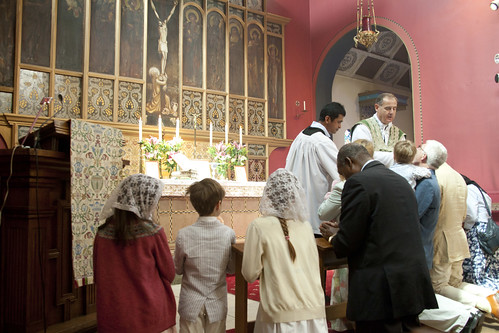
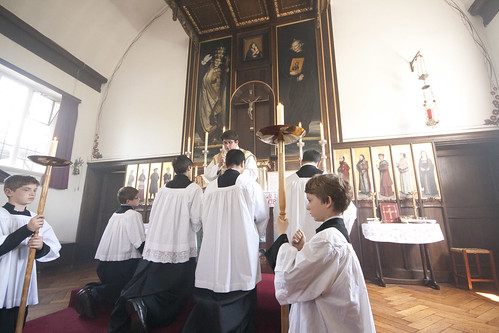
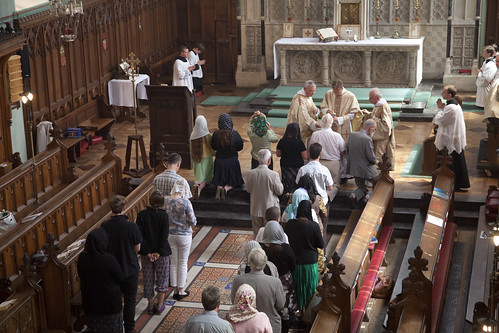
Mass of reparation in Oxford: Votive Mass pro remissione peccatorum
'Look not upon me', says the Beloved, the Church. 'For the sun hath looked upon me.' Labouring in the vineyard has darkened her skin; she is conscious that her beauty is hidden. She says: 'I am black but beautiful'. (Song of Songs, 1:5, 4)

Christ also, the spotless Lamb, was disfigured, by his enemies. Isaiah says of Him in prophecy: 'there is no beauty in him, nor comeliness: and we have seen him, and there was no sightliness, that we should be desirous of him' (Is 53:2). But again, Christ's beauty is hidden, rather than lost.

What has happened to the Church in the last 50 years and more is a disfigurement, a disgrace. Like the Beloved of the Song of Songs, the Church has been cast out of doors without her veil:

'The watchmen that went about the city found me, they smote me, they wounded me; the keepers of the walls took away my veil from me.' (Song 5:7)

The defilement of the Church is real in one sense, and only apparent in another. As a human institution she can be wounded and shamed. As a divine institution she cannot. She is both human and divine, a mirror of Christ, who in His humanity truly suffered and died. This suffering was not unreal or superficial: the betrayal, the stripping naked, the being spat upon, the being tortured and killed. It is profoundly real and of the greatest significance. And yet Christ in his Divine nature, and the Church as the Mystical Body and Bride of Christ, is not defiled: such a thing is impossible. She remains beautiful, though blackened.

Tuesday, July 24, 2018

Are things simply going to get gradually better? Or should we hang some bishops?

I was a little startled to read over the last 24 hours two calls for bishops to be hanged. One was from Matthew Walther, writing for the non-Catholic, mainstream magazine The Week. Walther is no anti-clerical fanatic, but a faithful Catholic. He is writing with a touch of hyperbole, perhaps, but he is making a serious point.

McCarrick obviously should not have been elevated to the cardinalate in 2001. He should not have been made archbishop of Washington. He should not have been simply "removed from public ministry" a month ago, but defrocked. In the time of St. Pius V, a cleric found guilty by an ecclesiastical tribunal of McCarrick's crimes would have been publicly executed by the secular authorities.

That would have been fitting. Indeed, I cannot really aspire to some kind of quasi-journalistic neutrality here. I believe that anyone who abuses a child should be put to death, priest or layman, man or woman. I hate child abusers with a perfect hatred, one that rests uneasily in my heart with the imperative of forgiveness enjoined by Our Lord.

Thursday, June 21, 2018

Corrupt bishops: why it is a problem: Part 1


The shocking news about Cardinal McCarrick prompts me to repost this, from September 2014. The subsequent posts on the series can be seen here and here.

------------------------------

It is hard to think of a precedent in England and Wales for what has happened to Bishop Kieran Conry, though there are plenty from other countries. The downfall of Cardinal O'Brien over the border in Scotland is an obvious one, a closer parallel, however, is afforded by the career of late Bishop of Argyll and the Isles (in north west Scotland), 'Roddy' Wright. I discussed this on this blog because Mgr Basil Loftus had declared that Bishop Wright had merely wanted to get married to the woman he loved. How sweet. Loftus neglected to mention that the wretched Wright had been having affairs with two women, one of them married, simultaneously, and eloped (this was back in 1996) with the one by whom he had not had a child; other affairs had apparently preceded this.

I have no wish to engage in prurient judgmentalism about Bishop Conry, but precisely because this is a new thing for us in England and Wales it is important to consider what we should learn from it.

What Basil Loftus would like us to conclude - and Catherine Pepinster, editor of the Tablet, was quick to make this point on Twitter - is that it is further evidence that mandatory clerical celibacy should be ended. This reaction has become such an ingrained reflex among liberals that they haven't stopped to think about the circumstances of this case. What sort of 'marriage' would have suited Bishop Conry or Bishop Wright? Some sort of free-wheeling polyamorous ménage, one assumes, open to women who are inconveniently married to other men, men who aren't necessarily very happy about sharing the marital bed with their bishop.

Saturday, May 05, 2018

Excommunication of SSPX faithful: LMS Press Release

In light of recent events in the Diocese of Buffalo, New York, I'm reposting this from November 2014

----------------------------------------

4 NOVEMBER 2014

PRESS RELEASE ON THE STATUS OF THE FAITHFUL WHO RECEIVE THE SACRAMENTS FROM PRIESTS AND BISHOPS OF THE SOCIETY OF ST PIUS X.

Bishop Semararo

FROM THE LATIN MASS SOCIETY

COMMENT: letters from the Bishop Semeraro of Albano, Italy, and then from Bishop Sarlinga of Zárate-Campana in Argentina, have declared that the lay faithful who receive the sacraments from priests and bishops of the Society of St Pius X (SSPX) are automatically excommunicated, and would need to go through a process authorised by the bishop to be readmitted to communion with the Church (i.e., not simply confession). The Latin Mass Society holds no brief to defend the position of the SSPX, which is canonically irregular, but feels it necessary to point out that these letters are not just ill-considered but have potentially very serious pastoral consequences. They imply that anyone who has ever been to Mass said by a priest of the SSPX is not welcome in the churches of these dioceses. This conflicts not only with the ‘opening of hearts’ requested by Pope Benedict XVI as a prelude to a healing of these divisions ‘in the heart of the Church’, but equally with the emphasis on mercy of Pope Francis.

CANON LAW BRIEFING: In light of canonical advice from our National Chaplain and Canonical Adviser, Mgr Gordon Read, the Latin Mass Society would like to clarify some canonical principles in relation to the recent statements of Bishop Semeraro of Albano, Italy, and Bishop Sarlinga of Zárate-Campana in Argentina, lest misunderstandings spread to dioceses around the world.

Friday, December 29, 2017

Can good Catholics criticise the Pope?

I'm reposting this from March 2014, inspired by seeing one of the arguments I address below used on social media somewhere. (By someone who apparently hadn't heard of Savoranola, Dante, or Robert Grosseteste.) 2014 seems like a lifetime ago, but although I have criticised Pope Francis since then I stand by the principles I set out back then, which explain the on-going policy of this blog about how to handle difficult issues surrounding Pope Francis.

------------------------------------------------

Michael Voris thinks not. His arguments are interesting but don't work.

First, he says that to criticise the Pope causes scandal, sharply contrasting this with criticism of bishops and Cardinals. (First silly point: there is no sharp contrast. What is true of one is to a large extent true of the other.) That there is a danger of causing scandal is true, but it is also true that, in certain circumstances, not criticising the Pope causes scandal. It is lucky for us today that St Catherine of Siena and Savoranola and Dante and Robert Grossteste criticised the popes of their day, because they prove that not all Catholics are guilty of Papolatry: that it is not necessary to have your conscience surgically removed to become a member of the Mystical Body. They are our defence against some of the most insistent and damaging polemics, developed by Protestants and re-used by Secularists, against the Church. To use a phrase of Pope Francis, when I encounter a clericalist, it makes me feel anti-clerical.

Voris then turns to the counter-argument that saints have criticised Popes. In an astonishing inversion of logic, he says that they could legitimately criticise Popes because they were saints.

First, this misses the point, which was not that only saints are widely regarded as being justified in their criticisms of Popes (see my short list above: plenty of others have been too), but that this widespread judgement can't be too off the mark because even saints criticised popes.

Secondly, it would be strange to suggest that St Catherine and St Paul and the other saints had to ask themselves if they were holy enough to carry out their obligations. That way only egomaniacs will criticise the Pope, and that won't be progress.

The wider point is well made by no less that the Supreme Legislator himself, in Canon Law: even the laity can have the right and indeed the duty to voice their concerns about their pastors. The Pope is not excepted.

Canon 212 sec. 3, the laity has "the right and even at times the duty to manifest to the sacred pastors their opinion on matters which pertain to the good of the Church and to make their opinion known to the rest of the Christian faithful, without prejudice to the integrity of faith and morals, with reverence toward their pastors, and attentive to common advantage and the dignity of persons."

I don't say this because I am about to embark on a lot of blogging criticising the Holy Father. I just think it is important to oppose grossly distorted understandings of Catholic teaching wherever I see them, to the best of my ability, because, to coin a phrase, they cause scandal.

As far as criticising Popes is concerned, I would in practice urge great caution.

First, any criticism which comes across as personal, or as mocking or insulting, is inappropriate to a person holding his high office. That is because the office is holy, even if not all holders of the office are holy. The office is august, it commands our respect. The holder does not become impeccable - incapable of sin - but it does mean that any criticism is a serious matter, and should be undertaken, if at all, in a serious way. This of course is part of what the canon says.

I do, incidentally, think that mockery, ridicule and even invective can sometimes be appropriate: I'd be in trouble if I didn't, since Our Lord used them, and so did many prophets, Fathers of the Church, saints, and apologists down the ages. They are useful to take people worthy of ridicule down a peg or two. The Pope, however, is never ridiculous. When he is wrong, things are too serious for that.

Secondly, as with others in very exalted offices, but very much more so, it is difficult to separate what is personal to the Pope from what is the initiative of advisors and office-holders. He does have the fearful ultimate responsibility - true - but as initiatives and policies develop from day to day it is impossible, at least for those of us without inside information, to know what is the Pope's idea, what is his speechwriter, what comes from (good, bad, or indifferent) briefings given to the Pope, and what are the actions of his Cardinals and other ministers.

For example, I was astonished to read that Pope Paul VI approved the new Lectionary without giving it prolonged attention, and actually said so. He trusted his advisers. If this was an error, it was not the same error as the error (say) of deliberately excluding 1 Corinthians 11:29 (about the sin of receiving Communion unworthily) from the Lectionary, when it had previously been read on Maundy Thursday and Corpus Christi. Being too trusting is not the same fault as not taking seriously the importance of being well prepared for Holy Communion. If people had laid into Pope Paul for the second thing in 1970, they would have been barking up the wrong tree.

Far better, therefore, to voice concerns, if there are legitimate concerns, about policies, about new regulations or liturgical texts or other documents, but without turning it into a personal attack on the Holy Father.

We are sometimes told that being 'over critical' of the Pope or bishops is the besetting sin of traditionalists. As a matter of fact, this is not true. Not only do liberal Catholic publications like The Tablet attack the pope all the time (yes, including Pope Francis), but many Catholic organisations down the years who had no particular connection with the Traditional Mass have, for one reason or another, ended up associated with criticisms of the hierarchy.

The classic example is Aid to the Church in Need, which used to criticise the appeasement of Communism which was the official Vatican policy under Pope Paul VI. More recently, the headline cases have been Pro Ecclesia and SPUC. Now we have Deacon Nick Donnelly being hauled over the coals, for what we can assume is the same thing. I don't say these criticisms were not justified, or that they were not expressed in the best ways: that would be a long discussion. I've just said that criticism isn't ruled out in principle, so the matter is an open one. My point is simply that the Traditional Mass was nothing to do with it.

Critics of traditionalists have become confused by the fact that until Summorum Pontifcum it was such open season on trads and any old stick was good enough to beat them. But once you take away the assumption that support for the Traditional Mass is itself an act of personal disloyalty to the Pope, then you can allow yourself to notice that established traditionalist organisations like the Latin Mass Society and the Una Voce Federation are, and always have been, models of diplomacy and restraint.

They combine this respect for the hierarchy with a complete adherence to the unchanging teaching of the Church, not out of any superficial ultramontanism (whatever the Pope said about his breakfast is the latest infallible doctrine), but because of their attachment to Tradition. This is something I want to develop in future posts.

Tuesday, January 24, 2017

Archbishop Longley in Holy Trinity, Hethe: photos

IMG_9605

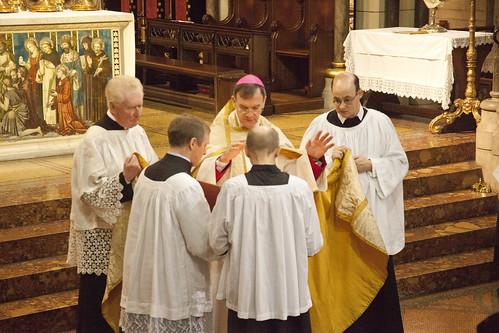
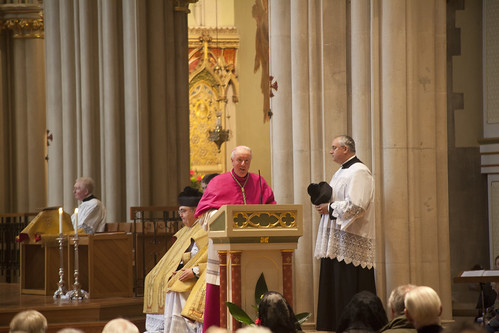
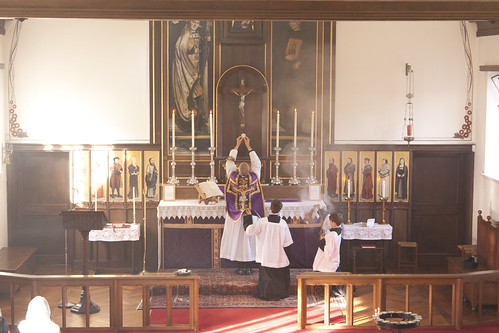
Archbishop Bernard Longley of Birmingham paid a pastoral visit to the parish of Holy Trinity, Hethe, last weekend, and celebrated Pontifical Low Mass on Sunday at noon. It was accompanied with motets sung by the Victoria Consort under Thomas Neal. The Archbishop was assisted by the Parish Priest, Fr Paul Lester, and Deacon Keith Crocker.

IMG_9510

Friday, January 20, 2017

Diocese of Rockford: no Summorum Pontificum here

Bishop Malloy of Rockford in the USA has told his priests that, whatever Summorum Pontificum may say, they need his permission to celebrate the Traditional Mass.

Though this puts traditionally-minded priests at an advantage to those seeking to implement the Reform of the Reform: in the same letter, Bishop Malloy informs them that celebration versus populum is forbidden.

Does the Pope's writ run to Illinois? The mind boggles.

I've blogged about this over on Rorate Caeli, where the letter can be seen in full.

Support the work of the LMS by becoming an 'Anniversary Supporter'.

Wednesday, January 18, 2017

Archbishop Longley is coming to Holy Trinity Hethe on Sunday

The church is close to Junction 10 of the M40, outside Bicester: OX27 8AW. Mass is at 12 noon. Lunch is provided afterwards. Pontifical Low Mass will be accompanied by some polyphonic motets.

It's going to be great: come along!


Support the work of the LMS by becoming an 'Anniversary Supporter'.

Sunday, May 22, 2016

Loftus attacks Archbishop Sample: on chant and children

Further to my recent posts about Montessori and children, I'm reposting this from 2014. I've not been keeping up my review of Mgr Basil Loftus output recently, but whenever I look at his columns I see that they make just as much sense as they ever did.

IMG_9025
Children at St Mary Magdalen, Wandsworth, a Mass with Chant propers and polyphonic Ordinary.
Every now and then Mgr Basil Loftus makes reference to singing in Mass. It appears to be one of his many obsessions. A classic was his suggestion that when the General Instruction recommends a chant or song at Communion, this rules out adherence to the Instruction Redemptionis Sacramentum's requirement that the Communion Plate be used, and the recommendation in that instruction, now a requirement of our own Bishops' Conference, that the Faithful make an 'act of reverence' before receiving Communion, because of the difficulty of multi-tasking...

It is not surprising, therefore, that when he turns his attention to chant and hymns he comes out with the usual muddle and deliberately misleading claims.

He starts by quoting Archbishop Sample of Portland, Oregon:
'It is clear that the Council calls for the liturgy to be sung. In recent decades we've adopted the practice of singing songs at Mass. We take the Mass and attach four songs or hymns to it. But this is not the Church's vision. We need to sing the Mass. It is meant to be sung. The texts of the Mass are meant to be sung.'

IMG_8789
Children at the LMS Pilgrimage to Holywell.
Loftus' comment on this typifies his disregard for making sense, as well as good manners or respect for his superiors:

The archbishop's observation, while very helpful, is also both simplistic and deceptive.

Was it a subeditor who added the phrase 'very helpful'? Or is Loftus able to hold two incompatible judgments in his head at the same time?

Tuesday, January 06, 2015

Fr Longenecker on duplicitous bishops: not big or clever

Update: A commenter below has alerted me to a post on Fr Longenecker's blog very similar to one I am commenting on, from the end of 2010: here.

In this post, he makes it a bit clearer who he is referring to. This hope for a priest shortage to be followed by lay pastoral leadership and the ordination of women was, he says,

shared with me with some enthusiasm in not one, but three of the Southern dioceses in England. Anyone who knows the English Church will be able to identify the three Southern Dioceses to which I am referring and I doubt if anyone will refute this proposed ‘new model’ of priesthood in England.

Well, Fr Longenecker, I know you've been out of the country for a while and may be a little out of the loop, but the following dioceses have changed hands since 2010: from the south, Plymouth, Portsmouth, Arundel and Brighton, Brentwood, Birmingham, Northampton, East Anglia... You really can't talk about any others as 'Southern Dioceses in England' apart from Westminster and Southwark, and those both had new bishops about a year before the 2010 blog post, long after these reported conversations.

I would suggest that justice and charity both require you, Fr Longenecker, to explain to your readers that not a single one of the bishops whose views you claim to know about is still in office. 

IMG_0728
Bishop John Arnold, now of Salford, at the LMS Confirmation service
Fr Dwight Longenecker has picked up the story (earlier reported here) about a religious sister being put in charge, in some sense, of two parishes in Milton Keynes. He expresses some of the concerns I and others have expressed over it, but adds something from his personal experience: an anecdote about a conversation he had many years ago with a senior priest in a particular diocese in England, who had suggested that having fewer vocations would have the advantage of forcing Rome's hand on ordaining women, through the intermediate step of female lay parish administrators.

No doubt that conversation took place as described. We've all heard stories like that. What came as a bit of a surprise is the way Fr Longenecker concluded his post.

I do not criticize my fellow Catholic clergy by name, but I will say here and now that the ten years I spent as a Catholic layman in England–working close up with the Catholic hierarchy makes me not surprised or shocked at all by this behavior.

Clergy can be devious and manipulative and secretive at times, and often they have a good reason to play their cards close to their chest, but a few members of the Catholic hierarchy in England and Wales (those Damien Thompson calls “the magic circle”) are the most secretive, devious, duplicitous and schemingly oily inside operators I have ever come across.

This article is typical of their behavior.


Now, there is a lot to be said about this. I feel confident, in saying it, that since he feels able to describe Successors of the Apostles as secretive, devious, duplicitous and schemingly oily inside operators, Fr Longecker won't mind a little fraternal correction from me.

Saturday, January 03, 2015

Open Letter to the Bishops of England and Wales

IMG_6804
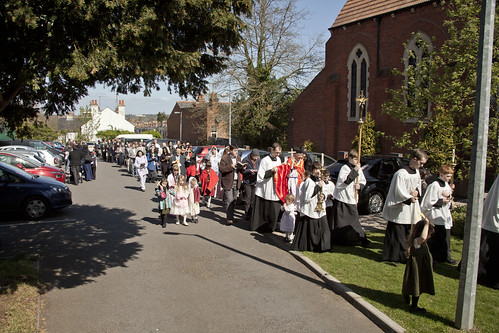
Palm Sunday procession with the FSSP in St William of York, Reading
This was published in the most recent issue of the Latin Mass Society's magazine, Mass of Ages. I've been pleasantly surprised by the coverage it has generated: it has been picked up by the Catholic Herald, The Tablet, and by the very strange people over at Traditio. Well, never mind them. Here's the full text.

------------

Why the Extraordinary Form should be promoted: an open letter to the Bishops of England and Wales

Looking back at the Latin Mass Society’s fifty years, we must acknowledge our gratitude for the almost complete disappearance of the hostility towards the Extraordinary Form (EF) which, though never universal, was once widespread enough to be both a cross for our supporters and a serious impediment to our activities. In this positive development you, our Bishops in England and Wales, have played a crucial role. The question arises: Is there any reason for those with the care of souls to go beyond toleration, and actually to facilitate or promote this form of the Mass?

Wednesday, October 01, 2014

Corrupt bishops: why it is a problem: Part 3

I ended my last post by saying that, when they elected Bishop Conry as chairman of the department of Evangelisation and Catechesis in 2009, the bishops of England and Wales were fooled. What, exactly, were they fooled by, and how can we avoid falling into the same trap?

Conry is not a pantomine villain. Fr Alexander Lucie-Smith, a priest of Bishop Conry's diocese, Arundel and Brighton, reminds us

He was very popular with many people, and his kindness to the sick on the Lourdes pilgrimage and his rapport with the young will be long remembered.

Many traditional priests and Faithful in Arundel and Brighton saw another side of his character; Bishop Conry's open-mindedness did not extend to the Traditional Mass. It must be said that Bishop Conry was a divisive figure, and leaves a divided diocese: feelings about his resignation are, well, polarised. Nevertheless, the fact remains that for many, he was just terribly nice. He didn't stand on ceremony, he was relaxed, he had friendly chats with those on the margins of the Church and they came away from these meetings with a happy feeling, he accommodated himself and his diocese to the adoption of children by homosexual couples, he was capable of warm friendships... Aren't you beginning to see the problem?

Tuesday, September 30, 2014

Corrupt bishops: why it is a problem: Part 2

2011 05 21_9809
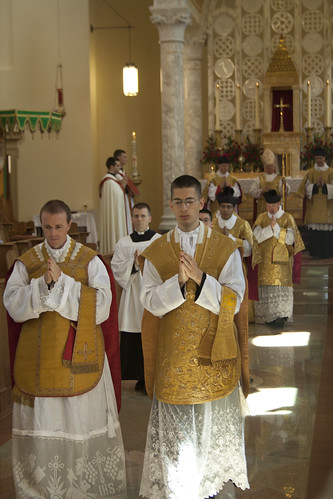
Newly ordained priests of the Fraternity of St Peter
In my last post I argued for the moral seriousness of clerical infidelity. It may seem amazing that this would be necessary, but it is; the urge to instrumentalise these tragic cases to undermine the discipline of clerical celibacy is so strong, that liberals, who would normally be enraged by male authority figures taking advantage of vulnerable women before moving on to another victim, come over all indulgent and say that the Church is cruel to them in asking them to fulfil the vows which these men, presumably voluntarily, undertook.

There is more to say about these cases, and it was summarised very well by Rorate Caeli:

Is the bishop speaking for himself, or is he speaking on behalf of those blackmailing him? Is there truly such thing as a "moderate" bishop, or is he being "moderated" by the enemies of the Church out of fear that his duplicitous behavior will be revealed?

Let me spell it out a bit more. Bishop Conry was famous for his ‘liberal views’. Reading some of his remarks with the benefit of hindsight, it is impossible not to see his various women-folk behind his shoulder. Their influence can take a number of slightly different forms.

Monday, September 22, 2014

Loftus: Vatican II ushered in 50-year 'winter'

IMG_9314

There must be no more post-conciliar winters, such as that which for nearly 50 years followed Vatican II, inhibiting new growth.

This is a pretty amazing assessment of the recent history of the Church, from some one who claims to support the message of the Council.

For most of his column for the Catholic Times, published on 29th August, Mgr Basil Loftus engages in one of his rambling explanations of why his every wish has the backing of the law of the Church, and in particular the Council, while nevertheless everyone else's is against the law of the Church.

The argument can be summarised in this way. When it comes to stopping people receive Communion on the Tongue:

Seriously unbalanced prejudice, whether it proceeds from a Roman Congregation or from an individual fundamentalist bigot [i.e. someone who prefers to receive on the tongue], is not a 'rightful expectation'. A local bishop in those circumstances is the equivalent of the military would call the 'field-commander'. He calls the shots.

When it comes to local bishops' failure to set up diocesan (as well as parochial) 'pastoral councils' of lay people, on the other hand:

The continuance of monarchical rule by certain bishops frustrates the rightful expectations of priests and people to share in the governance of the Church.

Right, so that's clear then, isn't it? When a bishop contravenes the right of the faithful to receive on the tongue, which is established by custom going back more than a millennium and affirmed by the latest Instruction from the Congregation for Divine Worship (Redemptionis sacramentum 92), that is right and proper.

When a bishop fails to adopt something merely suggested by a Council document, in this case Apostolicam actuositatem 10 (even Loftus concedes the bishop 'is not directly breaking a law of the Church. Such [pastoral] councils are merely 'earnestly recommended'.'), then that is wrong: 'a dishonest flanking manoeuvre by those in authority', which should be met with noisy opposition by priests and people. Never mind that after exhaustive experimentation the bishop may have concluded that these councils are unworkable, and in practice undermine the authority and even the identity of bishops and priests as taught by the same Council.

Saturday, August 16, 2014

Loftus attacks Bishop Alan Hopes

IMG_7508
Fr Daniel Lloyd of the Ordinariate celebrating the EF in SS Gregory & Augustine's, Oxford.

The subject of Mgr Basil Loftus article in the Catholic Times of 1st August is frequent Communion.

...it is really quite astounding that there should currently appear to be a campaign, led by some bishops in England and Wales, to play down the very desireability of frequent Holy Communion, to the extent that another Catholic newspaper, The Tablet, by no means alarmist or addicted to 'screaming headlines', recently warned: 'Frequent Communion in Question.'

Let's rewind the tape a bit. In the 12th July issue, the Tablet ran a story reporting some remarks of Bishop Alan Hopes, the new bishop of East Anglia, which included this passage.

“People at Mass have a view – ‘What do I get out of this?’,” he said. “We have shifted to a practice where everybody gets up for Communion and makes it awkward for those who can’t go to Communion.”

The headline was
Hopes says Mass has become consumerised (link for subscribers)

In the next issue, The Tablet published three letters criticising Bishop Hopes, one from the deeply depressing lay(icised) theologian Nicholas Lash, another from Mgr Loftus himself. The latter read:

To suggest that because people have “a sense of entitlement about receiving Holy Communion”, they are unacceptably becoming part of a “consumer society”, directly contradicts the Catechism of the Catholic Church: “it is in keeping with the very meaning of the Eucharist that the faithful, if they have the required disposition, receive Communion each time (italics in original) [sic] they participate in the Mass”, (n.1388). Of course “we expect Communion at every Mass, and Mass has become the most prevalent service”. That is what being a eucharistic community is all about. The Church makes the Eucharist and the Eucharist makes the Church. For the very bishop charged with promoting liturgical observance to suggest otherwise is deeply disturbing.

It was these letters which got the headline
Frequent Communion in question (link for subscribers)

Readers can decide for themselves what view The Tablet took of this exchange, but they did not use that headline as a quasi-editorial comment on Bishop Hopes' remarks, but to indicate the content of Loftus' own frothings about it - and those of his fellow correspondents. They once printed a letter of mine beneath the headline 'Enthusiasm of young for old rite'.

I report this because it illustrates a number of points I have been making about Mgr Loftus over the months.


1. He has no intellectual integrity.

How can you argue with someone who writes, in a newspaper column, things which he knows aren't true? It is not a matter of a divergent interpretation, but of someone who just doesn't care. If you challenged him he would, as always, have something to point to: the headline. But if you actually look it up it quite obviously doesn't support his argument in the way he claims. This is absolutely typical of Loftus. There's no engaging with him, but it is important to point out his superficially plausible falsehoods. Those without a subscription to The Tablet have no way independent way of knowing it was not true.


2. His level of polemic is far below even that of The Tablet.

I've made plenty of criticisms of The Tablet, but Loftus is on a completely different level. Whether it is fear of reprisals or journalistic self-respect, they don't print obvious and trivial falsehoods like this. It reminds me of a remark by the Australian Catholic politician, Arthur Calwell, who was leader of the Australian Labor Party, about Australian Communists.

If these people went to Russia, Stalin wouldn't even use them for manure.

If Loftus turned up at The Tablet, he wouldn't get a job cleaning the loos.

IMG_9168
Fr Armand de Malleray FSSP distributing Holy Communion at the LMS Day of Recollection
at St Edmund's College, Ware.

3. His attacks on the hierarchy are more persistent, more open, more extreme, and more unfair, than anything served up by a mainstream Traditional Catholic.

There is simply no one who can be described as part of the conversation among Catholics in the UK - which is to say, leaving aside those totally off the radar in either direction, whether it be sede vacantists or women-priest ordaining fantasists - who is as remotely hostile to our bishops as Mgr Basil Loftus. In this article he refers to Bishop Alan Hopes without naming him, but he names, and attacks, Cardinal Nichols and Bishop Michael Campbell of Lancaster. In other columns he has attacked Bishop Davies of Shrewsbury (whose remarks 'might even call for anger'), Cardinal Ranjith ('the Sri Lankan cappa magna fetishist and Tridentine-rite devotee'), Cardinal Müller (under whom the CDF is 'not fit for purpose'), Bishop Hugh Gilbert of Aberdeen (without naming him), his former ordinary Archbishop Roche (without naming him), and the Papal Nuncio. He has also made extraordinarily vicious swipes at the Congregation for Divine Worship, the Office of Papal Celebrations and its head, Mgr Marini, the PCED, the Ordinariate, and any bishop who has had anything to do with the Traditional Mass (of whom there are, these days, many). And again, and again, and again, Pope Benedict XVI.

This, remember, is in a newspaper which enjoys ecclesiastical approval, which is sold at the back of Catholic churches, has 'Catholic' in its name, and bears the legend 'Follow Peter' on its masthead.

Talk about about a lack of loyalty to the hierarchy by Traditional Catholics, which used to be something of a parlour game among conservative Catholics, has to be set into this context. For some inscrutable reason (which I've discussed here), the bishops of England and Wales, and Scotland, have chosen to put up with this clown's columns since the early 1990s.


4. Loftus never engages with the substance of the teaching he attacks.

Loftus presents the remarks of the various bishops about the problems presented by the over-casual frequent reception of Holy Communion as simply incomprehensible, motiveless attempts to stop people benefitting spiritually from the Sacrament. Never in the entire column, which takes up more than half a broadsheet page, does he so much as mention the possibility that receiving Communion in a state of grave sin does not confer spiritual benefits on the communicant, or the possibility that people should be encouraged to prepare more carefully, receive more reverently, and give thanks afterwards more gratefully, in order to receive more spiritual benefit from it. It is as if these considerations, which are clearly in the minds of the bishops, did not exist.

In fact, this has been a concern at the highest levels of the Church for decades. Back in 1980, St John Paul II noted:

Sometimes, indeed quite frequently, everybody participating in the eucharistic assembly goes to Communion; and on some such occasions, as experienced pastors confirm, there has not been due care to approach the sacrament of Penance so as to purify one’s conscience.

There more on this in the FIUV Position Paper on the Eucharistic Fast.

The importance of this point is that in no sense can Loftus be regarded as a valid or useful contribution to the debate. A liberal Catholic who articulated the claim that we don't need to worry about popping up to Communion regardless of our spiritual state, as if it were sweeties which were being handed out, because there is no such thing as an objective state of sin, and / or because the Eucharist does not really contain the Body, Blood, Soul and Divinity of Our Lord Jesus Christ, but just some kind of symbolic reminder - such a liberal might help to clarify the issues and advance the discussion. That is the kind of article, however, which the Catholic press would never print. Instead, they print this kind of thing, which by subterfuge and omission undermines the teaching without confronting it clearly. It serves to do nothing but confuse its readers and alienate them from the teaching of their bishops.


5. Loftus is losing the argument.

Like many liberals, Mgr Loftus is always fighting a rear-guard action. He protested in the most intemperate terms about the corrected English translation of the Novus Ordo Missal: in vain. He has railed repeatedly about the Ordinariate of Our Lady of Walsingham and the legal status of the Traditional Mass: in vain. But it is not just in Rome, under Pope Benedict, where things have been going badly for him. Here he is whining about increasingly urgent attempts by our own bishops, by no means some group of ultra-conservative 'usual suspects' but perfectly mainstream members of the Bishops' Conference, to do something about the lack of respect for the Blessed Sacrament. We can look forward to him complaining about recent statements condemning over-the-top behaviour at the Sign of Peace. This, remember, is under Pope Francis, by whom Loftus sets such store.

Why, the reader may ask, am I so concerned about Loftus, if he is always on the losing side of the argument? Taking the long view, it is clear that the liberals are losing the argument about almost everything about the liturgy and pastoral theology. It is possible to look ahead, on current trends, to the restoration of Altar Rails, the systematic encouragement of Communion on the Tongue, more frequent Confession, and perhaps a longer Eucharistic Fast: and similar developments in other areas of the Church's life.

But how many of the nominal Catholics in the pews today are the new generation of Bishops and priests going to take with them? Are we going to end up with a conservative Novus Ordo being celebrated by zealous young priests in empty churches?

If those Catholics interested enough in the Faith to read The Catholic Times are continually fed Loftus-style propaganda, it makes the preparation of the Faithful for liturgical re-sacrilisation much, much harder. Perhaps no one cares about this except me and my faithful blog readers, but it ought to be a serious concern for our bishops. By tolerating Loftus, they are making their jobs that much harder. And their job, remember, is an important one: it is the salvation of souls.

IMG_8744
Fr Anthony Glaysher distributing Holy Communion at the LMS AGM Mass in Westminst Cathedral.
As a service to the public, I have put together quotations on a range of themes from Loftus' published writings, mostly his Catholic Times columns, in a dossier here, and made one of his most theologically egregious articles, on the Resurrection of Our Lord, available here.

Support the work of the LMS by becoming an 'Anniversary Supporter'.

Monday, June 30, 2014

Loftus attacks Bishop Egan, again

IMG_4934
Bishop Egan preaching in his Cathedral at the Traditional Mass.
Somehow Loftus was never going to like him much.
When Mgr Loftus gets a good idea, he likes to return to it again and again, even if it's not actually true.

The ludicrous report, which turned out to be false as well as very unflattering towards Pope Francis, that the newly-elected Pope told his Master of Ceremonies 'The carnival is over' has been repeated by Loftus several times, with more or fewer details. Another one, it would seem of Basil's own manufacture, is a phrase torn from its context from a short piece by Bishop Egan after Pope Benedict announced his abdication.

Loftus writes (13th June 2014):

... a closed-minded approach, a refusal to take risks, a tendency to take refuge in a museum of antiquities, out-of-date laws, undeveloped doctrines, and unreformed liturgies, to want at all costs to guarantee a 'safe ride.' The English bishop who after, the resignation of Benedict XVI, expressed his desire for a new pope who would make him 'feel safe', as Benedict had done, typified that kind of Church.

Loftus cited this remark in a column almost exactly a year ago. What Bishop Egan actually wrote (in The Tablet), was:

I felt safe under Pope Benedict. He made us all feel in human terms that the Church was in good hands, reminding us that Christ founded his Church on a rock.

Attributing to Bishop Egan the attitude he describes, on the basis of this quotation, is simply a lie. Bishop Egan wasn't even talking about the qualities of the new Pope, and he went on to say that the new Pope also needed evangelical dynamism.

In any case, as I pointed out a year ago, Pope Benedict was quite evidently not risk-averse. For all the talk we have heard since the conclave about taking risks, Pope Francis has not had the time for a single public act to rival Pope Benedict's bold moves, which will continue to influence the Church for decades, and probably centuries, such as the Regensburg speech, the Motu Proprio Summorum Pontificum, Anglicanorum Coetibus, or the lifting of the excommunications of the SSPX bishops. At the time of every one of these acts the talk was about Pope Benedict being insufficiently cautious, about how he was taking too much of a risk, and how he should have done more checking and taken more critics' views into account. Basil has forgotten this, I suppose.

What is most remarkable about his description of the sea-side donkey attitude (as he puts it), is that it seems to describe himself.

Taking refuge in a 'museum of antiquities': yes, Loftus takes refuge in his memories of the 1960s, and the aesthetic of the same era.

These belong in a museum of antiquities.
'Out of date laws': yes, Loftus loves to cite obscure and redundant bits of legislation, usually to make a point they don't make. A favourite: the principle in the General Instruction of the Roman Missal (307) that the candles should not 'interfere with the faithful's clear view of the what takes place at the altar or what is placed upon it', used to attack Pope Benedict's arrangement of candles as 'dumb insolence.' (9 Oct 2011). Dumb insolence, for a Pope to dare to interpret the legislation in an open-minded way?

'Undeveloped doctrines': yes, Loftus refuses to accept the possibility that the Church developed her teaching about the transmission of Original Sin or the eternal fate of the unbaptised, and wishes to ignore everything written on the subject after the Bible until the 1960s, such as St Thomas Aquinas and the Councils of Trent and Florence.

'Unreformed liturgies': yes, Loftus fought tooth and nail against the reform of the English translation of the Ordinary Form missal. Clearly the old one had him in a nostalgic grip.

There's something else in this week's column worth quoting.

The mythical story of the apple in the Garden of Eden has somehow soaked into the Christian sub-consciousness. Imagine how unhealthy a child would be if he or she never 'scrumped' apples from other people's trees. ...if they live their lives starved by their parents of all curiosity, mischief and exploratory urges, then its intensive care they are headed for, and sooner rather than later.

It is a strange passage. Once upon a time Biblical critics who described Genesis chapter 2 as 'myth' claimed that they were trying to be helpful, to describe the literary genre so we could understand it better, and therefore draw from it its theological importance more accurately. The cat's out of the bag now: Basil just wants us to ignore it, because it's just 'myth', whatever that means, and is irritated to find that the story sticks in people's minds, as only the most truly profound and simple literature can. To draw a lesson about the wrongness of theft from it would, perhaps, be to risk ignoring the most importance aspects of it: but is Basil actually saying that theft is good? I know he thinks there's nothing wrong with fornication, homosexual sex, contraception, divorce, and breaking vows of celibacy (see his columns of 14th Oct 2012 and 21st April 2013), but theft?

Truly, Mgr Loftus' toleration is wide indeed. At least where sin is concerned.

IMG_6222
No need for that ash - unless you are repenting of making an accurate translation of the Missal.

Sunday, May 04, 2014

Protect the Pope: double standards, Part 3

IMG_7302
High Mass in the Extraordinary Form, at the LMS Priest Training Conference,
Belmont Abbey.

I explained in my last post the sorts of things even quite conservative bishops, religious superiors, and curial officials might say to explain why grass-roots conservative activism worries them, even as they cheerfully tolerate the likes of Basil Loftus and Tina Beattie. It rocks the boat. It makes - as the Holy Father might say - a mess. It complicates their careful plans. And, looking at the situation strategically, they may think that it is more important to seek after the lost sheep of liberal dissent, than the 99 sheep in the fold of orthodoxy. Especially as the dissidents seem to represent the wider culture - by being nice to them, they are opening the door to everyone outside the Church.

I should say right away that I completely understand the fear of conservative bishops that groups of conservative activists will make prudential mistakes, strategic blunders, and even theological errors. The Holy Ghost does not prevent good people seeking good things from being counter-productive. But the position of these conservative hierarchs is itself based on a number of prudential misjudgments. Let me list some.

1. If we are nice to the dissidents, we have some hope of saving them for the Church. By which they mean: allow the dissidents to keep their positions of prestige and influence, and make them feel valued. This is a mistake because this treatment simply reinforces the idea that dissident views are the new orthodoxy, both for the dissidents themselves, and for those who see them treated in this way.

2. If we sideline conservatives, they will at any rate stay in the Church and continue to support us. Wrong: Catholics who might be described as naturally conservative have joined the SSPX, become sede vacantists, or joined Evangelical Protestant churches; they have lapsed, they've taken to drink, and clerics have abandoned their vocations; in a talk of Michael Davies he mentions one he knew driven to suicide. They are deserving of pastoral concern just as much as other folk.

3. We can solve the problems behind the scenes more easily if conservative activists aren't making a fuss in public. This may sometimes be true, but it is hard to see how it could be in very many instances. If there is no fuss, then it is assumed there is no scandal. If there is no scandal, then it is assumed there is no problem. We can all think of examples of serious problems, well known to apparently conservative bishops, which were never publicised and - what do you know? - never addressed, sometimes for decades. The sex abuse scandals, of course, exemplify this.

4. These activists are out of control and poorly led. Sometimes: but if the conservatives in authority went to even a little trouble, they could gain the trust of the most important activists and exercise some guidance over them. This does indeed happen sometimes, but only when the bishops or officials throw off the attitude that error should not be publicly opposed, because without that they are not going to gain the trust of anyone.

5. Unity is more important than the purity of our orthodoxy. What those who say this actually mean is that any Catholics who still have the Faith should stop opposing attempts to teach a pack of lies to Catholic school children, trainee teachers, seminarians, and the Faithful. That may make for a quiet life, but it doesn't make for the unity for which Our Lord prayed.

6. By avoiding conflict, we keep doors open for dialogue. In practice, it is easier to have dialogue when people aren't pretending that they and others don't have the differences of opinion that they have. Basil Loftus sends out smoke signals that he's in favour of women priests: how can you have a meaningful discussion on that basis? If I pretended not to notice the smoke signals, the question of dialogue wouldn't even arise.

7. Evangalisation is about not scaring liberal non-Catholics away by talking about hard doctrines. I've addressed this before. To reiterate, evangelisation is, on the contrary, about offering something distinctive which non-Catholics don't already have.

The underlying misjudgment, in my view, is a failure to understand how much damage dissent does. The Faith is passed on, the life of grace is developed, nearly always in the context of institutions: the home, the school, the parish. This is logical because Catholic institutions manifest the community of the Church, the Mystical Body of Christ, in a tangible way, to us as individuals. These institutions can be turned into a nightmare of conflict, or just rendered completely useless, by a minority of dissidents, if they are given a free hand. I have in mind things like a few teachers who mock the Faith in the classroom, or parish busybodies who show no respect for the Blessed Sacrament. If they are left to get on with it, no one in the institution can take seriously the Catholic claims of those nominally in charge. It can no longer inculcate a Catholic culture, a Catholic perspective on the world, because it no longer manifests one. In a very short time, it is no longer a Catholic institution, though it may remain one where some Catholics work, or where some sacraments take place, which can have an effect on individuals as individuals. To repeat, this is not the unity for which Our Lord prayed.

In the destruction of these local, tangible institutions, as manifestations of the Mystical Body and as channels of grace, we see the destruction of the Catholic community. Those who have authority over these institutions have the obligation to exercise it for the common good - not just for the good, as they see it, of a few dissident intellectuals. Generally speaking, over the last half a century, they have not exercised this authority. When conservative activists talk about this, the get the sort of welcome which was extended to Elijah and Jeremiah.

This may start changing, but it is going to be very slow. Personally I admire these conservative activists, and I have made my own contribution to this work, such as in my posts on Mgr Loftus. I also acknowledge their limitations and mistakes - and my own, in this department. What I would say to them, and to their supporters, is that as well as criticising dissent, we need to start building things up from the grass roots in a positive way. I personally think that this has got to include a recovery of the ancient liturgy.

This is why tomorrow I will post about the Latin Mass Society's Priest Training Conference in Belmont Abbey, and from now until September my life is going to be dominated by a succession of devotional and educational events involving the traditional Mass. My readers may be less interested in these than they are about the latest episode of ecclesiastical politics, but, sub specie aeternitatis, from the perspective of eternity, these events may have more effect on the future of the Church. And they will, at any rate, keep me sane.

IMG_7313