Showing posts with label Clericalism. Show all posts

Sunday, November 25, 2018

Clericalism and abuse

My latest on LifeSite News.

A key passage:

The erasing of the distinction between clergy and laity does not remove the danger of the abuse of power. Priests who see themselves, or are seen by the laity, primarily as managers, and perhaps as more-or-less interchangeable with their lay assistants, rather than as men consecrated to a special sacramental role, can very easily abuse the power which their managerial status gives them. 
Even more dangerous is the substitution of personal charisma for formal clerical prerogatives, as the basis of a priest’s role in the community. It is clear enough where the role of the ordained priesthood begins and ends, what he has authority over and what he does not, what obligations he has and to whom he is responsible. A charismatic leader is not bound by any of this, and the devotion of his followers very easily opens up opportunities for abuse of all kinds. 
Read it all there.

Support the Latin Mass Society

Friday, October 05, 2018

The lay vocation and subordination to the clergy

LifeSiteNews has a piece by me on the lay vocation. It begins:

Recent and very public failures of bishops raise the question of what role the laity should have in the Catholic Church. Lay people can feel like dumb spectators watching a tragedy in which bishops and other clergy have all the leading roles. This is clearly not a healthy situation, but what, in fact, is the lay vocation? In what way are lay people called, as members of Christ’s mystical body, to advance the kingdom of God? Certainly, the laity are crew, not just passengers, in the barque of St. Peter, and not even subordinate crew. As the 1983 Code of Canon Law tells us (Canon 208):

From their rebirth in Christ, there exists among all the Christian faithful a true equality regarding dignity and action by which they all cooperate in the building up of the Body of Christ according to each one’s own condition and function.

What, then, is the function related to the lay condition? The Second Vatican Council’s Decree on the Apostolate of the Laity, Apostolicam actuositatem (4) tells us:

The laity must take up the restoration of the temporal order (ordo temporalis) as their own special task. Led by the light of the Gospel and the mind of the Church and motivated by Christian charity, they must act directly and in a definite way in the temporal sphere.

As the Decree goes on to detail, this can be done in the context of family, professional, and political life.

What this suggests, along with the traditional teaching of the Church on the “two swords,” the division of labor in the Christian society between Pope and Emperor, is that bishops and clergy as such should not seek to direct in detail the work of Catholic statesmen, academics and teachers, and parents. It is given to the clergy, and above all to bishops, to judge according to the moral law, but judgment on matters of prudence — scientific judgment, educational judgment, political judgement, and so on — is the special gift and duty of the lay state.

Read the whole thing here.

Support the work of the LMS by becoming an 'Anniversary Supporter'.

Friday, September 21, 2018

Clericalism and Clericalisation

Re-posted from May 2016

-----------------------------------------------------

IMG_8627
Not a specifically clerical role.
Some time ago I criticised the views of Russell Shaw (no relation) on the subject of clericalism and caesaropapism. He appeared to think, in his book To Hunt, To Shoot, To Entertain, that cases of caesaropapism, such as the Emperor Constantine regarding himself as holding ultimate authority over doctrinal matters, are actully cases of its opposite, clericalism: clericalism being the arrogation of lay authority by the clergy.

I have been thinking since then about the notion of 'clericalisation of the laity'. This term was popularised by Pope St John Paul II; it is used in Christifideles laici (1988: 23), but the most explicit discussion I have found is, for some reason, an address to the Bishops of the Antilles in 2002. As he explained, it


becomes a form of clericalism when the sacramental or liturgical roles that belong to the priest are assumed by the lay faithful, or when the latter set out to accomplish tasks of pastoral governing that properly belong to the priest.

Again:

The commitment of lay persons is politicised when the laity is absorbed by the exercise of ‘power’ within the Church.

Friday, August 17, 2018

There must be episcopal resignations

On CNA, JD Flynn writes:

A third thing that could derail serious ecclesial reform has to do with the call for episcopal resignations. Wuerl, in particular, has been the subject of ongoing calls for resignation, along with other bishops. While the Holy See might judge those moves to be justified, they could have the unintended effect of stalling more systematic and cultural change, if they are not managed carefully. If individual bishops resign, and are then cast as the cause of the problems, the pressure for broader reforms could deflate. The Vatican must ensure that if it accepts the resignation of some bishops, the remaining members of the episcopate remain under pressure to enact the reform efforts the USCCB has said it would like to facilitate.

Some strange things have been written on this crisis, but - in an otherwise helpful article - this deserves some kind of prize. I think it is useful, when addressing problems in the Church, to ask what we would be saying about a parallel problem in another institution, or a different problem in the same institution, and, if what we are saying about the the issue at hand is totally different, what justifies that difference. Flynn's bizarre reasoning illustrates such a contrast.

Thursday, August 16, 2018

'Look not upon me': thoughts on the abuse crisis

IMG_2057
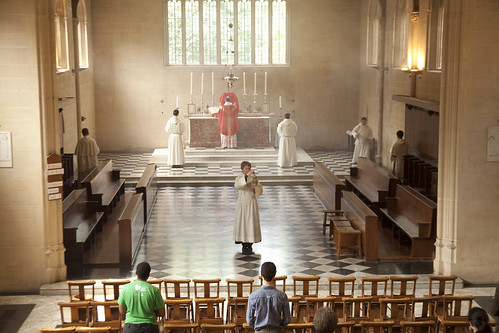
Mass of reparation in Oxford: Votive Mass pro remissione peccatorum
'Look not upon me', says the Beloved, the Church. 'For the sun hath looked upon me.' Labouring in the vineyard has darkened her skin; she is conscious that her beauty is hidden. She says: 'I am black but beautiful'. (Song of Songs, 1:5, 4)

Christ also, the spotless Lamb, was disfigured, by his enemies. Isaiah says of Him in prophecy: 'there is no beauty in him, nor comeliness: and we have seen him, and there was no sightliness, that we should be desirous of him' (Is 53:2). But again, Christ's beauty is hidden, rather than lost.

What has happened to the Church in the last 50 years and more is a disfigurement, a disgrace. Like the Beloved of the Song of Songs, the Church has been cast out of doors without her veil:

'The watchmen that went about the city found me, they smote me, they wounded me; the keepers of the walls took away my veil from me.' (Song 5:7)

The defilement of the Church is real in one sense, and only apparent in another. As a human institution she can be wounded and shamed. As a divine institution she cannot. She is both human and divine, a mirror of Christ, who in His humanity truly suffered and died. This suffering was not unreal or superficial: the betrayal, the stripping naked, the being spat upon, the being tortured and killed. It is profoundly real and of the greatest significance. And yet Christ in his Divine nature, and the Church as the Mystical Body and Bride of Christ, is not defiled: such a thing is impossible. She remains beautiful, though blackened.

Friday, March 10, 2017

The empty Imperial throne

Over on Rorate Caeli I've posted an article by James Bogle, former FIUV President, LMS Committee member and author of a book on Bl Charles of Austria, on the role formerly played by the Holy Roman Emperors (and indeed by the Christian emperors of Rome) in Church affairs, and the consequences of the disappearance of the Emperor from Europe's life.

It is easy to point to periods of conflict between Pope and Emperor. Conflict is inevitable over time and itsn't always unhealthy. What is worse than the conflict between the two pillars of Christian society, the spiritual and the temporal, is the disappearance for practical purposes of one side of the conflict: the disappearance of lay leadership in the Church. This is a point discussed in the FIUV Position Paper on the Extraordinary Form and the Laity.

It is not that the Pope since 1918 has made himself the Emperor; it is that the Catholic Emperor's power has been taken by people outside the Church.

I was very struck recently reading Valentin Tomberg's discussion of the symbolic meaning of the figure of the Emperor. He wrote, in part:

Europe is haunted by the shadow of the Emperor. One senses his absence just as vividly as in former times one sensed his presence. Because the emptiness of the wound speaks, that which we miss knows how to make us sense it.

Support the work of the LMS by becoming an 'Anniversary Supporter'.

Tuesday, June 28, 2016

The Traditional Mass and the Laity

IMG_1536
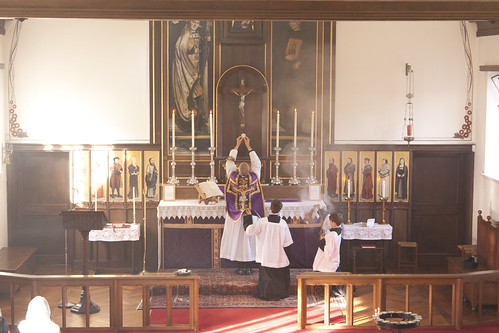
The congregation is blessed with incense as the celebrant carries on the prayers and
ceremonies at the Altar. Dominican Rite Mass in Oxford.
Over on Rorate Caeli I am publishing today a Position Paper on the Laity in the Traditional Mass. It is a response to the argument that the Traditional Mass exemplifies 'clericalism', because it doesn't have swarms of lay peope in the sanctuary, reading the lessons, cleansing the sacred vessels, leading prayers and hymns and distributing communion. Read it here.

The key point of the paper is that, while at least some 'special' lay roles in the liturgy are perfectly defensible - serving and singing being the obvious examples - even these don't exist for the sake of the liturgical participation of the people doing them. This is a crucial point. Without it the rest of the congregation may well feel excluded wrongly from graces available only to the parish elite.

Saturday, May 14, 2016

Female deacons: why not?

IMG_1338
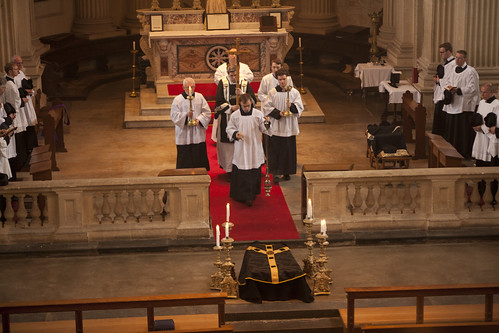
A male-dominated sanctuary at the LMS Priest Training Conference at Prior Park.
It is often pointed out that there are women described as 'deacons' in the early Church. Indeed, they continued to exist in the East into the 9th century. It's all there in the Catholic Encyclopedia.

This shouldn't be alarming, however, once a few pertient facts are remembered. These ladies were not ordained into the order of deacon: it was a non-sacramental ministry with distinct functions from that of ordained deacons. They would, for example, assist women who were being baptised when this meant full immersion. They ceased to exist because their special functions, like the one just mentioned, ceased to be necessary, after a period in which it it had been just an honorary role. There is no reason to imagine they existed in the primitive Church in a formalised way: there is no reference to them in Acts or St Paul's letters, though naturally women worked for the Church in all sorts of ways, by contrast with the order of (male) deacons, who were clearly quite significant.

This role could in principle be revived, as Pope Paul VI revived (or tried to revive) various other roles, like Lector and Acolyte, which had become simply steps on the way to ordination to the priesthood, and the permanent diaconate. It wouldn't be so easy to revive the things which they used to do, but maybe they could do something else. After all, women do all kinds of things in the Church.

Thursday, October 01, 2015

Was Constantine the Great a Clericalist?

It is an obvious point, but if you have a world view which requires you to assert things which are clearly absurd, then you have a problem with your world view. I've been reading Russell Shaw's 1993 book about clericalism, To Hunt, To Shoot, To Entertain, and this point has been borne in on me with great force.

Russell Shaw (RS) is an American neo-conservative Catholic. The importance of the 'neo' is considerable. A quick characterisation of neo-cons might be that they defend the teaching of the Church without being concerned about the ancient liturgy; perhaps that is how they see themselves. But as this small volume demonstrates, they have adopted so many of the premises of the liberals that their positions would be totally unrecognisable to orthodox Catholics of any time up to about 1970. In the case of RS' characterisation of clericalism (I'm interested in his book because I agree with him that it is a historical and contemporary problem), his analysis is distorted by two fundamental liberal claims: first, that the Church must be 'separated' from the state in an American sense; and second, that the liturgy glimpsed in the earliest surviving sources, and extrapolated from archaeological traces of the earliest surviving churches, wrongfully excluded the Faithful from meaningful participation, and went on doing so until the Novus Ordo Missae was promulgated in 1969.