I'm reposting this from March 2014, inspired by seeing one of the arguments I address below used on social media somewhere. (By someone who apparently hadn't heard of Savoranola, Dante, or Robert Grosseteste.) 2014 seems like a lifetime ago, but although I have criticised Pope Francis since then I stand by the principles I set out back then, which explain the on-going policy of this blog about how to handle difficult issues surrounding Pope Francis.
------------------------------------------------
Michael Voris thinks not. His arguments are interesting but don't work.
First, he says that to criticise the Pope causes scandal, sharply contrasting this with criticism of bishops and Cardinals. (First silly point: there is no sharp contrast. What is true of one is to a large extent true of the other.) That there is a danger of causing scandal is true, but it is also true that, in certain circumstances, not criticising the Pope causes scandal. It is lucky for us today that St Catherine of Siena and Savoranola and Dante and Robert Grossteste criticised the popes of their day, because they prove that not all Catholics are guilty of Papolatry: that it is not necessary to have your conscience surgically removed to become a member of the Mystical Body. They are our defence against some of the most insistent and damaging polemics, developed by Protestants and re-used by Secularists, against the Church. To use a phrase of Pope Francis, when I encounter a clericalist, it makes me feel anti-clerical.
Voris then turns to the counter-argument that saints have criticised Popes. In an astonishing inversion of logic, he says that they could legitimately criticise Popes because they were saints.
First, this misses the point, which was not that only saints are widely regarded as being justified in their criticisms of Popes (see my short list above: plenty of others have been too), but that this widespread judgement can't be too off the mark because even saints criticised popes.
Secondly, it would be strange to suggest that St Catherine and St Paul and the other saints had to ask themselves if they were holy enough to carry out their obligations. That way only egomaniacs will criticise the Pope, and that won't be progress.
The wider point is well made by no less that the Supreme Legislator himself, in Canon Law: even the laity can have the right and indeed the duty to voice their concerns about their pastors. The Pope is not excepted.
Canon 212 sec. 3, the laity has "the right and even at times the duty to manifest to the sacred pastors their opinion on matters which pertain to the good of the Church and to make their opinion known to the rest of the Christian faithful, without prejudice to the integrity of faith and morals, with reverence toward their pastors, and attentive to common advantage and the dignity of persons."
I don't say this because I am about to embark on a lot of blogging criticising the Holy Father. I just think it is important to oppose grossly distorted understandings of Catholic teaching wherever I see them, to the best of my ability, because, to coin a phrase, they cause scandal.
As far as criticising Popes is concerned, I would in practice urge great caution.
First, any criticism which comes across as personal, or as mocking or insulting, is inappropriate to a person holding his high office. That is because the office is holy, even if not all holders of the office are holy. The office is august, it commands our respect. The holder does not become impeccable - incapable of sin - but it does mean that any criticism is a serious matter, and should be undertaken, if at all, in a serious way. This of course is part of what the canon says.
I do, incidentally, think that mockery, ridicule and even invective can sometimes be appropriate: I'd be in trouble if I didn't, since Our Lord used them, and so did many prophets, Fathers of the Church, saints, and apologists down the ages. They are useful to take people worthy of ridicule down a peg or two. The Pope, however, is never ridiculous. When he is wrong, things are too serious for that.
Secondly, as with others in very exalted offices, but very much more so, it is difficult to separate what is personal to the Pope from what is the initiative of advisors and office-holders. He does have the fearful ultimate responsibility - true - but as initiatives and policies develop from day to day it is impossible, at least for those of us without inside information, to know what is the Pope's idea, what is his speechwriter, what comes from (good, bad, or indifferent) briefings given to the Pope, and what are the actions of his Cardinals and other ministers.
For example, I was astonished to read that Pope Paul VI approved the new Lectionary without giving it prolonged attention, and actually said so. He trusted his advisers. If this was an error, it was not the same error as the error (say) of deliberately excluding 1 Corinthians 11:29 (about the sin of receiving Communion unworthily) from the Lectionary, when it had previously been read on Maundy Thursday and Corpus Christi. Being too trusting is not the same fault as not taking seriously the importance of being well prepared for Holy Communion. If people had laid into Pope Paul for the second thing in 1970, they would have been barking up the wrong tree.
Far better, therefore, to voice concerns, if there are legitimate concerns, about policies, about new regulations or liturgical texts or other documents, but without turning it into a personal attack on the Holy Father.
We are sometimes told that being 'over critical' of the Pope or bishops is the besetting sin of traditionalists. As a matter of fact, this is not true. Not only do liberal Catholic publications like The Tablet attack the pope all the time (yes, including Pope Francis), but many Catholic organisations down the years who had no particular connection with the Traditional Mass have, for one reason or another, ended up associated with criticisms of the hierarchy.
The classic example is Aid to the Church in Need, which used to criticise the appeasement of Communism which was the official Vatican policy under Pope Paul VI. More recently, the headline cases have been Pro Ecclesia and SPUC. Now we have Deacon Nick Donnelly being hauled over the coals, for what we can assume is the same thing. I don't say these criticisms were not justified, or that they were not expressed in the best ways: that would be a long discussion. I've just said that criticism isn't ruled out in principle, so the matter is an open one. My point is simply that the Traditional Mass was nothing to do with it.
Critics of traditionalists have become confused by the fact that until Summorum Pontifcum it was such open season on trads and any old stick was good enough to beat them. But once you take away the assumption that support for the Traditional Mass is itself an act of personal disloyalty to the Pope, then you can allow yourself to notice that established traditionalist organisations like the Latin Mass Society and the Una Voce Federation are, and always have been, models of diplomacy and restraint.
They combine this respect for the hierarchy with a complete adherence to the unchanging teaching of the Church, not out of any superficial ultramontanism (whatever the Pope said about his breakfast is the latest infallible doctrine), but because of their attachment to Tradition. This is something I want to develop in future posts.
Labels
- Bishops
- Chant
- Children
- Clerical abuse
- Conservative critics of the EF
- Correctio Filialis
- FIUV Position Papers
- Fashion
- Freemasonry
- Historical and Liturgical Issues
- Islam
- Liberal critics of the EF
- Marriage & Divorce
- Masculinity
- New Age
- Patriarchy
- Pilgrimages
- Pope Francis
- Pro-Life
- Reform of the Reform
- Young people
Showing posts with label Orthodoxy and the Traditional Mass. Show all posts
Friday, December 29, 2017
Thursday, February 23, 2017
A smaller, weaker, impurer Church
Reposted from December 2015, since that Ratzinger passage is once more doing the rounds on Facebook.
From time to time people like to quote something Joseph Ratzinger wrote in 1969. Here's the key passage (source):
The church will become small and will have to start afresh more or less from the beginning.
------------------------------------------------------------------------------------------------------------![]() |
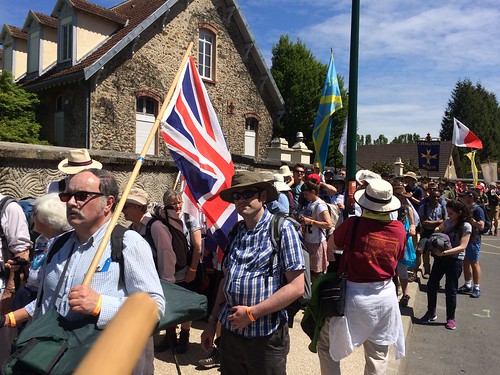
| An international pilgrimage: the traditional pilgrimage from Paris to Chartres. |
The church will become small and will have to start afresh more or less from the beginning.
She will no longer be able to inhabit many of the edifices she built in prosperity. As the number of her adherents diminishes . . . she will lose many of her social privileges. . . As a small society, [the Church] will make much bigger demands on the initiative of her individual members….
It will be hard-going for the Church, for the process of crystallization and clarification will cost her much valuable energy. It will make her poor and cause her to become the Church of the meek . . . The process will be long and wearisome as was the road from the false progressivism on the eve of the French Revolution — when a bishop might be thought smart if he made fun of dogmas and even insinuated that the existence of God was by no means certain . . . But when the trial of this sifting is past, a great power will flow from a more spiritualized and simplified Church. Men in a totally planned world will find themselves unspeakably lonely. If they have completely lost sight of God, they will feel the whole horror of their poverty. Then they will discover the little flock of believers as something wholly new. They will discover it as a hope that is meant for them, an answer for which they have always been searching in secret.
And so it seems certain to me that the Church is facing very hard times. The real crisis has scarcely begun. We will have to count on terrific upheavals. But I am equally certain about what will remain at the end: not the Church of the political cult, which is dead already, but the Church of faith. She may well no longer be the dominant social power to the extent that she was until recently; but she will enjoy a fresh blossoming and be seen as man’s home, where he will find life and hope beyond death.
I always like to oppose signs of false optimism, so I'll say something about this.
And so it seems certain to me that the Church is facing very hard times. The real crisis has scarcely begun. We will have to count on terrific upheavals. But I am equally certain about what will remain at the end: not the Church of the political cult, which is dead already, but the Church of faith. She may well no longer be the dominant social power to the extent that she was until recently; but she will enjoy a fresh blossoming and be seen as man’s home, where he will find life and hope beyond death.
I always like to oppose signs of false optimism, so I'll say something about this.
Saturday, September 24, 2016
Fr Longenecker, the Latin Mass, and the magic bullet
Reposted from October 2015.
--------------------------------------------
Further to my post the other day someone noted a recent post on this topic by Fr Dwight Longenecker: 'Is the Latin Mass a Magic Bullet?'. In it he attempts to put the thoughts of those 'conservative' Catholics who don't much like the Traditional Mass, about the relationship between the crisis in the Church and the liturgy, into order. The result is fascinating. Some key quotes, with a few comments of mine in black.
The problems in the Catholic church are not due to lack of reverence at Mass. The lack of reverence at Mass is due to the problems in the church. But it can't help, can it?
Simply obeying the rubrics or performing the Mass in this direction or that direction or standing here or there or wearing this particular vestment or that particular vestment or holding your fingers together there and bowing properly there do not necessarily make a Mass reverent. It makes the Mass more formal. .... So what's the point of them?
Here is my main point: I think those who blame all the problems of the church on the Novus Ordo are simply missing the point. If there are things wrong with the Novus Ordo they are symptoms, not causes. The core problem in the church is not the Novus Ordo or the liturgical abuses or the bad hymns and liturgical dance and all that awful stuff. So why exactly are these things 'awful'?
The reason the Latin Mass seems to be ‘more reverent’ is not because the language is in Latin or because the priest obeys all the rubrics or because he faces East. (remember I am not against all those things!) The reason the Latin Mass seems more reverent is because the people who attend the Latin Mass are far more likely to be well catechized Catholics ... So why do they go to this Mass and not another?
![]() |
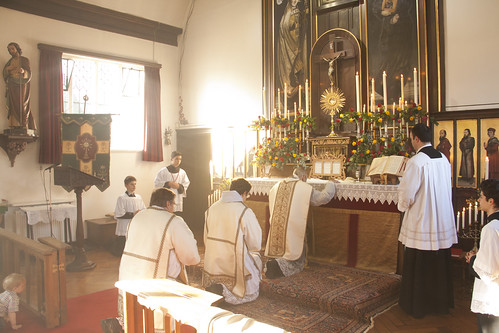
| An act of revence during Mass before the Blessed Sacrament Exposed, for Corpus Christi: it tells us something, does it not? (What does the little chap on the left think?) |
The problems in the Catholic church are not due to lack of reverence at Mass. The lack of reverence at Mass is due to the problems in the church. But it can't help, can it?
Simply obeying the rubrics or performing the Mass in this direction or that direction or standing here or there or wearing this particular vestment or that particular vestment or holding your fingers together there and bowing properly there do not necessarily make a Mass reverent. It makes the Mass more formal. .... So what's the point of them?
Here is my main point: I think those who blame all the problems of the church on the Novus Ordo are simply missing the point. If there are things wrong with the Novus Ordo they are symptoms, not causes. The core problem in the church is not the Novus Ordo or the liturgical abuses or the bad hymns and liturgical dance and all that awful stuff. So why exactly are these things 'awful'?
The reason the Latin Mass seems to be ‘more reverent’ is not because the language is in Latin or because the priest obeys all the rubrics or because he faces East. (remember I am not against all those things!) The reason the Latin Mass seems more reverent is because the people who attend the Latin Mass are far more likely to be well catechized Catholics ... So why do they go to this Mass and not another?
Tuesday, December 22, 2015
Fr Ratzinger, von Balthasar, and demolishing the bastions
![]() |
| Veneration of the relic of St Edmund: from St Edmund's College, Ware. |
Considering the reactions (mostly on Twitter) to my post about Fr Ratzinger's 1969 remarks about how once all the 'edifices' and 'privileges' of the Church had been completely wrecked, 'a great power will flow' from the Church, it strikes me how difficult many people find recognising liberalism when they see it. Even after all this time, many people with conservative, even traditional, instincts, don't really grasp what liberals are all about.
It should be obvious that the 1969 passage is an expression of liberal views; it is a perfectly clear, indeed a classical exposition of them. In his (much criticised) early book, Principles of Catholic Theology, Fr Ratzinger wrote:
The fact is, as Hans Urs von Balthasar pointed out as early as 1952, that … she [the Church] must relinquish many of the things that have hitherto spelled security for her and that she has taken for granted. She must demolish longstanding bastions and trust solely the shield of faith.
This is, clearly, the same thought as that expressed in the passage I quoted in the earlier post. Far from him regretting the loss of the Church's institutional baggage, as one might call it, Fr Ratzinger thought it was necessary and good.
This is simply the application to the Church of what political liberals have been saying since Rousseau, and are saying today more loudly than ever. Destroy the institutions, destroy the structures, customs, traditions and expectations of traditional society, of morality, of the family, and of the state, and a great awakening, a great liberation, a great flowering of humanity will take place. Haven't we all heard this? And isn't its absurdity sufficiently evident?
Tuesday, October 13, 2015
Does Tradition preserve us, or we the Tradition?
![]() |
| St Anthony of the Desert having a lovely quiet time. |
The Prioress rebukes her: Notre règle n'est pas un refuge. Ce n'est pas la règle qui nous garde, ma fille, c'est nous qui gardons la règle.
The Rule is not a refuge. It is not the rule which guards us, my daughter, but we who guard the Rule.
There is a little wordplay here: 'garde' means 'guard' and simply 'keep': we keep the Rule, in the ordinary sense of following it. But of course in keeping the Rule of religious life they by the same act maintain it, preserve it, guard it.
Thursday, October 08, 2015
Can the Traditional Mass preserve orthodoxy?
![]() |
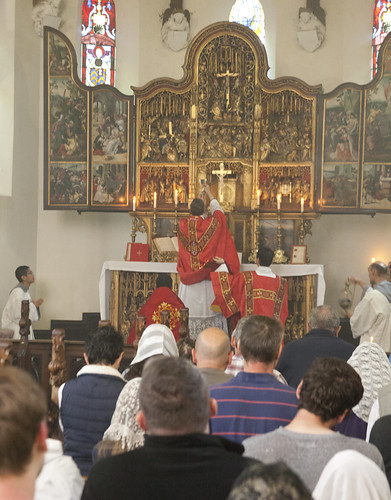
| High Mass in Oxburgh Hall Chapel, for the LMS Pilgrimage to Walsingham for the Conversion of England. |
Michael Dougherty has written (in The Week, largely reproduced on 1 Peter 5) that the current crisis in the Church arises out of a failure to centre the Faith on Christ. The Traditional Mass is Christ-centric, and in the writings of Cardinal Ratzinger we find powerful arguments that the Ordinary Form is much less so. Ratzinger explains the Christocentric meaning and influence of a series of features of the Traditional Mass which have been lost, or usually lost: the silent canon, the priestly prayers, and celebration ad orientem.
The solution to the dogmatic crisis, then, is connected with the solution to the liturgical crisis. Indeed, everyone by now knows the passage from Cardinal Ratzinger:
“I am convinced that the ecclesial crisis in which we find ourselves today depends in great part upon the collapse of the liturgy, which at times is actually being conceived of etsi Deus non daretur:as though in the liturgy it did not matter any more whether God exists and whether He speaks to us and listens to us."
In short, the Traditional Mass can help to restore the Church's lost balance.
The response to this in the com box is largely the same as the response to this idea made recently by Michael Voris in an interview with the Latin Mass Society which you can read here (see p8):
Friday, March 28, 2014
Orthodoxy and the Traditional Mass, 3: making the heart burn
Mass for the Epiphany as SS Gregory & Augustine's, Oxford
I have talked so far in this series about how those attached to the Traditional Mass tend to be orthodox in doctrine, and those opposed to the teaching of the Church often have a particular hatred of the Traditional Mass. This is not a coincidence, because an important part of the liberal strategy in the 1960s was to destroy the sense that what the Church had done and taught for centuries had value. Only in this way could the attack on the Church's teaching on issues like contraception - which on the face of it have nothing to do with the liturgy - be successful.
In this final post in the series I want to point out another aspect of the connection between the Extraordinary Form and orthodoxy. This is that the ancient Mass not only attracts people who are orthodox, but it creates and sustains communities which are orthodox, and it helps people become orthodox. I have seen on numerous occasions people who discover the Traditional Mass, becoming attached to it, learning more about it, and going on to learn more about their Faith, gradually freeing themselves from the attitudes and beliefs of the wider society, and of Catholic liberalism, which are opposed to the Faith.
No doubt this happens with 'conservative Novus Ordo' Masses, but my own experience is that this is more marked with the Traditional Mass, and it is not hard to explain why this should be so. As I explained in the last post, if you want to get Catholics to take seriously the teaching of the Church over the centuries, it is essential to free them from the contemptuous polemic against the liturgical practices which the Church had over the centuries. Furthermore, learning about the Traditional Mass puts you in touch with Catholic authors, of all periods of history, who are passionately committed to the teaching of the Church and to the apostolate.
But there is something else as well. The ancient liturgy itself, to use a favourite phrase of Pope Francis, 'makes the heart burn'. He is paraphrasing the account in Acts of the disciples who met Jesus after the Resurrection on the road to Emmaeus. Afterwards they said to each other: 'Did not our hearts burn within us?' One of the interesting things about the story is its liturgical character: the disciples recognised Jesus 'in the breaking of bread'.
There are many things which can give people a sense of euphoria, and if you want to feel a bit giddy and superb alcohol and drugs are probably what you are after. What we are talking about is something different. It is not a sense of human community, or the impression made by human achievements, even if these have real value (for example, artistic value). It is the sense of God's presence in the liturgy. This may be accompanied by spiritual consolation, but it is also compatible with a feeling of spiritual aridity, just as some of the great mystics had visions during times of great dryness. You may be able to see God is there even if you don't have a warm and fuzzy feeling.
This is especially important because we
need the liturgy to sustain us most of all during periods of dryness. If our experience of God in the Mass depends on the generation of a certain mood, then it won't happen if we are feeling a bit tired, depressed, or are suffering grief. It can and does happen in the Traditional Mass because of the objective nature of what is happening: precisely because it does not depend on us, because the ceremonies and prayers are about making something happen on the Altar, something which makes Jesus Christ present in our midst whether we feeling pious or not.
The combination of this objective, ritual efficacy with beauty of the furnishings, music, and of the texts, or with a moment of personal spiritual breakthrough, can have an electrifying effect, and it is a striking feature of many conversion stories from before the reform, many of those discussed, for example, in Joseph Pearce's Literary Converts. Converts today tend not to talk so much about the liturgy, unless it is to admit (as former Anglicans often do) that bad liturgy kept them out of the Catholic Church for a time. Perusing this book about a pilgrimage to Compostella, which was clearly a deeply significant spiritual experience for the young Catholic author, I was astonished to read that when he finally arrived and went to Mass in the great Basilica, it was an anti-climax. You just don't hear that in parallel accounts from before the liturgical reform.

In the Extraordinary Form the liturgy is still playing its customary role in conversions. Here's an example, from the website of the Archdiocese of Miami. 'It all clicked' says one young man, raised to be anti-Catholic, seeing the Traditional Latin Mass. I was particularly interested in this article because the young lady quoted, a former atheist, had the following experience in SS Gregory & Augustine's in Oxford:
When she heard Latin hymns coming from the choir loft, Tavakoli said, it felt like “hearing angels on high.” She was mesmerized. “It truly is extraordinary,” she said. “There is something beautiful and sacred about this form of the Mass.”
To cite individual cases, of course, shows that something is possible, not that it is typical or widespread. Statistics on these matters do not exist, and comparisons would be very difficult. It is easier to generalise from identifiable movements, made up of identifiable groups, and here a few things are obvious. The Traditional Movement, made up of the congregations attached to the Traditional Mass, is characterised by couples open to children (and therefore large families), by converts and 'reverts' as well as cradle Catholics, by zeal for pro-life causes, and by an astonishing number of vocations. There are eleven young men from England and Wales currently in the seminaries of orders and institutes devoted to the Traditional Mass. Those who wish to minimise the number of people who attend the Traditional Mass will merely succeed in making the number of vocations per thousand worshipers even more stratospherically high than it is.
The Traditional Mass draws people to the Church. It draws us further towards a serious attitude towards tradition - obviously - and so to orthodoxy. It draws us towards forms of spirituality which are both realistic and fruitful. It sustains us through the crises of life and gives us the motivation to apply ourselves in the Lord's vineyard in a thousand different ways. In short, it works.
Sadly, it is today available regularly in fewer than forty churches in England and Wales. It has not been tried and found wanting. For the most part, it has not been tried.
You can hear Joseph Pearce talking about the Traditional Mass and conversion at the LMS One Day Conference on May 24th. The theme is the Traditional Mass and Evangelisation.
Saturday, March 22, 2014
Orthodoxy and the Traditional Mass, 2: connecting with the past

In the prelude to this series, I addressed the accusation that Traditional Catholics are uniquely disloyal to the hierarchy. This, in fact, is the opposite of the truth. In the following post I noted that not only do those attached to the Traditional Mass tend to be orthodox, but there is an extraordinary hatred of the Traditional Mass among many radicals opposed to the teaching of the Church. In this post I want to expand on that.
Anne Roche Muggeridge, in her book The Desolate City, explains the way that the 'revolutionary' party in the Church gained dominance in a short space of time in the 1960s, in light of a parallel with revolutions in the secular sphere. Borrowing a phrase from a secular historian (Peter Shaw, no relation!), she talks about 'the rituals of the revolution':
'These rituals are designed to diminish the power of existing authority by destroying its mystique during a process in which the symbols that inspire awe are mocked and degraded in "reversed ceremonies of legitimacy". The mocking reversal of sacred symbols serves as a psychological preparation for a transference of allegiance.'
She goes on to discuss the shocking liturgical abuses, and parodies of the liturgy, which took place in the 1960s, particularly in the context of get-togethers of dissenting priests, but in many parishes too. In order to destroy the allegiance of the Faithful to the old doctrines, the liberals subjected them to the ritualised mockery of the most holy and important symbols of the old order. Of course, this did not stop in the 1960s, but it had a special importance in that decade because almost the whole Catholic population had to be brought round from a strong habitual attachment to the old ways to an attitude at least of non-resistance to the revolution the liberals wanted to push forward, of which the keynote issue was the rejection of the Church's teaching on contraception.
The end result was less, of course, than the 1960s radicals wanted. The interesting point for us now is the connection this reveals between the liturgy and orthodoxy. For practical purposes there are no references to the Church's teaching on contraception in the Traditional Mass. That wasn't the liberals' problem with it. They wanted to destroy the prestige of the ancient Mass because they wanted to destroy the prestige of the Church, since the Mass is the holiest thing the Church possesses. To express this in another way, they, like all revolutionaries, wanted to destroy the prestige of the past.
The ancient Mass is not simply a well put-together liturgy, cleverly combining this element with that one. It is something which has developed over many centuries, slowly enough to enable us to participate in a meaningful way in the spiritual atmosphere of the preceding generation of Catholics, and the one before that, and so on for many centuries. It is the product of the Church in a very deep way: not of a committee, even at some distant time in the past, but of the prayer and practice of innumerable Popes, Doctors and Saints, and ordinary priests and lay people as well. We all know instinctively that, despite identifiable changes made in the decades up to 1962, it is essentially very, very, old, and that this age is not the age of a pot-shard dug out from an ancient rubbish-tip where it has lain forgotten, but of a great public building or city square walked over and worked and lived in every day since its construction until today. And this lived-in age makes it venerable, worthy of respect.
The liberals of the 1960s needed to destroy this connection with the past, because they wanted to establish a new theology. The promulgation of the Novus Ordo Missae at the end of the decade restored a degree of stability to the liturgical scene, but of course a lot of damage had already been done, and even at its best the new liturgical settlement was a striking break with the past.
What I want to draw from this is the usefulness of the Traditional Mass for Catholics who want to promote orthodoxy, and the disaster a rejection of the Traditional Mass is for them. The polemic against the Traditional Mass, which is still heard today, is that it was 'all wrong': it 'excluded the people', it made them 'dumb spectators', the theology, even, was misguided. If we allow that polemic to stand we are saying that the Church was wrong about her most intimate inner life, the shared liturgical life of the Christian community. It may be logically possible to say that she was wrong about that and right about all the doctrines, but, as I said in the last post in the series, it is incongruous. I can now go a little further and say, from the point of view of psychology, it is incredible: it is, almost, impossible to believe.
It is not that people are incapable of distinguishing doctrine from liturgy, or are ignorant that the liturgy of the mid 20th century was not identical to that celebrated by the Apostles. It will amaze many neo-conservatives to hear this, but Catholics are not that stupid. It is, rather, that the institution they want us to believe in doctrinally also brought us this ancient liturgy. If the liturgy is rubbished, then the Church is rubbished. The Church loses her credibility. If you lose your credibility, you don't lose it selectively: people say, 'if he was deluded or a liar about that, I won't believe anything he says any more.' That's what the liberals wanted people to say about the Church, and to a tragically large extent they succeeded.
The conclusion for practical purposes is a simple one. If we want to promote orthodoxy in doctrine in the Church, we have to reverse the process the liberals undertook in the 1960s: we have to reconnect people with the ancient liturgy, restore the prestige of this liturgy, convince people again of its value. Only by doing this will we get them to accept the authority of the succession of Councils and the ancient Creeds and the Scriptures: the authority, in short, of the Church's continuous life over many centuries, or, even more briefly, of the past.
The neo-cons' constant harping about the difference between unchanging doctrines and potentially changeable liturgy has done nothing, over the decades, to reverse the collapse of orthodox belief in the Church. The connection between the liturgy and the faith cannot be so easily shrugged off. If we want people to believe in what the Church teaches we have to allow them to believe in the Church, and that means rejecting the idea that the Church was dumbly devoted to liturgical nonsense for fifteen or more centuries. The last word can be left to Pope Benedict (Salt of the Earth):
A community is calling its very being into question when it suddenly declares that what until now was its holiest and highest possession is strictly forbidden and when it makes the longing for it seem downright indecent.
![]() |
| The Elevation, under the gaze of St Gregory the Great and St Augustine of Canterbury. Patronal Feast of St Gregory & St Augustine's Church, Oxford. |
Wednesday, March 19, 2014
Orthodoxy and the Traditional Mass, Part 1
![]() |
| Low Mass at the convent chapel of Lanherne |
Having cleared the ground of the idea that Traditional Catholics are disloyal, I am going to do a short series on the relationship between the Traditional Catholic movement and Orthodoxy.
There are people who like the Extraordinary Form, but have heterodox theological views. There are, of course, many people who are orthodox in faith who don't even know about the Traditional Mass, or know about it but don't particularly seek it out. It is nevertheless an observable phenomenon that Traditional Catholics tend to very orthodox, and, conversely, that heterodox thinkers within the Church tend to dislike the Traditional Mass. Indeed, Cardinal Ratzinger commented on the latter fact, linking hatred of the Vetus Ordo to dissent specifically about the sacrificial nature of the Mass.
I want to mention two reasons for this linkage, and one important consequence of it.
The first reason is, as with Cardinal Ratzinger's example, the texts of the Extraordinary Form emphasise a lot of the teachings which the most popular heresies of our day reject. This has now been set out at scholarly length by Lauren Pristas: if you don't want to believe this, buy her book about the reform of the Collects. The old collects, many of them being very old indeed, make repeated and very clear points about our need for grace, for example. The Holy Father is absolutely right to worry about Pelagianism in the Church - Cardinal Ratzinger, again, remarked that the texts of the Novus Ordo were open to Pelagian intepretation. But there are many such issues, the Real Presence, the reality of the Devil (another favourite topic of Pope Francis), even the theology of marriage (in the Nuptial Blessing), and the importance of penance and the intercession of the Saints.
The second reason is that the Traditional Mass represents continuity. It is is logically possible to accept the validity of the ancient Mass and reject the validity of the ancient teaching of the Church, or to reject the Mass and accept the teaching, but unless you have some strange and complicated reason to do either thing it is incongruous.
So here's the consequence. Liberals tend not only to dislike the Traditional Mass personally, but oppose anyone having access to it. This is something which is puzzling, but there is an explanation. They find the texts about grace and penance and the intercession of the saints embarrassing, not only for themselves but for the whole Church. They want them wiped from the Church's collective memory. But more deeply, they want to deny the continuity of the Church. They are opposed to the idea that anything worthwhile can be found in the Church's past. If they do look at the past, they prefer to look at isolated bits and pieces from the distant past, with which there is no lived continuity.
The reason is that in order to deny the Church's teaching you have to stop people appealing to the teaching and also to the lived experience of Catholics over recent centuries up to Vatican II. The recent centuries are the most useful, often, because they were struggling with the same problems as us: 'natural' theories of education, the theory of evolution, critical methods of interpreting the Bible, contraception, divorce, secularism. The liberals want to cut us off most of all from those parts of the Magisterium which are most useful. They want to destroy the prestige and authority of this teaching by ridiculing the Mass which went with it.
To be continued.
Subscribe to:
Posts (Atom)