Adrian Vermeule (an academic lawyer and professor at Harvard) has written a very interesting and in some ways helpful article in the Catholic Herald about the the nostalgia felt by a number of conservative/ traditionalist-leaning Catholic writers for the apparent live-and-let-live harmony between the Church and the 'liberal' state in the USA and elsewhere in the past, recent or not quite so recent. (I'll come to my disagreement with him in a minute.)
His argument is simply that liberalism is an ideology inherently hostile to the Faith with which no long-term, stable compromise is possible. He is absolutely right. As he writes:
Put differently, as I have argued elsewhere, the main “tradition” of liberalism is in fact a liturgy, centred on a sacramental celebration of the progressive overcoming of the darkness of bigotry and unreason. To participate in that tradition, that liturgy, is necessarily and inescapably to commune with and be caught up into a particular substantive view of time, history, world and the sacred – the liberal view.
The same point can be expressed in a slightly different way, from a historical perspective, which was made clear to me by reading Edward Norman's Secularisation. Norman points out that the brief golden age in the UK with neither religious intolerance from the dominant religion, or secularist intolerance from a liberal state, was simply a momentary equilibrium of forces in the long decline of the influence of the formerly dominant religion (Anglicanism) and the long rise in the power and self-confidence of the liberal state. This golden age - more like a golden milli-second - has inspired absurd amounts of political theorising, but was simply a moment when Anglicanism was too weak to assert itself against others but still too strong to be pushed around.
Vermeule goes on to say that we should seek eternal habitations and not place our trust in princes, though he doesn't express it quite like that. Again, this is correct. But he draws a rather surprising conclusion from this. He writes:
Showing posts with label Western culture and Evangelisation. Show all posts
Showing posts with label Western culture and Evangelisation. Show all posts
Saturday, January 06, 2018

Thursday, August 17, 2017
Trump, Fascism, Evangelisation
Here is a post I did on Trump back in May 2016.
It may be time for me to write something about the 'traditionalism' of the 'alt-right', though I am put off by the prospect of reading up on it. There is an excellent article on the attitude of Richard Spencer (the alt-right's founding figure) to the pro-life movement, which perhaps tells us what we need to know. He's against, because he likes the fact that lots of black babies are aborted.
As I've said before, people who didn't like the 'religious right' are going to love the 'post-religious right'.
It may be time for me to write something about the 'traditionalism' of the 'alt-right', though I am put off by the prospect of reading up on it. There is an excellent article on the attitude of Richard Spencer (the alt-right's founding figure) to the pro-life movement, which perhaps tells us what we need to know. He's against, because he likes the fact that lots of black babies are aborted.
As I've said before, people who didn't like the 'religious right' are going to love the 'post-religious right'.
----------------------------------------------------------
I've been reading the collection of Dietrich von Hildebrand's writings published as My Struggle Against Hitler, which I highly recommend. Hildebrand, who much later emerged as one of the intellectual founders of the movement for the preservation of the Traditional Mass, was an important ideological opponent of the Nazis. He had to flee Germany when they came to power, and set up an anti-Nazi newspaper in Austria, until he had to flee from there as well.
Hildebrand was a philosopher by profession, and his analysis of the Nazi phenomenon, as a contemporary, is fascinating. He regards Nazism and Communism as feeding off a rejection of liberal individualism, but offering a false alternative to it. Instead of restoring to people a sense of identity rooted in genuine communities, they gave people an ersatz sense of belonging through the whipping up of mass hysteria, and based their ideologies on an idolisation of particular communities at the expense of all others, and of the value of the individual: for the Communists it was class, for the Nazis, race.
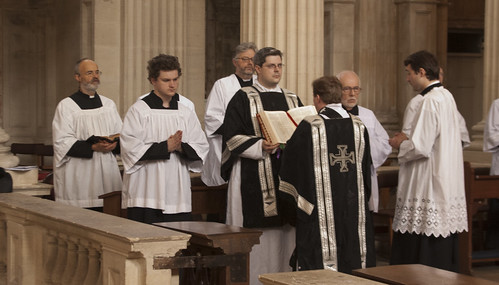 |
| Proclaiming the Gospel: at the LMS Training Conference, Prior Park |
Hildebrand was a philosopher by profession, and his analysis of the Nazi phenomenon, as a contemporary, is fascinating. He regards Nazism and Communism as feeding off a rejection of liberal individualism, but offering a false alternative to it. Instead of restoring to people a sense of identity rooted in genuine communities, they gave people an ersatz sense of belonging through the whipping up of mass hysteria, and based their ideologies on an idolisation of particular communities at the expense of all others, and of the value of the individual: for the Communists it was class, for the Nazis, race.
Thursday, February 23, 2017
A smaller, weaker, impurer Church
Reposted from December 2015, since that Ratzinger passage is once more doing the rounds on Facebook.
From time to time people like to quote something Joseph Ratzinger wrote in 1969. Here's the key passage (source):
The church will become small and will have to start afresh more or less from the beginning.
------------------------------------------------------------------------------------------------------------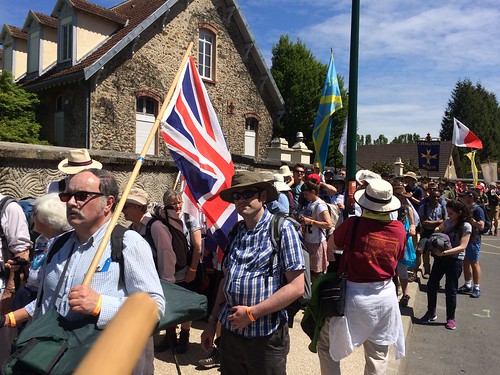 |
| An international pilgrimage: the traditional pilgrimage from Paris to Chartres. |
The church will become small and will have to start afresh more or less from the beginning.
She will no longer be able to inhabit many of the edifices she built in prosperity. As the number of her adherents diminishes . . . she will lose many of her social privileges. . . As a small society, [the Church] will make much bigger demands on the initiative of her individual members….
It will be hard-going for the Church, for the process of crystallization and clarification will cost her much valuable energy. It will make her poor and cause her to become the Church of the meek . . . The process will be long and wearisome as was the road from the false progressivism on the eve of the French Revolution — when a bishop might be thought smart if he made fun of dogmas and even insinuated that the existence of God was by no means certain . . . But when the trial of this sifting is past, a great power will flow from a more spiritualized and simplified Church. Men in a totally planned world will find themselves unspeakably lonely. If they have completely lost sight of God, they will feel the whole horror of their poverty. Then they will discover the little flock of believers as something wholly new. They will discover it as a hope that is meant for them, an answer for which they have always been searching in secret.
And so it seems certain to me that the Church is facing very hard times. The real crisis has scarcely begun. We will have to count on terrific upheavals. But I am equally certain about what will remain at the end: not the Church of the political cult, which is dead already, but the Church of faith. She may well no longer be the dominant social power to the extent that she was until recently; but she will enjoy a fresh blossoming and be seen as man’s home, where he will find life and hope beyond death.
I always like to oppose signs of false optimism, so I'll say something about this.
And so it seems certain to me that the Church is facing very hard times. The real crisis has scarcely begun. We will have to count on terrific upheavals. But I am equally certain about what will remain at the end: not the Church of the political cult, which is dead already, but the Church of faith. She may well no longer be the dominant social power to the extent that she was until recently; but she will enjoy a fresh blossoming and be seen as man’s home, where he will find life and hope beyond death.
I always like to oppose signs of false optimism, so I'll say something about this.
Tuesday, December 22, 2015
Fr Ratzinger, von Balthasar, and demolishing the bastions
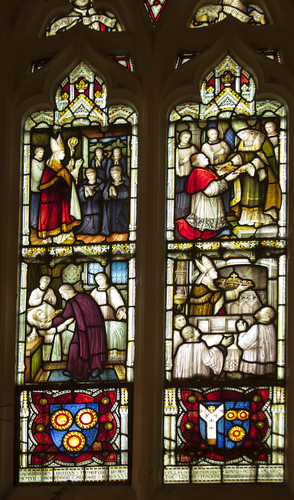 |
| Veneration of the relic of St Edmund: from St Edmund's College, Ware. |
Considering the reactions (mostly on Twitter) to my post about Fr Ratzinger's 1969 remarks about how once all the 'edifices' and 'privileges' of the Church had been completely wrecked, 'a great power will flow' from the Church, it strikes me how difficult many people find recognising liberalism when they see it. Even after all this time, many people with conservative, even traditional, instincts, don't really grasp what liberals are all about.
It should be obvious that the 1969 passage is an expression of liberal views; it is a perfectly clear, indeed a classical exposition of them. In his (much criticised) early book, Principles of Catholic Theology, Fr Ratzinger wrote:
The fact is, as Hans Urs von Balthasar pointed out as early as 1952, that … she [the Church] must relinquish many of the things that have hitherto spelled security for her and that she has taken for granted. She must demolish longstanding bastions and trust solely the shield of faith.
This is, clearly, the same thought as that expressed in the passage I quoted in the earlier post. Far from him regretting the loss of the Church's institutional baggage, as one might call it, Fr Ratzinger thought it was necessary and good.
This is simply the application to the Church of what political liberals have been saying since Rousseau, and are saying today more loudly than ever. Destroy the institutions, destroy the structures, customs, traditions and expectations of traditional society, of morality, of the family, and of the state, and a great awakening, a great liberation, a great flowering of humanity will take place. Haven't we all heard this? And isn't its absurdity sufficiently evident?
Sunday, November 02, 2014
Mr Bornhoft on the Latin Mass and evangelisation
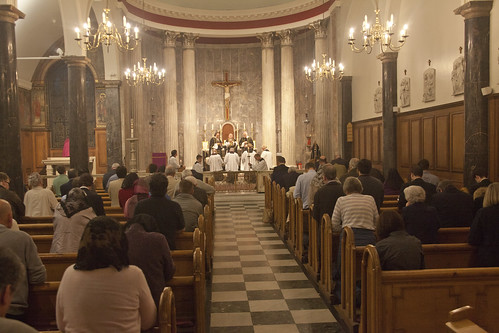 |
| Traditional Requiem for Michael Davies in St Mary Moorfields, London |
The liturgical renewal came about after the Church—no longer a primarily European institution existing in the age of medieval Christendom—realized that the Tridentine form made it hard to evangelize and communicate with the modern world. For TLM Millennials [ie Traditional Catholics], their personal preference for an older form of the mass is overriding the Church’s essential outreach efforts. It shouldn’t come to a surprise to Guzman, given his claimed expertise in this area, that most men may not be interested in attending an hour-long mass in a language they don’t understand.
This is what a lot of Catholics who don't know much about the Traditional Mass think, so it is worth explaining why it is wrong.
Saturday, September 15, 2012
FIUV Position Paper on Western Culture
 |
| Agatha Christie |
There were also arguments that changes to the liturgy needed to made for the sake of the Missions, and I hope we'll be able to follow this paper up with papers on other cultures.
As an appendix to this paper we have included the LMS Petition to Pope Paul VI of 1971, when it looked as though the ancient Mass would simply be banned. The signatures Alfred Marnau, my predecessor as Chairman of the Latin Mass Society, who organised it, was able to gather are astounding. I don't know how many were familiar in the curia, but it must have impressed people in the UK. The Duke of Norfolk, the Poet Laureate, the Controller of Music at the BBC, the Editor of The Times, the Master of Music at Westminster Cathedral, politicians from all the main parties, and a host of musicians, scholars and novelists signed the petition. In a short list - 56 names - Marnau managed to include a staggering range of interests and bagged a high proportion of the most important cultural figures of the day, not only in Britain, but from across Europe.
 |
| Yehudi Henuhin |
I have heard this petition criticised because of its inclusion of non-Catholics. That, of course, was the point of it. Having just, in its wisdom, promulgated the Novus Ordo Missae for the good of souls, the curia wasn't about to accept the argument that the ancient Mass had to be preserved for the good of souls, made by a bunch of laymen, who were't even liturgical scholars. At that moment, another argument had to be used, and I think it was a stroke of genius on Marnau's part that he appealed to its cultural importance. He was able to gather the support of people who were appalled by the vandalism being carried out in the Catholic Church, even from outside the Church. The recognition of the cultural value of the ancient liturgy, art, and literature of the Church is the tribute rightly paid by the cultural elite to the truth of the Gospel, even when they can't bring themselves to accept the truth in full. As a matter of fact, among the signatories were many prominent Catholics, many converts, and some, like Lord (Kenneth) Clark, who became Catholics later.
 |
| Sir Ralph Richardson |
The recongnition of the cultural value of the ancient Mass by non-Catholics who have taken the trouble to think about it actually undermines one of the central arguments against: that the Mass does not appeal to 'modern man'. There can be few causes which could unite, on one petition, the ferociously right-wing Monday Club member and Tory MP, Sir Patrick Wall, a paid-up Communist, Theodore Toynbee, and a British spy turned expert on Zoroastrianism, Robert Zaehner? Or the literary critic F.R. Leavis, with the novellists Agatha Christie, Nancy Mitford, Robert Graves and Graham Greene? Not to mention Harold Acton, Vladimir Ashkenazy, Malcom Muggeridge, Ralph Richardson, Iris Murdoch, Yehudi Menuhin, and Lennox Berkely.
Alfred Marnau's account of the petition, and its reception, is available on the LMS website here,
Subscribe to:
Posts (Atom)