Showing posts with label SSPX. Show all posts

Wednesday, July 11, 2018

SSPX Oxford Mass Centre to close

The Mass centre supplied by the Society of St Pius X in Oxford is to close. The last Mass will take place on Sunday 22nd July.

Priests of the Society have been travelling to Oxford from their base in Burghlere near Newbury.

Saturday, May 05, 2018

Excommunication of SSPX faithful: LMS Press Release

In light of recent events in the Diocese of Buffalo, New York, I'm reposting this from November 2014

----------------------------------------

4 NOVEMBER 2014

PRESS RELEASE ON THE STATUS OF THE FAITHFUL WHO RECEIVE THE SACRAMENTS FROM PRIESTS AND BISHOPS OF THE SOCIETY OF ST PIUS X.

Bishop Semararo

FROM THE LATIN MASS SOCIETY

COMMENT: letters from the Bishop Semeraro of Albano, Italy, and then from Bishop Sarlinga of Zárate-Campana in Argentina, have declared that the lay faithful who receive the sacraments from priests and bishops of the Society of St Pius X (SSPX) are automatically excommunicated, and would need to go through a process authorised by the bishop to be readmitted to communion with the Church (i.e., not simply confession). The Latin Mass Society holds no brief to defend the position of the SSPX, which is canonically irregular, but feels it necessary to point out that these letters are not just ill-considered but have potentially very serious pastoral consequences. They imply that anyone who has ever been to Mass said by a priest of the SSPX is not welcome in the churches of these dioceses. This conflicts not only with the ‘opening of hearts’ requested by Pope Benedict XVI as a prelude to a healing of these divisions ‘in the heart of the Church’, but equally with the emphasis on mercy of Pope Francis.

CANON LAW BRIEFING: In light of canonical advice from our National Chaplain and Canonical Adviser, Mgr Gordon Read, the Latin Mass Society would like to clarify some canonical principles in relation to the recent statements of Bishop Semeraro of Albano, Italy, and Bishop Sarlinga of Zárate-Campana in Argentina, lest misunderstandings spread to dioceses around the world.

Thursday, November 30, 2017

The Psychology of Traditionalism

2009 06 27_2815_edited-1
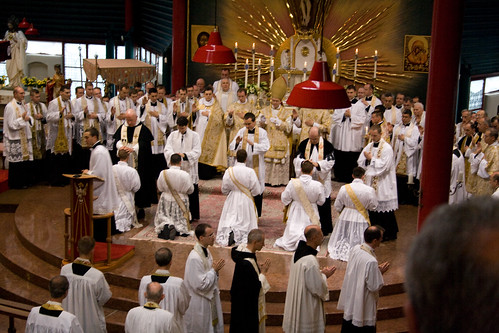
Ordinations for the Fraternity of St Peter in Wigratzbad in 2009
Guide to this series:
The Psychology of the Rigid Personality
The Psychology of Military Incompetence
The Psychology of Ecclesiastical Incompetence
The Psychology of Traditionalism

Before my series of posts about Norman Dixon's Psychology of Military Incompetence, I'd been writing about Mgr Basil Loftus, who exemplifies the attitude that respect for rules indicates a conformist, 'anal', weak-ego individual. This inference enables him, and many others, to conclude that theological and liturgical conservatism and traditionalism manifests a kind of 'rigidity' incompatible with pastoral effectiveness.

I have shown what is wrong with this argument in general terms. It is a truism that people with weak egos and an unhealthy fear of failure will be risk-averse, and will seek the approval of their peers and superiors by conforming. In the post-conciliar situation, however, this approval is not forthcoming to conservatives and traditionalists in mainstream Catholic or non-Catholic institutions: it is, rather, given to those who toe the liberal line. It is rather remarkable that Loftus and his like have not noticed this, but as I have observed that classical presentations of the psychological theory they draw from, including Norman Dixon's, are prone to confuse the risk-taking non-conformism of a person with a strong ego and moral courage, with the liberal violation of traditional norms, and with the norm-violation of the merely self-indulgent.

Tuesday, May 23, 2017

SSPX ordinations: with permission from the Holy See


Update: there's an amusing exchange in Fr Z's comment box on this. Fr Z quotes Archbishop Pozzo of the PCED that SSPX priestly ordinations are something they 'permit and tolerate' but which are still regarded as 'valid but illicit'. But, really, that doesn't make sense. If they are permitted, they are licit. The word 'licit' simply means 'permitted': any dictionary will tell you that.

Of course these are crazy times. And anyway I'm happy if Rome wants to make some concession now ('permit and tolerate') while allowing itself to make another, at least on paper ('make licit') at some future date. It is all part of a process, after all.

------------------------------------------------------------------------

This is really wonderful news: Bishop Fellay, Superior of the Society of St Pius X, has said (h/t Rorate Caeli) that he recieved a letter from the Holy See last year telling him that he could continue with priestly ordinations, without needing permission from the local bishop. This is a move I noted as a possible 'next step' after those involving confession and marriages in my 'Chairman's Message' in the latest Mass of Ages, which I reproduce below.

-------------------------------------

Not for the first time in the present pontificate, the Catholic media is abuzz with the possibility that the Society of Pope Pius X (SSPX) will be ‘reconciled’ to the Holy See: which is to say, that it would gain official canonical status. On a previous occasion, when asked for comments by Catholic journalists, I told them to calm down: my view was that it wasn’t about to happen, because of the issue of mutual trust. I was correct, then, but things have continued to develop. The ‘jurisdiction’ needed for priests to hear confessions validly, outside an emergency situation, was granted to the SSPX for the ‘Year of Mercy’, and when that year came to an end this jurisdiction was granted permanently. Now provisions have been made in relation to weddings celebrated by SSPX priests, so that there need not be any doubt about their validity either. These arrangements give the SSPX privileges, such as jurisdiction to hear confessions given directly from the Pope, enjoyed by no other religious institute.

Thursday, September 17, 2015

Michael Voris on the SSPX: not charitable, not true

The announcement by Pope Francis that priests of the Society of Pius X (SSPX) will be given faculties to hear confessions during the 'Year of Mercy' has stimulated Michael Voris to reiterate once again his view that the SSPX are in schism. I've mentioned Voris  positively over the years on this blog, and the current issue of the Latin Mass Society's magazine, Mass of Ages, includes an interview with him, but I have to disagree with him about this, which is far from being a merely theoretical issue.

The reality is that the exact legal status of the SSPX has always been somewhat ambiguous, and as does happen in real life, it is an ambiguity which has been deliberately maintained by both sides to facilitate a positive evolution of the relationship. It is not for Michael Voris to insist on what successive Roman officials have refused to insist on.

Voris tells us that 'In 1988, Pope St. John Paul called their movement a schism'

Not exactly. He said that Archbishop Lefebvre's ordination of four bishops without the consent of the Holy See was 'a schismatic act', and later in the document pointed out the penalty - excommunication - for 'formal adherence to schism'.

Friday, July 10, 2015

'An Extrarordinary Turn of Events': Pope Francis hasn't moved against the Traditional Mass

IMG_0218
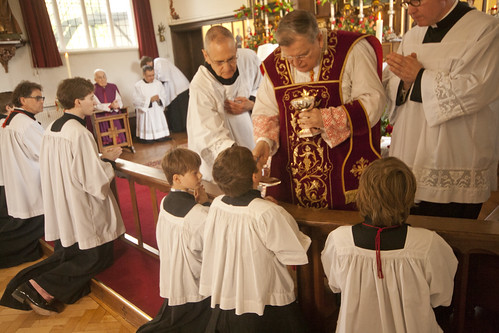
Cardinal Burke disctributes Holy Communion at a Low Mass in Oxford
My cover story for the Catholic Herald can be read on the Catholic Herald website. Here is a taster.

Those who expected Pope Francis to clamp down on the traditional liturgy, freed by Benedict XVI, have reason to be disappointed. Just last week Archbishop Malcolm McMahon of Liverpool announced that the impressive Pugin church of St Mary in Warrington would become a centre for the Extraordinary Form run by the Fraternity of St Peter. This brings to five the number of English dioceses that have welcomed either the fraternity or the Institute of Christ the King, another priestly institute dedicated to the traditional liturgy.
...
Even those who hadn’t prejudged Pope Francis’s papacy may be puzzled by these developments, which are not confined to England. Policy directly attributable to the Holy Father has smiled upon the Society of St Pius X (SSPX), a priestly institute dedicated to the traditional liturgy which was supposedly suppressed in 1975 and has been operating since then without Rome’s oversight.


...
Developments are being pushed along by something deeper, however, than the personal interests of popes. The inexorable turnover of the generations is having a transformative effect on attitudes within the Church. Only people now over 70 could have been caught up in the excitement of the liturgical reform as adults, and experienced what Benedict XVI called “all its hopes and its confusion”. They are being replaced by people with less emotional commitment, one way or the other: a generation that can take a step back and consider the matter dispassionately.

Read the whole thing.

IMG_0539
Fr Ian Verrier FSSP, a newly ordained priest, celebrates Mass in St James' Spanish Place
Support the work of the LMS by becoming an 'Anniversary Supporter'.

Tuesday, July 02, 2013

The legacy of 1988

This is the article of mine published last weekend by the Catholic Herald, under a headline with a howling typo. Well, you can't win them all! I am grateful to Luke Coppen for asking someone committed to the traditionalist cause for writing a reflection on what was one of the most divisive events in the Church's recent history: Archbishop Lefebvre's episcopal consecration of four of his priests without Papal mandate. (The other Catholic weeklies ignored the anniversary.)


On June 30 1988, 25 years ago this week, Archbishop Lefebvre carried out episcopal consecrations (to use the traditional term for the ordination of bishops), of four priests of the Society of St Pius X, which he had founded. He did so without the permission of the Holy See, facing the prospect of his own death (which occurred less than three years later), to ensure the continuity of the SSPX, dedicated to opposing what he saw as modern theological errors, and preserving the Traditional Latin Mass. The cluster of events of which this was the centre – the negotiations between the archbishop and Cardinal Ratzinger, later to become Benedict XVI, and their failure; the subsequent excommunication of the archbishop and his four new bishops; the apostolic letter of Pope John Paul II, Ecclesia Dei adflicta; the reconciliation to Rome of individuals and groups formerly aligned with the SSPX – may together be described as a turning point for the post-conciliar Church, whose consequences continue to play out today.

The Novus Ordo Missae, the post-Vatican II Mass, celebrated almost always in the vernacular, was promulgated, after a transitional period, in late 1969, and it was widely assumed that, apart from older priests saying Mass in private, the use of the older liturgical books was thenceforth forbidden. At the request of the Latin Mass Society and Cardinal Heenan, Pope Paul VI signed an indult (permission) for the “Old Mass” for England and Wales in 1971. In 1984 Pope John Paul II issued an indult for the whole world. Nevertheless, the dominant attitude among those in authority in the Church was well summarised by Cardinal Ratzinger, when he wrote: “Anyone who nowadays advocates the continuing existence of this liturgy or takes part in it is treated like a leper; all tolerance ends here.”
IMG_3582
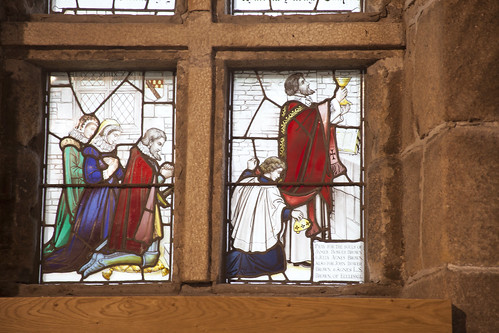
Window of Padley Chapel, Derbyshire, showing Mass said by a martyr-priest of the 16th century
Cardinal Ratzinger warned Catholics against this intolerance, for both human and theological reasons. Humanly speaking, the effective banning of what had been the basis of the spiritual life of the entire Catholic Faithful in the Latin Church, particularly in the context of liturgical abuses in the reformed Mass, “caused deep pain to individuals totally rooted in the faith of the Church”. Theologically, it was part of a “hermeneutic of rupture” which was incompatible with a Catholic view of the Church: a long view. “A community is calling its very being into question when it suddenly declares that what until now was its holiest and highest possession is strictly forbidden and when it makes the longing for it seem downright indecent,” Cardinal Ratzinger said. In a 2001 talk at the traditionalist French monastery of Fontgombault, he linked opposition to the Traditional Mass to a rejection of the theology of sacrifice: bad theology leads to bad liturgy in general, and a rejection of the ancient liturgy in particular.

It has become a common theme among a new generation of theologians, led by Benedict XVI, that on a series of points the Traditional Mass is an important corrective to problematic modern theological tendencies. Celebration ad orientem (with the priest facing the same way as the people), Latin and Chant, the silent Canon, the ancient prayers of the Missal, the reception of Communion on the tongue: all demonstrate theological principles sorely needed by the Church today.
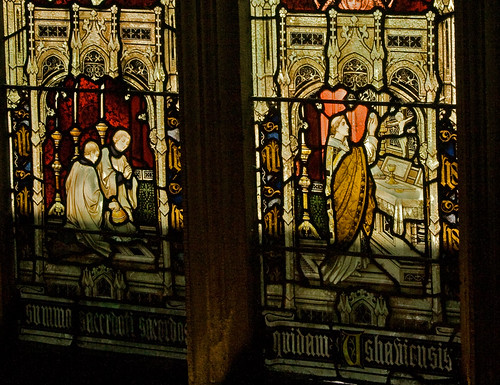
2010 04 16_5845
Window of the chapel of the former seminary at Ushaw, showing tonsured Medieval priest in Gothic vestments celebrating Mass
The crisis of 1988 had the immensely important result of the rapid establishment, by John Paul II, of the Fraternity of St Peter, a priestly fraternity committed to the Traditional liturgy. To a large extent the FSSP, founded by priests of the SSPX who repudiated Archbishop Lefebvre’s defiance of the Holy See, was able to adopt the deal which Lefebvre had negotiated and then rejected. They have over time been joined by other groups for whom the ancient Mass is the central plank of their charism and spirituality, most notably the Institute of Christ the King Sovereign Priest and the Apostolic Administration of St John Vianney in Campos, Brazil, which has its own bishop, Fernando Arêas Rifan.

After 1988 it has been impossible to interpret the official attitude of the Vatican towards the ancient Mass as a temporary toleration for the sake of the older generation. The Holy See does not authorise religious orders and communities with the hope or expectation that they will fade away and die. As things have turned out, these groups have grown quickly since 1988, and from a standing start now comprise more than 600 priests worldwide. This growth has meant that a new appreciation of the riches of the ancient Mass has been brought to one diocese after another as traditionalist apostolates have established themselves around the globe.
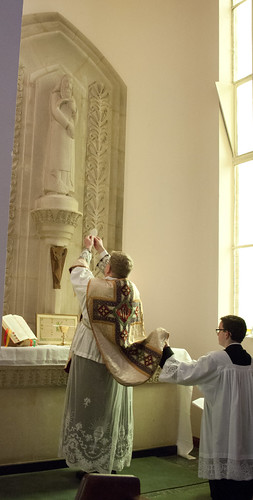
IMG_2711
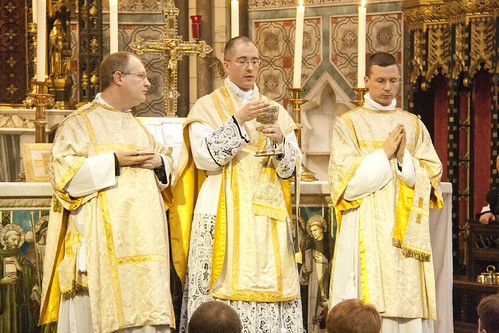
Low Mass at the LMS Training Conference in Ratcliffe College, Leicestershire. We're just doing what our forfathers did.
Those attached to the Traditional Mass after 1988, both lay and clerical, were still, however, in an anomalous position: while in principle their right to exist was acknowledged, in practice many bishops remained suspicious of them and restricted the opportunities for public celebrations of the Traditional Mass. This changed in 2007 when Pope Benedict declared, in his motu proprio Summorum Pontificum, that there was no need for permission from bishops for what he called the “Extraordinary Form” of Mass: all priests in the Western Church could say it, if they knew how. In England and Wales Sunday Masses in the Extraordinary Form have more than doubled in number since 2007 and there are now more than 200 priests regularly saying this form of the Mass.

This gesture of Pope Benedict was part of a renewed effort towards the Society of St Pius X, which also included the lifting of the excommunications on the four bishops consecrated in 1988, and doctrinal discussions between the SSPX and the Vatican. These have again, for the time being, failed to bring about the reconciliation Pope Benedict desired. The motu proprio does, nevertheless, represent another step in the healing of a cultural and theological schism with the past, which may be a necessary precondition for a healing of differences in the present.

Dr Joseph Shaw is chairman of the Latin Mass Society

------ Ends

I encourage readers to follow the link to the Fontgombault talk of Cardinal Ratzinger: it is the most theologically forthright discussion of the importance of the EF that he wrote, that I know of. 

Wednesday, November 07, 2012

Williamson goes 'independent'

Readers may or may not have heard of the phenomenon of 'independent' priests, priests with valid orders who, for one reason or another have kicked over the traces and no longer obey their bishops or superiors, but engage in some kind of pastoral work with a little group of followers. Of course there are Catholic priests who join the Anglicans, or the SSPX, or some other group on the wilder fringes, but these are the ones who don't want to be answerable to anyone at all. It seems Bishop Williamson, so graciously invited back to the fold by the Holy Father, who lifted the excommunication imposed on him for allowing himself to be consecrated as bishop without the Pope's permission in 1988, has now gone into this sterile wilderness, and is offering his episcopal services to others in a like situation. So I suppose he'll be offering confirmations, perhaps even priestly ordinations. He's by no means the first person with valid episcopal orders wandering around in this state, but he is by far the best known, and the validity of his orders is the most obvious. For these reasons he is going to cause a particularly acute scandal, and do a particularly grave amount of damage.
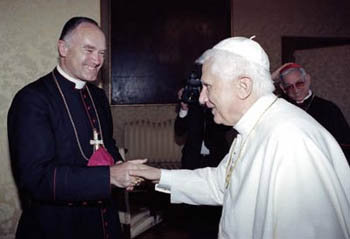
I don't normally post about this kind of thing but this is breaking news, and I urge readers to pray for him, and for those who find themselves involved in his set-up, however it evolves. The lunacy of the whole thing is obvious to perhaps all of my readers, but it clearly isn't obvious to them, for one thing they will include families with children who know nothing else. While we needn't follow their soap-opera antics, but we cannot be indifferent to what happens to them either.

More from the Sensible Bond.

Wednesday, October 24, 2012

Williamson ejected from the SSPX


Communiqué of the General House of the Society of Saint Pius X (October 24, 2012)

Bishop Richard Williamson, having distanced himself from the management and the government of the SSPX for several years, and refusing to show due respect and obedience to his lawful superiors, was declared excluded from the SSPX by decision of the Superior General and its Council, on October 4th, 2012. A final deadline had been granted to him to declare his submission, after which he announced the publication of an “open letter” asking the Superior General to resign.

This painful decision has become necessary by concern for the common good of the Society of Saint Pius X and its good government, according to what Archbishop Lefebvre denounced: “This is the destruction of authority. How authority can be exercised if it needs to ask all members to participate in the exercise of authority? “(Ecône, June 29, 1987)

Menzingen, October 24th, 2012

Thursday, May 10, 2012

Novena for the reconciliation of the SSPX

The Latin Mass Society is asking people to pray the Veni Creator Spiritus and the Memorare for this intention from 18th May to the Vigil of Pentecost (26 May). 

The prayers (available in Latin and English) can be seen on the LMS website here.

Please pass it on!

Wednesday, April 18, 2012

SSPX - Rome latest

It seems things are moving in a positive way. Bishop Fellay's own spokesman has confirmed that the SSPX Superior did indeed send a revised version of the Theological Pramble to Rome with which he is happy; the journalist Andrea Tornielli is claiming that this version will be acceptable to Rome as well, since the revisions are not substantive, but of course this is for the proper authorities to decide. That decision may take some time to emerge.

See Rorate Caeli:

http://rorate-caeli.blogspot.co.uk/2012/04/for-record-latest-tornielli-fellays.html


Friday, March 16, 2012

SSPX latest

"Pursuant to the decision made by Pope Benedict XVI, Bishop Fellay was, in a letter delivered today, informed of the evaluation of his response. The letter states that the position he expressed is not sufficient to overcome the doctrinal problems which lie at the foundation of the rift between the Holy See and the Society of St. Pius X.

"At the end of today's meeting, moved by concern to avoid an ecclesial rupture of painful and incalculable consequences, the superior general of the Society of St. Pius X was invited to clarify his position in order to be able to heal the existing rift, as is the desire of Pope Benedict XVI"


See the whole communique on the Vatican Information Service blog.

Prayers, prayers, prayers!!

Sunday, November 27, 2011

Trouble up North

The Sons of the Most Holy Redeemer, who are based at their monastery of Golgotha on the island of Papa Stronsay in the Orkneys, have documentation on their blog which appears to show that they have been deprived of a share of a legacy by the Society of St Pius X.

The will of the late Mrs Kingon-Rousse of Herne Bay stated:

7. SUBJECT TO the payment of my debts funeral and testamentary expenses and the aforementioned legacies I give all the remainder of my estate not otherwise effectively disposed of by this Will or any codicil hereto to the Society of St. Pius X in Great Britain and request that one half of such residue of my estate be used for the benefit of the London Branch of the Society operating from St. George's House 125 Arthur Road London SW19 7DR who service Saints John Fisher & Thomas More Church Herne and for the remaining half share to be utilised for the benefit of Father Michael Mary and the community of Redemptorists at Golgotha Monastery Island Papa Stronsay Orkney Isles KW17 2AR. And I further request that Father Michael Mary put aside the sum of TWO THOUSAND POUNDS (£2, 000.00) for mass offerings to be used for the repose of the soul of myself and my family by birth or marriage and for the benefit of every holy soul in purgatory AND I declare that the receipt of the Treasurer or other competent officer for the time being of the Society of St. Pius X in Great Britain appearing to my Executor shall be a sufficient receipt to my Executor in respect of this residuary bequest


The Sons have received the £2,000 for Mass stipends, but not the rest. A strange story.


But all is made clear in the latest edition of the SSPX Newsletter (December 2011):


'Let it be know that this good lady's wishes to support the traditional Redemptorists were certainly taken into consideration when, after consultation with the General House, and following legal advice, a good deal more than the original sum of money was used to purchase St Columba's House on Stronsay for the benefit of the faithful Redemptorists who remained following the 2008 split, as well as the local faithful.'


I am very happy to put this statement from Fr Paul Morgan, Superior of the SSPX in Great Britain, before a wider audience.


The Sons conclude their post with the words: 'we resign ourselves to this injustice.'


In the meantime, the Sons of the Most Holy Redeemer, a community which voted in 2008 to seek canonical regularisation from Rome, and have received it, are in serious need of money. You can send donations to them directly, and join the mailing list of the Friends of Papa Stronsay. If you have not done so,


take out a subscription to their quarterly newspaper, The Catholic,


buy their annual Wall Calendar!


Yes the LMS does one too, so buy that as well! One for your kitchen, one for the sitting room - obviously! And buy a few more to give your friends for Christmas!

Saturday, June 11, 2011

Novena for the reconciliation of the SSPX

Rorate Caeli is passing on an urgent request for a novena for this intention for the Octave of Pentecost. They have appropriate prayers to say for this.

There is a sense arising from various public statements that the discussions may be reaching a critical moment. This may turn out not to be the case, who knows?, but the prayers will not be wasted.