Saturday, April 13, 2013

That Gosnell case

Twitter has been awash with the Gossnell case. In case you've been living under a stone, the facts are that Kermit Gosnell is an abortionist, working in Philadelphia in the USA, whose clinic clearly failed the most elementary standards of hygiene, two of whose patients died, and who killed probably more than 100 babies after they had been delivered alive. He specialised in late abortions, and things didn't always go according to plan. Or maybe he had his own way of doing things. He has finally been charged, and is being tried, for murder: of one of his adult patients, and of a sample of the babies.

The case has a special significance because of the media black-out surrounding it: the mainstream media in the USA, and the UK, don't want to know. My suggestion is that it is embarassing to them for precisely the reason that it is newsworthy: it vindicates the highly controversial, but successful, approach of the US pro-life movement in recent years, of holding abortion clinics to existing laws, and where possible of imposing greater regulatory burdens on abortionists at state level. They demand (shock!) that abortionists are properly qualified, and (horror!) that their premises come up to clinical standards of cleanliness and so on. These obligations, which activists can invoke and pro-life states can impose and enforce in the way of ordinary local licensing requirements, have closed down many abortion centres, and the pro-abortion industry has been screaming blue murder about it. Cases have gone to court over whether they are covert ways of banning abortion, and therefore illegal. It all turns on whether the obligations are deemed 'unreasonable'. (The interesting history of 'Operation Rescue' illustrates the changing tactics.)

Gosnell was protected by a pro-abortion state, and wasn't inspected at all over a 17-year period. So what the Grosnell case exposes is that there really is a problem of poor regulation in the abortion industry. We've had our own case of this in England, when the Telegraph exposed the fact that scores of abortionists were failing to get the required two signatures from doctors to authorise an abortion. The abortionists were enraged that they be kept to even the most elementary legal safeguards. They had been keeping boxes of pre-signed, blank forms to speed things up.

Gosnell fits into the same narrative as the exposure of Planned Parenthood as offering abortion to under-age prostitutes (when asked by their pimp), without informing the police of what is obviously a crime: the sexual exploitation, including rape, of young girls. This narrative terrifies the abortion industry, and with good reason.

The Savita case, which of course has been stuffed down our throats by the media without ceasing, fits the contrary narrative: that abortion is necessary to save mothers' lives. Except, of course, that it doesn't, because the medical facts don't stack up. This is the narrative which must be exposed as a lie: abortion does not save women, it exposes them to harm, and even death.


Twitter has proved a useful way to by-pass the mainstream media. On my (seemingly endless) train journey from Leicester to my local stop north of Oxford yesterday, my timeline was full of people tweeting about #Gosnell, to make it 'trend' or simply to get the word out. Exceptions to this, like stationary rocks standing out of a mountain torrent, were the 'big name' Catholic bloggers I follow. They were all tweeting about each other's latest blog post or pop songs about Maggie Thatcher. Yup, they've been drinking the Kool Aid. Which is to say, that like many Catholic intellectuals (I realise I'm stretching a point to include journalists in that category), they measure respectability, or newsworthiness, by the standards of the World, even when those standards are distorted by anti-life priorities.

To illustrate the interest of the 'minor' Catholic bloggers, here's Mulier Fortis on the subject, here is the Counter Cultural Father, here is Mark Lambert.

Thursday, April 11, 2013

Pontifical Mass in Ratcliffe College for the LMS Training Conference

Updated! Lots more photos and commentary to follow, now the conference is over (and I'm back at my computer).

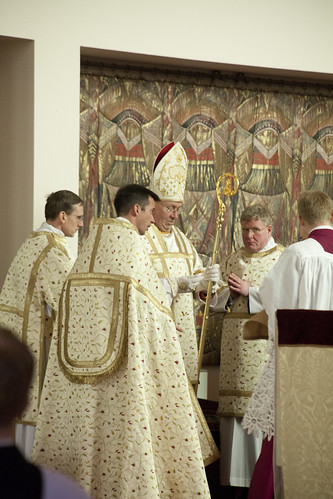
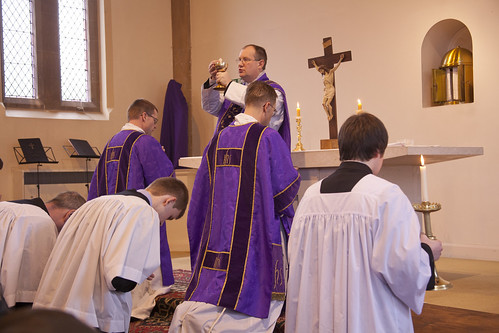
Bishop Malcolm McMahon, Bishop of Nottingham, celebrated the opening Mass for the LMS Priest Training Conference in the large school chapel of Ratcliffe College, our venue.
 IMG_2565
I will update this post when I next get a chance, but that won't be for a couple of days.  [Done!]IMG_2575
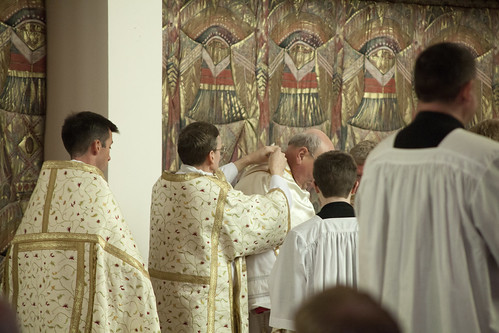
After visiting the Blessed Sacrament chapel, Bishop McMahon vests in the sanctuary. He puts on the vestments of a deacon and a priest before his own chasuble. (Yes, this is all supposed to happen this way!)
IMG_2578
When moving to the foot of the Altar, and again when preaching, he wears his mitre and holds his crozier.
IMG_2585
But they are held for him when he's not using them.

Ratcliffe College has an unusual chapel - it looks to me pre-Conciliar, but very late, so maybe 1950s. Say what you like about the style, the sight-lines are fantastic.
IMG_2603
The Collect.
 IMG_2606
The Epistle.
 IMG_2618
The Gospel.
 IMG_2635
 The Sermon. Bishop McMahon preached on Our Lady as a spiritual model for all Christians. IMG_2649
The Offertory.
 IMG_2650
Bishop McMahon is blessed with incense. He puts his mitre on again for this. Maybe someone can explain why it is a different mitre. (Before Mass, the two mitres, one gold and the other white with gold embroidery, are propped up at either end of the altar.)
IMG_2653
The Lavabo.
 IMG_2662
 The Consecration.
 IMG_2668
The Pax. The bishop gives each of the clergy the pax, not just (as the celebrant in Solemn Mass does) the deacon).
 IMG_2670 IMG_2678
Communion.
 IMG_2687
The Blessing.
 IMG_2691
After un-vesting, Bishop McMahon processes out. IMG_2695
Bishop McMahon gave conference participants a very warm welcome, in a little talk after dinner, and we had a very stimulating discussion.

I had not met Bishop McMahon before, and I am very glad to have done so. He takes a real interest in the liturgy, and is still the only Ordinary in England and Wales to have celebrated the Extraordinary Form in publicly in his own diocese, something he has done now a few times. I know this is old hat in the USA, but the kind of Mass described in this post is still very rare here, and it was a privilege to be able to attend and photograph it. It is wonderful to be see a bishop treated like a bishop, and acting like a bishop, in the liturgy.

The assistant priest, wearing the cope, was Canon Montjean of the Institute of Christ the King, who liturgical experience was hugely appreciated.

I'll blog more about the conference in the days to come. More photos are uploading.

Wednesday, April 10, 2013

More about the Retreat and Chant Course

IMG_2493
Our Retreat Giver this year was Fr John Hunwicke of the Ordinariate. He was brilliant - as I knew he would be. He was also rather heroic in taking it on, since he has not fully recovered from a very nasty broken shoulder.
 IMG_2403
Fr Guy Nicholls of the Birmingham Oratorty, and Scott Tanner, a seminarian of the Institute of Christ the King Sovereign Priest, joined us on Saturday, making Solemn Mass possible. Fr Matthew Goddard of the Fraternity of St Peter also came over (from Reading) to hear confessions one afternoon.
 IMG_2435Among the events of the Retreat, we always have a Marian procession; this goes from the Oratory School's main chapel to the smaller 'old' chapel. IMG_2449 After this we have tea; St Philip's Books, the well-known Oxford Catholic bookshop (second hand and new), had a stall.IMG_2473
The liturgy of the weekend included Mass, Sung or Solemn, plus Compline on the two evenings, and Vespers and Benediction on Saturday. The presence of the 25 or so singers on the Chant course at these liturgies meant that these were all accompanied with great confidence and gusto. I'll do another post on the chant.
IMG_2480
The special point of the Retreat is that, as parents can only attend a spiritual talk if someone is looking after their children, we have activities for the children, both 'older' and 'younger' (the dividing line is about 12). The culmination of the younger children's activities is an Easter Egg hunt on Sunday morning. The activities include talks for the older children, including (this year) one from Scott Tanner ICKSP about seminary, and one from me about miracles, as well as fun creative things for the younger ones - they cut out and coloured in some very cleverly designed vestments this year, which could be put onto a cut-out priest. We are very grateful to the volunteers who looked after the children in these sessions.
 IMG_2536
This is bit of real Catholic life and community, spiritual and social.

Tuesday, April 09, 2013

Family Retreat: reply to 'Ora Pro Nobis'

IMG_2397
Over on Fr Ray Blake's blog, some pseudonymous commenter suggests, not for the first time, that 'traditionalists' - presumably this means people attached to the traditional liturgy - don't do enough. This person's private apostolate is, apparently, to rid the Church of liberal Catholics by making them choke to death on their after-Mass biscuits by quoting the Catechism at them. Well, good for him (or her). There can be a place for that kind of thing, but it is not the only kind of activity pleasing in the sight of God. Far more productive, generally speaking, is the combination of the worthy worship of God and the Spiritual Works of Mercy, 'instructing the ignorant', 'comforting the afflicted', and 'giving counsel to the doubtful', where the recipients of our help actually want it. And this is what happens during a traditional retreat.
IMG_1045

We've gone one further by making this experience available to the parents of families, and to their children, the lay people perhaps most under attack in our society, and most in need of support.
IMG_2443
And we go a step further still by combining this with a Chant training weekend designed to improve the standard of liturgical music in parishes up and down the country, whether they sing for the Traditional Mass or the Novus Ordo. This year we had singers from the schola of St Bede's Clapham Park, the LMS Schola in Lancaster, the (lay) schola at Ealing Abbey, the Schola Abelis of Oxford, and the Juventutem Schola in Bristol.
IMG_1053

How does this compare with forcing biscuit crumbs down liberal windpipes? Is this more productive, 'Ora Pro Nobis', or less? And how much effort, over how many years, and by how many people, does this work represent? Do you think it is easier, or harder, than learning a handful of proof texts from the Catechism?

IMG_2432
It is a slightly depressing reality of the blogs that, looking at my statistics, far more people want to read me attacking Mgr Basil Loftus or Paul Inwood than want to read about the Masses, Pilgrimages, or other spiritual events with which I and the Latin Mass Society are involved. IMG_1031
Nevertheless, this is what we do: week after week, year after year. And I would suggest that far more hearts are softened to receive the fullness of the Faith by the Holy Sacrifice of the Mass, Gregorian Chant, and the prayers of the Faithful at our holy places, than are by the combination of milky tea and fragments of chocolate digestive going down the wrong way during a spat with some self-appointed guardian of orthodoxy intent on making his parish social club into a war zone.IMG_2542

Wednesday, April 03, 2013

Position Paper on Holy Week: Part II

I had intended to publish this some time ago; Part I is here. The Conclave, and the Holy Week itself, intervened, however, so it has gone up today on Rorate Caeli: go there to read it.

IMG_2232
This isn't a bad time to publish a discussion of the Holy Week ceremonies, when they are still fresh in our minds. While the pre-1955 ceremonies have their peculiarities, the 1955 Reform has its difficulties also. One of these is the way it relates to the later reforms of the liturgy.

The first paper, on the motivation of the 1955 reform, placed it in the context of the Liturgical Movement, and this is certainly part of the picture. The Liturgical Movement was itself evolving, of course, so to say the reform grew out of the movement is not to make it completely clear what was going on. But the classical attitude of the movement was one with a high degree of reverence for the liturgy, and a great interest in the history of the liturgy. The movement inspired all sorts of ambition projects to get the Faithful to take a fuller part in the liturgy, some of which we might think a little Quixotic, or even wrong-headed, some, though, we may want to carry forward today: getting everyone to have a good hand missal, to sing chant at Mass, to attend public celebrations of Vespers, and hey why not Matins on Sunday mornings? While we're about it how about getting them to say the responses, read a multi-volume commentary on the liturgy, say the whole Office at home, and heaven knows what else. But the excitement about the liturgy led to some very wrong-headed notions about reviving a past which was not only utterly unlike today in its social and educational conditions, but was also actually mythical, being based on very scanty evidence and a lot of overheated imagination.

IMG_2246
Then, I get the impression, some people in the movement became impatient. They realised how difficult it is to get people into church for non-obligatory services. How stubbornly attached to paraliturgical devotions like Stations of the Cross when they should be going to the Good Friday Liturgy. How hard it is to teach Latin to all those children. The temptation to make things easier began to be overwhelming. Why not have things in the vernacular? Why not make the services shorter? Why not make the services easier to understand?

Why not? Because by doing those things you are taking away what there is to understand: the complex ceremonies, the mysterious prayers, the Latin. You are undermining the liturgical experience of Faithful, which is the whole object of the exercise. You are sawing off the branch you are sitting on.

It seems to me that the 1955 Holy Week reform took place at just the tipping point in the history of the movement. There is still a huge interest in the history of the liturgy, still a Quixotic desire to bring back the glories of the 6th century Roman Church, but equally a nagging feeling that things must be made simpler, abbreviated, clarified. The move from the earlier to the later attitude was facilitated by the lazy notion that the liturgy of the distant past was simple, so simplifying was also getting back to how things were. Actually, we just know less about it. Have a look at the Book of Leviticus if you want to know where the Catholic liturgy came from, and ask yourself: Is there the smallest reason to suppose that people coming from this atmosphere would have wanted a liturgy of coffee tables and bean bags?

IMG_2261
The unique historical moment represented by the 1955 Holy Week Reform means that it occupies a paradoxical place in the history of the liturgy. On the one hand, all their quaint ideas about how the ceremonies should be done went out of the window in 1970, just 15 years later. As far as the Ordinary Form Holy Week is concerned, the 1955 reformers needn't have bothered. On the other hand, a lot of their more small-scale snipping and trimming was applied to the rest of the liturgical year in the course of the 1960s, and we can see here the beginning of the infinitely depressing stripping down of the Roman liturgy which has left us with... what we are left with. The attitude seemed to be: we can do without the Last Gospel - let's think of excuses to suppress on some occasions, then we'll get rid of it altogether. The same goes for the Preparatory Prayers (Prayers at the Foot of the Altar), duplications of texts (sung by the choir and said at the Altar by the priest), the maniple, the second Confiteor, the kissing of liturgical items, and a lot of other things. The other thing which is striking about the 1955 ceremonies is the mixture of said and sung texts, and Latin and the Vernacular, a situation very reminiscent of the Ordinary Form in this respect. Why is the Pater Noster said rather than sung on Good Friday? Why does the congregation break into the vernacular at the Easter Vigil? (Couldn't they master the response 'Abrenuntio!'?)

IMG_2264
What we should actually do about the situation we have today is a difficult question. I don't propose we even attempt to come up with a final and definitive answer. The use and spread and development of the Extraordinary Form is led completely by pastoral considerations: it happens because priests and people want it. Let's just see what that organic process leads us to to in fifty years time. Until then, for heaven's sake let's not jettison anything of real value. You never know when we might need it.

The images from the FSSP celebration of the Solemn Afternoon Liturgy of Good Friday. Fr Matthew Goddard was celebrant, Fr Armand de Malleray deacon and the Rev. James Mawdsley subdeacon. Mass was accompanied by the Newman Consort.

Notice the lack of maniples.

Postscript

One victim of the 1955 reform was the uniqueness of Good Friday as a day when Holy Communion is not given to the people. In Behold the Pierced One (pp.97-98), Joseph Ratzinger wrote:

The ancient Church had a highly expressive practice of this kind. Since apostolic times, no doubt, the fast from the Eucharist on Good Friday was a part of the Church’s spirituality of communion. This renunciation of communion on one of the most sacred days of the Church’s year was a particularly profound way of sharing in the Lord’s Passion; it was the Bride’s mourning for the lost Bridegroom (cf. Mk 2:20). Today too, I think, fasting from the Eucharist, really taken seriously and entered into, could be most meaningful on carefully considered occasions, such as days of penance—and why not reintroduce the practice on Good Friday?

Monday, April 01, 2013

Maundy Thursday with the FSSP in Reading

IMG_2172
On Maundy Thursday I attended (and sang at) the Mass of Maundy Thursday in Reading celebrated by the FSSP. Fr Matthew Goddard was celebrant, Fr Armand de Malleray deacon, and an FSSP seminarian, the Rev James Mawdsley, was subdeacon. IMG_2185
At the end of Mass the Blessed Sacrament is taken to the Altar of Repose, led by the MC with a clapper instead of a bell. Having rung the bells with great emphasis at the Gloria, they remain silent until the Easter Vigil.

The Blessed Sacrament is accompanied by an 'ombrellino', a ceremonial sun shade (like an umbrella).
IMG_2194 IMG_2199
The Altar of Repose is surrounded by flowers and made as splendid as possible.

Then takes place the 'Stripping of the Altar'.
Before:
 IMG_2203
During:
 IMG_2208
After:
 IMG_2216
The Altar is stripped in sympathy with the Passion, including stripping, of Our Lord. The Tabernacle is left empty and bare until the Easter Vigil.

Watching at the Altar of Repose, as Jesus watched and prayed in the Garden of Gethsemane before His Passion.
 IMG_2223
More photos.

Tenebrae in St Mary Moorefields

IMG_2127
On 'Spy Wednesday' I attended the celebration of Maundy Thursday Tenebrae in London organised by the Latin Mass Society. The Extraordinary Form Triduum is celebrated in St Mary Moorefields, thanks to the great generosity of the Parish Priest Fr Peter Newby (a former Chaplain of Oxford University); what with other things going on in the church, we only have one of the Triduum's three Tenebrae services, anticipated the day before.

IMG_2115
The polyphonic consort Cantus Magnus accompanied it, and presented the UK Premiere of Tenebrae Lamentations and Responses by Italian cleric and composer Pietro Amico Giacobetti (fl. 1579–1616).

Only two of his works are known, with the five-voice Lamentationes 'cum omnibus responsoriis in triduo hebdomadae sanctae' (Venice, 1601), a sublime, austere and elegant set that have been neglected in the choral repertoire. For this performance, the first modern edition has been prepared by Presto Publications.

This was an exciting musical event, and a very fitting accompaniment to the service.

IMG_2110

The polyphonists say the Responsaries between the readings, and the cry 'Jerusalem, return to the Lord!' found at the end of the three readings from Jeremiah's Lamentations.


I joined the schola singing the psalms, and these photos were taken by a member of the congregation.

Tenebrae is the Matins and Lauds of each day of the Triduum, celebrated with a number of special features. Not only is it austere (no Gloria Patri at the end of the psalms, for example), but there is a unique ceremony of extinguishing each of a set of 14 candles after each psalm. Although Matins is in origin a service celebrated at night ('Matins' means 'morning, but this is the 'morning' before dawn), it developed over many centuries as an evening service, and the candles are gradually extinguished as the evening gloom gathers. So our celebration was, in fact, in accord with tradition.