I appear at the beginning of this programme presented by Raymond Arroyo; having said my piece, they let me go and Arroyo discusses the issues raised, with his 'Papal Posse', Fr Gerald Murray (a canonist) and Robert Royal.
It was pre-recorded; I was in a BBC studio in Edinburgh. The reason for some of the awkwardness of the questions and answers between me and Arroyo was the five-second time lag down the line between Edinburgh and Washington DC. I couldn't hear him trying to interrupt me until five seconds after he did it. (When you appear like this you can't see the presenter.) They tried to edit out the resulting pauses but there are limits.
Support the work of the LMS by becoming an 'Anniversary Supporter'.
Saturday, September 30, 2017

Friday, September 29, 2017
Correctio Filialis: a response to some critics
Correctio Filialis: a response to some critics
The Filial Correction published last Sunday has attracted more support than I, as a signatory, had dared to hope. Additional signatures from pastors and academics have been submitted by the score; a petition in support has been signed by more than 10,000 people and counting; and it has been reported widely in the secular as well as the Catholic press.
There has been very little in the way of substantive response to the Correction from those who support what it criticises. Here I — in a personal capacity — want to look succinctly at three of the more serious attempts to get to grips with it. This is made easier by the fact that they all make essentially the same, erroneous criticism.
First, Stephen Walford writes, characteristically:
It is difficult to know where to start on this one: the hypocrisy or the risible accusations of heresy against the Holy Father. I’ll go with hypocrisy.
Tuesday, September 26, 2017
The mainstream media on the Correctio Filialis
When I agreed to be spokesman or media contact for the Correctio Filialis I didn't realise quite what was I was letting myself in for. I've now lost count of the number of telephone and email mini-interviews I've done, and I don't have time to keep track on the number of reports online which have resulted from these.
This could have been a nightmare, but it's not at all. The journalists have been polite and professional. (Associated Press was a teeny bit naughty breaking the media embargo, but it was only by an hour or two.) And all things considered, we are getting amazingly favourable coverage in Catholic and non-Catholic sources.
This could have been a nightmare, but it's not at all. The journalists have been polite and professional. (Associated Press was a teeny bit naughty breaking the media embargo, but it was only by an hour or two.) And all things considered, we are getting amazingly favourable coverage in Catholic and non-Catholic sources.
Monday, September 25, 2017
Reactions to the Filial Correction
Please note that academics and pastors who wish to are invited to apply to join the official list of signatories through a button on the website here (scroll down).
Everyone can sign the petition of support here.
I've been watching the reaction to the Filial Correction on the media - though I've certainly not read all of it - and the Catholic reaction in favour and against are both very interesting.
The reaction in favour has been overwhelming. At the time of writing the petition in support of the document has over 4,000 names, despite being very much an afterthought and not being integrated into the publicity.
But more important has been the tone of responses, and the range of people who have responded positively. Over the last forty years and more the 'conservative' end of the theological debate has been riven by disagreement about how bad things really are, and how strongly criticisms should be expressed. It sometimes seemed that every initiative by a conservative group would be denounced, simultaneously but by different people, as being excessively aggressive and as making too many concessions to liberalism: as being too strong and too weak. Differences of opinion on exactly how to protest about problems are inevitable, but these disagreements have at times become so violent as to cripple conservatives' ability to act at all.
Everyone can sign the petition of support here.
I've been watching the reaction to the Filial Correction on the media - though I've certainly not read all of it - and the Catholic reaction in favour and against are both very interesting.
The reaction in favour has been overwhelming. At the time of writing the petition in support of the document has over 4,000 names, despite being very much an afterthought and not being integrated into the publicity.
But more important has been the tone of responses, and the range of people who have responded positively. Over the last forty years and more the 'conservative' end of the theological debate has been riven by disagreement about how bad things really are, and how strongly criticisms should be expressed. It sometimes seemed that every initiative by a conservative group would be denounced, simultaneously but by different people, as being excessively aggressive and as making too many concessions to liberalism: as being too strong and too weak. Differences of opinion on exactly how to protest about problems are inevitable, but these disagreements have at times become so violent as to cripple conservatives' ability to act at all.
Saturday, September 23, 2017
With profound grief... A filial correction.
 |
| St Catherine of Siena before Pope Gregory XI |
info@correctiofilialis.org
or go to Change.org to support the petition.
With profound grief, but moved by fidelity to our Lord Jesus Christ, by love for the Church and for the papacy, and by filial devotion toward yourself, we are compelled to address a correction to Your Holiness on account of the propagation of heresies effected by the apostolic exhortation Amoris laetitia and by other words, deeds and omissions of Your Holiness.
We are permitted to issue this correction by natural law, by the law of Christ, and by the law of the Church, which three things Your Holiness has been appointed by divine providence to guard.
By natural law: for as subjects have by nature a duty to obey their superiors in all lawful things, so they have a right to be governed according to law, and therefore to insist, where need be, that their superiors so govern.
By the law of Christ: for His Spirit inspired the apostle Paul to rebuke Peter in public when the latter did not act according to the truth of the gospel (Gal. 2). St Thomas Aquinas notes that this public rebuke from a subject to a superior was licit on account of the imminent danger of scandal concerning the faith (Summa Theologiae 2a 2ae, 33, 4 ad 2), and ‘the gloss of St Augustine’ adds that on this occasion, “Peter gave an example to superiors, that if at any time they should happen to stray from the straight path, they should not disdain to be reproved by their subjects” (ibid.).
The law of the Church also constrains us, since it states that “Christ’s faithful . . . have the right, indeed at times the duty, in keeping with their knowledge, competence, and position, to manifest to the sacred pastors their views on matters which concern the good of the Church” (Code of Canon Law 212:2-3; Code of Canons of Oriental Churches 15:3).
I am a signatory of the document which begins with these words, and also its spokesman. You can read the full text on Rorate Caeli, and on a specially made website, http://correctiofilialis.org/ [corrected]. See also 1Peter5's commentary.
The document is signed by 62 people, Catholic academics and pastors, from 20 countries. It expresses, in technical theological language, the concern that, while Amoris laetitia itself may be open to an interpretation in line with the previous teaching of the Church, various informal indications, which appear to be favoured by Pope Francis himself, point to an interpretation not in line with that teaching.
Either the new view is wrong, or the old one is. There has in fact been no attempt to promulgate the new view magisterially - that is from the Holy Father himself, clearly, and in an authoritative format, such as a formal document - since Amoris laetitia itself. It would seem, in any case, that such an attempt could not be successful, in the sense of creating an obligation on Catholics to assent to this new view, because the old view expressed the Ordinary Magisterium, based on Scripture, and this teaching cannot be changed. In short, it seems to me that the new view which has been suggested and insinuated is incompatible with the Faith.
That does not mean that the Pope is a heretic. There is a wide gap between appearing to favour a view which is objectively contrary to the faith, and being a heretic, one part of which is the knowledge and intentions of the person concerned, and another part of which is the judgement of that person by a competent superior. We cannot ascertain the former, and as for the latter, in the law of the Church, the Pope has no superior. Judgment of the Pope's culpability or personal state has absolutely no place in this project.
What we can do, and are doing, is simply pointing out that the view being insinuated is not the Catholic faith, as we are able to understand it. In such a case, where the stakes are so high, it seems to us an obligation to discharge our consciences to the Holy Father himself, privately, as we did a month and more ago. And then, in the absence of a response, to manifest our concerns to the Catholic public at large.
This does not mean that I think I am or the petitioners as a group are infallible. It just means that I feel I must manifest my view. It is for those with teaching authority to address our concerns, to make clear what is unclear, and to show us, if necessary, where we have gone wrong. Any document like this, within the Church, is designed to stimulate the exercise of the magisterium, not to undermine or replace it.
Posted on the Feast of Our Lady of Ransom, and of Walsingham.
St Catherine of Siena, pray for us.
Support the work of the LMS by becoming an 'Anniversary Supporter'.
The document is signed by 62 people, Catholic academics and pastors, from 20 countries. It expresses, in technical theological language, the concern that, while Amoris laetitia itself may be open to an interpretation in line with the previous teaching of the Church, various informal indications, which appear to be favoured by Pope Francis himself, point to an interpretation not in line with that teaching.
Either the new view is wrong, or the old one is. There has in fact been no attempt to promulgate the new view magisterially - that is from the Holy Father himself, clearly, and in an authoritative format, such as a formal document - since Amoris laetitia itself. It would seem, in any case, that such an attempt could not be successful, in the sense of creating an obligation on Catholics to assent to this new view, because the old view expressed the Ordinary Magisterium, based on Scripture, and this teaching cannot be changed. In short, it seems to me that the new view which has been suggested and insinuated is incompatible with the Faith.
That does not mean that the Pope is a heretic. There is a wide gap between appearing to favour a view which is objectively contrary to the faith, and being a heretic, one part of which is the knowledge and intentions of the person concerned, and another part of which is the judgement of that person by a competent superior. We cannot ascertain the former, and as for the latter, in the law of the Church, the Pope has no superior. Judgment of the Pope's culpability or personal state has absolutely no place in this project.
What we can do, and are doing, is simply pointing out that the view being insinuated is not the Catholic faith, as we are able to understand it. In such a case, where the stakes are so high, it seems to us an obligation to discharge our consciences to the Holy Father himself, privately, as we did a month and more ago. And then, in the absence of a response, to manifest our concerns to the Catholic public at large.
This does not mean that I think I am or the petitioners as a group are infallible. It just means that I feel I must manifest my view. It is for those with teaching authority to address our concerns, to make clear what is unclear, and to show us, if necessary, where we have gone wrong. Any document like this, within the Church, is designed to stimulate the exercise of the magisterium, not to undermine or replace it.
Posted on the Feast of Our Lady of Ransom, and of Walsingham.
St Catherine of Siena, pray for us.
Support the work of the LMS by becoming an 'Anniversary Supporter'.
LMS Pilgrimage to Glastonbury
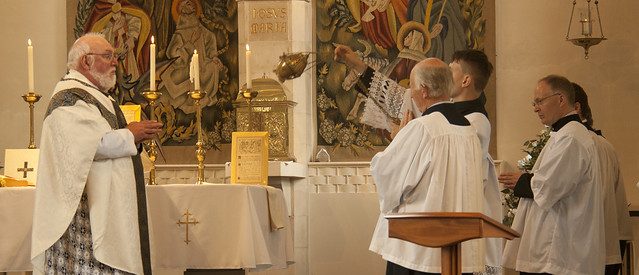
This year I was able to get to the Latin Mass Society's longstanding pilgrimage to Glastonbury, one of the ancient holy places of Europe. It generally takes place on the first Saturday of September.
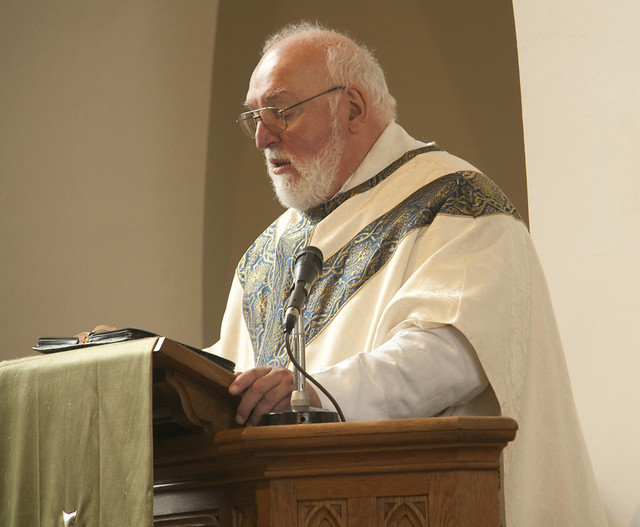
A Sung Mass was celebrated by Fr Philip Thomas. By coincidence, it has been announced that another priest of Clifton who has done much for the Traditional Mass, Fr Bede Rowe, will be taking over as Parish Priest of Glastonbury.
Wednesday, September 20, 2017
Cardinal Sarah's proposed reform of the Traditional Mass
In addressing the Summorum Pontificum Pilgrimage to Rome last weekend, with many very fine and important things to say, on the occasion of the 10th Anniversary of Summorum Pontificum, Cardinal Sarah acknowledged the response to his earlier remarks on the subject of ‘reconciling’ the Ordinary and the Extraordinary Forms of the Roman Rite.
In July I spoke of a possible future reconciliation between the two forms of the Roman rite. Some have interpreted this expression of personal opinion as the announcement of a programme that would end up in the future imposition of a hybrid rite which would bring about a compromise that would leave everybody unhappy and would abolish the usus antiquior by stealth, as it were. This interpretation is absolutely not what I intended. What I do wish to do is to encourage further thought and study on these questions in peace and tranquillity and in a spirit of prayerful discernment. There are improvements which can be made to both forms of the Roman rite in use today, and both forms can contribute to this in due course.
Subscribe to:
Posts (Atom)