Labels
- Bishops
- Chant
- Children
- Clerical abuse
- Conservative critics of the EF
- Correctio Filialis
- FIUV Position Papers
- Fashion
- Freemasonry
- Historical and Liturgical Issues
- Islam
- Liberal critics of the EF
- Marriage & Divorce
- Masculinity
- New Age
- Patriarchy
- Pilgrimages
- Pope Francis
- Pro-Life
- Reform of the Reform
- Young people
Friday, July 31, 2020
One problem with infallible canonisations
Dr John Lamont made the theological case against the infallible nature of decrees of canonisation on Rorate Caeli a couple of years ago: here's the first post, and here is a follow-up. The other day I stirred up Twitter by repeating some of his arguments and it didn't surprise me at all to see a fair amount of resistence to this idea from traditionally-inclined Catholics.
This follows very naturally from the fact that a lot of old books and old authorities say that canonisations are infallible. What one has to remember is that St Alphonsus and the rest used the term 'infallible' in a far looser way than Vatican I's definition, and when the term is used today it is that definition which tends to uppermost in our minds. Again, the process of determining the sanctity of individuals has been vastly, well, 'speeded up' would be a polite term. Saints generally needed four miracles to be canonised in the past, now they need two. And so on.
But I'm not going into all that again: Dr Lamont lays it all out. No one outside Twitter has ever seriously suggested that the infallibility of canonisations was itself a doctrine of the Church which requires the assent of Catholics. So we can agree to differ, as theologians in fact always have.
I want to point out something else which is of huge importance. The process of canonisation has always required money - the researchers have to be paid - and many of those canonised have well-funded supporters. Having rich chums does not in itself show that a person is not holy - even Christ had some rich friends, after all. But joined to a, ahem, streamlined process, there is a potential problem.
Thursday, July 30, 2020
Guild of St Clare sponsorship awarded
![]() |
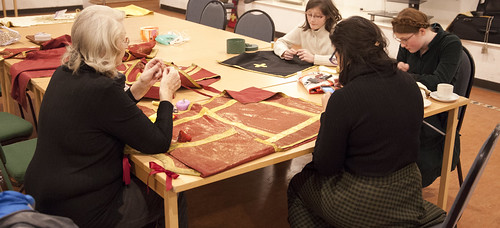
| A Guild of St Clare Vestment Mending Day before the Coronavirus |
This is the second year we have awarded sponsorship to assist a student undertake the Royal School of Needlework Certificate Course. The RSN is planning to restart teaching, with various safeguards, so our sponsored student will be able to start in August.
---------------------------------
The Guild of St Clare and the Latin Mass Society are pleased to announce that an award has been made for their Sponsorship Scheme which assists students in doing the Certificate in Hand Embroidery at the Royal School of Needlework.
The recipient is a religious who prefers to remain anonymous. We are delighted that the skills offered by the Royal School of Needlework will be joined to a vocation of hidden prayer and service to the Church.
![]() |
| The Royal School of Needlework at Hampton Court Palace |
Support the Latin Mass Society
Thursday, July 23, 2020
Communion on the tongue is an ancient practice
My latest on LifeSite.
I was honoured to be included in one of the videos created by LifeSite of people affirming their intention to receive the Holy Eucharist only kneeling and on the tongue. There are many ways of approaching the issue. John Henry Westen has approached it with a piece titled 5 reasons why Catholics should only receive Holy Communion on the tongue; also worth reading on this website is Peter Kwasniewski’s response to the suggestion by Fr Dwight Longenecker that reception on the tongue is somehow indicative of self-righteousness.
I would like to open up another avenue, a historical one. It is constantly reiterated by the proponents of reception in the hand that this is what the early Christians did. This is often put forward as part of a historical narrative that goes like this. As with many doctrines, the early Church had a very basic and common-sense understanding of the Blessed Sacrament, which was turned into something much more elaborate and extreme by the theology and devotional practices of the Middle Ages, which established the term ‘transubstantiation’ and the practice of Eucharistic reservation and adoration. The Protestants reacted against these extreme ideas with some justification, and Vatican II rowed back from them as well in the interests of getting back to the pure doctrine of the earliest Christians.
While it is true that theological terms became more precise, and devotional practice did develop, it is demonstrably false to suggest that Christian authenticity requires us to repudiate the more developed teaching and practice of the Church.
Read the whole thing.
Support the Latin Mass Society
Tuesday, July 21, 2020
Liturgy should be beautiful
My latest on LifeSite
What is one to make of the claim, apparently made in all seriousness, by Jesuit David Inczauskis, who rejoices in the Twitter handle @LibTheoJesuit?
Liturgy should not be beautiful.
At the Last Supper, Jesus washed stinky feet.
In the Garden, Jesus sweat blood.
At the cross, Jesus was violently murdered.
Upon rising, Jesus still had open wounds.
No, liturgy should not be beautiful. It should be ugly & scandalous.
I should like to engage with this tweet, which is of course a public statement intended to stimulate reflection and debate, with seriousness and charity. It is, nevertheless, presumably intended to shock.
I had imagined, naively perhaps, that when we see ugly vestments and church decorations, or hear hideous liturgical music, it was the result of well-intentioned efforts which had failed somehow—or that perhaps others’ tastes just differ from mine.
Was I wrong? Do some liturgists actually want to make the Mass repugnant, horrible, and off-putting?
Read the whole thing.
Support the Latin Mass Society
Thursday, July 16, 2020
LMS Online Conference on Saturday
![]() |
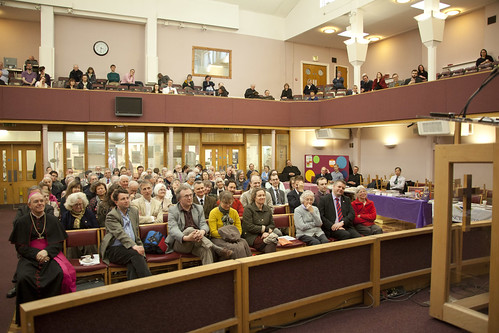
| A real-world conference organised by the LMS in pre-covid days |
An online conference “Catholicism in a Covid-19 World” will be hosted by the Latin Mass Society this Saturday, 18th July, from 12 noon (GMT + 1) until 4.45 pm (GMT + 1) featuring speakers Bishop Athanasius Schneider, Fr Tim Finigan, Fr John Zuhlsdorf, Dr Joseph Shaw, Archbishop Thomas Gullickson and Mgr Gordon Read. The event will be hosted by Dr Shaw and Sebastian Morello and will begin with Live High Mass in the Traditional Rite from St Mary’s Warrington.
Joseph Shaw writes “I am delighted to be taking part in the Latin Mass Society’s first online conference with a wonderful selection of speakers. I hope that many people will be able to join us on the day.”
This event is being held online for free and can be viewed on the Latin Mass Society’s new YouTube channel. To bookmark the LMS YouTube channel go HERE.
The direct link for the Conference is HERE.
No registration is necessary, although to sign up for updates before and during the event, go to HERE.
A recording of the day will remain on our YouTube channel.
Programme (Subject to change)
12 noon Introduction from Dr Joseph Shaw, Chairman of the Latin Mass Society and Sebastian Morello, Formation Adviser for the Archdiocese of Southwark.
12.10pm High Mass Live from St Mary’s Warrington. Celebrant Fr Armand de Malleray FSSP
13.25 Archbishop Gullickson, Apostolic Nuncio to Switzerland and Liechtenstein and Bishop Athanasius Schneider, Auxiliary Bishop of Astana, Kazakhstan
13.45 Fr Tim Finigan, Priest of the Archdiocese of Southwark
14.15 Mgr Gordon Read, National Chaplain to the LMS
14.45 Fr John Zuhlsdorf, President of the Tridentine Mass Society of Madison and Blogger: Covid-19 : What are the implications for Tradition?
15.45 Dr Joseph Shaw, Chairman of the LMS: After the Plague
16.15 Live Q & A with Dr Shaw, Fr Tim Finigan and Sebastian Morello
16.45 End
Support the Latin Mass Society
Monday, June 22, 2020
Online Latin Course in August and September
I'm delighted to announce that although our annual, residential Latin Course has had to be cancelled for 2020, another option for learning Latin has emerged. I can't take any credit for this, but am happy to advertise it: an online course using Christian Latin run by an experienced teacher of ancient languages, Matthew Spencer.
One reason for optimism about Latin is the continuing enthusiasm of teachers and students, and their continuing willingness to experiment with different approaches to language learning and the delivery of lessons, to reach new people, both beginners and those wishing to improve their Latin.
These won't take over your life: they will be 2 hours of online tuition a week, and homework between sessions is optional.
I am myself planning to do this course: join me and Mr Spencer in the adventure of Christian Latin!
-----------------------
Mr Spencer has previously been teaching ancient languages to university students preparing for further studies, and he would now like to apply his skills to teaching Latin. The course’s focus on the distinctive, later period of Latin of writers such as Augustine and Boethius will make this course of particular interest and usefulness to Catholics and all those interested in discovering the rich world of Christian Latin.
He plans to teach very small groups once or twice a week, some aimed at 'Beginners' and others at those with some previous experience of Latin.
Thursday, June 18, 2020
Conservatism after Bostock
The recent
Supreme Court decision, penned by Neil Gorsuch, has knocked the wind out of a
lot of Americans on the right. The central claim, that an Act of Congress in
1964 intended to include sexual orientation and gender identity in the word
“sex”, as a characteristic to be protected against discrimination, is so
evidently insane surely—one might think—no person of intellectual integrity
could affirm it. If we view it as not, strictly and literally true, but as a
necessary legal fiction, then the question becomes one of policy. What urgent
issue of natural justice is served by erasing the distinction between
biological sex, erotic preferences, and feelings-about-what-one-is?
The answer
is protecting people from discrimination on the basis of those two other
things. I can understand why the liberal Justices on the Supreme Court should
think this. In UK law “sexual orientation” and “gender reassignment” are both “protected characteristics” which must not motivate
discrimination. So is “sex”. The Bostock decision goes much further than the UK
law, however, in bypassing the need for any formal “gender reassignment” (the
very concept seems old-fashioned today: the UK law dates from 2011), and also
by rolling the three characteristics into one. Gorsuch’s remarkable reasoning
is that discrimination on the basis of sexual orientation just is
discrimination on the basis of sex.
The precise
legal consequences of the decision will emerge over time. The most astonishing
aspect of it is that this decision was approved not only by liberal judges, but
by two supposedly conservative ones: John Roberts and Neil Gorsuch.
Republican-nominated Supreme Court Justices turning into liberals in office is nothing new, and it is part of a wider pattern
of conservatives in positions of power and influence not wanting to stand up
for conservative causes. At the individual level this is easy to understand: if
you want to preserve your ability to earn a living, you have to watch what you
say. But collectively, it is incomprehensible. On many occasions, liberal views
have triumphed despite lacking popular support. If the conservative opposition
to the latest progressive cause simply stood up for itself, in many cases the
issue would not be in doubt. But not only does this not happen, but people tend
to accept each step of the progressive revolution after it has happened.
Subscribe to:
Posts (Atom)