Saturday, June 07, 2014

Chartres: gathering outside Notre Dame


- Posted using BlogPress from my iPhone

Friday, June 06, 2014

The Kiss of Peace

IMG_7615
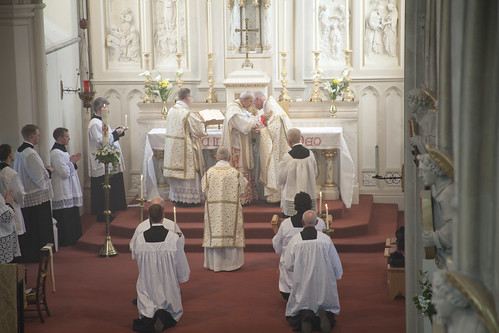
Bishop Schneider giving the Kiss of Peace to Fr Finnegan, the Assistant Priest, at West Grinstead
Today I am publishing a new Position Paper from the Una Voce Federation (FIUV), on the Kiss of Peace: go over there to read it.

The Pax may not seem the most important issue, but it is an interesting one, and also one which has a big effect on many people's liturgical experience. The over-chumminess and disruption caused by the Novus Ordo's 'Sign of Peace' is a trial for many people, and has been repeatedly condemned by Rome, notably in Pope Benedict's Post-Synodal Exhortation Sacramentum Caritatis (2007) 49:
IMG_7617
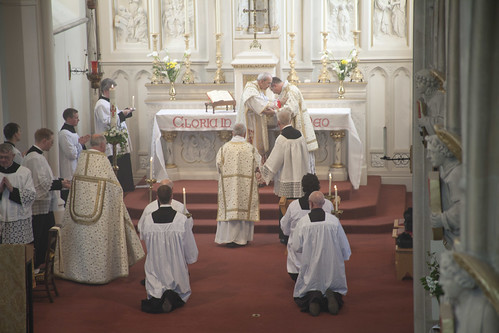
Bishop Schneider giving the Peace to Fr Goddard FSSP, the deacon

‘…during the [2007] Synod of Bishops there was discussion about the appropriateness of greater restraint in this gesture, which can be exaggerated and cause a certain distraction in the assembly just before the reception of Communion. It should be kept in mind that nothing is lost when the sign of peace is marked by a sobriety which preserves the proper spirit of the celebration, as, for example, when it is restricted to one's immediate neighbours.’

Pope Benedict's words reflects the feelings of many, like those of a certain Mr Waits who felt moved to write the following to the Universe (UK Catholic weekly newspaper) in 2011:

Whoever dreamt up the sugary sign of peace seems to have been naively oblivious to some unpleasant practicalities. In my church, one elderly widower tours the pews 'making a meal'; of his license to to make contact with female bodies. ... When the 'feel good' moment arrives, they approach me expectactly, but I ignore such cheap, shallow, bonhomie. I have often felt like adding 'a little peace before Mass would not have gone amiss.'

The reform of this little ceremony exemplifies the 'archaeologism' of the reformers: their attempts, at least in some places, to resurrect long-extinct texts and rubrics. It also exemplifies the problems with such archaeologism: its dependence on the limited scholarship of half a century ago, its ability to miss the most crucial point about a ceremony, and its refusal to understand the good reasons why, under providence (not thanks so some know-it-all committee), change happened, gradually, over the course of the centuries.
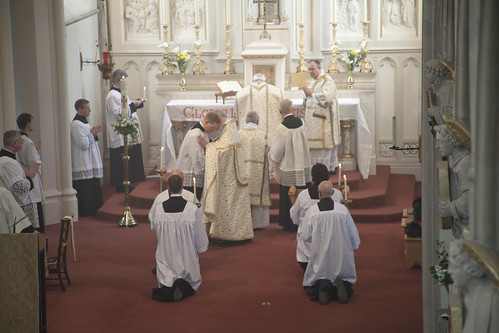
IMG_7619
The Assistant Priest giving the Peace to the Master of Ceremonies
First, yes everyone did exchange the kiss of peace in antiquity. The reformers saw that this took place earlier, at the Offertory, in the Gallican Rite, and there was a widespread idea (see the scholars Gregory Dix and Josef Jungmann) that the Roman Rite moved the Pax from that position to its current one before Communion, at some point prior to a famous letter on the subject written by Pope Innocent I in 416. This is an example of scholarship getting ahead of itself, however: there is not a scrap of evidence that it ever took place at the Offertory in the Roman Rite (or in the closely associated African liturgical practice).

This is important for the meaning of the ceremony. At the Offertory, the key to it is the reconciliation of the Community, an idea which appealed to Bugnini and his gang in the 1960s. But in the Roman Rite, while this idea is not absent, there is something else which sets it into a bigger context.

The Peace is on the Altar.

Christ, the Prince of Peace, has come down upon the Altar, and it is His peace which is imparted in the Kiss. So it is not just exchanged between members of the congregation: it is given to them from Christ. The celebrant kisses the Altar next to the Consecrated Host, and it is this kiss, exchanged with Christ, which is passed on, one by one, to the rest of those present.
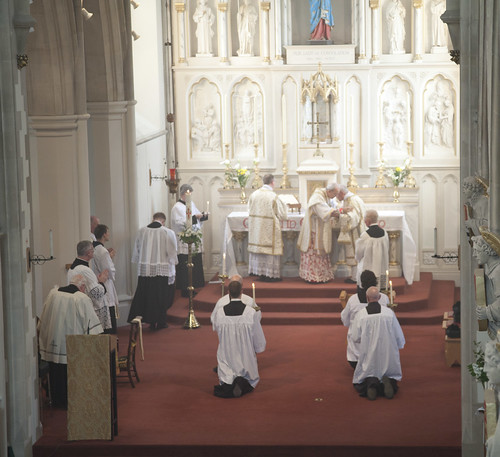
IMG_7620
Bishop Schneider giving the Peace to Fr Hayward, the subdeacon
This is done with the very beautiful ceremony of the 'embrace', first to the deacon, then the subdeacon, then the MC and so on. I was delighted to hear that in Spain and her former Empire this can be passed on to the congregation with a 'paxbrede', a physical object (usually a small silver disc with a handle), as was done in Medieval England. Elsewhere, for practical reasons, the participation of the Faithful in the ceremony has, since the end of the Middle Ages, become purely spiritual.

The passing on of the Peace from the Altar has been completely lost in the current ceremony--if we can call it that--in the Novus Ordo, where everyone simultaneously shakes hands with everyone else.

Speaking personally, I am always moved to see the ceremony of the Pax at Traditional High Mass; I think it is one of the most symbolically eloquent ceremonies in the Mass. It is an example of something which really works. Those arguing about what to do about the Sign of Peace in the Novus Ordo should bear that in mind.

Thursday, June 05, 2014

Sodality of St Augustine: public Mass on 13th July

The Sodality of St Augustine was set up last year by the Latin Mass Society as a means for members to pray for each others' loved ones, who are lapsed or non-Catholics. It takes its inspiration from the prayers of St Monica for her wayward son, St Augustine.

In addition to a daily prayer, members can have Masses said for the Sodality's intention.

Every year we have a public Mass celebrated for the same intention; this year, the second one, will be on:

Sunday 13th July, 10:45am, at St Bede's, Clapham Park.

It will be a sung Mass with polyphony, the music provided by Charles Finch and his Cantores Missae.

St Bede's is located at 58 Thornton Rd., Clapham Park, London SW12 0LF

Members are invited to contribute to the cost of this Mass.

For more details, to join and to donate, click here.

The Sodality prayer is is the Collect of the Commemoration 'Pro Amicis' found in the 1962 Missal, which is ideally used in Masses for the Sodality's intention.

O God, who, by the grace of the Holy Ghost, hast poured the gifts of charity in the hearts of thy faithful, grant to thy servants and handmaids, for whom we entreat thy mercy, health of mind and body; that they may love thee with all their strength and, by perfect love, may do what is pleasing to thee. Through our Lord Jesus Christ thy Son, who liveth and reigneth in the unity of the same Holy Ghost, God, world without end. Amen.

Wednesday, June 04, 2014

Roman Forum on the Gardone Riviera

I've posted up the information about this already on this blog; the Latin Mass Society is sponsoring two young people from England and Wales to attend this year.

The dates: 30 June – 11 July 2014

Here is a video about it with an interview with Dr John Rao.

Tuesday, June 03, 2014

LMS Pilgrimage in honour of St Chad, Birmingham


As I mentioned on this blog, the Pilgrimage to Our Lady of Consolation at West Grinstead, where Bishop Schneider celebrated Mass, unavoidably clashed with the first LMS Pilgrimage to the Shrine of St Chad in Birmingham Cathedral (St Chad's). The Birmingham Pilgrimage was marking St Chad's secondary feast day, the feast of his Translation, which falls on the Tuesday of the 4th Week after Easter, in the Archdiocese of Birmingham (in the EF calendar).


I'd delighted the the Birmingham pilgrimage was a success, with High Mass at the High Altar of the Cathedral, which is where St Chad's bones are kept. The Cathedral is one of Pugin's masterpieces.


I'll make every effort to be there next time. More details on the Birmingham Reps' blog.

Monday, June 02, 2014

Ten years of the Juventutem Movement

From Juventutem: Floreat!


The International Juventutem Federation is pleased to announce that His Eminence George Cardinal Pell, Prefect of the Secretariat for Economy, has kindly accepted our invitation to be the Celebrant at a Pontifical Solemn High Mass according to the Missal of St John XXIII on Friday 24 October 2014, 6:30pm, at Santissima Trinità dei Pellegrini, Parish Church of the Priestly Fraternity of St Peter in Rome, Italy. The Holy Sacrifice will be offered in thanksgiving for the tenth anniversary of Juventutem, the worldwide youth movement fostering the sanctification of the young through the Roman traditions of Holy Mother Church. We are grateful to His Eminence who generously presided at Solemn Pontifical Vespers organised by Juventutem during World Youth Days in the past, first in Düsseldorf on 17 August 2005, and again in Sydney on 16 July 2008.

After Vespers in Düsseldorf, Cardinal Pell gave the following encouragements to the young WYD pilgrims of Juventutem: "I am happy to be here because the old Latin rite is one of the most beautiful things in the entire Western civilization. And I am very glad that this ancient rite has its place in the Church today. I am happy because this rite helps you to love God and to love one another. In this ancient rite we always see that our prayer is an act of worship. It is impossible to see a celebration like these Vespers as something horizontal. We have one Church only, whose Head is the Successor of Peter, with the Bishops as successors of the Apostles, and this unity is very important for the life of the Church” (translated from the original French).

Members and supporters of Juventutem are cordially invited to make arrangements to be in Rome and attend the Mass, which will be preceded by other Juventutem activities (full schedule to be advertised soon). All pilgrims in Rome are naturally invited as well, regardless of their involvement with Juventutem. The event will be part of the Populus Summorum Pontificum Pilgrimage 2014. The following day, on Saturday 25 October, His Eminence Raymond Leo Cardinal Burke, Prefect of the Supreme Tribunal of the Apostolic Signatura, will celebrate a Solemn Pontifical High Mass according to the Extraordinary Form of the Roman Rite in Saint Peter’s Basilica, at 12:00 noon.

Signed: International Juventutem Federation, on 27 May 2014.

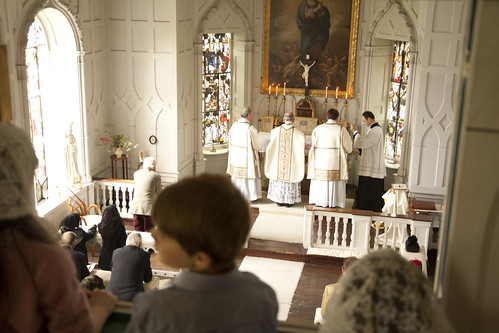
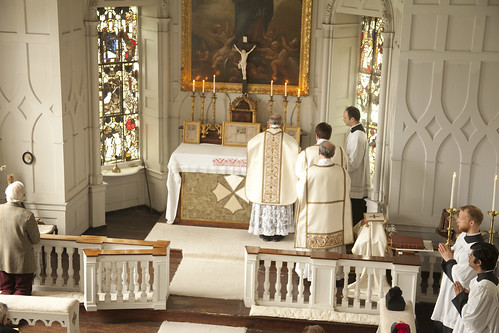
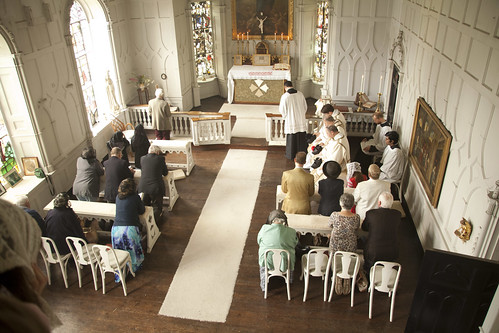
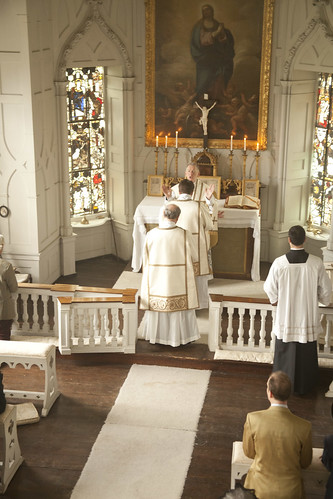
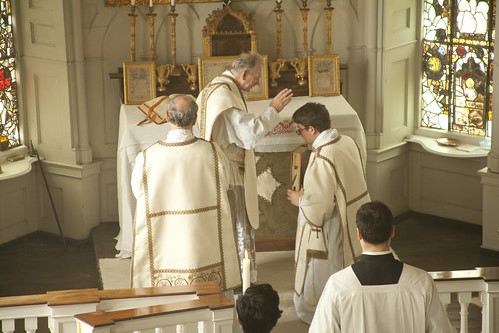
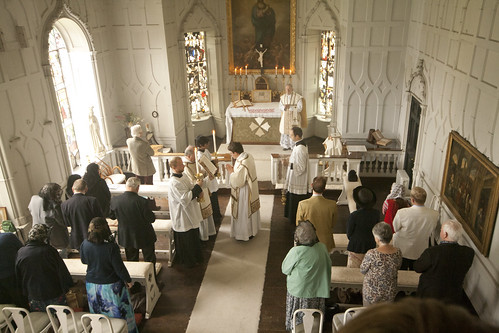
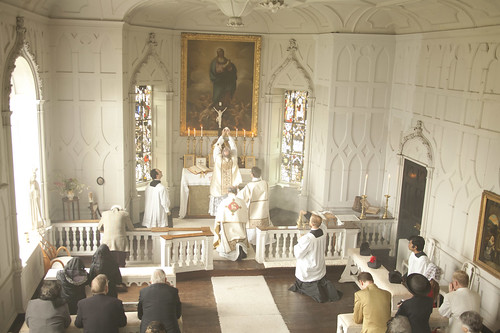
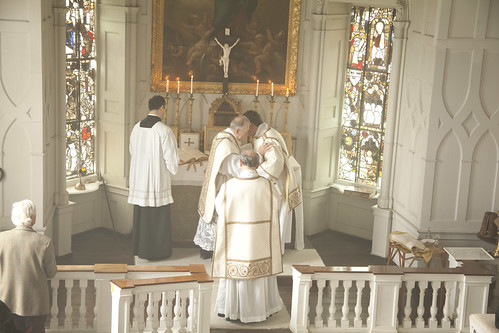
High Mass in Milton Manor: photos

IMG_7976

This is the first time we have done this. It may be the first time it has ever happened, but there's no telling what went on here over two and a half centuries. Always in the past we--the Latin Mass Society--have had Missa Cantata, sung Mass with one priest.

IMG_7982

Even then, getting all the servers into the sanctuary can be a challenge; if we have a big serving team (acolytes plus torchbearers), the torchbearers have to kneel outside the sanctuary. So spilling over into the nave a bit is nothing new.

IMG_7978

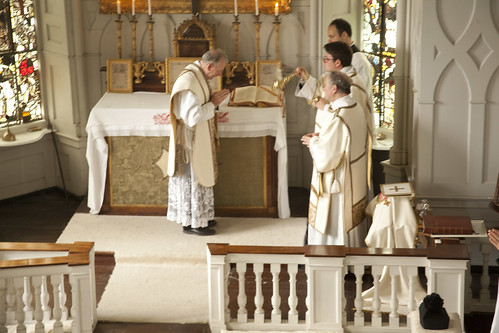
I was fortunate to get a team of sacred ministers who all knew exactly what they were doing. Fr Anthony Conlon, the celebrant, was for many years the National Chaplain of the Latin Mass Society; Fr Daniel Lloyd, of the Ordinariate of Our Lady, the deacon, has rapidly become quite an expert on the Traditional Mass, and Fr Guy Nichols, of the Birmingham Oratory, comes from the only place in Britain where there is an EF High Mass every Sunday.

IMG_7981

Thanks to the initiative of our Master of Ceremonies, who had the idea of the bench for the clergy seen in the pictures, it all worked extremely well. There is--just--enough space for three sacred ministers lined up at the Altar.

IMG_7986

I wanted to celebrate this Mass with special solemnity because this year we are celebrating the 250th anniversary of the purchase of the property by the Barrett family, who built the chapel and turned the house into a Catholic centre for the area.

IMG_7989

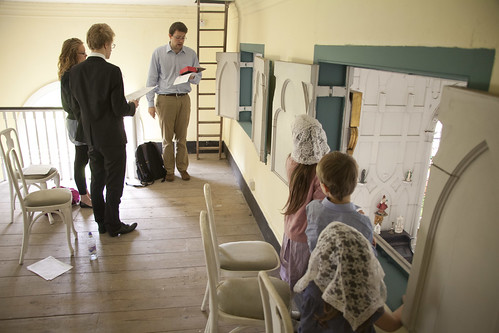
The splendour of the ceremonies was matched with the singing. In the unique little choir loft (I'm not sure if it was intended as a loft for the family, since unlike others I have seen it doesn't connect directly with the house), we had a small chant schola from the Schola Abelis and a small polyphonic group from the Newman Consort.

IMG_7994

May the descendant of the Barretts, now the Mockler-Barretts, continue to flourish in this wonderful house.

IMG_7771

IMG_8007

IMG_8011

More photographs here.