Sunday, March 31, 2019

Family Retreat: last call

I'm re-posting this: please book NOW! On the SCT website.

IMG_1682

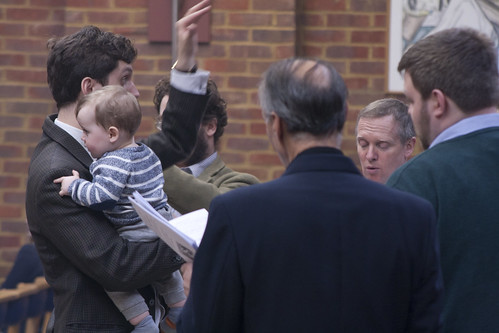
The St Catherine's Trust Family Retreat takes place at the Oratory School, Woodcote near Reading, Friday to Sunday 5-7th April this year.

Booking is open: go to the SCT website.

As the name implies, in organisation and pricing it is adapted for families, with children. Unaccompanied adults are very welcome as well.

This year it will be led by Fr Konrad Loewenstein and Fr Seth Phipps of the Fraternity of St Peter. The theme is the Passion.

Don't miss out on this unique event. The Gregorian Chant Network's Training Weekend runs alongside: see the same page for information and booking.

IMG_1664

Support the Latin Mass Society

Friday, March 29, 2019

Cardinal Marx on Celibacy

A recent LifeSite article of mine. It begins:

When asked what he thought about Western civilization, the Indian independence campaigner Gandhi is supposed to have replied, “I think it would be a good idea.” A similar witticism might seem appropriate when considering priests engaged in sexual abuse and celibacy. Celibacy: It would be a good idea.
Cardinal Marx takes a different view. During last October’s Youth Synod, he seemed disappointed that the subject was not discussed. LifeSiteNews reported him as saying that, although “celibacy is not the cause for abuse,” the stresses of unmarried life might be a factor. Now he has arranged for it to be discussed by a synod of the German bishops, saying “sexual freedom” is intrinsic to the “inner freedom of faith and orientation to the example of Jesus Christ” and that celibacy might not be “realistic” for all priests.
It sounds as though Cardinal Marx is preparing to dismiss celibacy, even while paying lip service to its value as an “expression of religious commitment to God.”
Continue reading there.

Support the Latin Mass Society

Saturday, March 23, 2019

Re re-print: the Parish Ritual

Cross-posted from Rorate Caeli.

Preserving Christian Publications has brought out a beautiful reprint of a book once almost as essential to the work of a priest as the Missal or Breviary: the Parish Ritual.

Published in the USA in 1962, it is the equivalent to the Small Ritual published in England in 1964. It is an extract from the Missal and the Roman Ritual, containing the texts needed by a priest for weddings, baptisms, and funerals, Extreme Unction, receptions of converts, and a large number of blessings (of Rosaries, the Miraculous Medal, Holy Water, etc. etc.), all in a handy format worthy of use in the liturgy itself.

Friday, March 22, 2019

Calx Mariae on Sex Education in Schools


I have an article in the new and excellent edition of Calx Mariae, which is published by Voice of the Family. You can take out a subscription here.

Calx Mariae is an impressive publication, with some very distinguished contributors: this issue has articles by Prof Roberto de Mattei and Duke von Oldenburg.

My article begins:

Tuesday, March 12, 2019

Chant Training Weekend, 5-7th April, now booking

IMG_1748


Booking open for the Gregorian Chant Network Chant Training Weekend

GCN Logo

5-7th April
Oratory School, Woodcote, near Reading RG8 0PJ
Registration is from 4pm to 4.45pm on Friday 5th April.
There is a Sung Mass at 5pm followed by dinner.
Late registrations are possible from 7 to 7.30pm, after which the course begins.
The course ends after Mass and lunch on the Sunday (lunch at 1.10pm approx.).
The weekend is being led by Fr Guy Nichols and Dominic Bevan.
Deep discounts for two, three, or more members of a single choir or schola!
I look forward to seeing many of you there!
Joseph Shaw
Support the Latin Mass Society

Sunday, March 10, 2019

We need better bishops, not (just) better procedures

My latest on LifeSite.

Many proposed solutions to the crisis in the Catholic Church focus on structural or administrative reform. Administrative solutions are attractive because they promise that our problems could be solved by a committee somewhere coming up with a new set of rules. Wouldn’t that be wonderful? It is true that some administrative systems are better than others, and we should naturally prefer better over worse, but no system is better than the people who administer it. What was going wrong in past decades was already against the rules, but the rules were not being taught in seminary, they were not being preached from the pulpit, they were not being defended in public by bishops, and they were not being enforced by Rome. The rules failed because of a failure of will.
An illustration is given by Cardinal Joseph Ratzinger’s insistence, in 2001, that all cases of the clerical abuse of minors be thenceforth dealt with by the Congregation of the Doctrine of the Faith (CDF), of which he was then Prefect. Ratzinger, later Pope Benedict, deserves credit, which he usually does not get, for driving this through. The reason it made a positive difference was not that before 2001 no one had the job of dealing with these cases. The reason is that for many years a huge number of local bishops, and great swathes of the Vatican curia, had lacked the will the deal with the problem. At that time, the CDF was one of the few places one could go to find people who still believed in sexual sin, and in the appropriateness of punishing it.
Ratzinger’s reform was good news for the many victims who, finally, began to have their accusations taken seriously. But it couldn’t address the fundamental problem, the problem of bishops and various categories of officials who were by character and attitude incapable of dealing with clerical abuse in an appropriate way. Their incapacity is obviously closely linked to the attitudes and behaviors of the abusers themselves.


Support the Latin Mass Society

Thursday, February 28, 2019

Felt banners and participation

My latest for LifeSiteNews.
IMG_8563
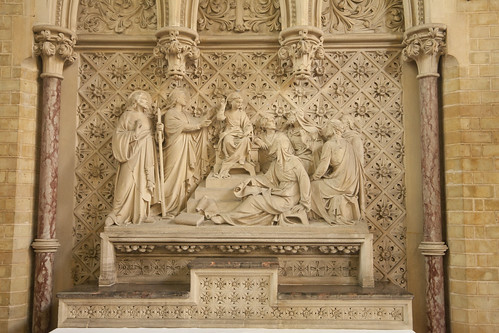
The Christ-child with the Doctors of the Law: an elaborate, classical, and beautifully
executed sculpture in St Dominic's, Haverstock Hill, in London. The time, money, effort, and
sheer  competence represented by the sculptures for the fifteen altars corresponding to the
Mysteries of the Rosary is staggering.
An alien from outer space studying the Catholic Church of the last few decades might be puzzled at the frequency and apparent significance of the phrase ‘felt banners’ in Catholic discourse. It seems to sum up much of what is wrong with the Church, at least for many Catholics, but it is rarely explained. It doesn’t need to be, because we have all seen these objects, and we know the significance of the attitudes and processes which led to their production and display.
If I wanted to explain to Zog the Martian what is at issue when felt banners come up in conversations among Catholics, I might say that ugly and inappropriate items of church decoration exemplify and have come to symbolize an attitude of hostility towards objective standards of beauty, excellence, and truth. Zog, however, might find this explanation even more strange than the items themselves. How on earth did such an attitude come to be held by people in the Church, let alone by those with power over what gets hung on the walls of places of worship?
Familiar as the phenomenon is, it is useful to try to articulate what is at issue. The partisans of felt banners do not necessarily prefer ugliness over beauty. Their concern, rather, is to prioritize the contribution to church decoration of the artistically incompetent over that of the artistically competent. Because the latter might be paid, or might not be members of the parish, or might be long dead, their contribution has less value seen as a form of participation in community life. Indeed, the artists who beautified the Catholic churches of yesteryear, and the few who still place their expertise and judgment in the service of the Church, were and are not thinking of their work primarily in terms of community participation, but in terms of objective standards of devotional appropriateness and of artistic excellence.
Read it all there.

Support the Latin Mass Society