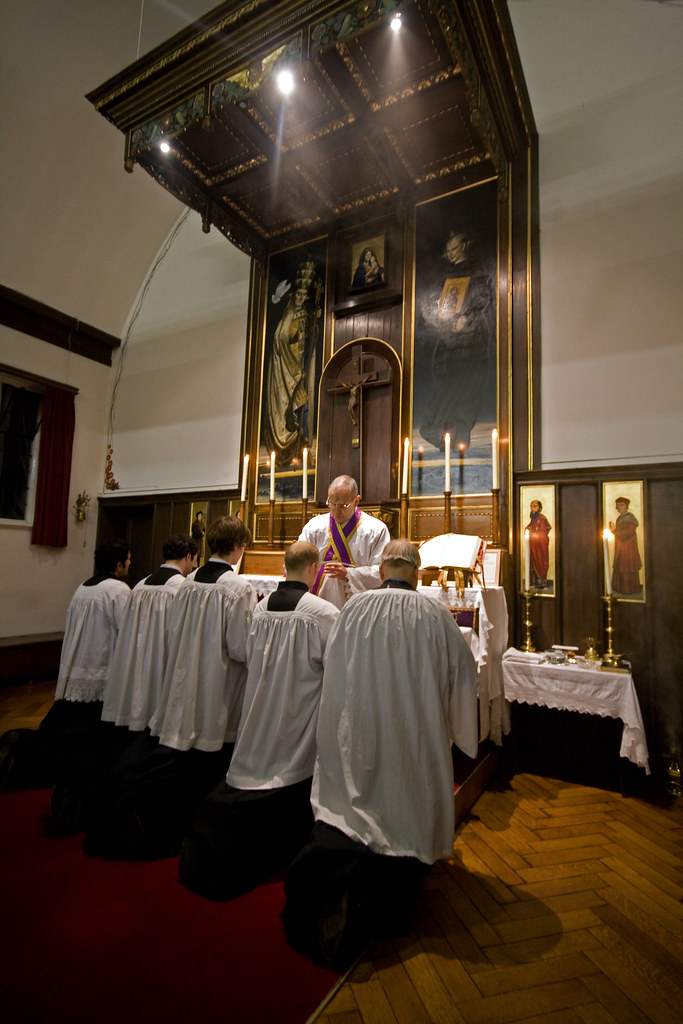
It is often asked, with puzzlement, why the readings are read in Latin in the
usus antiquior. That they must be read in Latin has been
reiterated by the PCED in a recent ruling, although they can be repeated in the vernacular. But surely, people say, the readings are intended to be understood by the people! What is the point of reading them in Latin?
The greatest obstacle of all to the acceptance of the TLM by ordinary Catholics brought up on the Novus Ordo is this simple point, which is implicit even in the New Mass but is inescapable in the TLM: the ceremonies and prayers may be edifying to the people, if they understand them, but they are directed towards not the congregation but to God. That is why the 1970 Missal continues to make use of ceremonies and language people cannot readily understand. Placing a fragment of the consecrated host into the consecrated chalice: how many people understand what that means? (Indeed, is there a single uncontroversial answer?) The priest continues to pray silently at the Lavabo. And of course the use of Latin, especially Latin chants, is still recommended. The 1970 Missal does plenty of things the people can't see, or hear, or understand, because it is directed towards God.
In the
usus antiquior the pretence that the people 'should be able to see and understand everything' is totally impossible. You are forced to see that what the congregation is doing is looking at a sacred action carried out on their behalf by the priest who ascends the altar steps to face God Himself. The kind of participation possible to the congregation is principally that of uniting themselves to the sacrifice offered by the priest to God. This is what makes them more than mere spectators, but this is a prayerful interior participation, not the participation of fellow actors on the stage.
A colleague of mine put the point very eloquently:
The translations of the readings read in vernacular, in fact, do not belong to the Liturgy. Even the homily is not part of the Mass, because of that the priest before preaching often takes off the maniple (and sometimes even the chasuble).... The Liturgical readings in Latin do not have mainly a didactic purpose: they are also and primarily acts or worship. They do not have to be understood in terms of a rational knowledge (the eagerness to understand clearly and distinctly every single part of the Mass and especially the readings is pure Cartesianism). We should look upon the readings of the Mass with the Eastern mentality (as we are reminded by Msgr. Klaus Gamber): as true Epiphanies of God who, as Saint Paul says, "multifariam, multisque modis olim Deus loquens patribus in prophetis : novissime, diebus istis locutus est nobis in Filio". The Epistle is the manifestation of Our Lord through the Prophets and the Apostles, whilst the Gospel is His Epiphany in the Son. It is for this reason that the Gospel is honoured, accompanied by the candle-bearers, incensed by the deacon and kissed by the priest in High Mass. The Gospel in the Mass is the Logos made flesh (Verbum caro factum) and manifested to us. The readings of the Mass, then, are sacred and worthy of our deep veneration and must not be considered as a mere "instruction" (the instruction comes with the homily or in the teaching of the catechism).There is a lot we have to re-learn about the liturgy, including many things which were being forgotten in the first half of the 20th Century. The desire that everything should be immediately comprehensible has, thankfully, been rejected in the context of the new translation of the 1970 Missal, which is going to use words not readily comprehensible by all members of the congregation, but about which they will need to be catechised. The wider point, however, is that, as Martin Mosebach puts it in his book '
The Heresy of Formlessness', when Mass begins we enter into a sacred time characterised by the sacred space, clothing, and language of the liturgy. He asks us to acknowledge breaking into that sacred time, and interupt what is being done in the sacred space of the sanctuary in the sacred language, as being problematic: he is speaking of the sermon. Perhaps it would be better to have the sermon at the end of Mass, as was formerly done. But even if we think that a vernacular sermon after the gospel, preceeded by a reading of translations of the epistle and gospel, is justified, the point is that we are holding our breaths: the sacred action is suspended. It will recommense when the priest puts his maniple back on, and returns to the altar.
A number of priests all over the world have, in good faith, adopted vernacular readings to the exclusion of the Latin in the EF for 'pastoral reasons', thinking this has been permitted by the Motu Proprio. I have always found this a little puzzling: why not simply repeat them in the vernacular? However, the legal goalposts have now been moved.
 Please form an orderly queue!