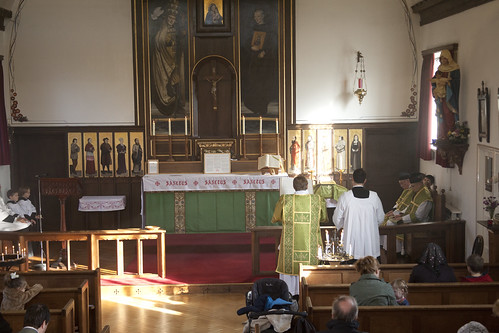
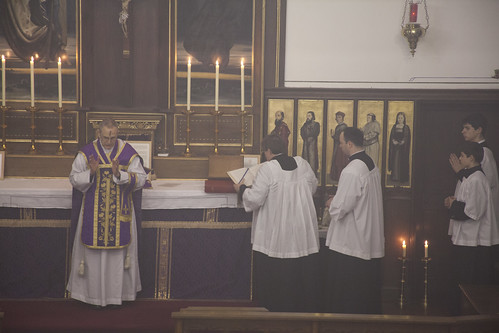
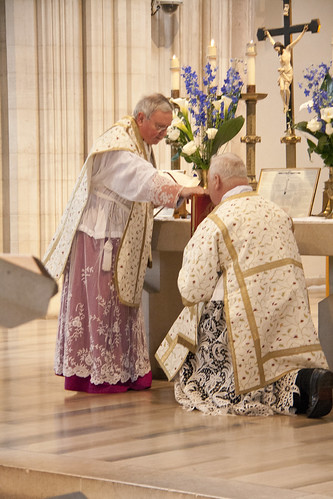
 Having readings in Latin at Mass is something which many people find rather baffling about the Traditional Mass. Today I am posting a Position Paper on the subject over on Rorate Caeli, defending the traditional practice: go there to read it.
Here I want to reflect on an associated issue: the wider question of the use of the vernacular at the Traditional Mass. One of the things which struck me when reading up on the topic is a polarisation of views, among those who want to mix Latin and the vernacular, as to which should be used for what. I think this is quite revealing.
One view says that they should be used for the changing parts of the Mass - the parts which are unfamiliar. If we had the readings and the proper prayers in English (or whatever vernacular we are considering), then we wouldn't have to refer to our Mass books. We are after all familiar enough with the unchanging parts - or, if we're not, we will be in time. This is essentially what happens in most Latin Novus Ordo Masses: we revert to Latin in the bits everyone knows, like the Agnus Dei, the little dialogues ('Dominus vobiscum!' and everyone booms back, at different speeds, 'Et cum spiritu tuo!'), the Canon, and the Pater Noster.
The other view is the opposite. The most obscure propers, like the Collect, should be kept in Latin, and English should be used for really familiar things like the Pater Noster. This is the view of the influential and highly regarded liturgical schola László Dobsay. He's quoted in a footnote to the Position Paper as follows:
This is an interesting and powerful argument. But it applies equally, or more, to the Scriptures. Sacred Scripture is the basis of theology, and the terms of Sacred Scripture have an even more fundamental importance than the terms of the Collects. The Vulgate version of the Scriptures, which is used in the readings, has been pondered and commented upon by the great theologians of every generation since it was composed; often enough the earlier versions, used by St Augustine and others, are close enough to this text too. It diverges in certain ways from modern English translations, and it is exactly for this reason that it is important for us to keep up some familiarity with it: otherwise we risk losing touch with what the Fathers and Doctors are talking about.
This subject, of course, takes us back to an earlier Position Paper: on the use of the Vulgate and Ancient Latin Psalters.
 Dobsay's suggestion that some of the most familiar texts of Mass should be in the vernacular, including the Pater Noster, remains baffling. What is supposed to be the point of this? Everyone - for practical purposes - knows the Our Father in their native language, so you aren't telling them anything they didn't already know when you recite it in English. It doesn't take long for people to become thoroughly familiar with the Pater Noster in Latin, and it is not uncommon for people to pray or sing it in Latin, as we do on traddy pilgrimages. Why break out of the sacred language for the sake of a text we know by heart?
To some extent the argument of familiarity applies to the readings. Because we are familiar with the Gospel stories, especially those used at Mass which we read in our hand-missals, it doesn't take long before you often recognise what the story is as it is being read, from the odd name or phrase: St John the Baptist and Herod, the Rich Man and Lazarus, and so on. If you listen to it and follow it in a missal, you start to recognise more and more of it, and you start to notice quotations from it in some of the other propers of the day. Even if you have little or no Latin to start with, you gain a certain familiarity with both the words and the meaning.
I can't help thinking that the only reason for Dobsay to suggest having the Pater Noster in the vernacular is that he wanted to say something should be in the vernacular, and couldn't think of anything else. But, as the paper argues, a problem is raised by even the most limited use of vernacular, because we end up switching between two languages. This, if you think about it, is a very strange thing to do, and it makes it impossible for Latin to mark out a sacred, liturgical space.
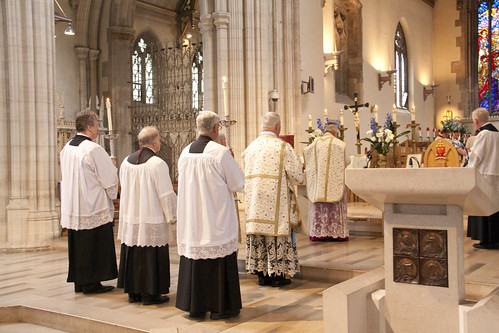
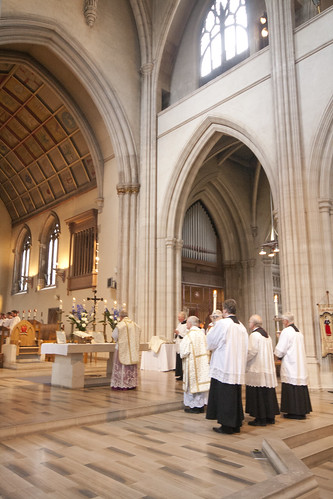
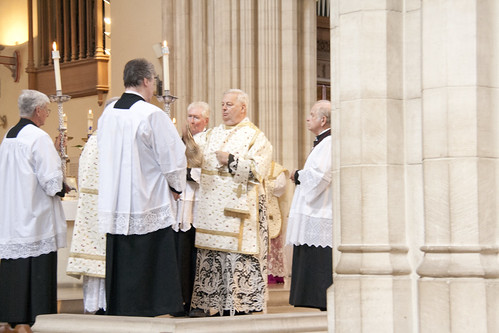
Pictures: preparations for the proclamation of the Gospel, Solemn Mass in St George's Cathedral, Southwark, for the Latin Mass Society's Annual General Meeting. The gospel procession pauses in the middle of the sanctuary to allow the singers to complete the Gradual and Alleluia.