Monday, March 12, 2012

Ordinariate gets its own liturgical calendar

The Ordinariate of the USA has got its own calendar approved: dowload it here. This goes far beyond a few local feasts one might find in a diocesan calendar. It is a serious attempt to maintain their patrimony. And funnily enough, that turns out to be a the Catholic patrimony.
  1. As in England, Ordinary Time will no longer be referred to, being replaced by Sundays after Epiphany or Sundays after Trinity, thus ensuring the whole liturgical year is now explicitly anchored and referenced to the mysteries of salvation.
  2. The three “-gesima” Sundays are restored.
  3. Rogation days before Ascension, and the Ember days in the four seasons of the year are restored.
  4. The Octave of Pentecost is restored, to be marked properly except for the readings which will be of the particular weekday.
The recognition of the value of the Season of Septuagesima, Rogation Days and so on by the Holy See in this official way, for a brand new initiative, is enormously significant. If it has value for the Ordinariate, then obviously it has value in the context of the Traditional Mass.

I understand the English Ordinariate has a very similar calendar, but you can't download it as far as I can find.

H-t Fr Hugh.

Saturday, March 10, 2012

Superstition at the Ashmolean Museum

I visited the Ashmoleum in Oxford on Friday. The have some wonderful exhibits, from a vast range of periods and regions. They need to explain all sorts of strange customs and forms of life to their visitors. This is what they came up with to explain what a pilgrimage is- or was.

 This is so utterly bizarre, as a description of what pilgrimages were about, that I am baffled as to where they could possibly picked up the idea. Were they reading some kind of Protestant polemic against pilgrimages from the 17th Century? Or were they just making it up?

I always regret not complaining about these kinds of things. Once I made a special trip to the Oxford Story (a little train took you past exhibits) to note down the anti-Catholic bias, but delayed my complaint only to find the place had closed down. (The finest example, I recall, was the claim that Medieval philosophers thought the earth was flat. Really?) So I'll write to the Ashmoleum and see what happens.

What is so regular as to be expected is referring to Catholics and their beliefs in the past tense, as if they were talking about the Incas.
But they also have really wonderful things. Here is the decoration on a Coptic dalmatic: the Virgin and Child, and under them, St George slaying the dragon.

Friday, March 09, 2012

Two special Masses in Clifton Diocese

2010 08 12_7298'
The first is a Sung Mass for the Annunciation on Monday 26th March, which will be celebrated at the Immaculate Conception, St Joseph's Place, Devizes 
SN10 1DD at 7pm.

On Saturday 5th May there will be a Solemn High Mass at Downside Abbey, celebrated by Dom Boniface Hill, at 11am.
The Abbot will preach, and the St John's Festival Choir will sing the Missa 'O Rex Gloriae' by Lobo. At the Offertory will be "Ave Jesu Christe" by the sixteenth century English recusant exile Peter Phillips, and at Communion "Ave Maria" by Clemens non Papa.

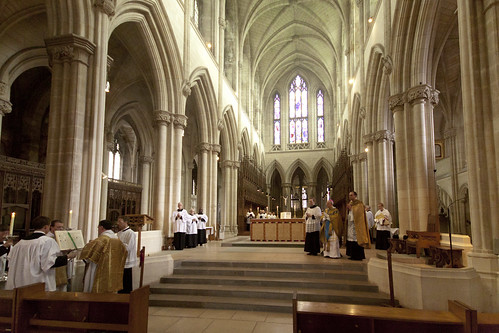
(Photo: Downside Abbey Church, on the occasion of the Pontifical Mass celebrated by Bishop Anthanasius Shneider at the LMS Pirests' Training Conference 2010.)

Wednesday, March 07, 2012

Ember Saturday Mass at St Anthony's

IMG_8936
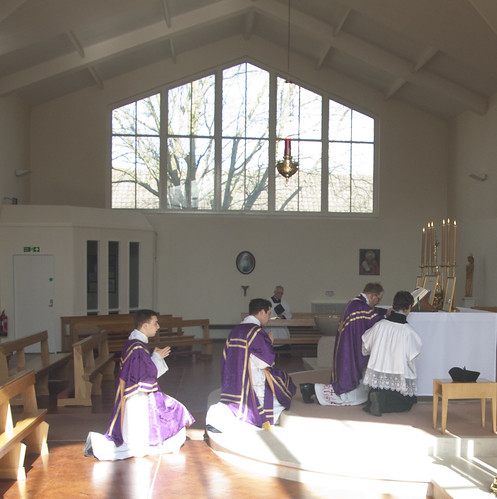
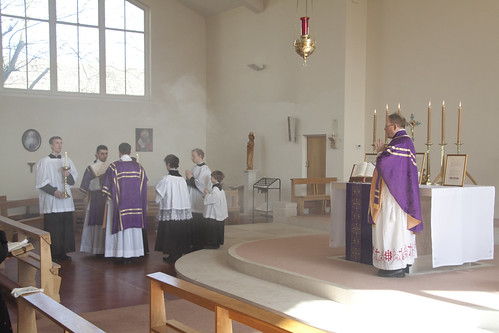
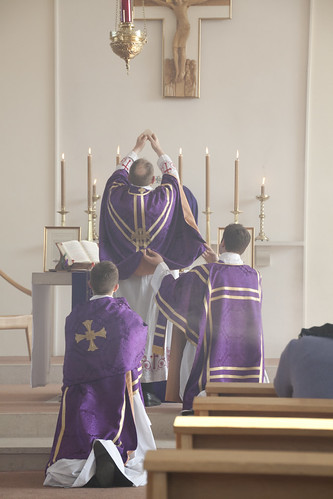
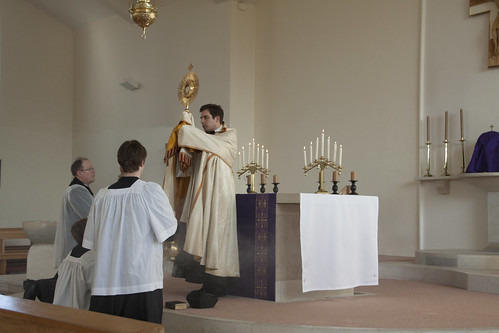
Last Saturday there was a splendid Solemn Mass, with the full Ember Saturday Mass, with a spiritual talk, at Westminster Cathedral in London. Partly by chance, we mirrored this occasion in Oxford, at St Anthony of Padua.

The Ember Days are a truly great liturgical event, taking place four times a year. They consist of Wednesday, Friday and Saturday, traditionally days of pennance, to sanctify each season of the year. The Saturday Mass includes five Prophecies (readings from the Old Testament), an Epistle and a Gospel. Since it was Sung, the schola last Saturday sang the Graduals between each one, and the lovely Canticle of the Three Young Men sung as a continuation of the last Prophecy, which gives the story of the attempt to martyr them, and their miraculous preservation in the heart of the fiery furnace.
IMG_8945
The pattern of a series of lessons followed by the Offertory and the rest of Mass is reminiscent of the Easter Vigil, and the Ember Saturday Mass was originally a vigil. The lessons took place during the night, and at dawn Mass was said. This is why the Gospel for the Sunday following is the same as the Gospel for the Ember Saturday: originally the Ember Saturday Mass started on Saturday and ended on Sunday, and there was no separate Sunday Mass.
IMG_8949
While in the ancient Easter Vigil, more of the vigil was taken up by baptisms, formerly the vigil of the Ember Saturday was used for ordinations, with different orders being conferred after each reading.
IMG_8968
The richness of the Ember Saturday Mass is really a case in point of the glories of the traditional calendar. The richness of the scripture and chant of this service is wonderful, and this is given to us four times a year, not on a feast day, but as part of the seasonal unfolding of the year.

The celebrant was Fr Simon Leworthy FSSP, the deacon Fr Nicholas Edmonds-Smith Cong Orat, and the subdeacon Br Oliver Craddock Cong Orat (both of the Oxford Oratory). The day was arranged by Fr Aldo Tapparo, the parish priest, who sat in choir. After lunch in the presbytery, Fr Edmonds-Smith gave a very interesting and edifying talk about the Ember Saturday liturgy, and we concluded with Benediction.
IMG_8991
More photos here.


Pastoral letter on marriage

Archbishop Vincent Nichols, as President of the Bishops' Conference of England and Wales, and Archbishop Peter Smith, have signed a letter to be read out in churches this weekend all over England and Wales, on the subject of same-sex marriage.

The letter looks very good to me. Here's a short extract:

Changing the legal definition of marriage would be a profoundly radical step. Its consequences should be taken seriously now. The law helps to shape and form social and cultural values. A change in the law would gradually and inevitably transform society’s understanding of the purpose of marriage. It would reduce it just to the commitment of the two people involved. There would be no recognition of the complementarity of male and female or that marriage is intended for the procreation and education of children.

You can see the full text on Fr Ray Blake's blog.


- Posted using BlogPress from my iPhone

Tuesday, March 06, 2012

LMS Sponsored places to Chartres

I mentioned our sponsored places to Chartres not long ago, and as of today 11 of the 12 for young people (16-35) places have been snapped up. So if you want the last one - saving £100 - you need to move fast: go here.

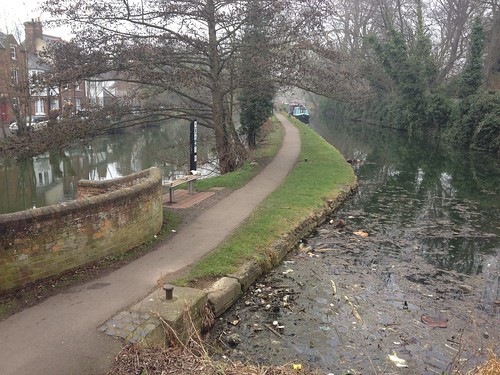
For those, like me, who've exceeded that age range, and live a basically sedentry life, I recommend a bit of practice. The other day I walked home from Oxford along the Oxford canal: from the old canal basin (now, alas, the Worcester Street car park, but the canal is still there a few yards away), photo (2)
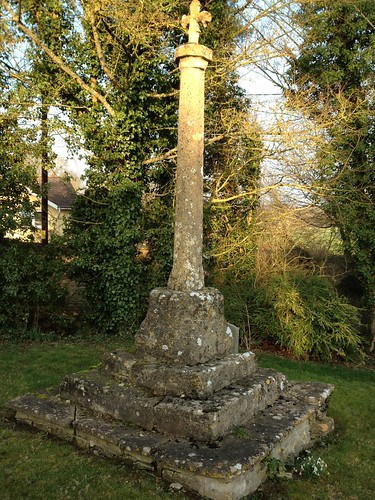
to Shipton on Cherwell, where this Medieval 'preaching cross' is preserved, and then accross country to Woodstock. More photos.
 photo (1)

Monday, March 05, 2012

FIUV Position Papers on the 1962 Missal

The Foederation Internationalis Una Voce (FIUV), the international federation to which the LMS, and an ever-growing number of associations from other countries, is affilated, is publishing a series of discussion papers on specific aspects of the 1962 Missal. These are all things in which the EF differs from the OF. They are brief (1,500 words), and while aimed at a general link the issues to the most recent relevant magisterial documents and modern liturgical scholarship.

The purpose of the papers is to inform those attached to the 'former liturgical tradition', and other interested Catholics, of good arguments in favour of these traditions, and to contribute to the debate about the future development of the 1962 liturgical books.

I am the 'Moderator' of the working group which is overseeing these papers. They are available on the FIUV website, and are being published one by one on the Rorate Caeli blog. A very interesting discussion is taking place there on the first paper, 'The Service of the Altar by Men and Boys'.

I've also put them on the LMS website.

We are very interested in comments and have a special email address where they can be sent, for those who'd rather not post them in a comments box:

positio AT fiuv.org

(remove spaces and replace AT with @: if, that is, you are not a robot!)