Thursday, May 03, 2012

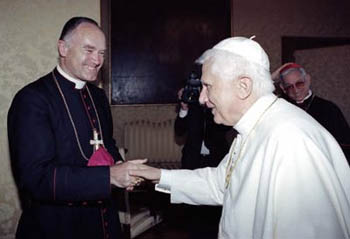
Bishop Rifan is coming to Britain!


Press release from the Latin Mass Society.

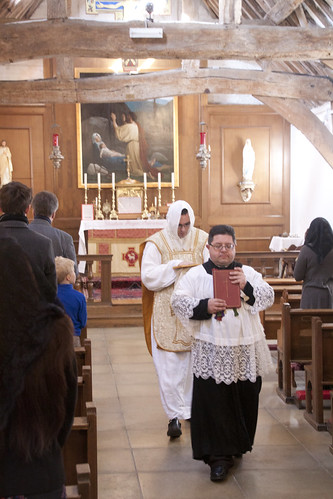
The Latin Mass Society is pleased to announce that Bishop Fernando Rifan, Apostolic Administrator of the Personal Apostolic Administration of Saint John Mary Vianney in Brazil, will be visiting Britain this summer and will celebrate Pontifical High Masses at three locations across England and Wales at events organised by the LMS.

The main events are as follows:

Saturday, 30 June, 3pm: Pontifical High Mass at Immaculate Heart of Mary Church, 294 Harrogate Road, Moortown, Leeds LS17 6LE

Sunday, 1 July, 2.30pm: Holywell Pilgrimage, St Winefride’s Catholic Church, Well Street, Holywell, Flintshire CH8 7PL (Pontifical High Mass)
The Mass and Pilgrimage will be filmed by EWTN as part of a forthcoming television series. There will be a coach leaving for Holywell from London (Contact Graham Moorhouse on 01322 409231) and also, we hope, from Birmingham (phone 020 7404 7284), Liverpool (phone Jim Pennington on 0151 426 0361) and Wirral (phone Anthony Sibert on 0151 625 9033).

Saturday, 7 July, 11.00am: Annual General Meeting and Pontifical High Mass at St George’s Cathedral, Southwark, London SE1 6HX (Mass at 11.00am, AGM at 2.00pm, addressed by the bishop).
We are hoping to run coaches from Cambridge, Reading and Brighton if there is sufficient demand. Please phone the LMS office (020 7404 7284) to book a place or for more information.
There will be a buffet lunch at the AGM for all paid-up members of the LMS. The cost per head will be £5, payable on the door. But if you are intending to come, please tell us beforehand so that we can budget for the catering.

Bishop Rifan will also be visiting Scotland during his time in Britain and will celebrate Mass in Edinburgh (venue to be announced by Una Voce Scotland) on Monday 2 July at 7pm.

This promises to be a wonderful week of events in the summer giving full witness to the Traditional Mass and the Faith that goes with it. We warmly encourage everyone to make the effort to attend at least one of the Masses.

Wednesday, May 02, 2012

Position Paper 5 on Rorate Caeli: The Vulgate

I have just published Position Paper 5: The Vulgate and the Ancient Latin Psalters on behalf of the Una Voce Federation (FIUV). Go over to Rorate Caeli to read it.

The history of the Latin Bible is a fascinating one. St Jerome didn't translate the Bible into Latin: he revised existing translations, in the case of some books of the Bible he left them entirely alone. He ended up producing three versions of the Psalter, but the more ancient Psalters were already too embedded in the liturgy to replace: the Roman Psalter, used in Rome, and the Gallican Psalter used elsewhere. When Roman chant texts were adopted in the Carolingian Empire the Roman Psalter went with them; only where it wouldn't disrupt the melody did the Gallican Psalter creep in, so we find Roman Psalter antiphons followed by Gallican Psalter verses, for example in some Introits and Graduals.

But all these Latin versions were based on the Greek Septuagint translation of the Old Testament, dating from the 2nd Century BC, which was regarded by all the Fathers of the Church, with the odd exception of St Jerome, as being inspired. So where the Septuagint varied from the Hebrew (or rather: from the Hebrew available to later scholars, since the Septuagint translators had much more ancient versions to use), this didn't worry anyone. The Latin scriptures thus formed a part of a tradition of translation which is found in the Greek Fathers (who obviously used the Septuagint), and the New Testament itself.

Modern Latin versions of the Psalms, the 'Pian Psalter' by Augustin Bea (1945) and the Neo Vulgate Psalter (1969) are based on the Hebrew, and have completely different readings in many places from the ancient Latin ones. Their versions rule out the interpretation of the Psalms which is embedded in the ancient chants, such as the Introit for Easter Sunday, 'Resurrexi!' 'I have arisen'. (The corresponding verse in the Neo Vulgate has the baffling ‘Si ad finem pervenerim, adhuc sum tecum:’ ‘If I were to have arrived at the end, still I am with you.’)

Does this mean that the old texts are rubbish and should be quietly swept away? It doesn't mean that if we take seriously the tradition of interpretation and the authority of the Septuagint. One of the most striking things I have found in coordinating these Position Papers is the way that the modern magisterium supports the ancient liturgy. The Second Vatican Council (Sacrosantam Concilium 91) called for a translation of the Psalms which respected the 'the entire tradition of the Latin Church'. This becomes a major theme of the 2001 Instruction Liturgiam authenticam 41:

The effort should be made to ensure that the translations be conformed to that understanding of biblical passages which has been handed down by liturgical use and by the tradition of the Fathers of the Church, especially as regards very important texts such as the Psalms and the readings used for the principal celebrations of the liturgical year; in these cases the greatest care is to be taken so that the translation express the traditional Christological, typological and spiritual sense, and manifest the unity and the inter-relatedness of the two Testaments. 

And what do we find in the 1994 Instruction Variationes legitimae 9? The Septuagint is an inspired translation. ‘…the translation of the Bible into Greek introduced the word of God into a world which had been closed to it and caused, under divine inspiration, an enrichment of the Scriptures.’ This being so, the ancient Latin Psalters, and the Vulgate, need no further vindication.

(Picture: St Jerome)

Saturday, April 28, 2012

Catholic Cyber Bullying

Over the last few days I've witnessed the most extraordinary episode of cyber-bullying I ever hope to see. I've come to this late; I realise now it has been going on for months. Looking into it, with increasing incredulity, I have seen numerous examples of bullying which would be extreme in a dysfunctional school playground, but where the bullies present themselves, not just as Catholics, but as Catholic bloggers: people who go to some thought and care, one would assume, in what they say and do, acting in the public eye as identifiable Catholics. Among other things they ridicule their victim's appearance, and call her 'Iggy Pop'. Here is just one delightful trio of tweets from one of them; I have erased the identity of the writer. (With Twitter, the bottom message comes first.)
Can you guess what the victim's alleged crime was? In a nutshell, cyber bullying. The actual evidence for this is lacking, but the claim is that, using false or anonymous identities, she attacked others on-line.

But hang on a minute: are her critics against cyber bullying, or in favour of it?

I am not interested in the truth of the original allegations, or the identity of any of the parties involved. I just want to draw attention to this as a general issue. We all know how mobs can go berserk and lynch innocent people. (Shakespeare gives a brilliant example in Julius Caesar.) We may have seen references to twitter-storms of people going berserk and pouring vitriol on even rather mild critics of very popular people, like Steven Fry. But here we have a small, albeit strongly mutually-reinforcing, group of people, no more than half a dozen, ganging up to attack a pregnant woman, in a way which would be completely wrong even if she had been a serial killer, and these people are simultaneously claiming to be Catholic. I never knew what Pharisaism was until now. The two main protagonists have blogs which they clearly think are a cut above the average - oh-so-clever, oh-so-sophisticated, giving their wonderfully deep views on every issue to the punters, and all terribly, terribly orthodox of course.

Truly, there are few crimes which Catholics have not committed. We are not the saved; we are sinners in need of salvation. But this is a serious matter. Bullying like this needs the active collaboration of a few, and the passive cooperation of many. It is very hard to intervene when these things are going on without making it look, to the next person coming upon the discussion, like a sack of ferrets throwing insults at each other. But we can support the victim in many ways, and withdraw our support from the bullies. The systematic attempt to cause a breakdown by needling and insulting, which I remember so well from school, is grave matter for adults. Calumny and detraction, about serious issues of character, is grave matter. As we all know, those who have damaged another's reputation, even accidentally, are obliged in justice to do what they can to repair it. In a case like this this means public apologies and retractions. I know that is very hard to do, but the great moral theologians who've turned to on-line bullying as a recreation will know, I am sure, that this will be on their consciences until they do this. Alas, it is not a matter of the private forum: it is out in the public forum.

We must all repent of our on-line sins. We have all been too swift to condemn, too busy to check facts first, too eager to jump on a band-wagon, too busy or too afraid to stand up for truth and justice. I hope this sorry example will make us all more vigilant, and not just be the first of many such disedifying episodes. If it is the latter, then alas for Catholic blogging.

Women beware women

Catholic Voices have asked Joanna Bogle and Sarah de Nordwall to give them a talk, in an in-house gathering. Not ground-rockingly surprising, you may think, but the fact that, shock, Joanna Bogle isn't in favour of women's ordination, and, horror, Sarah de Nordwall is pro-life, has aroused the ire of the absurd Tina Beattie. She claims, jaw-droppingly, that they have 'relatively affluent backgrounds so are likely to have little experience of the issues that poverty presents for any women.'

Austin Ivereigh responds, within this news item, as follows: 'It is a bit rich, if you'll excuse the pun, for Tina, with her professor's salary, to pour scorn on our speakers for being 'affluent' (how does she know?) and to criticise them for not knowing about poverty. She should get out of suburban Roehampton some time.'

A swallow doesn't make a summer, but the fact that they've asked for, and printed, Ivereigh's response in this way may suggest a slight improvement in The Tablet's journalistic standards.


Monday, April 23, 2012

Passing on the fruits of contemplation

The reason my blog has fallen silent over the last few days is because I have been unwell. It is just the latest little bug going round but it has cut a swathe through the Shaw household. When not asleep I've been reading, and I've just finished James Mawdsley's account of his three Burmese incarcerations, 'The Heart Must Break', published in 2001.

Mawdsley is now a seminarian with the FSSP; back then he was a campaigner for Burmese democracy and human rights. His thinking has moved on from the book in some ways but it remains a fascinating insight into Burma, dictatorships, and suffering.

Here is a long quotation which I thought particularly perceptive. We've all heard it said, and we all believe, that 'to change the world you have to start with yourself'; such aphorisms can sound trite and empty if it is not explained exactly why. And this is from the pen of no mere armchair activist.

'...much as I disliked Maung Lo, the [prison] governor, he was not my enemy. The goodness in him was my friend and the badness in him was my enemy. How do I go about fighting the bad part of him without damaging the good part? Well, it is extremely difficult. In fact, if I want to fight the evil in the world I find that there is only one place where I can be assured of succeeding and that is the evil inside myself. So in prison ninety per cent of my struggle was against myself and it is precisely in striving to overcome the evil in oneself that one consequently has the effect of reducing evil in the world.
'When I received a food parcel I had the choice of sharing it with other prisoners or eating it myself. I could be more or less greedy. But if I eat most of it myself, how are the other prisoners supposed to believe me the next time I shout out "Your cause is my cause" or claim that all beings are of equal worth? My words will mean nothing if I do not overcome my greed. I will not be a source of support to other prisoners if I cannot overcome my greed.
'...it does not matter if person speaks truly or falsely because, if he is doing it offensively, few people are humble enough to listen. So whenever I meet with authorities I have to try to be humble. If they find the very sight of me obnoxious, I am not going to get over the democratic message. ...with high-ranking [guards], oh what a struggle for me to rein in my pride! ...
'It is a paradox. Whoever would change the world must change themselves. Strive to overcome your own pride, greed and anger and this very process will affect the world. It is not something to be done first, to make yourself a goodly person so that you can then deal with the world. To sort oneself out takes more than a lifetime. It is our task from God: to seek perfection, to strive to love our neighbour and our enemy. And by thus striving, by obeying His command, we unknowingly shape the word round us to make a better place. I should not have spent ninety per cent of my effort in prison fighting myself, I should have spent a hundred per cent of it.'

James Mawdsley, 'The Heart Must Break', pp294-5

- Posted using BlogPress from my iPhone

Wednesday, April 18, 2012

SSPX - Rome latest

It seems things are moving in a positive way. Bishop Fellay's own spokesman has confirmed that the SSPX Superior did indeed send a revised version of the Theological Pramble to Rome with which he is happy; the journalist Andrea Tornielli is claiming that this version will be acceptable to Rome as well, since the revisions are not substantive, but of course this is for the proper authorities to decide. That decision may take some time to emerge.

See Rorate Caeli:

http://rorate-caeli.blogspot.co.uk/2012/04/for-record-latest-tornielli-fellays.html


The Dominican Rite at the Family Retreat

IMG_9877
Fr Thomas repeating the readings in English on Sunday morning.

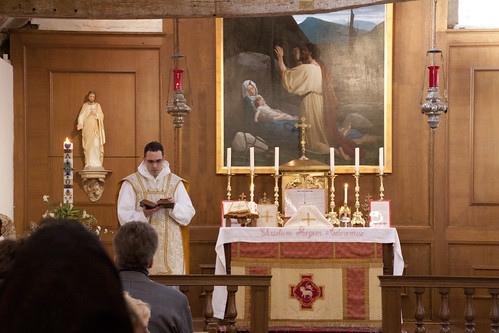
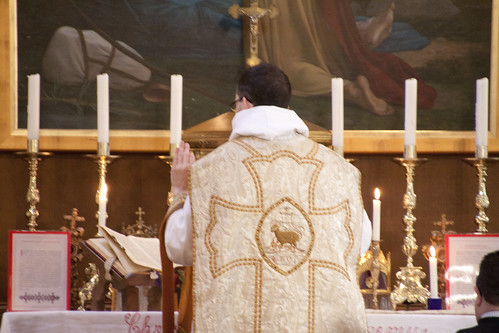
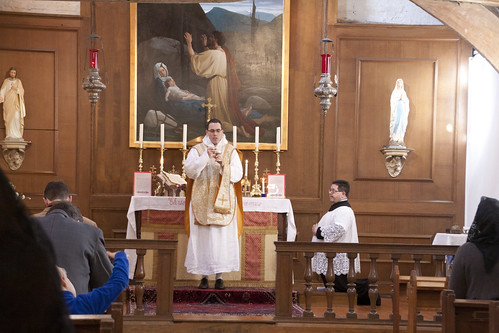
Before breakfast on Saturday and Sunday Fr Thomas Crean celebrated Low Mass in the Dominican Rite, in the Old Chapel, which attracted a good number of people. I don't often get the chance to assist at the Dominican Rite and the differences between it and the Traditional Roman Rite are fascinating.
IMG_9881
Lighting the 'Sanctus candles', alight between the Sanctus and the Communion of the Faithful.
IMG_9883
The elevation: more restrained than in the Roman Rite, the Host is only just visible.
I laid in a stock of booklets to help people follow the Mass - booklets created, coincidentally, by Fr Thomas himself, with others; the front cover shows a Mass at a previous Family Retreat, with Fr Andrew Southwell celebrating. You can buy them on Lulu (or the expensive version printed in two colours).
IMG_9887
A characteristic gesture of the Dominican Rite, which it had in common with the Sarum Rite.
IMG_9892
Something I hadn't noticed before was the server extinguishing the candles before the priest leaves the Altar, during the Last Gospel; the Epistle side one first. (Corrected: see comments.)
IMG_9903
The hood is worn up when entering and leaving the chapel.
More photos.