Wednesday, August 10, 2011

The Dominican Rite at Evagelium

2011 08 07_0904

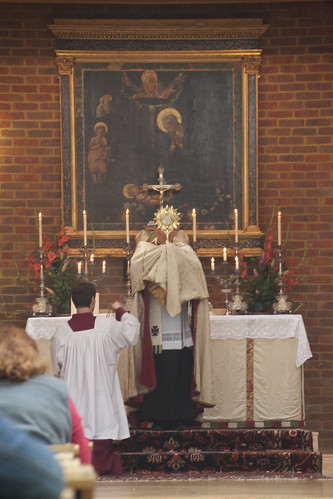
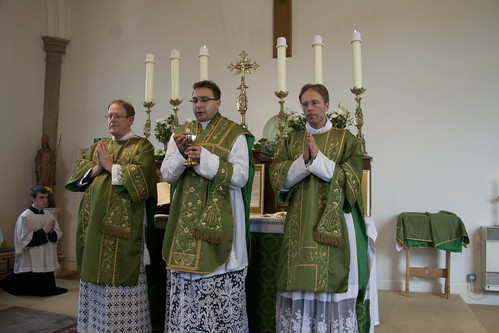
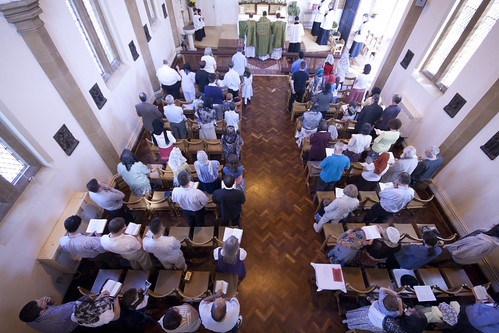
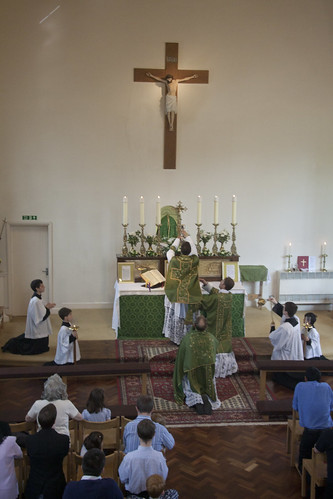
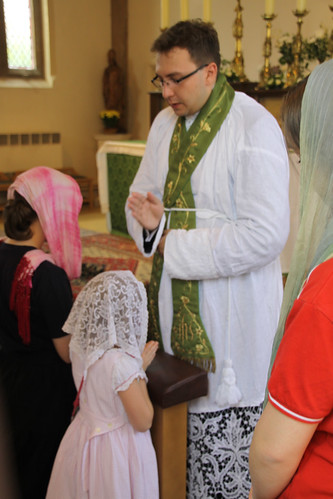
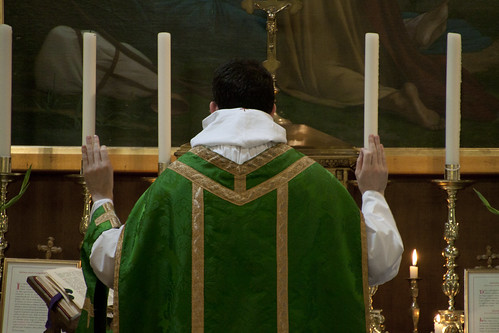
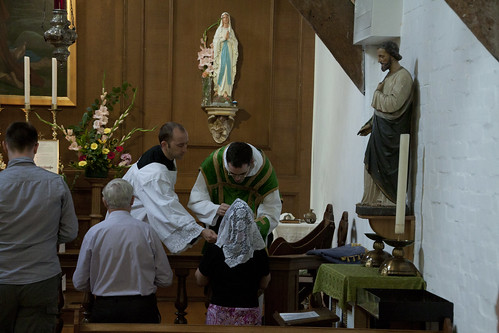
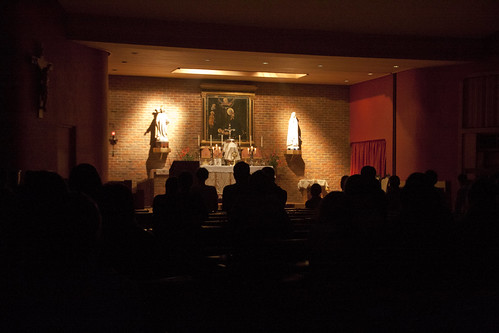
The main Masses at the Evangelium conference are in the 'Ordinary Form', but in a reflection of the growing place of the Traditional Mass in the life of the Church many priests over the three days chose to say private Masses in the Extraordinary Form. On Sunday morning, I attended a Mass in neither form of the Roman Rite, but a Mass in the Dominican Rite.
2011 08 07_0885
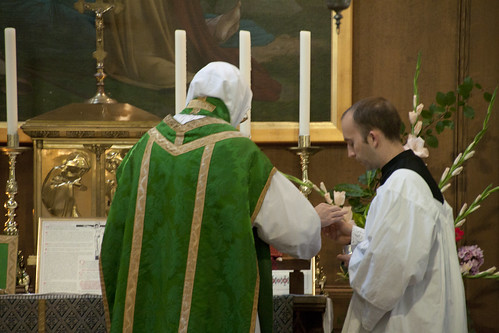
Preparing the chalice before the Prayers at the Foot of the Altar, one of the most obvious differences between the Dominican Rite and the Roman Rite. The Prayers at the Foot of the Altar are also shorter, and a shorter version of the Confiteor is used.

Local and order-specific rites of Mass suffered different fates after the Second Vatican Council. The Mozarabic Rite and Carthusian Rite were reformed: if you attend them today, the Mozarabic Rite in Toledo Cathedral, the Carthusian Rite in Parkminster Abbey, you will get the Bugninified version, which nevertheless preserves some distinctive features setting them apart from the Roman Rite. The Dominican Rite and the Norbertine Rite were never reformed: in practice the Dominicans and Norbertines stopped using them, at least for public liturgies. Universae Ecclesiae clarifies the application of the Holy Father's Motu Proprio Summorum Pontificum to these Rites, saying that members of the orders at issue have the right to use them. This is increasingly happening.
2011 08 07_0901
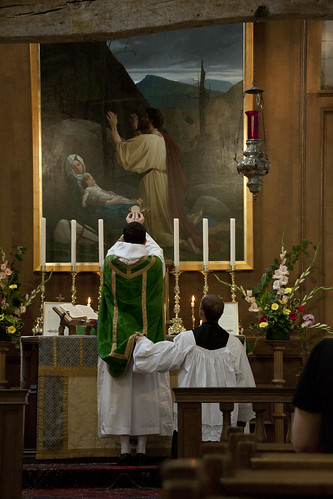
It is much to be hoped that the Church will in time recover the right kind of liturgical diversity: not the diversity of every priest making things up as he goes along, or of some priests following the rules and others following various fads, but the diversity of a multiplicity of legitimate and venerable traditions. We are Roman Catholics in the sense of being in unity with Rome, not in the sense of all living in the diocese of Rome. It is fitting that the customs used in Rome are recognised everywhere and available to everyone; it is equally fitting that the customs of other places, and of religious orders, are accorded the respect which is their due.
2011 08 07_0910
The full set is here. I've also taken photos of Fr Crean saying the Dominican Rite at Holy Cross Priory in Leicester, where he is based, and during the London Colney Priest Training Conference back in 2009. You can download for free the Ordinary of the Dominican Rite of Mass here (pdf), thanks to the Church Music Association of America.

Tuesday, August 09, 2011

Evangelium 2011

2011 08 06_0974
Exposition on Saturday, which continued until Midnight.

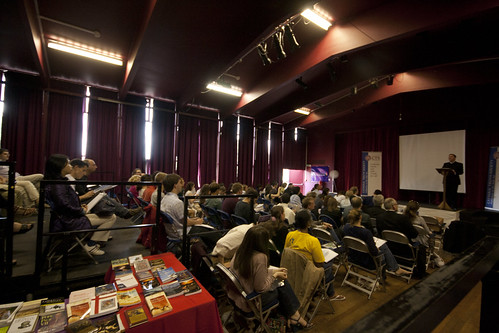
Over the weekend I was at the Evangelium Conference, for the first time. I gave two short talks and was on the 'Apologetics Panel', which was asked to respond to a number of very interesting questions.
2011 08 06_0975
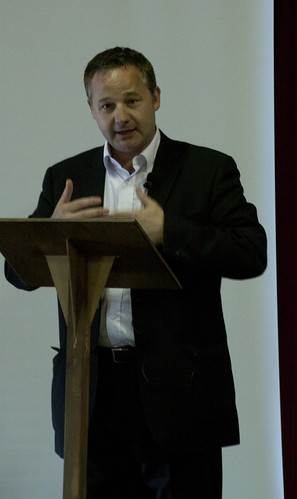
Fr Marcus Holden introducing a speaker.

I didn't take a vast number of photos, since for once I was attending something as a footsoldier rather than an organiser, but I have got a few more here. The conference was both spiritually uplifting and intellectually very stimulating.
2011 08 06_0963
Edmund Adamus gave a fascinating 'plenary' talk on the Family and the Culture of Death.

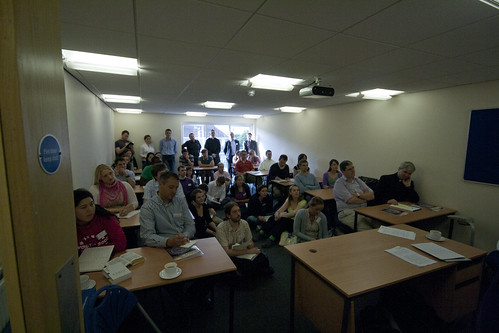
I was very impressed by the interest of participants in philosophy. My talks had been given titles which made it clear they were going to be pretty abstract - 'How do I know I have a soul?' and 'Showing that God exists from reason' - but although there were four talks going on simultaneously, both of mine were packed. Indeed, the first one, which was in a rather small classroom, people were standing at the back and sitting on the floor.
2011 08 06_0981

The organisers deserve great credit for the conference, which has now taken place four times. I hope it will continue to flourish.

2011 08 07_0938

2011 08 06_0950
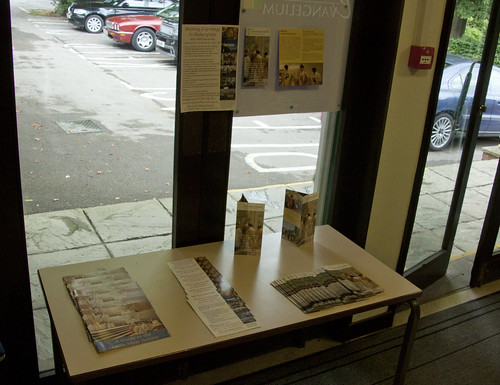
The LMS stall, which I set up and manned during the breaks, alongside stalls from St Anthony Communications, the CTS, and Steve Ray, the American apologist.

Tomorrow I'll be putting up photographs of a Traditional Mass I attended while there.

Monday, August 08, 2011

LMS Pilgrimage to Our Lady of the Taper

This took place yesterday, well done to everyone who made it. I was detained in the Evangelium Conference; I went two years ago. This year Mike Lord, the General Manager was there.

More from Linen on the Hedgerow; h-t to him for the photo, taken during Benediction.

More on Evangelium when my photos have uploaded!

Pilgrimage for Restoration in the USA

I heard about this when I visited the FSSP ordinations in Denton, Nebraska. The Pilgrimage is 63 miles for those walking the full thing, accompanied by the Traditional Mass.

'Walk all three days through the Adirondacks, 63 miles, from the Lake of the Blessed Sacrament (aka Lake George, NY) to Our Lady's Martyrs Shrine, Auriesville.' The dates are Friday - Sunday, September 23 - 25. See their website.

Pretty cool, eh? If you find yourself on the wrong side of the Atlantic Ocean this Summer, then why not join the LMS Pilgrimage to Walsingham, for the Conversion of England - about 55 miles from Ely to Walsingham, again over 3 days, 26th-18th August. Book here.

Saturday, August 06, 2011

Religious Liberty: a fresh approach

Over on Rorate Caeli there is a fascinating and truly important article by Dr Thomas Pink on the question of religious liberty. Please read it.

Just to give you a taste, rather than substitute for reading the article (which is not terribly long) in full Dr Pink explains that the debate about religious liberty since Vatican II has been based largely on a misunderstanding. Most liberals and Traditionalists seem to agree that before Vatican II the doctrine or policy of the Church was based on the idea that states had the right and sometimes the duty to suppress the outward manifestation of religious error (this would include for example stopping evangelisation by Protestant sects, not allowing public processions by Satanists, policies which were uncontroversial in Catholic countries up to the 1960s). They saw this as encapsulated in many pre-Vatican II documents.

The Vatican II document Dignitatis Humanae says that the role of the state is the 'natural end of man': justice and peace. So the state has no right to get involved in religious questions.

So both liberals and traditionalists further agreed that there had been a change; the question was whether it was a change of policy, or whether the old documents had dogmatic authority. If the latter was the case, then Vatican II was in error.

What Dr Pink points out that a more careful reading of the pre-Vatican II documents reveals that they never said that the state had a right to limit religious liberty. They did say that the Church has the right, over baptised Christians, to hold them to their baptismal obligations (and to protect them from attack by non-baptised zealots), using coercion. An equally careful reading of Dignitatis Humanae reveals that this proposition is not denied there.

What was happening in Catholic states up to the 1960s is that the State was acting on behalf of the Church: the state was not exercising its own rights. The State was both an instrument of the Church, and also leaders of the State were themselves baptized Christians and members of the Church, and were acting in that capacity.

It is true that Dignitatis Humanae recommends a new policy: a policy in which the Church's use of coercion (directly, or through the State) is very limited. But it is not abolished: the Church still uses temporal penalties against those who deny the Faith, under the 1983 Code of Canon Law, such as depriving heretical teachers in Catholic insitutions of their jobs.

In short, the liberals who denied that coercion can ever be used in defence of the Faith are wrong: in fact this position is infallibly ruled out by the Council of Trent. They are also wrong that Vatican II supports them. But their error has been entrenched by the mis-statement of the doctrine by Traditionalists: it is not a question of the teaching of the Church on the State, but the teaching on the Church herself, which is at issue.

This point is completely missed by, for example, Michael Davies' 'The Second Vatican Council on Religious Liberty', which is an admirably detailed and clear explanation of the debate as Traditionalists have usually understood it. Davies ends his book saying that there is a problem which can only be resolved by a further, and authoritative, act of the Magisterium. This impasse now looks at though it was based on a misreading of the key texts - not just by Davies, but by pretty well everyone, on both sides of the debate.

Dr Pink is to be congratulated on coming up with a solution to the apparantly insoluble problem of Vatican II vs. Trent, Lateran IV and a string of papal documents. This solution ought to be helpful not only to the SSPX in their doctrinal discussions with the Vatican, but to all faithful Catholics who have struggled to read Dignitatis Humanae in the light of Tradition: with the hermeneutic of continuity. Let me give the last word to that document:

Indeed, since people's demand for religious liberty in carrying out their duty to worship God concerns freedom from compulsion in civil society, it leaves intact the traditional catholic teaching on the moral obligation of individuals and societies towards the true religion and the one Church of Christ.

More very interesting commentary can be found on The Sensible Bond.

Thursday, August 04, 2011

New chant resources

I have been busy updating the blog of the Schola Abelis: we now have ten 'pages', accessible from the labels at the top, on what we sing and why, the history of the schola and of the chant. In particular we have picked out a selection of videos of our singing, to give people an indication of what we are like. If you like them, you can even make a donation to the Schola.


I have also put up a new resource for Scholas singing at the Traditional Mass: a guide to the Mass, explaining exactly when to sing what, what cues to look out for from the sanctuary to indicate you are running out of time and so on.
I know this is a puzzle for singers not used to the Extraordinary Form; those used to it develop an instinct, but it can be hard to put it all down in black and white. When is the priest ready to be given the opening notes of the Creed, for example? When he has returned from the pulpit, got his maniple back on, and is at the centre of the altar facing east - not before, and not after! When do you start the Agnus Dei? After the Pater Noster, when at the end of short sung dialogue the choir and congregation sing 'Et cum spiritu tuo'. Not before, not after.

It was surprisingly complicated to put all this into writing, and many people helped me - the mistakes, which I look forward to correcting, are unfortunately my own. I hope it will be some use to ordinary parish choirs, who are increasingly asked to accompany EF Masses on special occasions, funerals and so on. On one occasion I was at such a Mass and the choir failed to sing the Agnus Dei at all. Here's the Agnus Dei video.


Please let me know in the comments where the Guide can be improved.

Tuesday, August 02, 2011

First Mass of Fr Marek Grabowski FSSP

2011 07 31_0858
Fr Marek Grabowski FSSP made news with his ordination in Poland, this being the first traditional ordination since 1970. He is well known to the English Traditional Catholic community, as he has often visited Reading and was a member of staff at the St Catherine's Trust Summer School in 2007. It was wonderful to see him back here again as a priest. He celebrated Mass with the assistance of Fr Armand de Malleray FSSP as deacon, and Fr Simon Leeworthy FSSP as subdeacon.
2011 07 31_0882
I have never seen St William of York so full. There were people crowded at the back, the extension had about 30 people in it, and of course there was the choir in the choir loft. In all about 120 people. (No, Paul Inwood, not the 'same 30 people' in Portsmouth diocese going to more Masses than before, but four times that number at St William of York alone.)
2011 07 31_0852
Afterwards Fr Grabowski gave 'first blessings'.
2011 07 31_0872
More photos here.