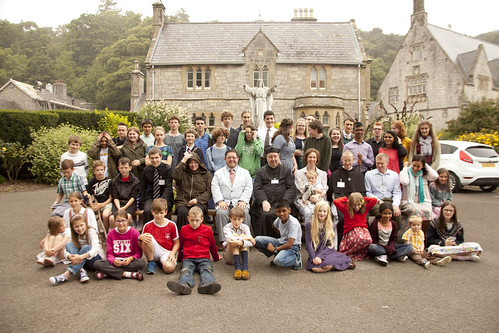
When we encourage young Catholics to touch the monstrance, when exposition becomes routine and people just wander in and out of church without thinking about Who is on the Altar, when we have preaching in front of the Blessed Sacrament as if it were a simple devotional image, we are failing to give God the honour due to Him.
I know this will fail to motivate a lot of people reading this. They will say that Christ on earth did not demand special treatment, He did not demand 'worshp', He ate and drank with sinners and embraced children. They will be little impressed when I point out that Christ is continually worshipped in the Gospels: the Wise Men worship Him, St Peter falls on his face, there is frequent bowing (proskynesis), there is the use of the divine title 'Lord', there is His sitting on a cushion on the waters as on a throne during the storm on Lake Gallilee, there is the revelation of His glory in the Transfiguration: and the rest of the time His glory, his divinity, was deliberately hidden. They have their way of reading the Gospels and they will take no notice.
Listen, then, to the subjective aspect. Never mind what we are doing or failing to do to God, what are we doing to the young Catholics? We are taking away the seriousness of their encounter with God in the Blessed Sacrament. We are undermining their very sense that God is there, because if the experience is not serious, then, subjectively, it will not seem to be an experience of God. This won't happen straight away: the first time, it may seem an incalculable privilege to touch the monstrance, something forbidden to all but those in major orders within living memory. It may feel intimate and exciting to share a space with the Blessed Sacrament exposed while listening to a preacher. But with familiarity comes familiarity. What is no longer separated, what is no longer surrounded by special rules, ceremony, double-genuflections and incense, will no longer be perceived as holy.