Hat-tip to Fr Brown of Forest Murmers! He stood next to me while we were singing this at Ushaw...
Purists can note that this is the original version of the hymn; I gather Joanna Bogle has written a new version, though I've never seen it.
Saturday, April 25, 2009

Friday, April 24, 2009
Ushaw: laughter and good red wine
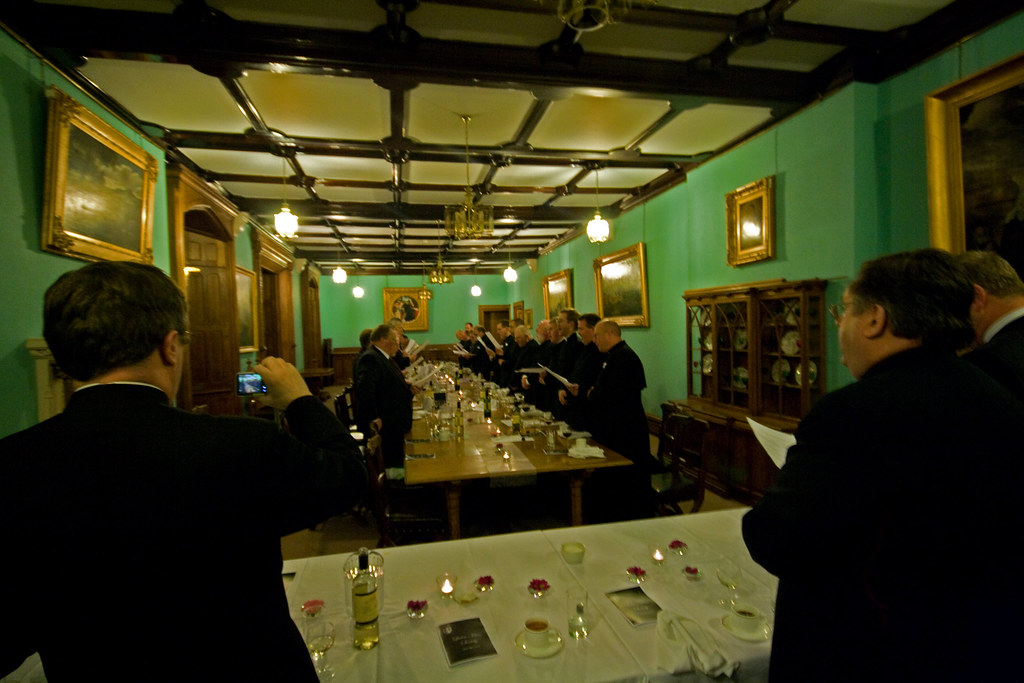
Hillaire Belloc would have been able to predict the mood at the Conference dinner of the LMS Priests Training Conference in Ushaw. Although (in the 'good old days') the boys' school which shared the site with the seminary had an austere reputation, and the seminary prompted some mixed feelings with priests who had trained there more recently (one warned us against scheduling future conferences there in February...), the LMS conference was a joyful occasion.
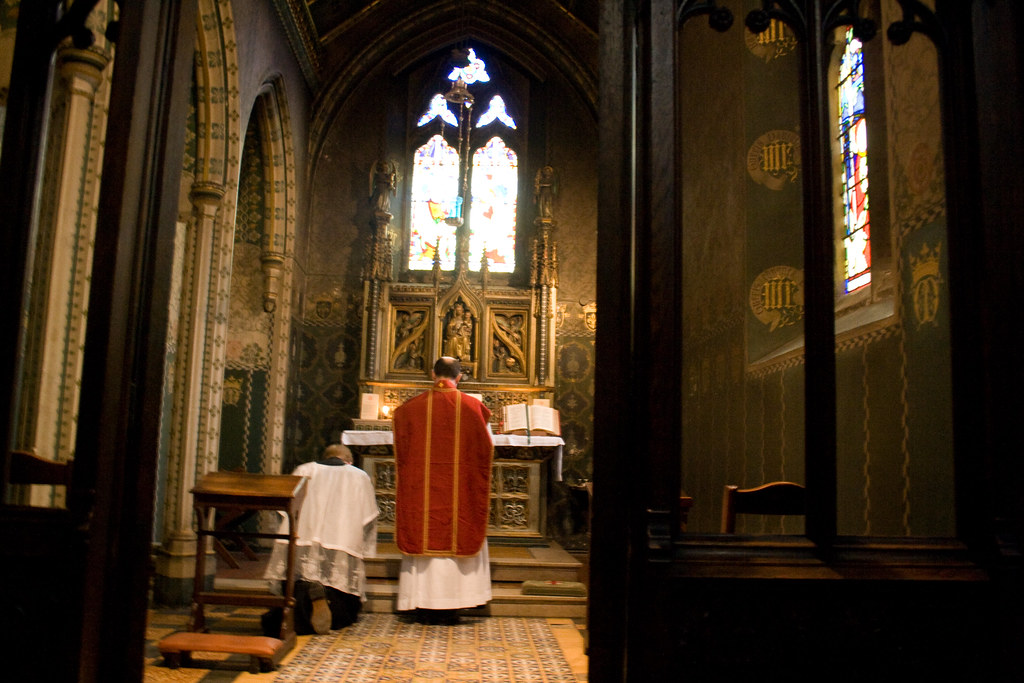
The men who built Ushaw may not have been very generous with second helpings of suet pudding but they cared a lot about architecture. The main chapel is stunning, and it is surrounded by tiny chapels intended for private Masses, all of them beuatifully and elaborately decorated. These chapels, which can't have seen many Masses since concelebratation became the norm in the 1970s, were used so heavily at the Conference, that private Masses - nearly all of them Traditional - had to be scheduled in two waves, at 6.15 and 7.15am, followed by Lauds at 8am (which itself was followed by breakfast). I was privileged to serve two Masses yesterday morning, first of Fr de Malleray FSSP, who had been giving tuition at the conference, and then the irrepressible Canon Noonan, who attended the conference as a trainee.
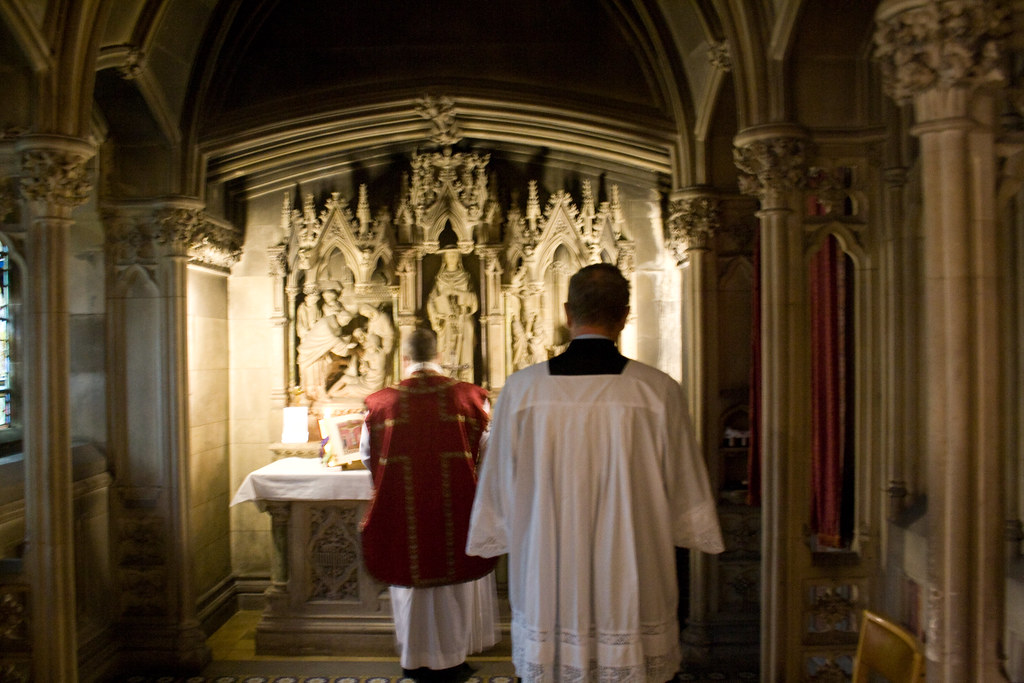
For my money the glorious sight of the great chapel with Solemn Mass, with two choirs, more than a score of priests in choir, and a good number of local faithful, was surpassed by the bustle of the enormous sacristy and the whisper of private Masses at innumerable altars in the early morning. Traditional groups have long been able to put on the occasional 'big Mass' in a nice church, but what the conference represented is the re-establishment of the Traditional Mass as part of the tool-kit of parish priests all over England (and not forgetting a participant from Glasgow). It is wonderful to see Ushaw College doing what it has done for two centuries: enabling the training of priests in the Church's great liturgical tradition.
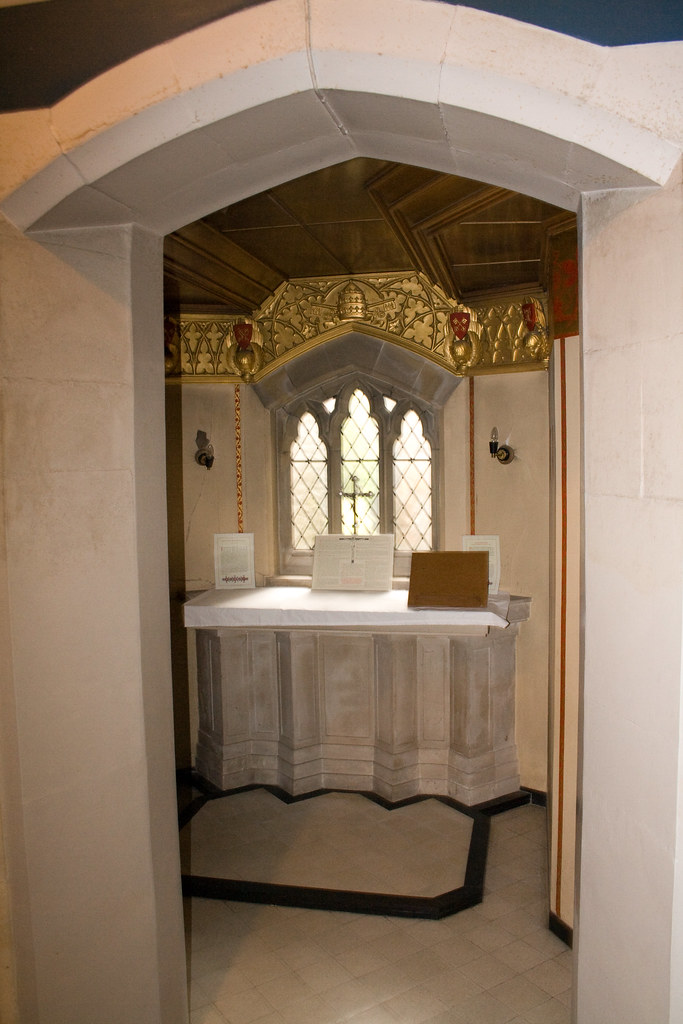
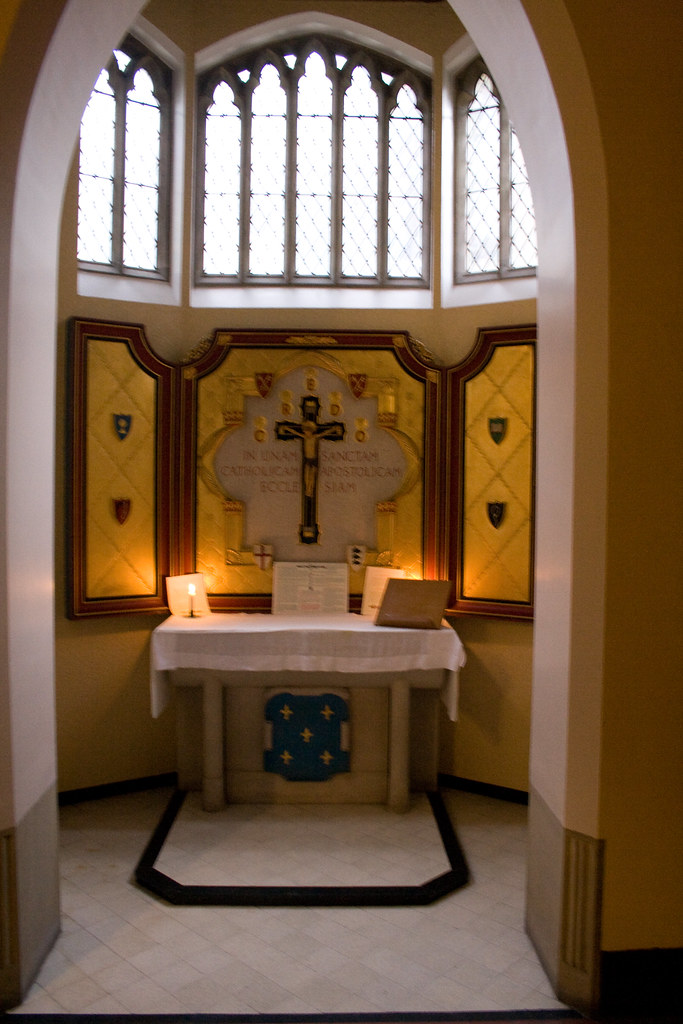
Ushaw
I'm just back from the LMS Priests' Training Conference in Ushaw, the historic seminary of the North of England. Here are some photographs.
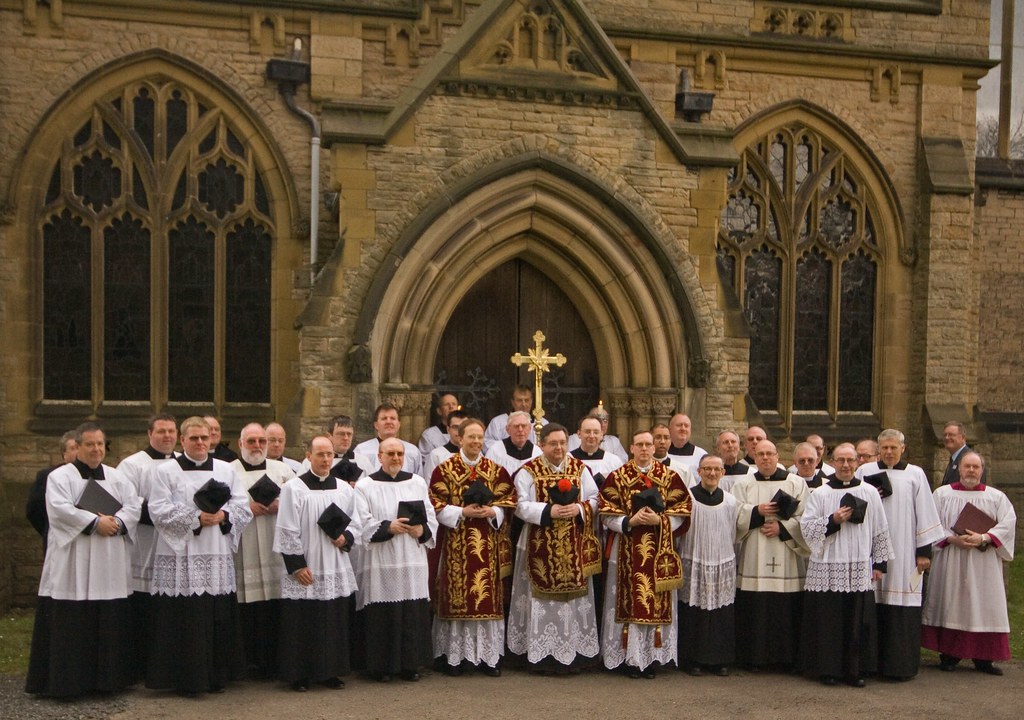
The priests, servers and schola after the closing Mass (Solemn Mass for the Feast of St George, appropriately enough):
Benediction of the Blessed Sacrament in the wonderful main chapel of the seminary.
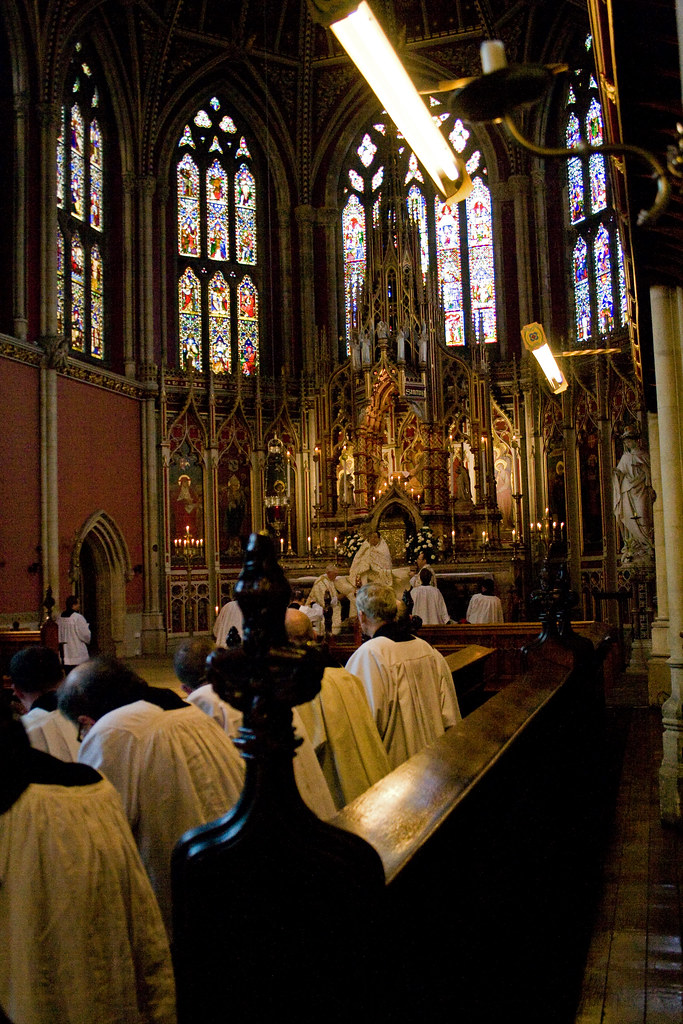
The seminary chapel was built by Pugin, and then dismantled and rebuilt, much larger, by Hanson and others.
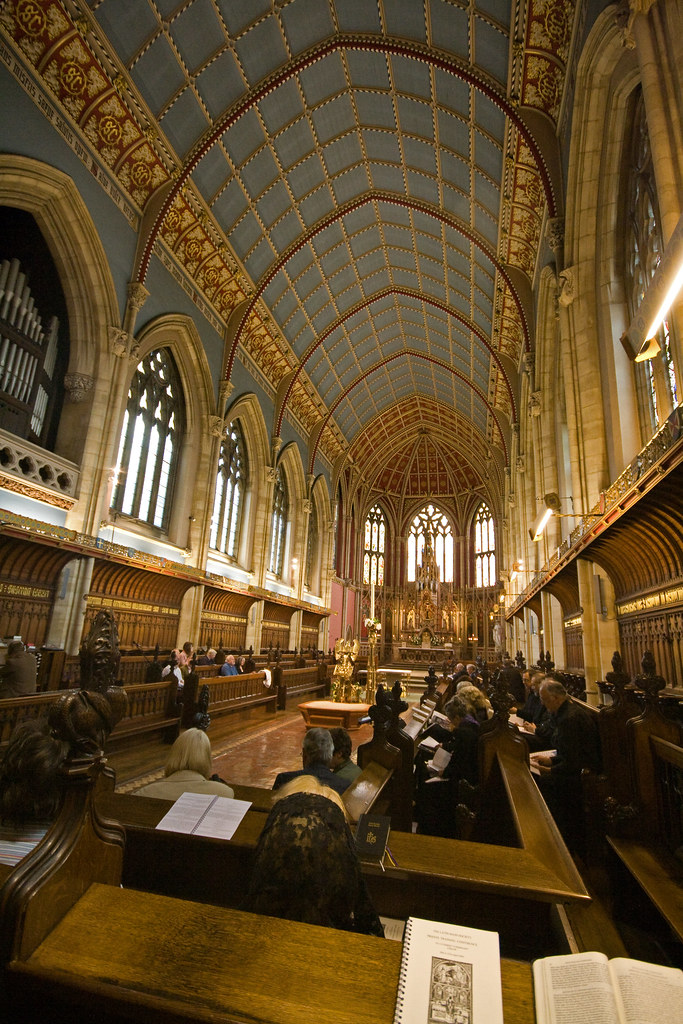
There was a litugical schola, in cassock and cotta, at the Offices (Vespers and Lauds) and to sing the propers at Mass. These were led by Mike Forbester of the Rudgate Singers. At the Solemn Mass on Thursday Mike arranged the assistance of an excellent polyphonic choir, Antiphon, who sang Byrd's Four-Part Mass, under the expert direction of Christian Spence. Mike has quite a lot about the organisation and the liturgies on his own blog, Rudgate Ramblings.
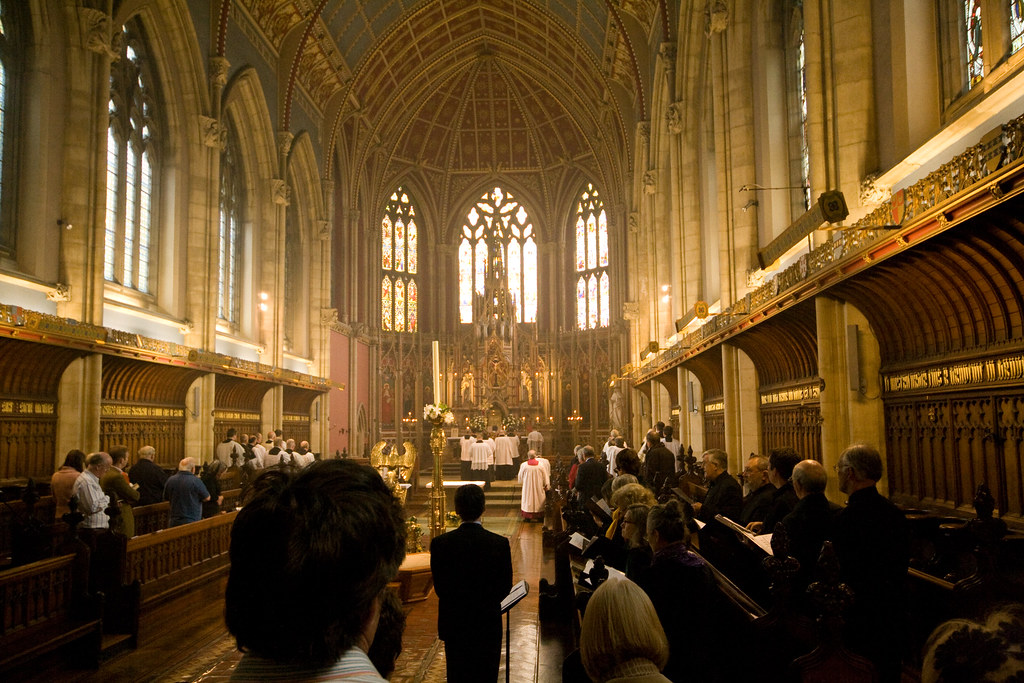
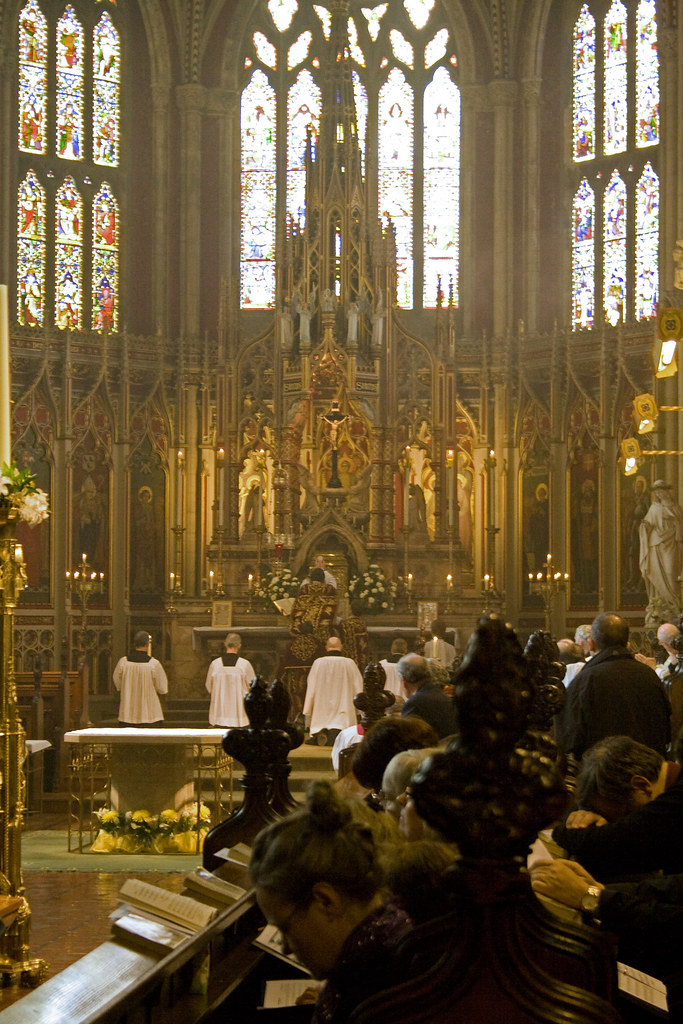
Pictures of the conference are appearing all over the blogosphere: see in particular Middlesbrough LMS and Fr Brown at Forest Murmers. See also my Flickr set.
The priests, servers and schola after the closing Mass (Solemn Mass for the Feast of St George, appropriately enough):
Benediction of the Blessed Sacrament in the wonderful main chapel of the seminary.
The seminary chapel was built by Pugin, and then dismantled and rebuilt, much larger, by Hanson and others.
There was a litugical schola, in cassock and cotta, at the Offices (Vespers and Lauds) and to sing the propers at Mass. These were led by Mike Forbester of the Rudgate Singers. At the Solemn Mass on Thursday Mike arranged the assistance of an excellent polyphonic choir, Antiphon, who sang Byrd's Four-Part Mass, under the expert direction of Christian Spence. Mike has quite a lot about the organisation and the liturgies on his own blog, Rudgate Ramblings.
Pictures of the conference are appearing all over the blogosphere: see in particular Middlesbrough LMS and Fr Brown at Forest Murmers. See also my Flickr set.
Monday, April 20, 2009
What's in a name?
In a wide-ranging article in this week's Catholic Herald, Fr Leo Chamberlain OSB reflects on the two 'forms' of the Roman Rite. I knew Fr Chamberlain of course from his time as Master of St Benet's Hall, where I was (and still am) a Fellow.
It is interesting to hear the experiences of the generation of priests who were, as he explains, the first not to learn anything other than the Novus Ordo. He remembers the problem of priests racing through the Mass in the 1950s; he is equally aware of the 'arbitrary deformations' of the new missal which have shaped the liturgical experience of most people since 1970.
However, the article ends with a rather strange paragraph.
In the article Fr Chamberlain uses the term 'old form' nine times, 'new form' four times, and 'ordinary form' twice. The last of these clearly derives from the Motu Proprio Summorum Pontificum, where Pope Benedict describes the 1962 Missal as the (or an) 'extraordinary form' of the Roman Rite, whereas the 1970 Missal is the 'ordinary form'. But the contrasting terms 'old' and 'new' do not appear. Other terms for the 1962 Mass in the Motu Proprio (without contrasting terms) are 'usus antiquior', 'the older use', and 'the Missal of Blessed John XXIII.'
Not that I object to the development of the vocabularly. Fr Tim Finnigan, for example, has adopted the 'usus antiquior' / 'usus recentior' distinction (using the Latin terms). If Fr Chamberlain wants to talk about 'old' and 'new' forms he is free to do so; it seems to flow from the terms 'new Mass' and 'old Mass' which have had a long currency. But they are not the terms used by the Pope.
It is worth asking why the Holy Father adopted the vocabulary he did. It is important to remember that the Motu Proprio is a legal document, and makes a very important legal point: that the 1962 Missal was never abrogated, and should be regarded as a legitimate version of the Roman Rite. The 1970 Missal is the 'ordinary' form of the Rite; the 1962 Missal is accordingly an 'extraordinary' form. This is not simply a statement of fact: it is a legal enactment. The Holy Father is not, as a scholar, contradicting the great Klaus Gamber, who said that the 1970 Missal could not be regarded as a form of the Roman Rite. He is making it true, not as a historical, liturgical judgement, but as a matter of the law of the Church, that the two Missals are two forms of a single Rite.
To enact that they are two forms of a single Rite (neither of which tied to a particular locality or religious order) is to enact that every priest of the Latin Church, trained in the 1970 Missal, has the right to use the 1962 Missal. If they were, legally speaking, two Rites, then a priest of the 'New Rite' would have to get a special permission to celebrate a Mass of the 'Old Rite', just as a Latin Rite priest cannot, without special permission (granted for special reasons) celebrate a Mass according to the Greek Rite.
The Holy Father, a liturgical scholar of great importance himself, is not trying to close down the long-running debate about the nature and implications of the liturgical reform, to which he has made his own contributions. Still less is he attempting to enforce terminological uniformity. Why it should be imagined he is doing the latter is frankly beyond me - what would be the point? - but if proof were needed it was provided by Cardinal Castrillon Hoyos, in the famous interview he gave during his visit to England last year, when, in defending and explaining the Motu Proprio, he repeatedly referred to the 'Gregorian' Mass: indeed, on three occasions he calls it the 'Gregorian Rite'.
Cardinal Hoyos is not making a legal point by using that term. He is not suggesting, for example, that the different Masses should be said only be the priests of mutually exclusive 'Rites'. He is using 'Rite' in the extremely well-established looser, non-legal sense: compare 'Sarum Rite', 'Dominican Rite', 'Gallican Rites': legally speaking these are all probably 'uses'. And he is referring to the Mass as 'Gregorian' to make a historical point: contrary to the suggestion that this Mass is, in any important way, a product of the Council of Trent, it is actually the Mass of Pope Gregory the Great.
Equally, however, a useful point can be made by talking of the 'Missal of Blessed John XXIII', as the Holy Father describes it in the Motu Proprio, or even as 'the Mass of the Council' (ie Vatican II): it reminds us that as well as being of great antiquity, it was the ordinary used form of the Roman Rite even for Pope John XXIII and during the Second Vatican Council itself.
The notion of terminological uniformity arising out of all this is pretty far fetched. But what of the term 'the Traditional Mass', or, as the legal name of the Latin Mass Society has it, 'the Traditional Roman Rite'?
Well, clearly the term 'traditional' is descriptive and widely understood. The Mass we are referring to is the traditional as opposed to the reformed version. It also draws attention to the fact that the 1962 Missal is 'traditional' in the sense that it had not been altered much from previous editions, going back over enormous stretches of time. Not only does the 1970 Missal represent a significant change, but - as its designers intended - it ushered in an era in which there would be more changes as time wore on. Since 1970 there have, for example, been a large number of new Eucharistic prayers authorised for use. There have been successive changes to the rubrics, as various new practices have been permitted. As I write we are preparing for a substantially new English translation. This all represents a different attitude to the Missal from what might be called a 'traditional' attitude, which emphasises the idea that what has been handed to us should be handed on to the next generation as faithfully as possible.
This suggests that the term 'Traditional Mass' makes perfect sense. It is reinforced by some interesting terminology adopted by a number of Vatican officials, referring to the 1962 Missal and its surrounding books and customs as 'the former liturgical tradition'. Cardinal Meyer used this term in his well-known letter othe American Bishops of 1991; it has been used many times since, in the context of the people 'adhering' to this tradition. The term 'usus antiquior' seems related to this: it refers to a liturgical tradition or usage with which the 1970 Missal is not in complete continuity. One can make a distinction between the tradition up to 1969, as Klaus Gamber did, and what happened in 1970 and subsequently.
One cannot read very far into the Holy Father's great book 'The Spirit of the Liturgy' without realising that he acknowledges this discontinuity of tradition himself. It forms the great problem of the liturgy today, to which, as Pope, Benedict XVI is clearly concerned to address himself. To claim, as Fr Chamberlain does, that acknowledging this discontinuity is 'insulting' is, it seems to me, an attempt to deny the obvious. To his great credit, this is not something which Holy Father, and indeed the Vatican in general, have any wish to do.
Let's hear it again, the oft-quoted remark of Cardinal Ratzinger, before his election as Pope: ‘I am convinced that the ecclesial crisis in which we find ourselves today depends in great part upon the collapse of the liturgy.’
It is interesting to hear the experiences of the generation of priests who were, as he explains, the first not to learn anything other than the Novus Ordo. He remembers the problem of priests racing through the Mass in the 1950s; he is equally aware of the 'arbitrary deformations' of the new missal which have shaped the liturgical experience of most people since 1970.
However, the article ends with a rather strange paragraph.
...we should all use the terms used by the Pope. I have tried to do so in this article. It is offensive to speak of "traditional Mass" as do the advertisements of the Latin Mass Society. We are all of the tradition, we all celebrate within the tradition, and our unity depends on our recognising it.
It is odd in part because, however hard he tried, Fr Chamberlain has not, in general, succeeded in using the 'terms used by the Pope'.In the article Fr Chamberlain uses the term 'old form' nine times, 'new form' four times, and 'ordinary form' twice. The last of these clearly derives from the Motu Proprio Summorum Pontificum, where Pope Benedict describes the 1962 Missal as the (or an) 'extraordinary form' of the Roman Rite, whereas the 1970 Missal is the 'ordinary form'. But the contrasting terms 'old' and 'new' do not appear. Other terms for the 1962 Mass in the Motu Proprio (without contrasting terms) are 'usus antiquior', 'the older use', and 'the Missal of Blessed John XXIII.'
Not that I object to the development of the vocabularly. Fr Tim Finnigan, for example, has adopted the 'usus antiquior' / 'usus recentior' distinction (using the Latin terms). If Fr Chamberlain wants to talk about 'old' and 'new' forms he is free to do so; it seems to flow from the terms 'new Mass' and 'old Mass' which have had a long currency. But they are not the terms used by the Pope.
It is worth asking why the Holy Father adopted the vocabulary he did. It is important to remember that the Motu Proprio is a legal document, and makes a very important legal point: that the 1962 Missal was never abrogated, and should be regarded as a legitimate version of the Roman Rite. The 1970 Missal is the 'ordinary' form of the Rite; the 1962 Missal is accordingly an 'extraordinary' form. This is not simply a statement of fact: it is a legal enactment. The Holy Father is not, as a scholar, contradicting the great Klaus Gamber, who said that the 1970 Missal could not be regarded as a form of the Roman Rite. He is making it true, not as a historical, liturgical judgement, but as a matter of the law of the Church, that the two Missals are two forms of a single Rite.
To enact that they are two forms of a single Rite (neither of which tied to a particular locality or religious order) is to enact that every priest of the Latin Church, trained in the 1970 Missal, has the right to use the 1962 Missal. If they were, legally speaking, two Rites, then a priest of the 'New Rite' would have to get a special permission to celebrate a Mass of the 'Old Rite', just as a Latin Rite priest cannot, without special permission (granted for special reasons) celebrate a Mass according to the Greek Rite.
The Holy Father, a liturgical scholar of great importance himself, is not trying to close down the long-running debate about the nature and implications of the liturgical reform, to which he has made his own contributions. Still less is he attempting to enforce terminological uniformity. Why it should be imagined he is doing the latter is frankly beyond me - what would be the point? - but if proof were needed it was provided by Cardinal Castrillon Hoyos, in the famous interview he gave during his visit to England last year, when, in defending and explaining the Motu Proprio, he repeatedly referred to the 'Gregorian' Mass: indeed, on three occasions he calls it the 'Gregorian Rite'.
Cardinal Hoyos is not making a legal point by using that term. He is not suggesting, for example, that the different Masses should be said only be the priests of mutually exclusive 'Rites'. He is using 'Rite' in the extremely well-established looser, non-legal sense: compare 'Sarum Rite', 'Dominican Rite', 'Gallican Rites': legally speaking these are all probably 'uses'. And he is referring to the Mass as 'Gregorian' to make a historical point: contrary to the suggestion that this Mass is, in any important way, a product of the Council of Trent, it is actually the Mass of Pope Gregory the Great.
Equally, however, a useful point can be made by talking of the 'Missal of Blessed John XXIII', as the Holy Father describes it in the Motu Proprio, or even as 'the Mass of the Council' (ie Vatican II): it reminds us that as well as being of great antiquity, it was the ordinary used form of the Roman Rite even for Pope John XXIII and during the Second Vatican Council itself.
The notion of terminological uniformity arising out of all this is pretty far fetched. But what of the term 'the Traditional Mass', or, as the legal name of the Latin Mass Society has it, 'the Traditional Roman Rite'?
Well, clearly the term 'traditional' is descriptive and widely understood. The Mass we are referring to is the traditional as opposed to the reformed version. It also draws attention to the fact that the 1962 Missal is 'traditional' in the sense that it had not been altered much from previous editions, going back over enormous stretches of time. Not only does the 1970 Missal represent a significant change, but - as its designers intended - it ushered in an era in which there would be more changes as time wore on. Since 1970 there have, for example, been a large number of new Eucharistic prayers authorised for use. There have been successive changes to the rubrics, as various new practices have been permitted. As I write we are preparing for a substantially new English translation. This all represents a different attitude to the Missal from what might be called a 'traditional' attitude, which emphasises the idea that what has been handed to us should be handed on to the next generation as faithfully as possible.
This suggests that the term 'Traditional Mass' makes perfect sense. It is reinforced by some interesting terminology adopted by a number of Vatican officials, referring to the 1962 Missal and its surrounding books and customs as 'the former liturgical tradition'. Cardinal Meyer used this term in his well-known letter othe American Bishops of 1991; it has been used many times since, in the context of the people 'adhering' to this tradition. The term 'usus antiquior' seems related to this: it refers to a liturgical tradition or usage with which the 1970 Missal is not in complete continuity. One can make a distinction between the tradition up to 1969, as Klaus Gamber did, and what happened in 1970 and subsequently.
One cannot read very far into the Holy Father's great book 'The Spirit of the Liturgy' without realising that he acknowledges this discontinuity of tradition himself. It forms the great problem of the liturgy today, to which, as Pope, Benedict XVI is clearly concerned to address himself. To claim, as Fr Chamberlain does, that acknowledging this discontinuity is 'insulting' is, it seems to me, an attempt to deny the obvious. To his great credit, this is not something which Holy Father, and indeed the Vatican in general, have any wish to do.
Let's hear it again, the oft-quoted remark of Cardinal Ratzinger, before his election as Pope: ‘I am convinced that the ecclesial crisis in which we find ourselves today depends in great part upon the collapse of the liturgy.’
Sunday, April 19, 2009
Sung Masses at St William of York, Reading
This is the church served by the priests of the Fraternity of St Peter.
Following the Sung Triduum, we will be returning to the usual pattern of Masses alternativing between Sung and Low. Just confirmed:
Sunday 26th April will be Sung,
Sunday 3rd May will be Low,
Sunday 10th May will be Sung.
Masses are at 11am.
Our all-male schola rehearses before Mass every week, so we have two weeks to prepare for each Mass. If you'd like to get involved in singing, do get in touch!
Following the Sung Triduum, we will be returning to the usual pattern of Masses alternativing between Sung and Low. Just confirmed:
Sunday 26th April will be Sung,
Sunday 3rd May will be Low,
Sunday 10th May will be Sung.
Masses are at 11am.
Our all-male schola rehearses before Mass every week, so we have two weeks to prepare for each Mass. If you'd like to get involved in singing, do get in touch!
Thursday, April 16, 2009
May procession announcement
ST GREGORY’S MAY PROCESSION

Sunday 10th May 2009 3 p.m.
Procession & Crowning of Our Lady
Benediction of the Blessed Sacrament
Tea in the Presbytery garden
SS. Gregory & Augustine, 322 Woodstock Road, Oxford
01865 515138
Procession & Crowning of Our Lady
Benediction of the Blessed Sacrament
Tea in the Presbytery garden
SS. Gregory & Augustine, 322 Woodstock Road, Oxford
01865 515138
Tuesday, April 14, 2009
Yuventutem Retreat at Douai
I've had this by email.
During the weekend of the 18-20 September 2009. Young Catholic Adults will be running a Traditional Retreat at Douai Abbey, the retreat will be led by Juventutem Ecclesiastical Leader Fr de Malleray .
Bookings are now being taken .Places are limited so please book early
* YCA will have half of the whole retreat centre to itself
* There will be a social in the evening
* Fr. de Malleray FSSP head of Juventutem will preach the retreat,
Mass will be in the Extraordinary form.
The cost of the weekend will be:-
Saturday 19th – Sunday 20th September (full board)*
48 pounds full-board (except Sunday lunch)
25 pounds for students/low waged/unwaged
Or to come for 3 days:- Friday 18th - Sunday 20th September 88 pounds;
45 pounds for students/low waged/unwaged.
*All costs are full board - apart from Sunday lunch
Come for the day
Or come for the day on Saturday 19th September
Suggested donation 5 pounds (extra for meals)
How to book - limited places so please reserve your place early
To reserve your place FOR THE WEEKEND (no deposit needed if you are coming for the day on Saturday 5th July), please a 20 pound deposit (NON RETURNABLE) to Damian Barker, Flat 5, 12 St. Catherine Street, Kingsholm, Gloucester, Glos. GL2 9DU (please make any cheques payable to Damian Barker).
During the weekend of the 18-20 September 2009. Young Catholic Adults will be running a Traditional Retreat at Douai Abbey, the retreat will be led by Juventutem Ecclesiastical Leader Fr de Malleray .
Bookings are now being taken .Places are limited so please book early
* YCA will have half of the whole retreat centre to itself
* There will be a social in the evening
* Fr. de Malleray FSSP head of Juventutem will preach the retreat,
Mass will be in the Extraordinary form.
The cost of the weekend will be:-
Saturday 19th – Sunday 20th September (full board)*
48 pounds full-board (except Sunday lunch)
25 pounds for students/low waged/unwaged
Or to come for 3 days:- Friday 18th - Sunday 20th September 88 pounds;
45 pounds for students/low waged/unwaged.
*All costs are full board - apart from Sunday lunch
Come for the day
Or come for the day on Saturday 19th September
Suggested donation 5 pounds (extra for meals)
How to book - limited places so please reserve your place early
To reserve your place FOR THE WEEKEND (no deposit needed if you are coming for the day on Saturday 5th July), please a 20 pound deposit (NON RETURNABLE) to Damian Barker, Flat 5, 12 St. Catherine Street, Kingsholm, Gloucester, Glos. GL2 9DU (please make any cheques payable to Damian Barker).
Subscribe to:
Posts (Atom)