Tuesday, December 10, 2013

Wall calendars for 2014

The Latin Mass Society and the Sons of the Most Holy Redeemer both have wall calendars out for the new year.

Get your Papa Stronsay calendar directly from them for £5 + p&p, here.


Get the LMS calendar from the LMS Office for £8.95 including postage, from the Office here.

You may well be able to buy one from one of your local Reps, or from the St Paul's Bookshop in Westminster, for £7.


Saturday, December 07, 2013

Centralisation?

Over at Pray Tell they are getting excited about Pope Francis' ambition to 'decentralise'. But what does this mean?

They give the example of the translations of the liturgy. In the good old days, before the bad old Pope John Paul II (they say), the Bishops Conferences of the English-speaking world could propose a translation and Rome could say 'no': which, of course, they did. Now, Rome proposes a translation and the Bishops' conference then votes on it (they said 'yes').

I'm afraid I can't summon up much outrage about this. The notion of some body theoretically answerable to the Bishops' Conferences of the entire Anglosphere being 'decentralised' is pretty ludicrous. And if a system doesn't work, that seems a good reason to try something else.

They are clearly a bit stuck for examples, so they turn to Summorum Pontificum.

'In another decision with implications for the relationship between Rome and bishops, the 2007 moto proprio Summorum Pontificum of Pope Benedict gives every priest the right to celebrate Mass according to the books in use before the Second Vatican Council, taking this decision out of the hands of the local bishop who previously had to give his permission.'

Is this supposed to be an example of centralisation? To devolve authority from bishops to parish priests?

In fact of course Rome was heavily involved in the question of the Vetus Ordo before Summorum Pontificum - far too involved. We now know that the indults and celebrets coming from Rome pre-Summorum Pontificum were legally pointless as well as time-consuming and complicated.

Pray Tell's attitude is revealing. This is the blog above all which represents the lay and clerical apparatchiks of the Church's bureaucracy. These are the guys who advised the Bishops so brilliantly, over the decades, on how to cover up clerical abuse, how to wreck irreplaceable historic buildings, and how to give in to abortion, euthanasia, and gay marriage. Some bishops resisted this better than others, but there is no mistaking the culture of the machine with which they had to deal.

Now they are complaining when power is taken away from them. It doesn't matter where it goes: to Rome, to parish priests, or to bishops who tell them to get lost. They say the first is 'centralisation', they say the last is 'clericalism', and they say the second is just bad.

Well, their time is drawing to an end.


Friday, December 06, 2013

Communion under Both Kinds: or not.

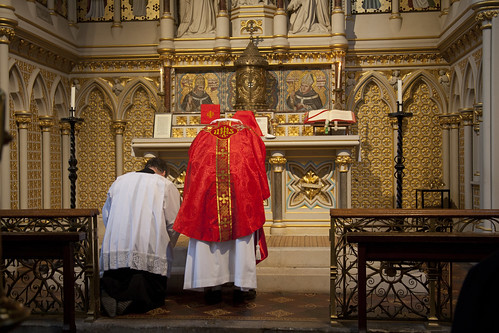
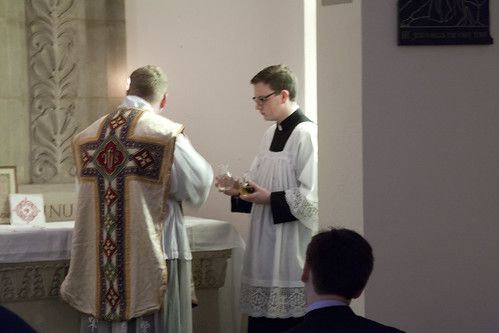
IMG_2704
The Preparation of the Chalice by the Celebrant
I have just posted a Position Paper on the Extraordinary Form's not allowing Reception of Holy Communion Under Both Kinds - ie, you receive only the Host. Go over there to read it.

It is one of those issues where, for many years, I quite liked what happens in the Ordinary Form. I can't say I missed it when I started going to the EF, there are so many differences with the OF that it hardly seemed important, but as I've been thinking about this over the years, and especially after researching for this Position Paper, I have come to the conclusion not only that the EF practice shouldn't be changed, but that there is a problem with the practice of the OF.

The Position Paper goes into all the details, here is a little more on three salient points.

1. The current practice, familiar in England and Wales and throughout Europe and North America, is not the restoration of an ancient practice in any precise sense.

2. The current practice was not called for by Vatican II.

3. The current practice is incompatible with the traditional respect due to the Sacred Vessels.
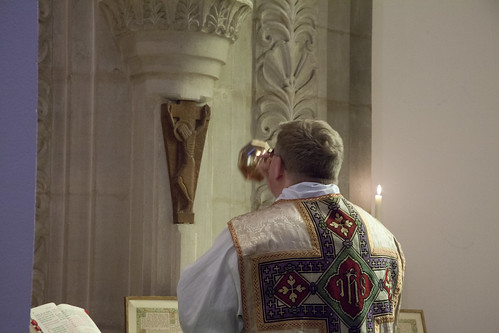
IMG_2716
The Celebrant receives the Precious Blood
1. The business of everyone queuing up and taking the Chalice in their hands from an Extraordinary Minister of Holy Communion is NOT what happened in Early Church - at least, as far as we know, or can reasonably infer. The earliest practices we know about are intinction and the use of a special metal straw, the fistula. Yes, the laity received the Precious Blood using one of these methods in antiquity, but by the time we hear about this (the 7th century) the frequency of reception was only a few times a year. This puts a number of practical issues in a very different light: reverence, the time it takes, the number of people needed to distribute it, and issues of hygiene. To restore the distribution of the Precious Blood, without intinction or the fistula, in the context of frequent Communion, large congregations, and Extraordinary Ministers, makes it a very different experience with very different pastoral implications.

2. The decree on the liturgy, Sacrosanctum Concilium, in para 55 suggested the distribution of the Precious Blood in three possible cases. The list was not intended to be exhaustive, but illustrative. What does it illustrate? Remarkably, all three cases are once-in-a-lifetime events: a baptism, a religious profession, and an ordination. It wasn't for everyone to receive from the Chalice on these occasions, just the newly baptised, professed, or ordained. This looks like a late Medieval monarch having the privilege - as they sometimes did - of receiving from the Chalice at his Coronation. The current practice is something completely different: to repeat, it has completely different pastoral implications. (This point about Communion Under Both Kinds and the Council has also been made recently by Peter Kwasniewski on the New Liturgical Movement blog.)
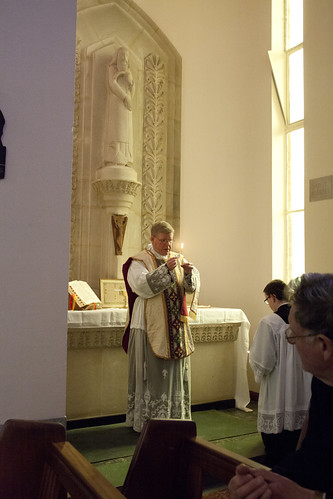
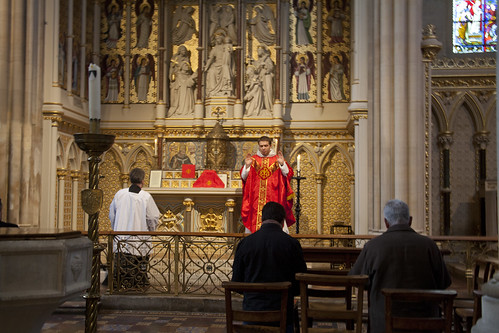
IMG_2717
The celebrant presents the Host to the Faithful
3. One of the things which had to change, to make possible the current Ordinary Form practice, is the attitude to the Chalice itself. Traditionally, this was not just blessed but 'consecrated' to liturgical use, and the sense of the special nature of the Chalice was such that it was out of the question for lay people to touch it with their bare hands. (In cases of necessity a lay sacristan would use a cloth or gloves.) This is not one of those 'late Medieval superstitions' the liberals like to talk about, it goes back at least to the time of Gregory Nazianzen, who died in 389 or 390 AD, who himself didn't invent it but rather took it for granted. The rules in Canon law and the General Instruction underwent a revolution in the respect after Vatican II; now anyone can touch anything. Canon 1171 simply cautions that the Sacred Vessels 'are to be treated reverently and are not to be employed for profane or inappropriate use.' If we are serious about restoring reverence for the Blessed Sacrament, this is one area which is in need of attention. You can't reap, in reverence, what you haven't sowed, in the established practices of the Church. But this diminution of the reverence for the Chalice was necessary if people were to pick it up and receive from it.

The EF has something to teach the whole Church here: we keep, as liturgical principles, rules which bound the whole Church for at least sixteen centuries. We are the guardians, if you like, of the Church's memory.
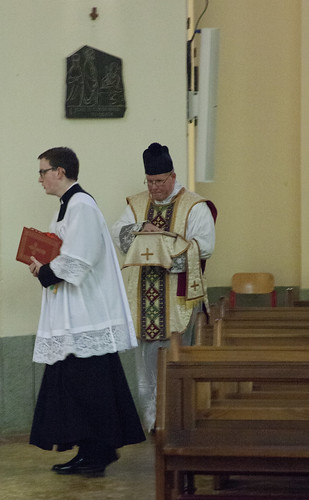
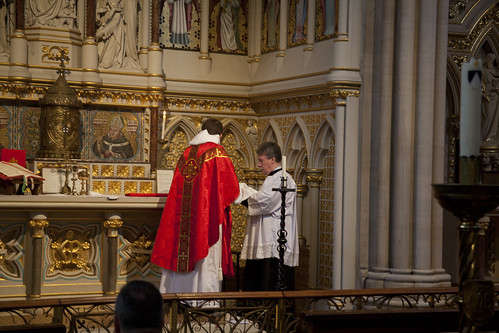
IMG_2727
At 'private' Masses it is the priest who carries the Chalice,
under the burse and pall, to and from the Altar, while
the server carries the Missal.
Photos: A Low Mass at the LMS Priest Training Conference in Ratcliffe College, Leicester.

Thursday, December 05, 2013

Dominican Low Mass in St Dominic's, Haverstock Hill

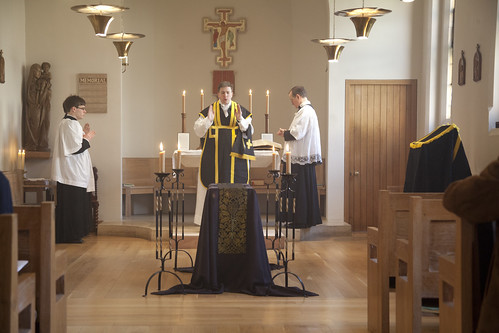
IMG_5971

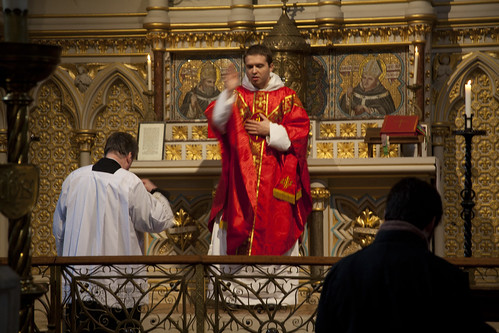
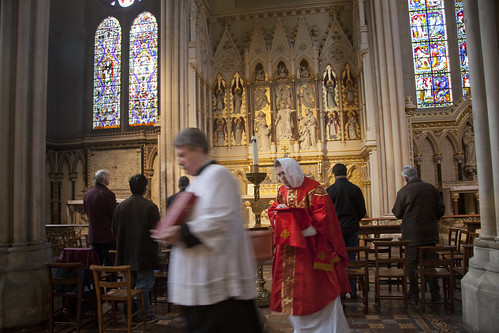
 For the same meeting I mentioned in my post about St Dominic's Mysteries of the Rosary, we had Low Mass celebrated for us in the chapel of the Coronation of Our Lady, in the traditional Dominican Rite. The Celebrant was Fr Gregory Pearson OP.
IMG_5974

The Dominican Rite is different in certain interesting ways from the Roman Rite, and preserves some of the features of ancient 'Gallican' rites, including the medieval rites of England, of which the chief was the Sarum Rite. I don't know enough about it to go into all the details, but one striking thing is the preparation of the Chalice (pouring wine and water into it) at the very beginning: Fr Pearson hasn't even taken down his hood yet, or said the Prayers at the Foot of the Altar. (This is Low Mass; in High Mass the Chalice is prepared later, but still not when it is done in the Roman Rite.)
IMG_5983

The prayers at the Foot of the Altar don't include the Psalm Judica, which makes them rather short. The Dominicans have their own version of the Confiteor as well.

This, below, is my favourite gesture, not found in the Roman Rite. You have to be quick, it is soon after the Consecration and doesn't last long.

IMG_5993

Here is another gesture not found in the Roman Rite - at least, I don't think so. Palms forward, not towards each other. 'Dominus vobiscum': it happens more than once.

IMG_6001

Compare Fr Edward van der Burgh, celebrating the Roman Rite. At the same point:

IMG_5913

Something I can't even capture with a still camera is a distinct way of making the sign of the cross at the Gospel.

  IMG_6007

This is part of the wonderful liturgical pluralism of the Church's Tradition. At the even of the Council many parishes in England were run by Dominicans, all of which enjoyed this distinctive form of the Church's liturgy; the Norbertines also used their own Rite in their parishes, and the Carthusian Rite was used in their houses (and a reformed version still is). Again, there are English customs which differ from German, Italian, French or Spanish ones, sometimes these were significant enough to have special provision in liturgical law. For example, we have a distinct formula for the handing over of gold and silver by the groom to the bride at the Marriage Service. (What? you say. Yup, the whole thing has disappeared in the Ordinary Form.) The tradition is not about uniformity, but about, well, tradition. Those things handed on to us, which are good, which have been done by countless generations in organic continuity with us, they should be preserved and handed on to our children. That is fidelity to tradition, as opposed to fidelity to a centralised rule-book.

IMG_6014

Tuesday, December 03, 2013

Mysteries of the Rosary at St Dominic's, Haverstock Hill

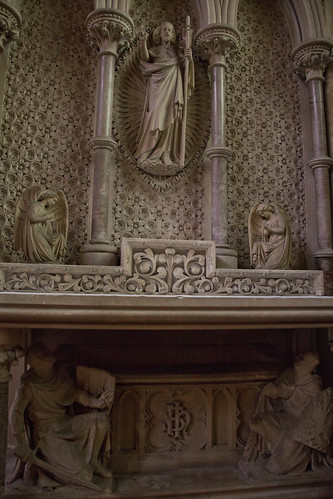
IMG_5936
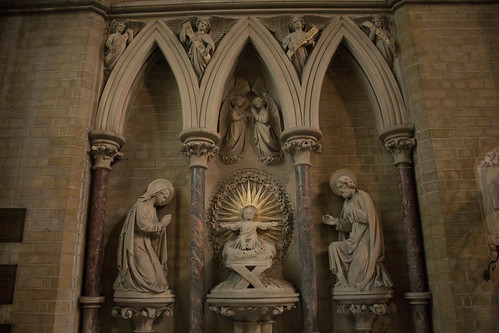
The Nativity of Our Lord

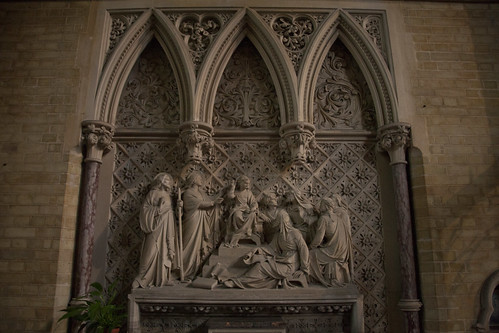
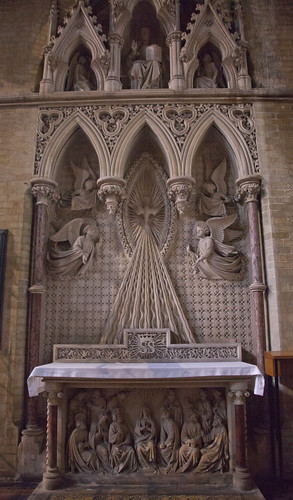
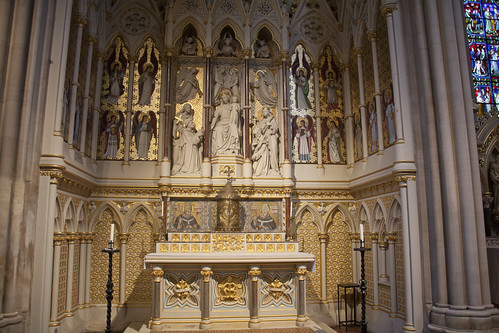
On Saturday the annual meeting of the Latin Mass Society's Local Representatives took place. We've taken to having this at the impressive Dominican church, St Dominic's, Haverstock Hill, in North London. This year I took the opportunity of being early to photograph the reredos of the side chapels dedicated to the Mysteries of the Rosary. There are, in fact, 18 side chapels; 15 of them are dedicated to these mysteries.

IMG_5940
The Finding in the Temple

I've put the Flickr set here. For some reason I've come away without the Annunciation, I will have to get that next time I'm there.

IMG_5952
The Resurrection: with the soldiers guarding the Tomb
IMG_5957
The Coming of the Holy Ghost at Pentecost
IMG_5966
The Coronation of Our Lady and the Glory of All the Saints
I never cease to be amazed by the acheivments of our predecessors in the Faith, and in particular the reconstruction of the institutional Church in the 19th century. The church dates from 1883.

Monday, December 02, 2013

More on the Una Voce Federation

IMG_5516
Archbishop Pozzo with those attending the FIUV 'Open Forum', when there are talks and questions
open to the public. He celebrated Vespers for us.
Over on Rorate Caeli I've posted the official press release of the Foederation Internationalis Una Voce: the federation of lay organisations around the world which promote the Traditional Mass, the Extraordinary Form or Vetus Ordo.

IMG_5594
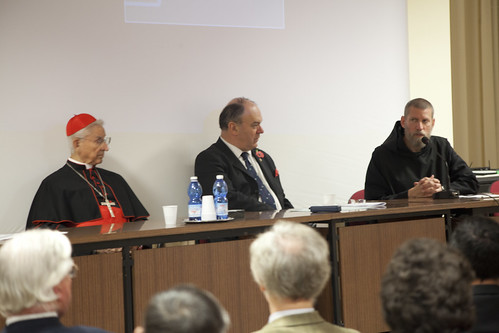
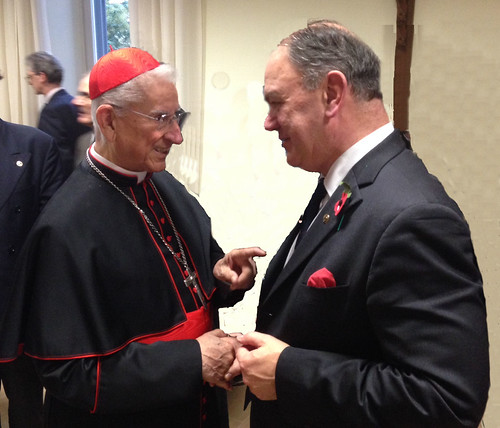
James Bogle, the new President, flanked by two speakers at the Open Forum:
Cardinal Castrillon, left, and Prior Cassian Folsom of the Norcia Benedictine community

Here is the opening section:

'The biennial General Assembly of the International Federation Una Voce (FIUV), the international body representing lay groups attached to the traditional Roman Catholic liturgy, has elected a new President, Mr James Bogle, a barrister (trial attorney) and former Chairman of the Catholic Union of Great Britain.


IMG_5671
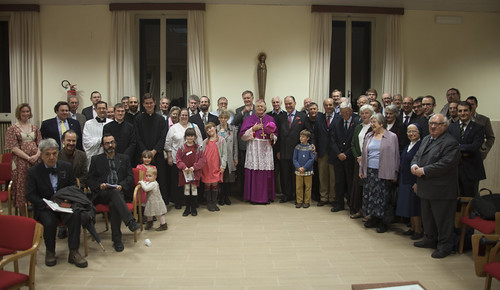
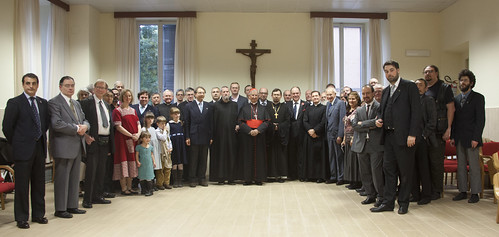
Open Forum attendees with Cardinal Castrillon.

During the General Assembly, Mass and Vespers were celebrated for the Federation in the Chapel of the Choir, in St Peter’s Basilica. Walter, Cardinal BrandmΓΌller and Archbishop Guido Pozzo were among the celebrants for Mass and Vespers.
Mr Bogle said “I am very honoured to have been elected and would like to thank the out-going President, and all those who have served with him, and all those who have been working so much for the Federation and for Catholic tradition. I am most grateful to them all.”
IMG_5676
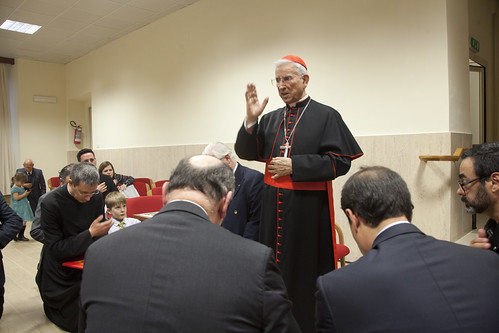
Cardinal Castrillon gives us his blessing.

The new head of the Federation stressed that if the New Evangelization is to be effective, it is vital that the faithful also experience and understand the Church’s roots of history and tradition.'

Read the rest over on Rorate Caeli. Here I can identify some of the people the Press Release mentions.

IMG_5680
Another speaker, next to Mr Bogle: Fabio Barnabei of the Cultural Center Lepanto
New Vice Presidents include  Mr Paul Fournier (Latin Mass Society of Canada):

IMG_5575
Mr Fournier, in the middle
Mr Marcin Gola (Una Voce Polonia).

IMG_5574
Mr Gola, in the middle
We also elected two new Presidents of Honour, elder statesmen of the movement: Mr Helmut Ruckriegel (from Germany) and Mr Jacques Dhaussy (from France).

IMG_5573
Left: Mr Ruckriegel, right: Mr Dhaussy
Our other President of Honour, the great canon lawyer Count Neri Capponi, is unable to travel due to ill health.

It is a great privilege for me to be Treasurer to the FIUV, a truly international organisation with such a distinguished history. The Federation is an indispensible part of the Traditional Movement, and deserves more recognition. Although the members are national associations, individuals can support it by becoming 'friends', for a small annual donation.

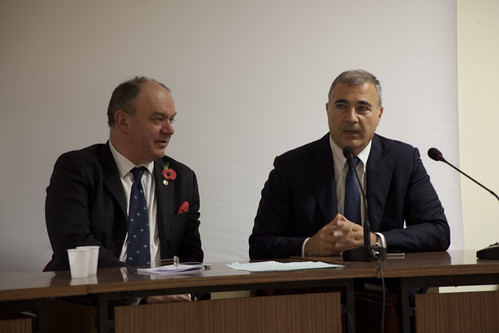
Castrillon Bogle 1

Sunday, December 01, 2013

Pro-Abortionists disrupt peaceful prayer witness in Oxford

The pro-life witness in Oxford takes place one Saturday a month, for an hour, and has done so for seven years without any disruption or opposition. I go when I can. The location is outside St Anthony of Padua church, near the entrance to the John Radcliffe Hospital. The 'JR' is the only place in Oxford where abortions take place. But they don't take place, I undertand, on Saturdays, so we don't see women on their way there. It is, nevertheless, a symbolic place for us to pray.

We pray the Rosary, led usually by Fr John Saward, Priest in Charge of SS Gregory & Augustine's down the road. Before we start he exposes the Blessed Sacrament in the monstrance, and some of us stay in the church to keep Him company. At the end we have a brief Benediction.

Two months ago a small number of pro-abortionists turned up to join us. They stood on one side of us. Last month there were more of them; our numbers were also good and we outnumbered them by nearly 10 to one. Yesterday, more of them came, seven in all - still not very many - but much more aggressive. Here's an eyewitness account.

"Today as we went to take up our positions, with the Most Blessed Sacrament next door inside the Church, there approached 7 volatile, jeering, almost demonic pro-death people.

They had made more home made banners and came and stood in front of us and interspersed themselves between us all. They brought out two large (dirty) sheets and held them in front of us and stood jostling with pro-lifers so that they were standing in front of us and hiding our posters. They had tasteless music blaring, were dancing, wiggling their hips, acting like the devil incarnate. It had a very diabolical feel to it to be honest.

"We were most definitely hounded today but one could hear the beauty of the Rosary - especially when all those able bodied knelt for the the Crucifixion mystery - which they especially loathed- ringing out and reaching the ears of God.
This is what it normally looks like.

"We did call the police who tried to diffuse the situation and have offered us sound advice for next time which will allow us to remain protected and safe. I suppose in many ways having such protesters only shows the magnitude of the truth, the pro life message reaching their hearts and souls and which will, please God, one day affect them and change their beliefs."

O Lady of Guadalupe, pray for us! And most of all, for them.