Saturday, February 27, 2016

The Pope and Nuns in the Congo

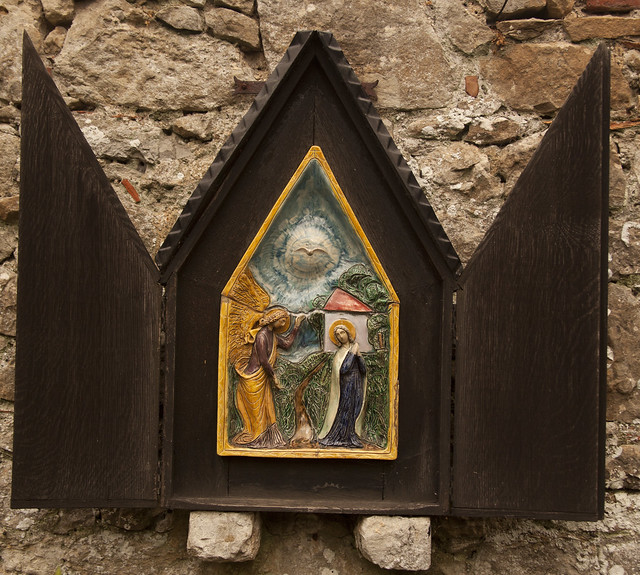
IMG_0268
The Annunciation. From the Rosary Walk at Aylesford Priory.
Here is a post of some rather technical ethical reasoning. But if you want to understand the debate on the 'Nuns in the Congo' case, read on.

The Pope referred to the famous case of the 'Nuns in the Congo' in the latest aeroplane interview. The case is about nuns who, fearing rape, take some kind of contraceptive pill. Pope Francis' exact purpose in making the reference was unclear, but not nearly unclear enough for the Vatican spokesman Fr Lombardi, who relived his triumphs in obscuring the teaching of Pope Benedict XVI on the dangers of condoms for people with AIDS, and in throwing sand into the eyes of everyone trying to make sense of Pope Benedict's remarks about male prostitutes using condoms.

In the meantime, Sandro Magister seems to have uncovered the history of the 'Nuns in the Congo' discussion, which wasn't what pretty well everyone had assumed up to now, claiming that Pope Paul VI said nothing on the subject. Rahter, it had simply been discussed by some theologians under Pope John XXIII.

Being a moral philosopher rather than a historian or, for that matter, a mind-reader, I think the contribution I can best make here is to explain why the Nuns in the Congo case is important, regardless of whether Pope Paul VI or any other pope authorised any ruling about it.

Friday, February 26, 2016

Social conservatism and social Darwinism: r/K selection theory

Among the various weird and wonderful things on the internet I've been directed this idea: r/K selection theory. Some people think it explains everything in the universe. Most people haven't heard of it. The second group are onto something. But at the risk of giving some rather strange ideas unwarrented publicity, I'm going to use this post to warn my readers about it. Because although presenting itself as a defence of the family, it is not just wrong-headed, but actually dangerous.

The theory, in a nutshell, goes like this. It is a truism that if you are a poppy, an insect, an antelope or a human being, you can have fewer offspring, and devote more resources to each one, or more offspring, and devote fewer resources to each one. Certain conditions favour one strategy over the other. The theory claims that the 'more offspring' strategy ('r') is favoured by conditions where the constraint on population is not resources, but predation, and the 'fewer but better offspring' strategy ('K') is favoured when the constraint on population is resources (or the 'carrying capacity of the environment'). So prey animals tend to be r, predators K.

The contrast is not an absolute but a matter of degree, so a species can move in one direction or another as conditions change, and different groups within a species can adopt somewhat distinct strategies.

Theorists then pile up a list of characteristics correlated to r and K respectively. 'r' organisms are smaller, have shorter life-spans, are less competitive and less cooperative, don't plan for the future (resources are plentiful), are less complex and sophisticated, than K. Because K want to invest more in each offspring, who are dependent on them for longer, they tend to mate for life and have more complex and enduring family structures.

Thursday, February 25, 2016

Milton Manor this Saturday

The LMS Annual Mass at Milton Manor is on Saturday 27th February. Mass starts at 11am.

The celebrant will be Fr Daniel Lloyd of the Ordinariate, Priest in Charge of the Parish opf Hinksey in South Oxford.

The Mass will be the Ferial Mass of the day, with the ancient and very beautiful chants and readings of the day.

It will be a Sung Mass, accompanied with chant by the Schola Abelis.

Milton Manor is between Didcot and Abingdon, near the A34; the entrance to the house is off Milton Village's High Street. Postcode OX14 4EN. Click for a map.

IMG_7773
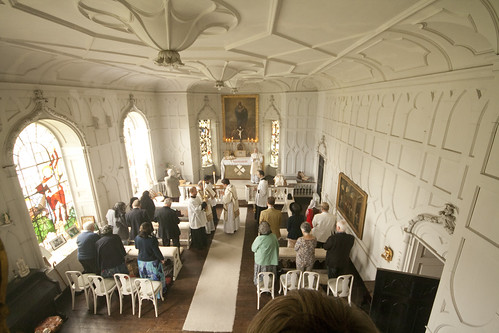
High Mass at Milton Manor for the 250th anniversary.
Milton Manor is one of the historic Catholic houses where the Mass was said and the Faith preserved through the dark days of 'penal times'. The chapel at Milton Manor celebrated its 250 anniversary last year, which we marked with a particularly splendid High Mass.

The chapel was consecrated by Bishop Richard Challoner, and celebrants at LMS Masses often use Challoner's vestments, and always his his altar cards and chalice.


Support the work of the LMS by becoming an 'Anniversary Supporter'.

Wednesday, February 24, 2016

Patriarchy and symmetry

IMG_0280
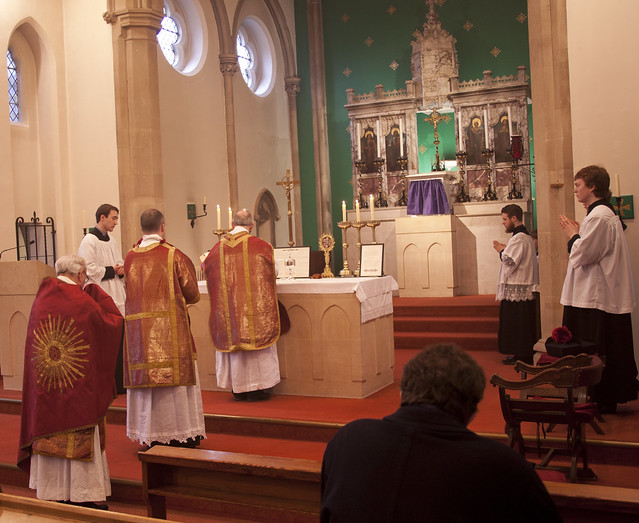
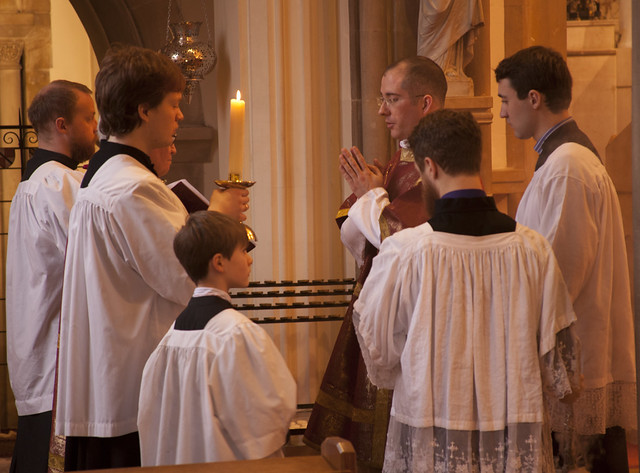
Hierarchy. (In this case, a temporary, liturgical one.)

I noted in the last post in this series that neo-cons frequently prefer silence about the authority of the husband to outright denial of the teaching. The few brave neo-cons who address the question twist themselves into the most extraordinary knots about it, like this one.

To love IS TO SUBMIT. To love is to make oneself SUBJECT TO ANOTHER. To love is to freely choose to put another above yourself, to literally live for another. Within the context of marriage this dynamic of total self-gift obviously meant to flow in BOTH DIRECTIONS (as the love between God the Father and God the Son, and between Christ and the Church) and is equally expected of men vis-a-vis their wives.

So now Christ submits to the Church? Anyone who can write that, read it again, and not say 'Oh, no, that obviously doesn't work, I'll have to think of another argument'  has crossed some kind of Rubicon of cognitive dissonance.

Tuesday, February 23, 2016

Pilgrimage to Caversham

IMG_0317

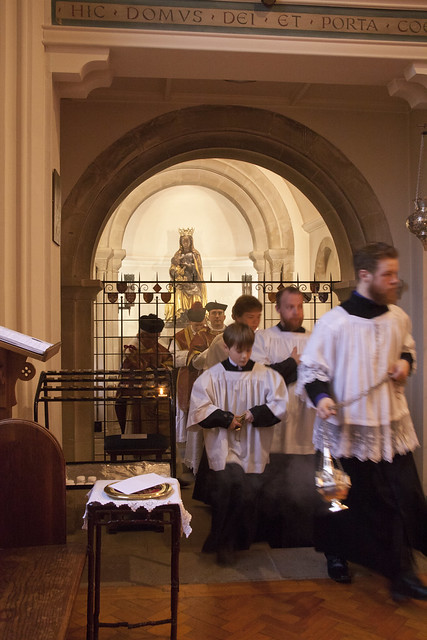
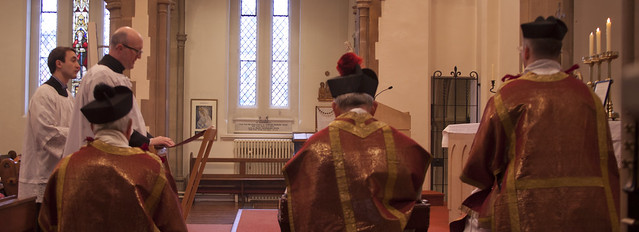
Last Saturday we had a splendid Mass for the Ember Saturday of Lent, at the Archdioce of Birmingham's Marian Shrine at  Caversham.

IMG_0251

The celebrant was Fr Anthony Conlon, assisted by Fr Ian Verrier FSSP (from over the river in Reading), and Rev Keith Crocker. It was accompanied by the Schola Abelis and Cantus Magnus under Matthew Schellhorn.


IMG_0265

Saturday, February 20, 2016

LMS Easter Triduum in London

Times of services in St Mary Moorfield's, Eldon Street, EC2M 7LS

Spy Wednesday: 9pm Tenebrae of Maundy Thursday

Maundy Thursday: 6:30pm Mass of the Lord's Supper
9pm Tenebrae of Good Friday

Good Friday: 5:30pm Solemn Liturgy of Good Friday
9pm Tenebrae of Holy Saturday

Holy Saturday: 4pm East Vigil

Friday, February 19, 2016

Is Patriarchy oppressive?


This series now has its own label: to access the full set, click here.

In this post I am going to address three questions.

What is Patriarchy?
Is is taught by the Church?
Is it oppressive?

I am going to define Patriarchy narrowly, as the view that within marriage the husband has authority over the wife, with certain limitations, and the wife the right of the support of the husband (ie he cannot chuck her out to starve in the snow). I want to use this narrow definition because it relates to references in Scripture, and also because in the Christian tradition it can legitimately take a wide range of specific forms in different social, economic, and cultural circumstances.

It fits in with a conception of marriage which is founded on the free consent of both parties, is indissoluble, and gives both parties the right to a common life - 'of bed and table' - and a duty of openness to life.

Although compatible with a range of cultural expressions, this definition is specifically Christian: it excludes some of the practices and attitudes found in Classical paganism and Islam, for example. I suppose I need to point out also that it is compatible with female ownership of property, participation in the workforce, and education. Indeed, these three things are normal in Christian societies, even if what married women have and do is not typically the same as what married men have and do. But I'm not going to write a blog post about married women's property or the history of female education; if you doubt me on this just think about Chaucer's Wife of Bath, Margery Kempe, Portia in The Merchant of Venice, etc. etc.. As for married women doing paid work, this was a victim of the Industrial Revolution, not of grim-faced Christian misogynists.