Here's another problematic aspect of the annulment reform.
Every now and then I hear some one has married following an annulment. I think, I expect most Catholics think, 'well, I'm glad they sorted that out properly'.
If someone told us of the circumstances of the annulment, and it sounded terribly dodgy, I would still try very hard not jump to the conclusion that the second marriage was in reality adulterous. I would say to myself: 'I don't have all the facts, I was not the judge in the tribunal.'
In a few years time we are all going to encounter cases of people who have had 'quickie' annulments. Assuming the reform proceeds, and until it is reversed, I suspect that few people will find it necessary to go through the 'ordinary' procedure. That is the way in the post-Conciliar Church: the exception is the rule. This appears to be the plan: the Holy Father himself has said the reform aims to help not just a few people at the margins, but rather -
"The enormous number of faithful who, despite wanting to look after their conscience, too often are turned aside by the juridical structures of the Church.”
Now when in a few years time we encounter a person who has had an annulment, we won't be able to quiet any misgivings by telling ourselves that it did at least go in front of a panel of canonical experts for serious discussion. Instead, what will we do? Will we just roll our eyes?
One of the consequences of the reform is that couples whose marriages really were invalid will be placed in the same category as any number of couples whose marriages have been annulled without any serious consideration. All of them, then, will be unable to get married again in a way which is genuinely publicly recognised. When they tell faithful Catholics they are licitly remarried, they will see rolling eyes.
This is very unjust for people who have, in some cases through no fault of their own, gone through the trauma of an invalid marriage and separation. But it won't be the fault of the people who roll their eyes; it will be the fault of the people in authority who refuse to consider petitions for annulment seriously, on their merits.
What we are going to end up with is a category of licit 'second class marriage': people of whom we say 'oh they remarried after an annulment.' It will be as if the Church were to recognise, alongside marriage, concubinage. The perception of the reality and indissolubility of first marriages will also be undermined, but nothing like as much as the reality of second 'marriages' following a quickie 'annulment'.
A second-class annulment will give couples only a second-class marriage.
The couples celebrating the possibility of 'getting married in the Church' after years of living in an 'uncanonical' situation will be the first to notice, sadly, the hollowness of their victory.
Support the work of the LMS by becoming an 'Anniversary Supporter'.
Showing posts with label Annulment reform. Show all posts
Showing posts with label Annulment reform. Show all posts
Friday, September 18, 2015

Wednesday, September 16, 2015
Annulment reform and the Kasper proposal
 Back in the innocent days we had discussing Cardinal Kasper's proposals, the suggestion was that people be allowed to receive Holy Communion despite living in uncanonical situations. He said, in an interview, that he thought reform of the process of annulment wouldn't make a difference to all that many people. Instead, we had to take a different view of the new, adulterous, unions, which people who had left perfectly valid first marriages had contracted. (My post about it.) He said:
And the second is not a marriage in the same sense, but there are elements of it—the partners take care of one another, they are exclusively bound to one another, there is an intention of permanence, they care of children, they lead a life of prayer, and so on. It’s not the best situation. It’s the best possible situation. Realistically, we should respect such situations, as we do with Protestants. We recognize them as Christians. We pray with them.
Part of the motivation for this was, no doubt, a naive belief that the annulment process could only be twisted so far, but another, and perhaps a more powerful one, is the observation that many of the couples in illicit second unions do not want an annulment.
This may seem surprising, but it is true. I've encountered this attitude myself; here is Mgr Basil Loftus about it (criticising 'the often negative and harmful purported 'solution' of marriage nullity.'), and here is Cristina Odone (angered by 'the practice of annulment, where you could effectively buy the Church’s collusion in untying the marital knot.')
Tuesday, September 15, 2015
Worries about the arguments for annulment reform
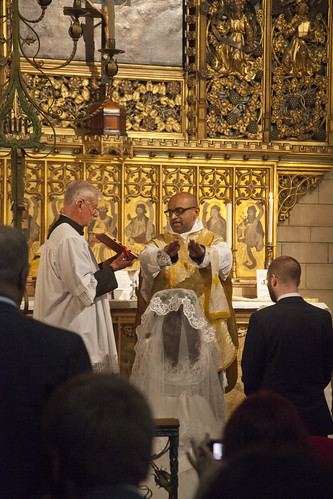 |
| The Blessing of the Bride |
I want to base my own reflections around two mutually inconsistent attitudes which are the hallmark of all too many reforms carried out in the Church since Vatican II, which appear to be present in this reform as well. (I wrote this post before reading Rorate Caeli's translation of excerpts from an article by Msgr. Pio Vito Pinto, the leader of the commission which crafted this reform; the article confirms my observations.)
The first is an impatience with the traditional approach to whatever the issue might be. In this case, the traditional approach places the burden of proof on the side of the validity of a marriage, which has the result that gaining an annulment takes on the appearance of a hurdling race. A petitioner has to prove that the marriage was void; he or she has to seek out grounds, and then evidence for those grounds, and then do it all over again with a second tribunal.
Where the system has been corrupted, of course, these obstacles may not be difficult to overcome, but the procedure still consists of overcoming them one by one. Where it has not been corrupted, then it remains a very real possibility that a petition will be refused even when the marriage is truly invalid, simply because it could not be proved to be invalid: in exactly the same way that a guilty man may walk free from from a criminal court for lack of evidence. But in the case of annulments, it does not appear to be a matter of erring on the side of caution, in that way that not imprisoning people without sufficient evidence counts as erring on the side of caution, but of erring on the side of bloodyminded intransigence. A refused petition is in most cases today a refusal to allow a couple married (or soon to be married) outside the Church to return to (or remain in) good standing and receive the sacraments. Isn't the very possibility of refusing a petition to a person in a marriage which is in reality invalid a horrifying one? Should we not err on the side of the invalidity of the marriages in front of tribunals?
No, of course not. Because the final result desired by petitioners is not, in fact, a declaration of nullity, in almost every case, but a valid marriage - a new one, that is, with a new partner. To place the burden of proof on the side of invalidity is to place a doubt on every single marriage on the face of the earth, including the marriage the petitioner wants to contract as soon as the decree is granted. It is, to this extent, self-defeating.
Monday, September 14, 2015
Marriage and annulment reform
 |
| Christ the Judge |
First thoughts, including the abolition of second instance.
More thoughts, including worries about the effects of the reform.
Lengthy procedures in Argentina
More on the causing of unnecessary doubts about the validity of marriages
Unlike Roberto de Mattei, whose article on the subject can be seen on Rorate Caeli, Peters is not too worried about the abolition of the requirement of 'second instance'. Until now, declarations of nullity have had to be confirmed by another tribunal, which obviously adds to the time and expense of the process. The new rules make this unnecessary.
While I agree with de Mattei that the change is clearly moving things in the direction of taking less seriously the marriage bond, I can see Peters' point as well. Where the canonical procedure is weak, for whatever reason, adding another weak tribunal to the process may do little to help.
Peters identifies three aspects of the reform which really do worry him, and I urge readers to see what he says in detail. They are:
1. Making relevant to the way cases are heard, whether both spouses agree to seek an annulment. Why should it be relevant? The rule will encourage an attitude of conspiring between estranged spouses to get the desired result - or pressure by one on the other to agree, for the sake of a quick result.
2. The rag-bag list of reasons to allow an accelerated procedure, which includes issues related to grounds for nullity such as lack of discretion in making the vows, with issues utterly unrelated, such as 'brevity of marriage', and issues expressed in terribly vague terms. As Peters says, this is going to lead people to have doubts about the validity of their marriages who should not. ('Gosh, I was pregnant when we married; I'd be able to have a quickie annulment. Doesn't that mean there is something wrong with my marriage?')
3. The accelerated procedure itself, which can be undertaken by a bishop assisted by people without any training in Canon Law. Bishops may have the authority, by virtue of their office, to judge cases, but putting them personally in the hot seat without the support of experts is a recipe for disaster.
I want to devote another post to some reflections of my own on this topic.
Support the work of the LMS by becoming an 'Anniversary Supporter'.
Subscribe to:
Posts (Atom)