Showing posts with label Celibacy. Show all posts

Friday, July 27, 2018

Traditional spirituality is part of the solution to the abuse crisis, not part of the problem

IMG_9313
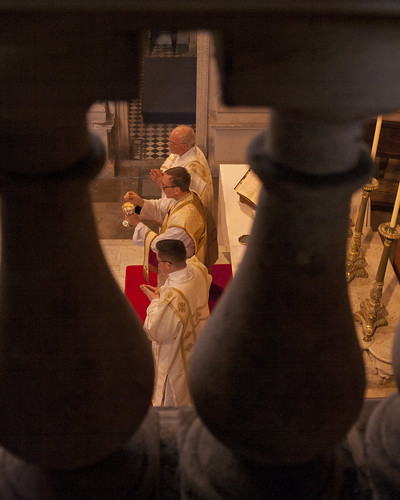
Fr Richard Bailey of the Manchester Oratory celebrates Mass for the St Catherine's Trust
Summer School in St Winifride's, Holywell, in Wales
As regular readers know, I have from time to time addressed the claim that 'traditional' spirituality and attitudes are part of the cause of clerical abuse. This idea, more often assumed than stated clearly, is part of the reason why the liberal mainstream media has been more comfortable reporting abuse, and failures to deal with abuse, by bishops and indeed Popes regarded as conservative. To make a fuss over Archbishop Rembert Weakland, whose homosexual affairs were as notorious as his dissent from the teaching of the Church and his wreckovation of his Cathedral, ran against the narrative. It seems to have left editors scratching their heads and wondering how to play the story. They are still doing so today with stories about Cardinal McCarrick.

The power of the 'media narrative' is extraordinary, and needs explaining. Here's an article which says the American media is so inward-looking they suffer from group-think. But the attitude which this narrative reflects is also found in the Church.

I want to say something about the association of ideas at work here, making use of things I have already written on this blog.

Friday, April 27, 2018

Crisis of celibacy

In light of the latest news about clerical celibacy, I thought I'd repost this from March 2013, with a new photo. I hope to write something about the Alfie Evans affair soon.
---------------------------------------------------------------------------------------
IMG_1793
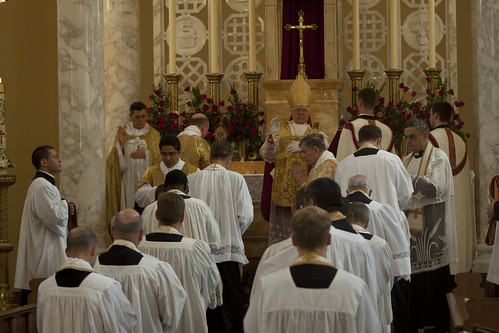
LMS Priest Training Conference April 2018
Dr Edward Peters, the well-known canonist, explains what he means by a 'crisis of celibacy' in a post which is well worth reading in full.

[T]he last four decades have seen, I suggest, a steady retreat from defending that value in canon law and pastoral practice—married clergy now outnumber celibate clergy in many arch/dioceses, thousands of married ministers have recently come into full communion with Rome and been ordained priests, the observance of clerical continence has been abandoned in the West, and the quasi-decriminalization of attempted clerical marriage itself (as opposed to remaining in pseudo-marriage) has been accomplished. Any one of these developments would have been portentous; but that they have occurred simultaneously is, I suggest, undeniable evidence that clerical celibacy is in crisis.

Thursday, October 26, 2017

A renewed attack on celibacy?

Reposted from December 2015
-----------------------------------------

The word is out that the next subject for discussion at a Synod of Bishops will be celibacy. I don't know if this is true, but it is worth reminding ourselves of exactly why the Latin Church (as opposed to the Byzantine, Maronite etc. churches) should not abandon celibacy.

A while ago I wrote a short series of posts on the topic:

The Crisis of Celibacy

The Attack on Celibacy is an Attack on the Priesthood

The Attack on Celibacy is an Attack on Marriage

Here are a few points from those posts.

First, we have come to this stage in the debate because, in a series of choices between strengthening or weakening celibacy, the Church's leadership has chosen to weaken it. These decisions have been understandable - it is important to stress that, taken individually, they may seem inevitable, or even laudable - but the cumulative effect has been to erode the principle of priestly celibacy. Examples of such decisions have been: the giving way to the massive departure of priests from their vows, and the moral support given by bishops to laicised priests, including groups calling openly for the end of celibacy; the promotion of married deacons, and the endemic confusion about deacons' obligations; the taking over of various liturgical functions by lay people, including women; and concessions made to former Anglican (and occasionally Lutheran) convert clergy.

Sunday, March 24, 2013

The attack on celibacy is an attack on marriage

2011 05 21_9733
I have explained why the attack on clerical celibacy is an attack on the priesthood. More surprisingly, perhaps, it is also an attack on marriage.

The first thing to notice - something that The Tablet tendency resolutely refuses to notice - is that marriage is an institution under intense attack, both cultural and legal. The number of people getting married has now fallen to such a low level that the divorce rate has itself begun to sag. No cause for celebration: the only people getting married today are those with a slightly better chance of staying together, because everyone else is just living in sin, a lifestyle of quasi-marriage punctuated by quasi-divorces. The progressive collapse of marriage as the normative context for child-rearing is something whose consequences will unroll like a hideous snake over the next fifty years.
2009 06 27_2780_edited-1
A institution is this state of collapse, increasingly unrecognised socially or legally, under ceaseless attack by social engineers, ceaselessly mocked by opinion-formers, and relegated to one of many 'lifestyle options', is hardly in a good shape to support the tottering edifice of another important institution, the priesthood. But the attitude that marriage can be slotted alongside the priesthood at this juncture does not, in fact, come from people with a high level of reverence and esteem for marriage. It comes from people pretty contemptuous of it.

Caroline Farrow (@carolinefarrow) put her finger on something very important in a tweet: 'I'm really finding a lot of this celibacy debate offensive. Women are treated as objects upon which men must exercise their lust.'

2009 06 27_2803_edited-1
Exactly so. For the liberals, marriage is seen as a sexual outlet for men who can't keep their flies done up. As best it is regarded as the source of 'emotional support' for priests who get lonely and don't have a housekeeper to do the cooking. I'm not saying that celibacy doesn't represent a real sacrifice for priests, the giving up of something comforting, good, and important - it certainly does. But what the liberals are missing is that marriage is itself a vocation and a commitment. It is not just a handy bit on the side, a sort of concubinage.

2010 06 12_6069
When a priest is ordained he gives up his life for the Church. When a man marries he gives up his life for his family, the family which does not appear later down the line, when children arrive, but which is represented right away by his wife. A husband gives up his property, he gives up his privacy, he gives up his right to be in a foul mood or to get drunk or lie all day in bed or leave his job to be a bum. He may do those things, of course, but to do them is not only wrong, more seriously wrong than if he were unmarried, but wrong to those in his care, his family, who didn't previously come into the picture. This family have rights over him which are all-encompassing, rights to his very body, to his very life. The seriousness and sacredness of marriage carry with them the impossibility of bigamy, polygamy, concubinage, and adultery. We are warned that even marriage after widowhood, while legitimate, is the lesser way, a way less recommended. While marriage is not absolutely, sacramentally, incompatible with the priesthood, this is something we need to stop and think about. In the West, we have persevered, through thick and thin, in the example of Christ's celibacy. We have stopped to think, and that was our conclusion: the priesthood is to be celibate, exceptional concessions aside.

What the liberals are saying about the reform of priestly celibacy is this: marriage is nothing special. Marriage is no special commitment, it leaves a man still free to do other things, like become a priest. The same people, in many cases, would no doubt say that divorce and remarriage should be allowed, and adultery and fornication are no big deals either.
2011 07 26_0707

So not content with cheapening the priesthood, they cheapen marriage. The cultural and legal cheapening of marriage, particularly since the 1968 Divorce Reform Act, has not led to more marriages, but fewer and fewer marriages. If Catholic liberals have their way and carry this cheapening further, extending it formally to places where marriage was still being taken seriously, and by parallel cheapen the priesthood too, we are not looking at a revival of Catholic life. We are staring into the abyss.

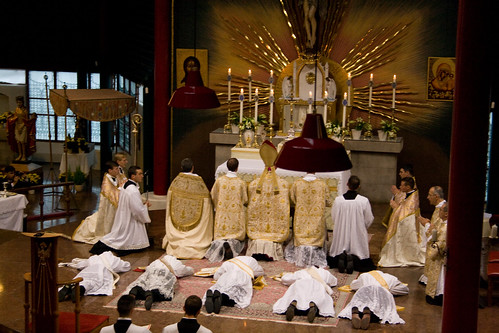
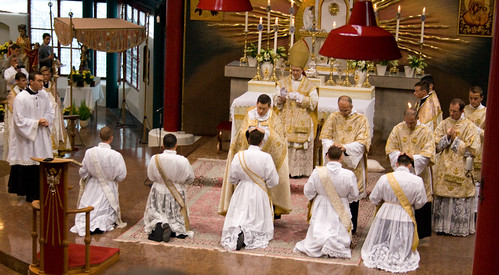
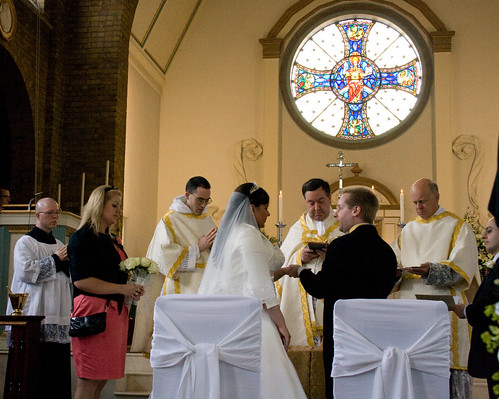
Photos: FSSP ordinations are Wigratzbad 2009; and at Denton 2011; one wedding in the Traditional rite, and another.

Saturday, March 23, 2013

The attack on celibacy is an attack on the priesthood

Yesterday I pointed to Dr Peters' observation that the legal manifestations of the Church's concern for clerical celibacy were undermined in the 1983 Code of Canon Law, and that practice since then had further undermined it. We can't proclaim the importance of celibacy and carry on as if we didn't believe it is important. We have to walk the talk.

That is one aspect of the problem. Another is the facile argument made by liberals that, if you lower the bar on the priesthood by removing the obligation to celibacy, then you'll get more vocations, better vocations, better priests, and everything will be wonderful.

Implicit in this is a very un-liberal suggestion. They wouldn't dare to say it openly; they are 'dog-whistling' it, to use political terminology. 'Are you thinking what we're thinking?' they ask. 'Well you know, married men in the priesthood wouldn't cause us these sex-abuse problems would they? Not like those homosexuals.' Nudge nudge, wink wink. I wonder what The Tablet's homosexual chums think of this argument.

The fact is that men with a disordered sexuality should not be ordained: end of story. Sex abusers - whether their victims are of the same or opposite sex - have a very seriously disordered sexuality; they should have been picked up at an early stage. If they had been, we wouldn't be faced with empty seminaries, because, as a mountain of anecdotal evidence (collected in Michael Rose's Goodbye Good Men) shows, the sexual anarchy of some seminaries in the 1970s and 1980s put many good candidates off, or forced them out. Today, potential priests have to consider putting on a suit of clothes which will inspire strangers in the street to shout 'paedophile!' at them. Yup, getting rid of the paedophiles from seminary is a win-win strategy.

An upward sloping demand curve
There is also something utterly crass about the idea that you can get more people to do something by making it easier. Yes, it works with selling crisps. But the nature of the priesthood is completely different. Even economists acknowledge that there are some goods whose demand would fall if they got cheaper - diamonds are a standard example. People value diamonds because they are expensive: their high cost is essential to the roles they play in our lives, as a display of wealth, as a demonstration of commitment, or as a store of value.

Cultivating vocations is not like selling crisps. A much better parallel would be with getting into elite institutions, such as universities, clubs, or, best of all, military units. Getting into these institutions carries a high cost, and the cost is directly proportional to the prestige of the institution, and therefore to the demand. The higher the cost, within reason, the higher the prestige, and the higher the demand. You could destroy the appeal of Oxford or the SAS or White's Club in a few years by making them open to everyone at no cost. Good candidates would go elsewhere.

With the priesthood it is not, of course, a simple matter of prestige. It is a matter of the clergy manifesting the self-sacrificial commitment of Christ. There are various personal ways in which priests may be called to do this, which can be very inspiring. As a body, they need institutional ways to manifest it to others, and to cultivate it inwardly. Clerical dress is a powerful means of doing this; the commitment to the Office and the Mass is another. Celibacy is another.

It always has been - celibacy goes back to Christ Himself. The fact that it has been compulsory in the West for all these centuries means that if we, in the West, abandoned it now, it would be a powerful signal that we were giving up on Christ as an ideal for our priests. It would be, perhaps, like the Orthodox clergy giving up their commitment to their lengthy liturgies, or the rigorous fasting of their four annual 'lents'. Is someone going to suggest that when the Latin Church gives up clerical celibacy, it should take up the things the Oriental Churches do which manifest the spiritual seriousness of their own clergy? I've not heard anyone suggest that. No, it not that critics of celibacy want to replace it with some other costly form of commitment: they want to cheapen the priesthood.


Don't be fooled: the attack on celibacy is an attack on the priesthood. The attack is led be people who consciously reject the divine foundation and supernatural vocation of the priesthood; it is followed by people who have forgotten these things. They want to cheapen the priesthood because they think it is cheap and it should be cheap. But it is not: it is something of a value beyond our comprehension. As I said about the Papacy, it is not the man who is necessarily worthy of veneration, but the office; but equally it is the man as priest who exercises the office. He can speak the words of Christ as direct, nor reported, speech: 'I absolve you', 'Do this in memory of me'. The priest is Christ among us, for all his human faults and limitations. When we need to go to Christ we can go to the priest, a human being who can be found by human means, and find Christ there.

St. Francis of Assisi used to say: "If I saw an Angel and a priest, I would bend my knee first to the priest and then to the Angel." (Read this by St Alphonsus on the priesthood.)

But this is not all: tomorrow I will argue that the attack on celibacy is an attack on marriage.