Showing posts with label Prayer for the Jews. Show all posts

Saturday, March 19, 2016

The right way to deal with offensive liturgical texts

IMG_0416
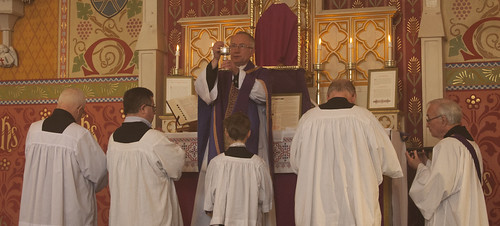
Another photo of the Sung Mass last Sunday, Passion Sunday, at Holy Trinity, Hethe.
The way to deal with offensive texts is to explain them. Such explanation may show that they are not, in fact, offensive, or it may show that they genuinely condemn something held dear by the offended person. If the enquirer is sincere, and the explanation is of the former kind, then he will be satisfied. If the explanation is of the latter kind, then he needs to hear it.

Thus, the claim is sometimes made that some or all of the Gospels are anti-Semitic, on the grounds of passages such as the cry of the crowd to Pilate, condemning Christ: 'His blood be on us and on our children' (Matthew 27:25). In his commentary on this verse, Pope Benedict points out that being sprinkled with Christ's blood has a very different meaning, for Christians, than acquiring blood guilt (Jesus of Nazareth: Holy Week, p187). Pope Benedict refers, like St Thomas Aquinas in his own commentary on the passage, to the Letter to the Hebrews, contrasting the effects of the blood of Christ with that of the murdered Abel (Heb 12:24). I was reminded of this last Sunday, in the Extraordinary Form, when we heard an earlier passage from Hebrews (9:13f):

For if the blood of bulls and of goats, and the ashes of an heifer sprinkling the unclean, sanctifieth to the purifying of the flesh: How much more shall the blood of Christ, who through the eternal Spirit offered himself without spot to God, purge your conscience from dead works to serve the living God?

Thursday, March 17, 2016

How not to deal with offensive liturgical texts

IMG_0408
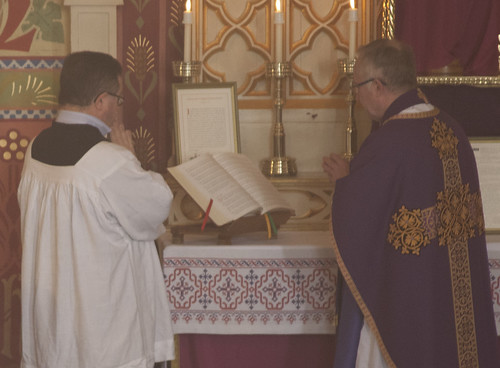
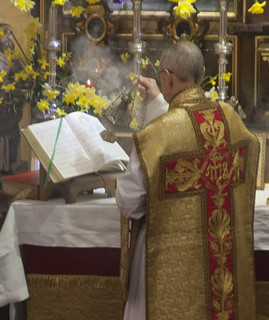
Passion Sunday, sung in Holy Trinity, Hethe, last Sunday. The Gospel, John 8:46-59, is
not found anywhere in the 1970 Lectionary. It is too scary.
Ildefonsus Schuster, the great liturgical commentator of the early 20th century, and a bishop and beatus to boot, remarked of the Good Friday 'Orationes Sollemnes', which he thought of as a single, great 'litany':

In reciting a prayer of such venerable antiquity, we seem to enter into a closer spiritual relationship with those early generations of martyrs and confessors for the faith, who used the self-same words before us, and thus obtained the graces needful to enable them to correspond to their high vocation of witnessing to this faith with their own blood.

A couple of decades later, Josef Jungmann, whose personal views were distinctly reform-minded, not to say modernist, wrote in the great work which has become the standard reference for the history of the Roman Rite, that in the same prayers,

whose echo goes back to the first century, we have the general prayer of the Church in the exact wording in which it was performed … since the third century.

Tuesday, March 15, 2016

Prayer for the Jews: what about Medieval anti-Semitism?

IMG_0375
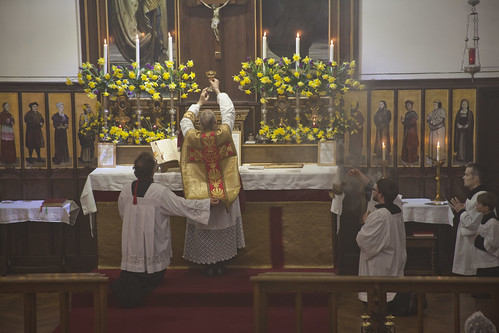
Another photo of Mass for the Feast of St Gregory the Great. 
The Position Paper on the Prayer for the Jews goes into the question of Medieval anti-Semitism, because of the association between the Traditional Mass and the medieval period. The Middle Ages is when the Traditional Mass assumed its current form in a number of ways. Should we not expect to find in its texts a reflection of Medieval attitudes?

Certainly not in this case, because the Orationes sollemnes, of which the Prayer for the Jews is a part, derive not from the Middle Ages at all, but from Antiquity: probably the 3rd century, with links back to even earlier times. This is the scholarly consensus; the references are in the Position Paper. There is such a thing as Medieval anti-Semitism, and it is a phenomenon which got going in a big way in the 13th century. The Prayer for the Jews of the ancient liturgical tradition was composed a thousand years earlier. That really is rather a long gap.

Monday, March 14, 2016

The English Bishops, the Prayer for the Jews, and bad PR

IMG_0369
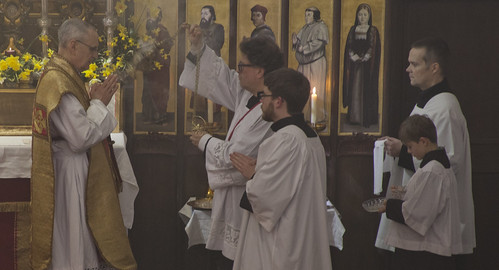
An image from the Mass of the feast of St Gregory the Great, who threatened
excommunication for anyone attempting to force Jews to convert to Christianity.
I explained in the last post in this series that there are, in the reformed Liturgy of the Hours, numerous prayers for the conversion of the Jews: specifically, the conversion of Jews to Christianity, by accepting Christ as the Messiah, as in:

Let Israel recognise in you the Messiah it has longed for; 

may the Jewish people accept you [sc. Christ] as their awaited Deliverer [Latin: 'Messiah']

In the Bishops' Conference press release about the need to change the Extraordinary Form Prayer for the Jews in the Good Friday Liturgy, Archbishop MacDonald complained that by comparison with the 1970 Novus Ordo equivalent, the 2008 version 'reverted to being a prayer for the conversion of Jews to Christianity'. Other have noted, as problematic, that the title of the prayer in the Missal is 'pro conversione Iudaiorum' instead of, as in the Novus Ordo, simply, 'For the Jews'.

How are we to understand these complaints? Naturally, we must assume that spokesmen are being honest and are reasonably well-informed. What this is about, on those assumptions, is presentation, of controlling perceptions, above all by Jews. As I noted in the last post, the suppression of the more explicit language of conversion in the Novus Ordo cannot be explained theologically, since the explict language was retained in the Liturgy of the Hours published the year after the reformed Missal: 1971. Nevertheless, the Good Friday prayers have come to Jews' attention (why? as a result of briefing by whom?), the Liturgy of the Hours prayers have not, so - the argument must be - it will be possible to make progress in terms of Catholic-Jewish relations if we talk about changing the Good Friday Prayer and ignore the Liturgy of the Hours.

Saturday, March 12, 2016

The other Prayers for the Jews

IMG_0362
'But their minds were made dull, for to this day the same veil 
remains when the old covenant is read.
It has not been removed, because only in Christ

 is it taken away.' 2 Cor 3:14

Over on Rorate Caeli I am today publishing a Position Paper on the Prayer for the Jews said during the Good Friday Liturgy in the Extraordinary Form. Go over there to read it.

Here I am going to add some additional commentary, in a hope a digestible form. The first thing I want to tackle is the other Prayers for the Jews: the ones the English bishops don't want to change, at least not at the moment, or at least aren't petitioning Rome about.

So here's a little competition. Which of the following prayers is a serious threat to peaceful and productive dialogue between Catholics and Jews?

A. Let Israel recognise in you the Messiah it has longed for; fill all men with the knowledge of your glory.

B. Let us pray also for the Jews: that our God and Lord may be pleased to shine the light of his face over them; that they too may acknowledge Jesus Christ our Lord as the Redeemer of all.

C. Let us pray also for the Jews: that Almighty God may remove the veil from their hearts so that they too may acknowledge Jesus Christ our Lord.

D. Christ, Son of David, fulfilment of the prophecies, may the Jewish people accept you as their awaited Deliverer [Messiah].

E. Let us also pray for the Jews: That our God and Lord may illuminate their hearts, that they may acknowledge Jesus Christ the Saviour of all men. 


Wednesday, December 30, 2015

Prayer for the Jews: Letter in the Tablet

It has sadly become an established media narrative that references to the Church's relations with Jews, and the Vatican II document on the subject, Nostra aetate, must include an attack on the Traditional Mass. This was on display a few years ago in the disgraceful CTS pamphlet about 'Catholic Traditionalism' by Raymond Edwards (thankfully, no longer in print), but has been taken to new lengths in connection with the 50th anniversary of Nostra aetate. A really deplorable article in the Jewish Chronicle makes an unambiguous connection between Pope Benedict, the Traditional Mass, and antisemitism - though the article displays such a poor knowledge of the issues that I am more inclined to see the author, the historian Dr Geoffrey Alderman, as a victim of misinformation, rather than as a perpetrator of it.

The Jewish Chronicle has chosen not to publish my letter in reply. I can't imagine they have any interest in the Traditional Catholic liturgy; instead, they may rather like the narrative of Jewish-Catholic reconciliation after Vatican II, which my letter questioned by stressing the elements of continuity.

Monday, December 07, 2015

Guest post on Faith in Our Familes

Today the blog 'Faith in Our Families' is posting a guest post by me, about the Good Friday Prayer for the Jews.

Read it here.


Support the work of the LMS by becoming an 'Anniversary Supporter'.

Thursday, December 03, 2015

Good Friday Prayer for the Jews: Press Release from the FIUV

The occasion for this Press Release is the story reported here that the Bishops of England and Wales are to petition the Pontifical Commission Ecclesia Dei for a change to the Good Friday Prayer for the Conversion of the Jews used in the Extraordinary Form.

FIUV Press Release: on the Good Friday ‘Prayer for the Jews’

The Prayer for the Jews used in the Extraordinary Form Good Friday Liturgy continues to be a source of comment and misunderstanding, and the FIUV wishes to respond as follows.

Statement by the President of the FIUV, Felipe Alanís Suárez:

It was to avoid misunderstandings of the Prayer for the Jews that Pope Benedict XVI composed the 2008 version of the prayer, which is clearly based on what is essential to Christianity: the acceptance of Christ as the saviour of the whole world, and the desire that all persons be saved. Jews are mentioned because of their special role in the history of salvation, and the special concern we must have for our ‘elder brothers’ (as Pope St John Paul II called them). The prayer looks forward to the incorporation of the Jewish people, of which Our Lord Jesus Christ and His first disciples were all members, in the salvation won for the human race by Christ on the Cross, a reconciliation which, as St Paul teaches, will be fulfilled only towards the end of history.

The FIUV is convinced that any possible continuing misunderstanding regarding the Good Friday Prayer for the Jews can be resolved in the context of the Magisterium of the Church, without veiling the treasures of our Faith.

We, as faithful attached to the Extraordinary Form of the Roman Rite, acknowledge that to ask of our Lord for the grace of sharing with all our brothers the joy of salvation in Jesus Christ, is an act of humility and selfless love, and a spiritual work of mercy.  

The FIUV entirely rejects all hatred and hostility towards the Jewish people, and all forms of unjust discrimination.

Further observations:

Sunday, November 29, 2015

Prayers for the Jews in the Liturgy of the Hours

Jesus and the SyroPhoneician Woman. Jesus insisted that He was sent only 
to the Jews, but allowed Himself to be won over by her faith. Mark 7:24-30
This, from a letter to The Remnant by the distinguished theologian Fr Brian Harrison, deserves a wider audience. The letter was written in the context of Pope Benedict's Prayer for the Jews, which that paper strongly supported. Fr Harrison is talking about the reformed Office, or Liturgy of the Hours, the Novus Ordo one, not the 1962 or any earlier edition.

His observations places the ambiguity of the 1970 Good Friday Prayer for the Jews into some liturgical context.

[O]n the last day of every year (December 31 at "Lauds" or "Morning Prayer"), the Church prays: "O Christ, God and man, you fulfil the prophecies as David's Lord as well as his son: we beseech you that Israel may recognize you as Messiah (te rogamus, ut Israel te Messiam agnoscat)".

Saturday, November 28, 2015

Rabbi Neusner on the Prayer for the Jews

Rabbi Jacob Neusner
This short article was published in response to the publication of the revised Prayer for the Jews, to be used in the Extraordinary Form Good Friday Liturgy, by Pope Benedict XVI, in 2008. The prolific American writer and translator, Rabbi Jacob Neusner, points out that Jews pray every day for the conversion and enlightenment of the gentiles, and have no reason to be offended if their charity is reciprocated.

I have taken the text from Chiesa, here.

Israel also asks God to enlighten the hearts of the Gentiles 

by Jacob Neusner 

Israel prays for the Gentiles. So the other monotheistic religions, including the Catholic Church, have the right to do the same thing, and no one should feel offended. Any other attitude toward the Gentiles would block them from encountering the one God revealed to Israel in the Torah.

The Catholic prayer manifests the same altruistic spirit that characterizes the faith of Judaism. The kingdom of God opens its gates to all of humanity: when they pray and ask for the swift coming of the kingdom of God, the Israelites express the same degree of freedom of spirit that impregnates the papal text of the prayer for the Jews (better: "Holy Israel ") to be recited on Good Friday.

Friday, November 27, 2015

Cardinal Kasper on the Prayer for the Jews

St Paul of Tarsus
In case anyone has forgotten, back in 2008 when Pope Benedict's Prayer for the Jews, for use in the Extraordinary Form Good Friday Liturgy, it was explained and defended by Cardinal Kasper, among others.

Cardinal Kasper's is a particular way of understanding the question of the conversion of the Jews. While I appreciate the sensitivies, I would not be comfortable with a blanket condemnation of 'targeted' evangelical outreach to Jews, as for example that taken by the Jewish convert Alphonse Ratisbon in the late 19th century. Cardinal Kasper does not make such a condemnation, but it might seem implicit in what he says. It is important, however, that he makes the point that we don't hide our witness to the Faith from Jews, and that our belief in the universal validity of Christ's redemption, and their rejection of this, has to be the basis of an honest dialogue.

If Cardinal Kasper has no problem with Pope Benedict's Prayer for the Jews, then it seems pretty surprising that anyone in the Church should have a problem with it. His affirmation that, obviously, Christ died for all men, could usefully be underlined.

The full text is here; I paste in highlights.

Unlike the 1970 text, the new formulation of the 1962 text speaks of Jesus as the Christ and as the salvation of all men, and therefore also of the Jews.

Thursday, November 26, 2015

The Good Friday Prayer and the conversion of the Jews

IMG_0290
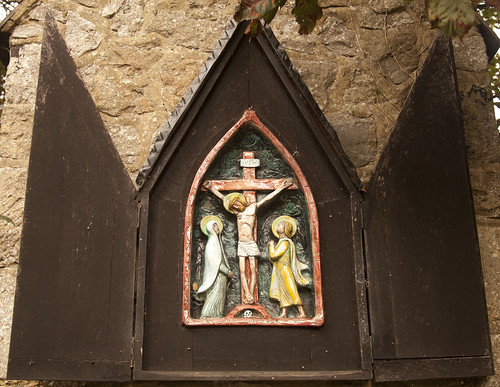
The Crucifixion: for the Rosary Walk at Aylesford Priory
We've heard from the Bishops' Conference of England and Wales that they would like to get rid of the Prayer for the Jews used in the Extraordinary Form Good Friday Liturgy. Archbishop Kevin McDonald (former Archbishop of Southwark), who is in charge of Catholic-Jewish relations, says this about it:

“The 1970 prayer which is now used throughout the Church is basically a prayer that the Jewish people would continue to grow in the love of God’s name and in faithfulness of his Covenant, a Covenant which – as St John Paul II made clear in 1980 – has not been revoked. By contrast the prayer produced in 2008 for use in the Extraordinary Form of the liturgy reverted to being a prayer for the conversion of Jews to Christianity.”

The 2008 prayer replaced one expressed in rather strong language, language used by St Paul in 2 Corinthians 3 and 4. Pope Benedict thought it best to express its central idea, and even its central image - of light overcoming darkness - in a slightly different way.

Saturday, March 08, 2014

The Church, the Jews, and the Piranha tank

I am pleased to see that the lay theologian Dr John Lamont has published an article on the Jews and the Church: 'Why the Jews are not the Enemies of the Church' in the Homiletic and Pastoral Review.


Dr Lamont is extremely sympathetic to the Traditional Catholic cause, and this is by no means an attack on that. It is a corrective, however, to claims made by some attached to the Traditional Mass, and specifically to some remarks of Bishop Fellay, Superior of the Society of St Pius X. I do not regard the SSPX, as an organisation, as anti-Semitic either in theory or practice: anyone who has been paying attention will have noticed that the SSPX has the habit of ejecting members who have clearly anti-Semitic views. What is evident, however, is that there is a current of conspiracy-theory thinking which can be found in Traditional Catholic circles which can easily lend itself to anti-Semitism.

Dr Lamont's article on the Homiletic and Pastoral Review website is already generating the kinds of comments which give Traditional Catholics a bad name: anyone addressing these matters on the internet steps into a tank of piranhas. These commenters - perhaps they will make an appearance on this blog as well - are not representative of the Traditional Catholic movement. Since they are attracting the attention of many who are open-minded about or hostile to the Traditional Catholic cause, I believe that it has become dangerous simply to ignore them. It is time the rest of us made it clear that we do not agree with them, and why.

The same task falls to those on both the political left and right in the UK, the fringes (and not just the fringes) of whose movements attract their own versions of the unpleasant views which can be found on the fringes of Traditional Catholicism.

I also think it is important to set out the reasoned case, from a perspective friendly to Traditional Catholicism, against the key claims of the conspiracy-theory types, since this case involves historical facts which are not all widely known even by those not at all attracted by the conspiracy theories.

-------------------------------

Here are some extracts (in red) of, and paraphrasing summaries from, the article.

The reason why Rabbinic Jews are not enemies of the Church can be put briefly. Such Jews do not seek to convert Christians to Judaism, or to prevent non-Jewish Christians from exercising their faith. They only refuse to become Christians themselves, which does not suffice to make them “enemies” of the Church.

-----------


Rabbinic Judaism is something which, properly speaking, arose only after the destruction of the Temple in 70 AD. Furthermore, as a result of the massive pogroms against Jews carried out by the Romans in the wake of the various Jewish Revolts, Rabbinic Judaism derives overwhelmingly from Jewish sources outside the Roman Empire, notably in Babylon. The Jewish antecedents of Rabbinic Judaism who lived in the time of Our Lord, therefore, were many hundreds of miles away from Jerusalem when He was crucified.

------------

The statements of St. Peter condemn those Jews who were themselves personally involved and responsible for the death of Christ in bringing about his crucifixion. The term “adversary,” that is used by St. Paul, is applied to the Jews who sought to prevent the first Christians from preaching the Gospel to the Gentiles. It is this attempt to prevent the preaching of the Gospel that constitutes the Jews as “enemies” of all men in St. Paul’s eyes since they are trying to prevent the message of salvation from reaching the rest of the human race. Since Rabbinic Jews make no effort to prevent the preaching of the Gospel to Gentiles, and the founders of Rabbinic Judaism lived some time after the death of Christ, these condemnations cannot be applied to them.

--------------

When the Talmud was burnt in Paris at the instigation of [the Jewish convert to Catholicism] Nicholas Donin, French Jews appealed to the Pope, who judged that it could be permitted, if it was expurgated of any anti-Christian remarks. A similar judgement was made by the Council of Trent. A commission of Jews approached the Council to request that it rule that the Talmud could be printed. The Council passed their request on to the Congregation for the Index, which again ruled that it could be printed if any anti-Christian statements were removed. This evaluation of the Talmud was more positive than that given to the works of Luther, Calvin, Peter Abelard’s Introduction to Theology, and Samuel Richardson’s Pamela – all of which were banned in their entirety by the Church.
---------------
“Because Rabbinic Jews deny the doctrine of the Trinity, they do not believe in the same God as the Christians.”  The claim makes the mistake of inferring the psychological state of the believer from the logical consequence of his beliefs. It is true that since God is necessarily a trinity of persons, it necessarily follows that any being that is not a trinity of persons is not God. However, it is not true that every believer accepts all the logical consequences of his beliefs, simply because they do not always draw these logical consequences; and, indeed, are not capable of drawing all of them, since these consequences will be infinite in number. In the particular case of inferring that no being who is not a trinity of persons is the true God, it is only Christians who are capable of making this inference; the belief that God is necessarily a trinity of persons is needed to make it, and this belief can only be acquired through an act of Christian faith. Thus, from the facts that the Jews reject the doctrine of the Trinity, and that the denial of this doctrine entails that the true God does not exist, we cannot conclude that Jews do not believe in the existence of the true God.
-------------------
However, the Jewish organizations who insist that the Church should accept that the Mosaic law is still valid for Jews, are not representative of Jews as a whole. Most religious Jews are realistic enough to understand that the Church is not going to change her fundamental teachings, and are content with a vigorous rejection of anti-Semitic hatred and discrimination by Catholics. In defence of these Jewish organizations, it should be said that they are not necessarily well-informed about Christian thought, and that they have been assured, by some individuals with high positions in the Church, that Catholics no longer consider that they need to be saved by belief in Christ. They naturally take these assurances to correspond to what Catholic teachings now assert. When they are told that this is not, in fact, the case, they consider this to be an attempt to cheat them by going back on prior agreements. Some apologies are owed to them for having been given false assurances. The ecclesiastics who gave these assurances sought to use Catholic-Jewish relations as a pretext and disguise for advancing their own theological agenda, which was one of modernist promotion of all religions as good, and as paths to salvation. The Jews who accepted these assurances got caught up in an internal game of subversion of the Church, which was not their objective.