(I'm posting this in light of the recent Synod in Crete.)
But the Roman Church does not attack these traditions, I hear my readers cry! Well, no, but yes.
Here are some extracts from the FIUV Position Paper on the Traditional Mass and the Eastern Churches.
... the Latin reform saw the almost universal abandonment of the Latin
tradition of liturgical orientation: the celebration of Mass by a priest facing liturgical east,
which meant (outside a small number of exceptional churches), facing the same way as
the Faithful. The promotion of this change, which was not discussed by the Second
Vatican Council and has never been made obligatory in the Latin Church, has been
accompanied by a polemic against the traditional practice, which is disparagingly
described as ‘the priest turning his back on the people’. This polemic is not endorsed in
the Church’s official documents and has often been criticised, notably by Pope Benedict
XVI. It is, nevertheless, very widespread, and is clearly applicable to the tradition of
worship ad orientem in the Eastern Rites. The Congregation for the Oriental Churches
has felt it necessary to address the issue in the Instruction Il Padre, (107):
Showing posts with label TLM and the Eastern Churches. Show all posts
Showing posts with label TLM and the Eastern Churches. Show all posts
Monday, June 27, 2016

Monday, November 11, 2013
The Traditional Mass and the Christian East, Part 3: Il Padre
 |
| Tradition is doing... |
Il Padre, incomprensibile,
with the more prosaic English title
'Applying the Liturgical Prescriptions of the Code of Canons of the Eastern Churches'.
It is available (in English) in the online library of the EWTN, and also (in a less searchable and legible form) on the Vatican website, as is the original Italian.
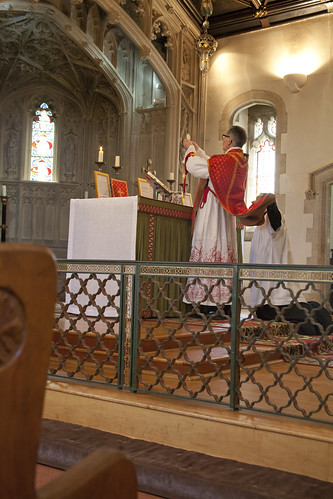
Here are some quotations. If we take these seriously, they have implications for liturgical practice in the West as well as in the East. The priest facing the people is alien to the customs of the East? It is in the West as well, for all the necessary caveats about Roman basilicas (where the celebrant would always have been impossible to see in any case). Lay people distributing the Eucharist are repugnant to the Eastern tradition? They are to the Western tradition as well. Should the Eastern Churches accept developments only if they are 'coherent with the contextual meaning in which it is placed'? Well, so should we in the West. The Eastern Churches should not only preserve but restore their liturgies in fidelity to their traditions? Well, we clearly have an even more urgent need to do that in the West.
Tradition and development.
18. The first requirement of every Eastern liturgical renewal, as is also the case for liturgical reform in the West, is that of rediscovering full fidelity to their own liturgical traditions, benefiting from their riches and eliminating that which has altered their authenticity. Such heedfulness is not subordinate to but precedes so-called updating. Although a delicate task that must be executed with care so as not to disturb souls, it must be coherently and constantly pursued if the Eastern Catholic Churches want to remain faithful to the mandate received. It is once again John Paul II who declares: "If, therefore, you must trim extraneous forms and developments, deriving from various influences that come from liturgical and paraliturgical traditions foreign to your tradition, it is possible that, so doing, you will have to also correct some popular habits."
We are witness today to the diffusion of a mentality that tends to overvalue efficiency, excessive activism, and the attainment of results with minimum effort and without deep personal involvement. This attitude can also negatively influence the approach towards liturgy, even in the East. The liturgy, rather, continues to be a demanding school which requires an assimilation that is progressive, laborious, and never completely accomplished. ...
These considerations do not take away from the rightful exigency to express, as much as possible, the Gospel in a plain and clear way for the contemporary man and woman. Every formula necessitates, therefore, unceasing vigilance to remain alive under the breath of the Spirit. But Tradition, even in its literal expression—as is the case for Scriptures—contains unrenouncable treasures; its strengths are received, assimilated, and utilized to transmit to mankind the fullness of the Mystery of God. Indeed, it is about words of fire, just like the Word of God which is sharper than a two-edged sword and penetrates to the division of soul and spirit (cf. Heb. 4:12). The fact that they are constantly repeated in the liturgy should not take anything away from their vigor and perennial timeliness.
...
 |
| what your forbears in the Faith did... |
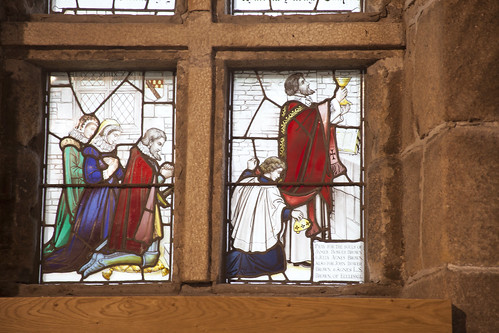
20. In modifying ancient liturgical practice, it must be determined if the element to be introduced is coherent with the contextual meaning in which it is placed. Such a context should be understood beginning with eventual references to Sacred Scripture, interpretations of the Holy Fathers, liturgical reforms previously made, and mystagogical catechesis. Here it must be verified that the new change is homogeneous with the symbolic language, with the images and the style specific to the liturgy of the particular Church. The new element will have its place if, required for serious pastoral reasons, it blends within the celebration without contrast but with coherence, almost as if it had naturally derived from it. In addition, it should be ensured that it is not already present, perhaps in another form, in a different moment of the celebration or in another part of the liturgical of that Church.
Can. 709 § 1 of the Code of Canons of the Eastern Churches establishes that it is the responsibility of the priest to distribute the Eucharist, or also the deacon if the particular law of the Church so disposes. The subsequent paragraph grants the right to the Synod of Bishops of the patriarchal Church, or to the Council of Hierarchs, to establish norms by which other Christian faithful can also distribute the Eucharist.
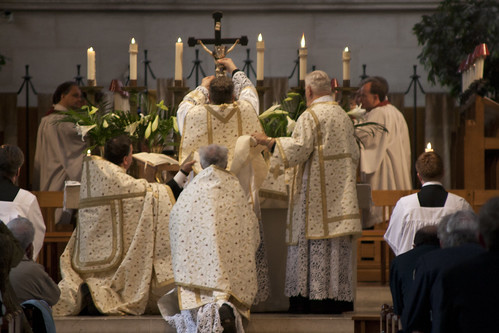
Therefore, assigning to the deacon or even to other faithful the task of distributing the Divine Eucharist depends on the instructions of the particular law. It is indispensable to remember, however, that these instructions must be coherent with the specific context of the liturgical tradition in which they are inserted. It should be remembered that all the Eastern traditions emphasize the greatness of the mystery of holy Communion. An ancient Syro-Chaldean commentator describes the presentation of the sacred gifts to the faithful with the following words: "The Holy One comes forth on the plate and in the cup, in glory and majesty, accompanied by the presbyters and deacons, in grand procession. Millions of angels and servants of the fire of the Spirit go before the Body of Our Lord, glorifying him. All the people and all the sons of the Church rejoice when they see the Body come from the altar." Therefore, reserving the distribution of the Eucharist normally to the priests has the scope of manifesting its highest sacredness. Even if this excludes enhancing the value of other criteria, also legitimate, and implies renouncing some convenience, a change of the traditional usage risks incurring a non-organic intrusion with respect to the spiritual framework to which it refers. Therefore, it is appropriate that the faculty of distributing the Eucharist by those other than the Bishop or the presbyter, or the deacon if so disposed by the particular law of each Church , be exercised only in the case of true emergency.
Rigorous observation of the eucharistic fast was a unanimous tradition, even if diversified in its forms, in all the Eastern and Western Churches up until the first reforms undertaken in this area by Pope Pius XII. It expressed and continues to signify the concern for a proper spiritual preparation for receiving the Eucharist, life-giving Bread come down from heaven. In the desire to facilitate access to the Eucharist, such practice has been greatly reduced in the Latin Church. A similar example was followed by many Eastern Catholic Churches, while those non-Catholic maintained their customs, even if perhaps less strictly. The change in the discipline of the eucharistic fast has contributed to the development of a greater participation in the Eucharist, although it has sometimes contributed to weakening the awareness of the extraordinary value and meaning of the mystery celebrated. Can. 707 § 1 of the Code of Canons of the Eastern Churches refers legislation in this regard to the particular law. An eventual restoration, at least partial, of the ancient norms for fasting in the Eastern Catholic Churches is valued opportune, taking into account the meaning of both the traditional practice, which does not always exactly coincide with the Latin sensibility, and of the need to correspond with the different conditions of life in the world today.
 |
| ...and handing this one to the next generation... |
87. The penitential attitude permeates all Christian worship
The penitential orientation which accompanies all Christian life constantly appears in every manifestation of worship; in fact, it demands truth (cf. Ps. 50[51]:6) and thus, implies unceasing acknowledgment of one's sins and of the need to change ways. Such an attitude is found throughout the liturgical year and in every hour of the day, but in a particularly exigent way during the times of preparations for the feasts, above all in the one preceding Easter. For this reason, all the liturgies of the East as in the West ever since time immemorial call for Psalm 50[51] to be prayed even several times a day, the psalm with which forgiveness and the gift of the Holy Spirit is invoked. The penitential attitude notably appears in many sacraments. Baptism, in fact, is given to us for the "blessed purification" of sins,[71] in the Divine Liturgy we offer "spiritual worship for our own sins and the faults of your people,"[72] approaching the Holy Communion in which we receive "the Body and the Blood of the Lord broken and shed for the remission of sins;"[73] the Anointing of the sick also procures the remission of sins (cf. Jas. 5:15). In various Eastern Churches, there are moments of liturgical prayer to which penitential value is particularly attributed as is also, in a certain way, a power of reconciliation. Penance in the ancient tradition did not obtain its fruit of salvation only in the liturgical setting, because there are other actions (fasts, alms, pilgrimages, etc.) which already obtain from God a certain grace of forgiveness and there are places (monasteries, sketes, cells, deserts, etc.) in which the ineffable gift of , or mourning for one's own sins, reveals through tears the possibility to be reborn every day in the newness of life in the Spirit.
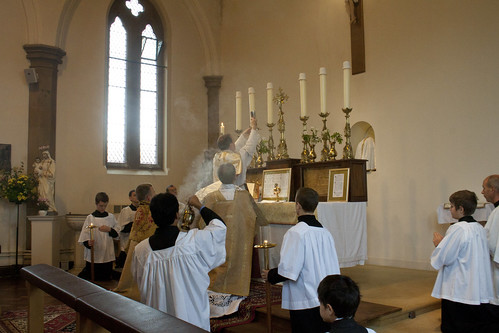
Ever since ancient times, it has been customary in the prayer of the Eastern Churches to prostrate oneself to the ground, turning toward the east; the buildings themselves were constructed such that the altar would face the east. Saint John of Damascus explains the meaning of this tradition: "It is not for simplicity nor by chance that we pray turned toward the regions of the east (...). Since God is intelligible light (1 Jn. 1:5), and in the Scripture, Christ is called the Sun of justice (Mal. 3:20) and the East (Zech. 3:8 of the LXX), it is necessary to dedicate the east to him in order to render him worship. The Scripture says: 'Then the Lord God planted a garden in Eden, in the east, and he placed there the man whom he had formed' (Gen. 2:8). (...) In search of the ancient homeland and tending toward it, we worship God. Even the tent of Moses had its curtain veil and propitiatory facing the east. And the tribe of Judah, in as much as it was the most notable, encamped on the east side (cf. Nm. 2:3). In the temple of Solomon, the Lord's gate was facing the east (cf. Ez. 44:1). Finally, the Lord placed on the cross looked toward the west, and so we prostrate ourselves in his direction, facing him. When he ascended to heaven, he was raised toward the east, and thus his disciples adored him, and thus he will return, in the same way as they saw him go to heaven (cf. Acts 1:11), as the Lord himself said: 'For just as lightning comes from the east and is seen as far as the west, so will the coming of the Son of Man be' (Mt. 24:27). Waiting for him, we prostrate ourselves toward the east. It is an unwritten tradition, deriving from the Apostles."[85]
This rich and fascinating interpretation also explains the reason for which the celebrant who presides in the liturgical celebration prays facing the east, just as the people who participate. It is not a question, as is often claimed, of presiding the celebration with the back turned to the people, but rather of guiding the people in pilgrimage toward the Kingdom, invoked in prayer until the return of the Lord.
Such practice, threatened in numerous Eastern Catholic Churches by a new and recent Latin influence, is thus of profound value and should be safeguarded as truly coherent with the Eastern liturgical spirituality.
Art and architecture
 |
| ...with as much reverence as possible. |
Saturday, November 09, 2013
The Traditional Mass and the Christian East, Part 2: Syro-Malabar
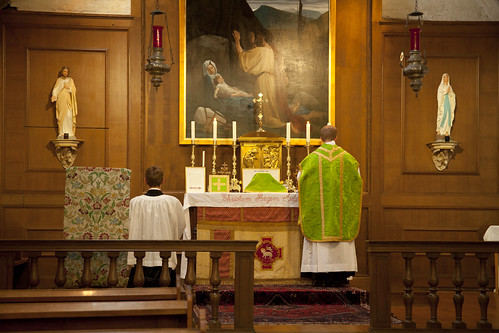 |
| Reading the Epistle from the Altar in Low Mass. |
Although the 1970 Missal, and the seemingly endless permissions for liturgical novelties which preceded and followed this (Communion under Both Kinds, Communion in the Hand, the priest facing the people, Altar Girls, etc.), were officially promulgated, theological arguments against the traditional practices are surprisingly difficult to find in Magisterial texts. It would be strange, after all, for the Magisterium to say that the continuous practice of many centuries was wrong, especially as this practice had been obligatory and defended continually by the Magisterium itself. The Council of Trent even saw fit to issue infallible statements defending a whole lot of them:
Session XXII:
Canon VII. If any one saith, that the ceremonies, vestments, and outward signs, which the Catholic Church makes use of in the celebration of masses, are incentives to impiety, rather than offices of piety; let him be anathema. ...
Canon IX. If any one saith, that the rite of the Roman Church, according to which a part of the canon and the words of consecration are pronounced in a low tone, is to be condemned; or, that the mass ought to be celebrated in the vulgar tongue only; ... let him be anathema.
Indeed, in many official documents we actually find encouragement of the traditional practice, even while something else is being permitted. This is notably the case with Communion in the Hand, but it is also true of the use of Latin, Chant, and the non-use of Extraordinary Ministers of Holy Communion and Altar Girls. What the Church has explicitly taught, even non-infallibly, is frequently a very long way short of what liturgists have had to argue in order to justify their novelties and abuses.
This becomes particularly clear when we come to the principles of liturgical reform set out by the Congregation for the Oriental Churches. They naturally take their start from the Second Vatican Council, which (with hindsight) seems amazingly conservative:
there must be no innovations unless the good of the Church genuinely and certainly requires them; and care must be taken that any new forms adopted should in some way grow organically from forms already existing. (Sacrosanctum Concilium 23)
Added to which is the political imperative of Eastern Catholics being seen by the Orthodox as holding faithfully to their traditions by Vatican II in Orientalium Ecclesiarum:
6. All members of the Eastern Rite should know and be convinced that they can and should always preserve their legitimate liturgical rite and their established way of life, and that these may not be altered except to obtain for themselves an organic improvement. All these, then, must be observed by the members of the Eastern rites themselves. Besides, they should attain to an ever greater knowledge and a more exact use of them, and, if in their regard they have fallen short owing to contingencies of times and persons, they should take steps to return to their ancestral traditions.
Now I am going to talk about a really obscure document, it is not even in the Acta Apostolis Sedis, but it has been published, and I can provide a copy online for the first time. It is the official response of the Congregation for the Oriental Churches to a proposal for liturgical reform by the Bishops of the Syro-Malabar Church, an Oriental Church with its own very ancient Rite which is in communion with Rome. This church is not autocephalous (self-governing, with its own Patriarch), so it comes more directly under the authority of the Congregation than the larger Catholic Oriental Churches, like the Ukranian or Maronite Churches. So, as you will see, the Congregation was involved in a very detailed way in criticising this proposal.
The proposal could be described loosely as a Novus Ordo-isation of the ancient liturgy of Syro-Malabar, whose authentic restoration had been sponsored by Rome, culminating in a new edition of their liturgical books in the 1950s. The proposal was finalised in 1981 and sent for approval to the Congregation, who replied in 1984, their document (which I think was composed in English) having the snappy title:
Instruction “Observations on: ‘The Order of the Holy Mass of the Syro-Malabar Church 1981’ ” (1984)
On the process by which the proposal was put together: the need for consensus.
The results of the voting in the commission show a rigid pattern of two opposed blocks, at least on most essential issues. Hence, the text represents not a consensus, but the victory of one party. This can hardly be a firm basis for changing age-old traditions that are the heritage of all. Furthermore, it is clear that the minority in the commission consisted of those desirous of preserving the integrity of the Eastern tradition, which is in accord with the constantly repeated instructions of the Holy See.
On principles of reform.
In general, there is a “reductionist” tendency to limit and reduce and Westernize as much as possible, with little awareness of the nature of ritual activity as understood from the view-point of cultural anthropology – that is, one sees hardly any awareness of what an extremely delicate thing it is to touch in any way the established ritual patterns of a tradition.
Low Mass as the normative form of Mass?
The text is based on a “low mass” celebrated by one priest, whereas universal, age-old Eastern practice has always been that the approved official text of the liturgy be the solemn form. Other liturgies are lesser services based on the solemn form; the solemn form is not a sung version of the low mass.
'The theme of today's Mass...' (see the Position Paper on the Lectionary)
The “intention” or “theme” is not announced at the beginning (“General Instructions” no. 4). This contemporary Western fad has no basis either in Indian culture nor in a proper understanding of the liturgy in any tradition. All liturgy has but one theme, Jesus Christ dead and risen for our salvation; and the intentions of every Eucharist, including the particular intentions of the local community, are expressed in the liturgical texts themselves at the proper time. The proper time is not the beginning of the service, when our thoughts should first turn to the glorification of God (hence the opening “Glory to God …”) and not to our own needs. Indeed, this proposal is an example of the inadequate liturgical understanding manifested by the proposed text: it proposes to suppress the diptychs, one of the most ancient and traditional Eastern expressions of such intentions, and to add a recent Western innovation at a place in the liturgy where it certainly does not belong.
Ex tempore prayers.
Spontaneous prayers are not to be admitted. This Western experiment has opened the door to mediocrity and banality. Very few people have the talent for spontaneous public prayer, and one person’s “spontaneous” prayers always sound the same. Furthermore, in public, ritual worship (as distinct from private prayer) there is little room for spontaneity of composition and from. Indeed, such “spontaneity” is actually not that of the people of God, but of individual celebrants, who often impose their particular ideas and piety on a captive audience. Spontaneity in liturgy is found in the movements of hearts as they respond to grace, not in the liberty of individual priests to impose their personal piety on the common prayer of all.
Silent prayers by the priest (see the Position Paper on Silence in the Liturgy)
Let the rubric specify that the prayer be said quietly. It is sometimes said that all liturgical prayers should be said aloud so that everyone can hear them. This is a false principle both historically and liturgically. Some prayers are specifically designed to be said during singing or processions or other activities of the people, or are apologies pro clero. Just as the clergy do not have to sing everything the people chant, so too the people do not have to hear all the prayers. Indeed, to recite all prayers aloud interrupts the proper flow of the liturgical structure.
Use of a lectern?
The place of honor for this book [the lectionary] is the altar, and nowhere else, in the Christian East. Let this be specified in the rubrics.
'Let us pause for silent prayer'?
Silent periods of reflection cannot be allowed to interrupt the liturgy: they have no place in Eastern usage.
Spontaneous bidding prayers?
If other, particular intentions are added to suit special necessities, these are to be submitted to the priest before the liturgy and are to be formulated in conformity with the pattern of the karozutha petitions. Spontaneous petitions from the congregation are to be avoided. (Privately composed litanies, generally unsatisfactory in both theology and expression, are one of the least successful aspects of the Western reform. There is no need to imitate the failures of others.)
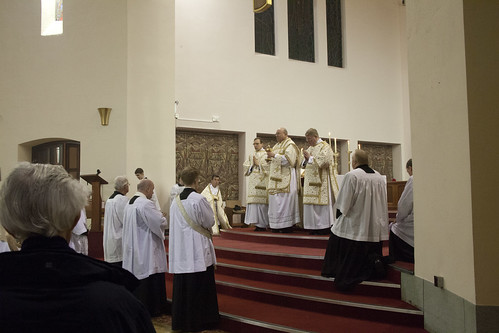
Elaborate Offertory procession to show the people's involvement?
These principles, expressed in an usually robust way by a somewhat exasperated Congregation, are applicable to the West as well as to the East, as the Congregation often makes clear. This is as clear a statement as one could wish that on a whole series of issues the theories of trendy liturgists are completely outside the teaching of the Church, even if the results are permitted in our churches.
In the next post I will examine another document of the same Congregation, Il Padre, incomprensibile, issued in 1996.
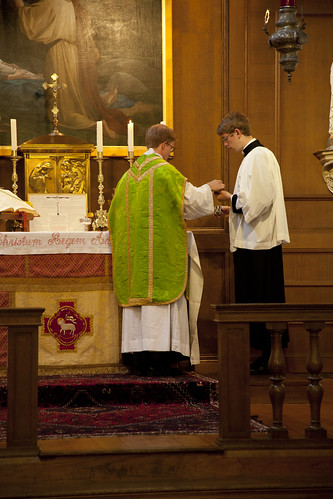 |
| A tiny Offertory procession, from credence table to Altar, by the server. In the Syro-Malabar rite it should be done by deacons, and never with a big fuss by lay people. |
Now I am going to talk about a really obscure document, it is not even in the Acta Apostolis Sedis, but it has been published, and I can provide a copy online for the first time. It is the official response of the Congregation for the Oriental Churches to a proposal for liturgical reform by the Bishops of the Syro-Malabar Church, an Oriental Church with its own very ancient Rite which is in communion with Rome. This church is not autocephalous (self-governing, with its own Patriarch), so it comes more directly under the authority of the Congregation than the larger Catholic Oriental Churches, like the Ukranian or Maronite Churches. So, as you will see, the Congregation was involved in a very detailed way in criticising this proposal.
The proposal could be described loosely as a Novus Ordo-isation of the ancient liturgy of Syro-Malabar, whose authentic restoration had been sponsored by Rome, culminating in a new edition of their liturgical books in the 1950s. The proposal was finalised in 1981 and sent for approval to the Congregation, who replied in 1984, their document (which I think was composed in English) having the snappy title:
Instruction “Observations on: ‘The Order of the Holy Mass of the Syro-Malabar Church 1981’ ” (1984)
On the process by which the proposal was put together: the need for consensus.
The results of the voting in the commission show a rigid pattern of two opposed blocks, at least on most essential issues. Hence, the text represents not a consensus, but the victory of one party. This can hardly be a firm basis for changing age-old traditions that are the heritage of all. Furthermore, it is clear that the minority in the commission consisted of those desirous of preserving the integrity of the Eastern tradition, which is in accord with the constantly repeated instructions of the Holy See.
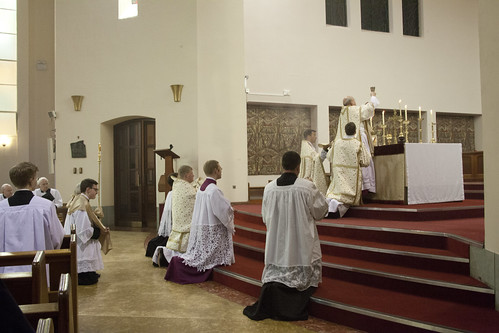 |
| The normal, most solemn form of Mass: Pontifical Mass |
In general, there is a “reductionist” tendency to limit and reduce and Westernize as much as possible, with little awareness of the nature of ritual activity as understood from the view-point of cultural anthropology – that is, one sees hardly any awareness of what an extremely delicate thing it is to touch in any way the established ritual patterns of a tradition.
Low Mass as the normative form of Mass?
The text is based on a “low mass” celebrated by one priest, whereas universal, age-old Eastern practice has always been that the approved official text of the liturgy be the solemn form. Other liturgies are lesser services based on the solemn form; the solemn form is not a sung version of the low mass.
'The theme of today's Mass...' (see the Position Paper on the Lectionary)
The “intention” or “theme” is not announced at the beginning (“General Instructions” no. 4). This contemporary Western fad has no basis either in Indian culture nor in a proper understanding of the liturgy in any tradition. All liturgy has but one theme, Jesus Christ dead and risen for our salvation; and the intentions of every Eucharist, including the particular intentions of the local community, are expressed in the liturgical texts themselves at the proper time. The proper time is not the beginning of the service, when our thoughts should first turn to the glorification of God (hence the opening “Glory to God …”) and not to our own needs. Indeed, this proposal is an example of the inadequate liturgical understanding manifested by the proposed text: it proposes to suppress the diptychs, one of the most ancient and traditional Eastern expressions of such intentions, and to add a recent Western innovation at a place in the liturgy where it certainly does not belong.
Ex tempore prayers.
Spontaneous prayers are not to be admitted. This Western experiment has opened the door to mediocrity and banality. Very few people have the talent for spontaneous public prayer, and one person’s “spontaneous” prayers always sound the same. Furthermore, in public, ritual worship (as distinct from private prayer) there is little room for spontaneity of composition and from. Indeed, such “spontaneity” is actually not that of the people of God, but of individual celebrants, who often impose their particular ideas and piety on a captive audience. Spontaneity in liturgy is found in the movements of hearts as they respond to grace, not in the liberty of individual priests to impose their personal piety on the common prayer of all.
Silent prayers by the priest (see the Position Paper on Silence in the Liturgy)
Let the rubric specify that the prayer be said quietly. It is sometimes said that all liturgical prayers should be said aloud so that everyone can hear them. This is a false principle both historically and liturgically. Some prayers are specifically designed to be said during singing or processions or other activities of the people, or are apologies pro clero. Just as the clergy do not have to sing everything the people chant, so too the people do not have to hear all the prayers. Indeed, to recite all prayers aloud interrupts the proper flow of the liturgical structure.
Use of a lectern?
The place of honor for this book [the lectionary] is the altar, and nowhere else, in the Christian East. Let this be specified in the rubrics.
'Let us pause for silent prayer'?
Silent periods of reflection cannot be allowed to interrupt the liturgy: they have no place in Eastern usage.
Spontaneous bidding prayers?
If other, particular intentions are added to suit special necessities, these are to be submitted to the priest before the liturgy and are to be formulated in conformity with the pattern of the karozutha petitions. Spontaneous petitions from the congregation are to be avoided. (Privately composed litanies, generally unsatisfactory in both theology and expression, are one of the least successful aspects of the Western reform. There is no need to imitate the failures of others.)
Elaborate Offertory procession to show the people's involvement?
Apropos of “General instructions”
n˚ 15 (“It is good if the bread and wine are brought to the altar in
procession”:) no Eastern tradition has ever known an “offertory procession” of
the faithful. If that is what is meant here, this is a latinization as well as
an anachronism. (Even Western liturgists have come to see that the excessive
solemnization of the preparation and transfer of gifts was based, in part, on a
pseudo-theology according to which the “offertory” is the laity’s liturgy, and
the “eucharistic offering” is the priest’s. As everyone knows today, the whole
Church offers the total service, each according to his or her place and order.)
These principles, expressed in an usually robust way by a somewhat exasperated Congregation, are applicable to the West as well as to the East, as the Congregation often makes clear. This is as clear a statement as one could wish that on a whole series of issues the theories of trendy liturgists are completely outside the teaching of the Church, even if the results are permitted in our churches.
In the next post I will examine another document of the same Congregation, Il Padre, incomprensibile, issued in 1996.
Friday, November 08, 2013
The Traditional Mass and the Christian East: Part 1
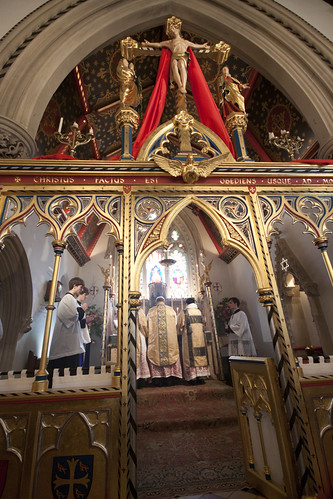 |
| The Traditional Latin Mass behind a Rood Screen, at St Birinus, Dorchester on Thames. |
The Oriental Catholic Churches, the ones in communion with the Pope, have endured a sad history of 'Latinisation': the adoption of the liturgical and other practices of the Latin Church, which has flattened the rich diversity of the Universal Church and cut them off from the traditions still kept, in most cases, by Eastern Churches not in communion with Rome. Indeed, from the point of view of the latter this process was and remains a scandal and an impediment to reunion: if this is what happens when you accept Rome, they reasoned, then we don't want to have anything to do with it! However, the great Pope Leo XIII initiated a very clear policy of encouraging Eastern Catholics to preserve and restore their traditions in their integrity, and this was powerfully reaffirmed at the Second Vatican Council. It was easier said than done, unfortunately, since the leaders of these Churches were usually educated in Rome and were often eager to be as like their Latin friends as possible, even without any of the official encouragement of Latinisation which was in evidence in the 17th and 18th centuries. Nevertheless, important progress was made.
In the meantime, of course, we had the liturgical reform of the West. Out goes (nearly all) silent prayer by the priest. Out goes worship ad orientem. Out goes the use of the West's ancient liturgical language. Out goes (a lot of) proskynesis, which in the West usually takes the form of kneeling and genuflections. Out goes the mystery, the awe, the timelessness and otherworldliness of the liturgy, and liturgical texts which anticipate the consecration (referring to the unconsecrated Host as 'this spotless Victim' in the Offertory). Out goes (a lot of) the sense of the sinfulness of the priest. Out goes the sharp distinction between Sanctuary and Nave, marked in modern times in the West by steps and rails. In comes a lot of new things like lay people distributing the Blessed Sacrament, secular musical styles, and so on.
None of these things were, in fact, called for by the Second Vatican Council, with the partial exception of the use of the vernacular, but they happened, they were officially promulgated or, at least, permitted, and the theological rationales for them gained currency even if they were never explicitly endorsed by the Magisterium.
Thus, Bugnini and his friends said that the pre-Conciliar Latin liturgy was illogical, that the stuff about sinfulness was 'negative' and unpastoral, that Latin, silence, and worship ad orientem excluded the Faithful and made them 'dumb spectators' at Mass, and that its historical development was a matter of 'accretions' which obscured the true, pastoral, and logical shape of the primitive liturgy.
If this is true, then it is true in the East as well as the West: you don't cross some invisible line in the Balkans and suddenly find that human nature, logic, and the principles of historical development flip upside-down.
The leaders of the Oriental Catholic Churches, accordingly, could hardly look at these arguments without seeing a systematic attack not only on the traditions of the West, but on the traditions of the East. Insofar as they wanted to be up with the latest trends, it was natural that they should seek to implement a version of the reform in their own churches, in direct opposition to the official policy of eastern traditionalism.
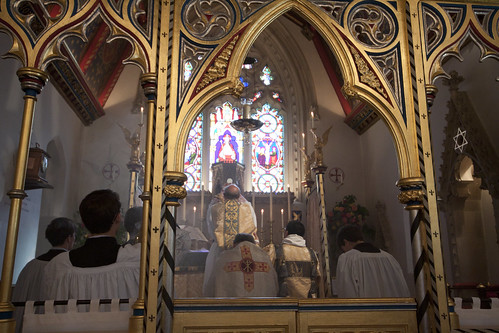
Taking the policy of Eastern Traditionalism with the de facto endorsement of Bugnini's attack on Western traditionalism, it would appear that in the West, the ancient Mass is obscurantist; in the East, though, where the liturgy exhibits many of the same traits in a far more extreme way, this is all wonderful, mysterious, and (in the words of Bl Pope John Paul II's Apostolic Letter Orientale Lumen), speaks to the human person in his totality, and not just the intellect: tota sua cum persona (Orientale lumen (1995) 11). Again (section 8):
Today we often feel ourselves prisoners of the present. It is as though man had lost his perception of belonging to a history which precedes and follows him. This effort to situate oneself between the past and the future, with a grateful heart for the benefits received and for those expected, is offered by the Eastern Churches in particular, with a clear-cut sense of continuity which takes the name of Tradition and of eschatological expectation.
Non-Catholic Easterners, of course, may well wonder how sincere all this respect for tradition is given the way the Latins treat their own traditions. Indeed, I would forgive them for thinking we are completely schizophrenic on the subject. It is not surprising that they welcomed Pope Benedict's Summorum Pontificum, since it suggests that the Latins might begin to walk the walk and not just talk the talk about preserving liturgical tradition. The late Patriarch of Moscow's reaction was recorded by Zenit:
‘Benedict XVI’s move to allow for wider celebration of the Roman Missal of 1962 has received a positive reaction from the Orthodox Patriarch Alexy II of Moscow. “The recovery and valuing of the ancient liturgical tradition is a fact that we greet positively,” Alexy II told the Italian daily Il Giornale. Benedict XVI's apostolic letter Summorum Pontificum, published in July, explains new norms allowing for the use of the 1962 missal as an extraordinary form of the liturgical celebration. “We hold very strongly to tradition,” he continued. “Without the faithful guardianship of liturgical tradition, the Russian Orthodox Church would not have been able to resist the period of persecution.”
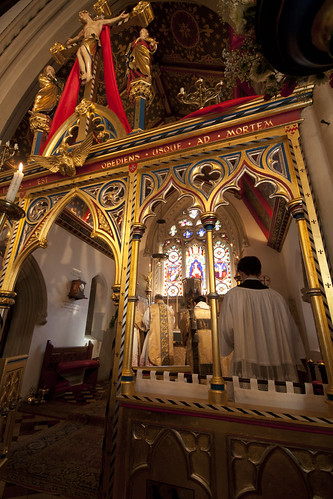
The Western Rood Screen served, as can be seen in the photos in the post, more to frame the action of the Mass than to prevent people seeing what was going on. It nevertheless places the importance of the symbolic separation of the Sanctuary, representing Heaven, from the Nave, representing Earth, ahead of considerations about sight-lines and feelings of 'inclusion'. The solid Eastern Iconostasis (Icon screen) takes this idea much further. Rood Screens were often destroyed by 18th century western liturgists inspired by very similar ideas to those of Bugnini and his followers, and a new wave of hostility to them manifested itself after the Council. But if we can't tolerate Rood Screens, what can we make of the Iconostasis?
The answer is that we need to distinguish that de facto but not de jure endorsement of the attack on Western traditions, from what the Church actually teaches about tradition.
In the next posts I will discuss two documents of the Congregation for the Oriental Churches which discuss the principles of liturgical reform, with this in mind.
Some of these issues and texts are discussed in two of the FIUV's short Position Papers: On Liturgical Piety and Participation, and on Liturgical Pluralism (pdfs).
Photographs: more from this Mass can be seen here.
Photographs: more from this Mass can be seen here.
Subscribe to:
Posts (Atom)