Saturday, November 27, 2010

Successful Garrigou-Lagrange Colloquium in Oxford


I couldn't attend the Server Training Day in Teading today, organised by the Society of St Tarcisius, because I was at a colloquium in Oxford held to discuss the theologian Garrigou-Lagrange.

It was organised by the Aquinas Institute, which is based at the Oxford Blackfriars; that's where the Colloquium took place. G-L was one of the most prominent orthodox theologians of the era leading up to the Second Vatican Council (he died in the 1950s), a period best known for it's dissidend theologians, some of whom sprang to prominence and influence during the Council itself. For this reason he has been unjustly neglected, and deserves a reappraisal.

He was renowned as a Thomist who combined his work on metaphysics with a large body of work on spirituality.

The Colloquium was a great success; the Aula at Blackfriars was packed; it was good to see about a dozen Dominicans there to discuss their confrere, including Br Lawrence Lew, Fr Aidan Nichols, and Fr Thomas Crean. There were lots of theology students from the University, and it was remarked how a serene discussion of G-L's merits was possible now, but would not have been twenty years ago. The instinctive and irrational barriers to the rehabilitation of a pre-Conciliar conservative theologian have, to a large extent, melted away.

Before I left I bought a copy of Aidan Nichols' 'Criticising the Critics', his recent work of apologetics, from the stall from St Philip's Books. I read the opening chapter, on Modernism, on the bus home and I recommend it highly as a short and clear introduction to Modernism as condemned by Pius X and as revived after the Second Vatican Council.


- Posted using BlogPress from my iPhone

Friday, November 26, 2010

The Tablet: escape from reality

Last week The Tablet published an article about demand for the usus antiquior (or the 'Tridentine Rite', as they always call it) since the Motu Proprio. The article was carefully researched: they made enquiries with all the dioceses of England and Wales (though they got few responses), and were most eager for facts and figures from the Latin Mass Society, which we duly provided.
IMG_4439
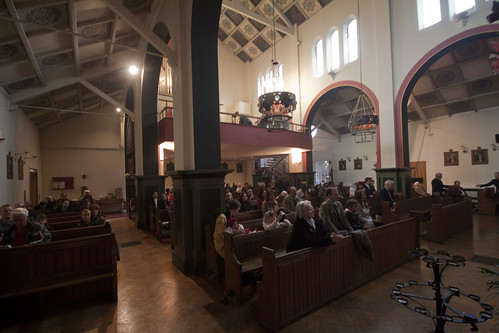
The Congregation at the Traditional Mass in St Mary Magdalen's, Wandsworth: were they all there three years ago? Is the camera lying?

What was actually printed, however, reflected not the results of their reporters' research but their own preconceptions: again and again The Tablet has simply asserted, in the teeth of the evidence, that demand for the Chruch's traditional liturgy is not growing, or is limited to people old enough to have experienced it before 1970. It won't surprise many people reading this blog to hear that the Tablet's editors are in a state of denial about the way the wind is blowing (or should that be: 'about innovative ways of being Church'?), but it is depressing to provide them with hard evidence for an article and then see the article draw the very conclusion the evidence shows is impossible.

They have very decently printed my letter protesting about this - with a few excisions which I show in bold.

Letter to the Editor, The Tablet.

Extrapolating from some off-the-cuff remarks made by spokesmen from seven of the twenty-two dioceses of England and Wales, your report (News From Britain and Ireland, 20th November) suggests that the Latin Mass Society may be mistaken in claiming that there has been a significant increase in demand for the Traditional Mass since the Motu Proprio Summorum Pontificum came into effect three years ago.

We offered your reporters hard statistical evidence for our claim, but this data did not find its way into the article. Perhaps your reporters thought that Tablet readers would not wish to hear that the number of regular Sunday Masses celebrated according to the Usus Antiquior has almost doubled since before the Motu Proprio, or that the number of Masses on a typical feast day has increased by more than 60%. Nevertheless, it is true, and readers not inclined to believe it need only download the Mass listings from our website (www.lms.org.uk), and satisfy themselves that these Masses are really taking place: they will be most welcome.

It should be noted that the increase in the number of public traditional Masses on Sundays and holy days does not, yet, reflect the increase in the number of priests able, and eager, to say it. The number of priests able to say the Roman Rite in its traditional form has tripled since the Latin Mass Society’s first Priest Training Conference, which took place just before the Motu Proprio took effect. Many of these priests are saying traditional Masses on weekdays and on special occasions, exercising great pastoral sensitivity in gradually introducing this form of the Mass to their parishes. The number of traditional Masses on Saturdays, for example, has from a low base increased by a staggering 450%.

The notion of ‘demand’ for the Traditional Mass is a slippery one. People cannot demand what they do not know about, and people who want it won't appear in the statistics if they are unable, for reasons of geography, to get it. The reality is that when a parish priest introduces a Traditional Mass at a reasonable time on a Sunday in his church a congregation emerges from nowhere, and increases over time. After a few years these congregations can rival those for the other parish Masses. There is nothing special about the parishes where this has happened: it is reasonable to assume that it would happen in any parish where it was tried. But on the basis of the places where it actually has happened, we estimate that the number of people attending the Traditional Mass regularly has doubled since the Motu Proprio.

It tends to be younger Catholics who are more open-minded about the Usus Antiquior, and younger priests who are most eager to learn it and say it. On this point, however, we can take the Pope’s own word for it: as he put it, young people have “found in it a form of encounter with the Mystery of the Most Holy Eucharist, particularly suited to them.”

End.
2010 10 23_7844
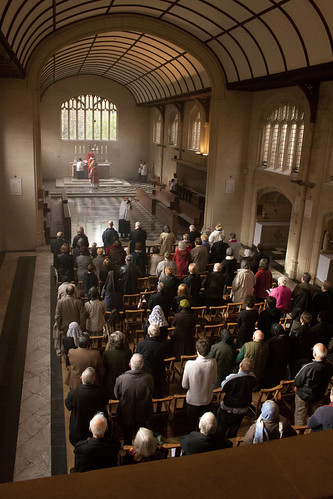
Congregation at the LMS Oxford Pilgrimage, regularly more than double the number we saw 2005-2007 - or are the pictures lying?

Ok, so it's a busy week; the letters page includes such jems as Mgr Basil Loftus denying that he shut down Fr Michael Clifton's blog and a screed from (once Mgr) Bruce Kent on nuclear disarmant. But lest anyone be in doubt that it is the wishful thinking of The Tablet's editors, and not the facts of news stories, which generate the content of this publication, they need only turn to p28, where they will be greeted by the headline

'Pope says use of condoms can be justified in certain circumstances.'

I know all news sources have their own angle on things, but it is downright cruel to the liberal Catholics and assorted post-Christians reading this to make them think that the Pope has said something he manifestly hasn't: they will be sad and disapointed when they realise the truth. This process of sad realisation, on a host of subjects, is often in fact manifested in the letters pages, where one sees lacrimose epistles saying 'I thought that Vatican II had done away with (delete as appropriate) Latin / the cappa magna / moral theology / priestly vocations, but it seems this dreadful thing has somehow survived!'. By trying to keep the truth from their readers, The Tablet simply makes it more painful when it does emerge.
2010 04 02_5244_edited-1
Good Friday 2009 with the FSSP in Reading. I've been attending the Triduum with the FSSP since before the Motu Proprio, and numbers have again doubled - but don't take my word for it.
Message to the The Tablet: you can run, but the truth will catch up with you.

Thursday, November 25, 2010

Authur Pitts of Iffley, priest and confessor

Here's an interesting historical titbit from CFNews, on a local Oxfordshire man, a singer, scholar, and priest during penal times.

ARTHUR PITTS, 1557-1634?, Catholic priest, was born at Iffley, Oxfordshire, the younger son of Arthur Pitts, sometime fellow of All Souls', Oxford, who died a man of some wealth on 10 May 1578. Young Arthur became a chorister of All Souls', and was afterwards for a time at Brasenose College, Oxford. He did not graduate, but with two brothers left for Douai, apparently in 1575, and joined an elder brother, Robert, who was already settled there in deacon's orders. Although his father had left him and his brothers considerable property at Staunton, Woodfrey, Iffley, and Stafford, he was described in the Douay matriculation register as 'pauper.' From Douai he was sent in 1577 to the English seminary at Rome. He was back at Douai in 1579, when he was described as twenty-two years old and student of theology in minor orders, and as having 'declared himself ready to proceed to England for the help of souls, and confirmed this by oath.' He set out for England on 22 April 1581, in company with Standishe, the two forming part of a detachment of forty-seven priests sent from Douai during the year. On 6 Feb. 1582 he was seized, with George Haydock and another priest, while dining together at an inn in London. The three were committed to the Tower. In October Cardinal Allen wrote that Pitts was expecting torture and death. In January 1584-5 he and twenty other priests were banished from England. They were shipped from Tower Wharf, and landed on the coast of Normandy in February, after signing a certificate to the effect that they had been well treated on the voyage. Pitts then resumed his studies at Rheims, and came out doctor in both faculties of law and divinity. He then 'came into Lorraine,' and was received into the house of the Cardinal of Vaudemont, 'with whom all his life he was in great favour and credit.' When, in 1623, the Pope re-established the Catholic hierarchy in England, and William Bishop was nominated vicar-apostolic and bishop of Chalcedon, Pitts was appointed one of the first canons of the English chapter, and he became titular archdeacon of London, Westminster, and the suburbs. In later life he resided with the Stonors of Blount's Court in Oxfordshire, and, dying there about 1634, was buried in the church of Rotherfield Peppard.

- Posted using BlogPress from my iPhone

The Pope on Condoms: the dust begins to settle

Does the Pope undermine an argument against the use of condoms to stop AIDS? Arguably his comments undermine one of the arguments used - but this is going to get complicated so see my Philosophy blog here.

Wednesday, November 24, 2010

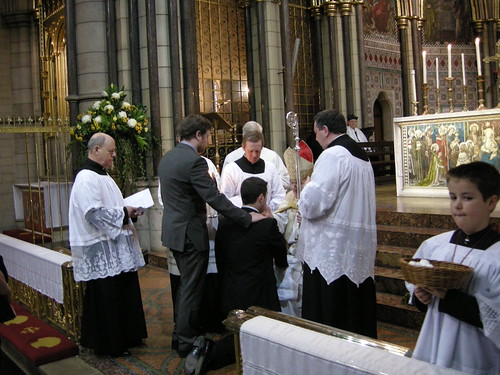
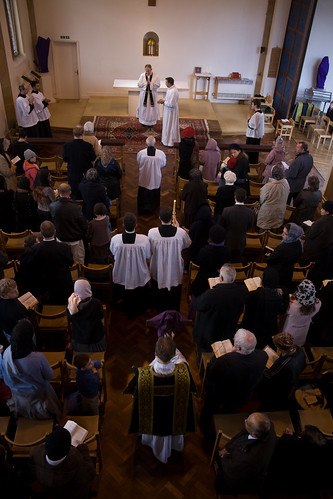
Traditional Baptism in Oxford

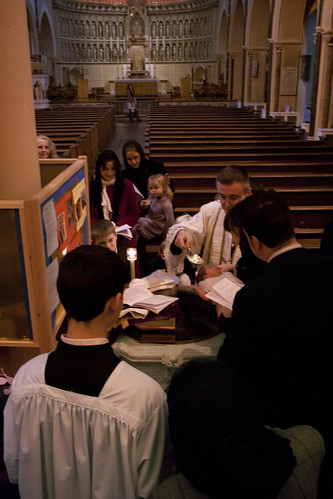
IMG_4496
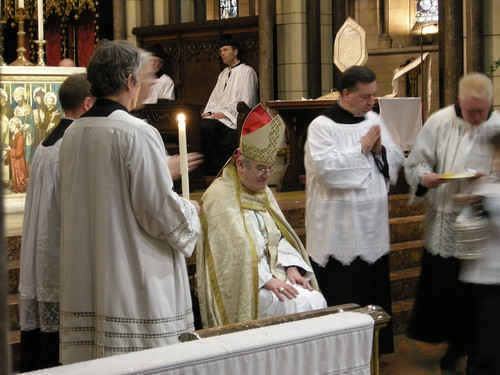
On Sunday afternoon there was a traditional baptism in the Oxford Oratory, followed by Low Mass in the chapel of St Philip.
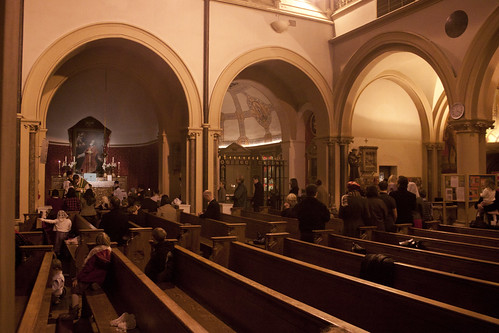
IMG_4539
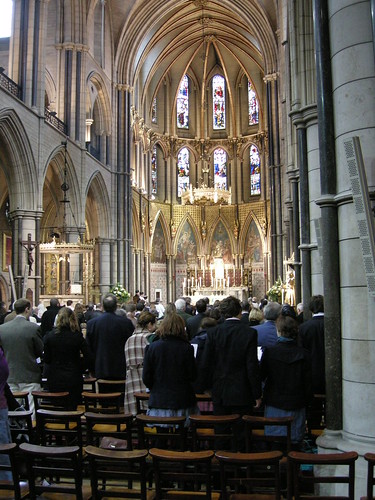
The Baptism was very well attended and we spread right across the nave in order to assist at Mass.
IMG_4540
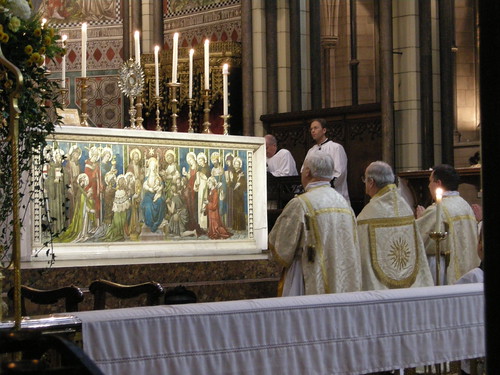
An unusual perspective on the Traditional Mass in the Oxford Oratory!

The lighting was particularly difficult for photography, since the lights in different parts of the church are different colours. As you can see above, the back of the church is too yellow while the interior of the chapel is fine.

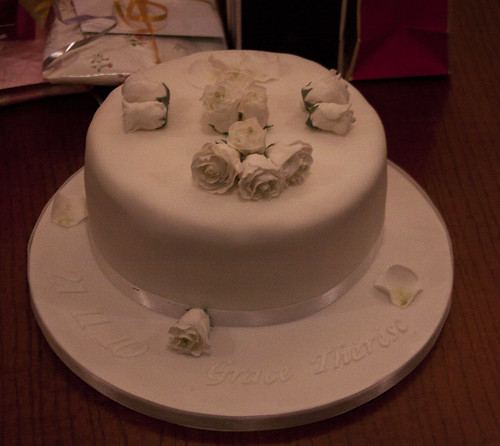
Lucy Shaw Cakes provided a cake for the party afterwards. The vast number of children made short work of the considerable quantity of refreshments which were on offer!
IMG_4550

Tuesday, November 23, 2010

Confirmations: pictures

DSCN3168
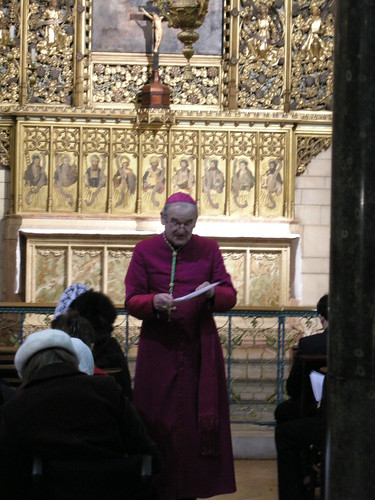
Bishop Stack talks to the confirmations before the service.

DSCN3203

DSCN3209

DSCN3215

DSCN3225

DSCN3238

DSCN3244

DSCN3271

We were delighted at the numbers at the service, both of confirmands (39) and the congregation. Two other confirmation services have taken place this year in the extraordinary form, one for St Philip's School and one in the diocese of Nottingham, so numbers overall are clearly on a strong upward curve.

This service is only possible thanks to the great efforts of Latin Mass Society staff and volunteers, organising it in advance and helping on the day. Many thanks are due to them!

Monday, November 22, 2010

Anscombe Centre on the Pope on condoms

The Anscombe Bioethics Centre is one of the foremost Catholic institutes dealing with these issues in the world, and is supported by the Bishops of the three Conferences of the British Isles. Their statement can be read here.

- Posted using BlogPress from my iPhone