Monday, June 13, 2011

More on the Seminary of Our Lady of Guadalupe

I've been meaning to put up more photos I took of the International Seminary of the Fraternity of St Peter when I was there for the ordination of Fr Matthew McCarthy.
2011 05 20_9865
The seminary is extremely impressive, all newly built. There are still a few things to be done - I think the pipe sticking out of the ground in the photo above is going to be a fountain. Stained glass in the chapel is planned, and so on.
2011 05 20_9863
Standing in front of the chapel there is a breathtaking view. In the distance is Denton itself, little more than a village. In the opposite direction, about 30 minutes' drive, is Lincoln.
2011 05 20_9852
The is the view from a balcony opening into the chapel. Notice the enormous painting of the tilda of Our Lady of Guadalupe on the opposite wall. The people in the sanctuary are getting ready for the ordinations.
2011 05 20_9854
The refectory. I was being shown around with Leo Darroch, the President of the Una Voce Federation.
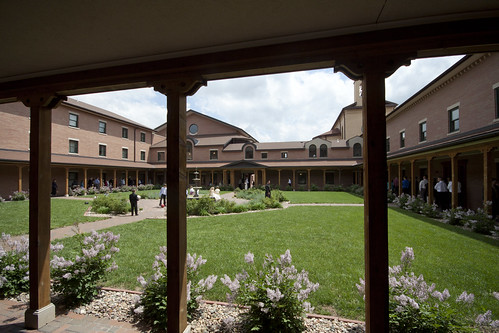
2011 05 21_9828
The cloister. I took this while the newly ordained priests were giving 'first blessings'.
<span class=
A familiar figure in the corridor: St Philomena. There are naturally lots of statues and religious pictures around the seminary.
2011 05 20_9855
The Sacristy.
2011 05 21_9671
Part of the very comfortable library. There is a another very large room of book stacks.
2011 05 21_9681
On the morning of the ordination, Fr Calvin Goodwin FSSP celebrated Low Mass. Here he is distributing communion to the first-year seminarians at the communion rail, where there is a houseling cloth. Fr Goodwin came to England in 2009 to help teach at the Latin Mass Society's Priest Training Conference.
2011 05 20_9856
A close-up of the high altar. It was rescued from a church in Quebec: the column capitals include the Canadian maple leaf and the fleur de lys. The extra lecterns have been placed there for a rehearsal for the ordination ceremony. Notice the ceiling as well.
2011 05 20_9870
At the east end of the main chapel there is a series of interconnecting side chapels for private Masses; this is one of them. Interestingly the relics of the martyrs used in the dedication of these altars are from martyrs of the persecuted church in Mexico; each chapel has a picture of the priest martyr whose relics are enclosed in the altar. (See it on the wall to the right of the altar.) That is Fr Matthew Goddard, incidentally, showing us the chapel, with a first-year seminarian next to him who is actually from Fr Goddard's apostolate in Canada.
<span class=
The Seminary was of course particularly full and busy at the time of the ordinations; most altars was being used more than once for private Masses early in the morning.
<span class=
An artists' impression of the Seminary, based on the plans. The tower to the side of the chapel was dropped from the plans, partly because of the strong winds of the area. The chapel has a belfrey instead.

More photos in this set here; see also my posts of the ordination and Fr McCarthy's first Mass.

Saturday, June 11, 2011

Novena for the reconciliation of the SSPX

Rorate Caeli is passing on an urgent request for a novena for this intention for the Octave of Pentecost. They have appropriate prayers to say for this.

There is a sense arising from various public statements that the discussions may be reaching a critical moment. This may turn out not to be the case, who knows?, but the prayers will not be wasted.

Sex abuse and the permissive 1960s

There has been a lot of coverage of the new CTS booklet on the sex abuse crisis in the Church: The Sex Abuse Crisis and the Catholic Church, by Dr Pravin Thevathasan. In it he describes a number of factors which contributed to the crisis; a key one was - pretty obviously - the sexual revolution of the 1960s which was not resisted successfully by the Church: as we all know, the Church's teaching against contraception was not vigorously promulgated in the years before Humanae Vitae in 1968, nor in the years after it, and something similar is true of other areas of the Church's teaching on sexuality. Generations of seminarians have been told to 'lighten up' if they have traditional views on sexual morality.

The Tablet represents, if any publication does, the views of those who did and still do not want to see the Church's teaching on sexuality properly taught to children, inculcated to seminarians, and enforced through canon law on priests and religious. Dr Thevathasan's book must make for unconfortable reading for them, and last week The Tablet's news report on the book quoted Fr Brendan Callaghan SJ making what might seem to be a good objection to it: a large proportion of the priests comitting abuse in the 1970s and 1980s were educated and ordained before the permissive 1960s could have an effect on seminary education. (The same is true, of course, of the many priests who left the priesthood in order to marry during those decades.)

Dr Thevathasan has answered this objection in a letter The Tablet has published only in the 'Letters Extra' section of their website, so here it is for a wider audience. Priests, along with Catholic catechists and school teachers did not have to be educated in the 1960s to feel its effect, since there were extensive programmes of re-education after the Second Vatican Council to bring them up to speed on the latest rubbish.

Sex abuse, bad theory and the permissive 1960s

In my forthcoming CTS booklet on "The Catholic Church and the sex abuse crisis", reported on by Christopher Lamb (News, 4 June), I suggest that while it would be wrong to claim a single cause for the crisis, the introduction of psychological theories proposed by Carl Rogers needs to be considered as a contributory factor.
William Coulson was a colleague of Rogers' who conducted Sensitivity Training workshops in numerous religious institutions in the 1960s. He later rejected humanistic psychology and claimed: "My theories have made priests feel good about being bad ... The Franciscans were so enamoured with our psychology that they introduced it to Saint Anthony's Seminary in Santa Barbara. Years later, 11 or 12 friars were accused of molesting 34 high school boys. I'm afraid that we planted the seeds and they carried the seeds to the next generation and they germinated." Seeds planted elsewhere would presumably have germinated in the same fashion.
There are many problems with humanistic psychology and this includes an absence of a moral framework. Coulson claims that Rogers himself rejected humanistic psychology by saying " I greatly underestimated the reality of evil. I hope Rogerian theory goes down the drain."
Dr Pravin Thevathasan, LondonYou can see a summary of Dr Coulson's ideas here; better still download an MP3 talk by him here. It is an eye-opener.

Pictures: Carl Rogers, whose teachings replaced those of Our Lord as the basis of thinking about
sexuality for 'progressive' Catholics in the 196os.

Friday, June 10, 2011

Farewell to Chartres

I was going to go on the Chartres Pilgrimage this year but circumstances have not allowed it. My place has, in fact, been taken by a fellow blogger.

Good luck to him and to all the pilgrims toiling towards Chartres today, tomorrow, and Monday.

Thursday, June 09, 2011

How should we read a blog?

John Hunwicke has announced that his ordination has been 'deferred': the news is over the blogosphere like a rash. Please pray for him. The evening before I read the news I read an account of the life of St John of the Cross to my children: he was kidnapped, beaten and starved by his own confreres, and then after a period of tranquility persecuted again in later life. I'm not saying JH is like (or for that matter unlike) St John of Cross, I'm just saying it can happen to anyone.

The issue is bigger than JH because it undermines the presumption that Anglican clergy who are orthodox and of reasonably sound mind will be ordained into the Ordinariate as priests, and it is an example (not the first) of a blog getting its author into trouble. Over the last few years a number of Catholic priest-bloggers have been rapped over the knuckles in different ways, and of course not just priestly bloggers either. Blogs are dangerous for the blogger because what you write remains public indefinitely; even if you delete it someone else may have copied it. The paradox is that bloggers write very freely, publishing their views several times a week, and it is all archived and searchable.

One problem Catholic bloggers face is that many senior Catholics, including obviously bishops, simply don't understand blogs, but can be shown snippets by anyone fancying himself as a snark (or should that be 'temple police'?) from here or there which can make the author look uncharitable or over the top. I've even heard of comments on blogs getting the blogger into trouble.

This is actually very dangerous for the Church because it reinforces the 'us vs. them' sense that some people (liberals) can get away with anything and others (orthodox Catholics) will be put on the rack for the slightest misdemenour. It is also dangerous because to outsiders who don't understand that distinction it looks like the revival of the Spanish Inquisition: the Anglican Bishop Broadbent, retweeted by the Church Mouse, opined on Twitter 'If you choose to join a monolithic authoritarian institution, you're likely to be told that you can't make criticisms! ' To the tweet in response 'I'd agree, but having avidly read his blog for ages, I cannot see a single instance of dissent from official RC teaching.' Broadbent adds: 'It's never stopped Rome in the past...' Is this good for the Church?

What we bloggers and regular readers of blogs understand instinctively is that things written in blogs, and even more so in comments boxes, are not written in stone. They aren't our most considered opinions, they can be changed in a trice. They aren't heavily researched, there is no time for that, they have to be responsive to events to remain newsworthy. They are not like academic articles: they are more like what we might say in a pub discussion. You come out with something partly to see how it will go down; maybe a student bar would be the best analogy since you know it'll be heard by people who are more interested and informed than average, but also people who will disagree, and even people opposed to your deepest assumptions. We bloggers think we can learn from them too, and we do.

What is written in a Catholic blog should of course not be offensive to pious ears, and should not undermine faith and morals. But just as in a bar you can be betrayed into expressing yourself a little too forthrightly, without the necessary nuance and caveats, so on blogs too we may be a little hasty; in both cases we will object to critics on the bar stool or in the comms box or on other blogs but we will note what they say too, and maybe express ourselves more carefully next time. After all we are all students. Remember that no Catholic under 50 has been properly catechised (now there's a generalisation for you!) and we need the stimulation of blogs to widen our understanding of the faith, conscious of our limitations but also unwilling to let error reign unopposed. Let us not judge each other by our lightest word.

But let us pray for John Hunwicke, for his good and for the good of the Ordinariate or Our Lady of Walsingham and the Church.

Sunday, June 05, 2011

Altar Girls: the PCED speaks

Monsignor Guido Pozzo, Secretary of the Pontifical Commission Ecclesia Dei, has written a letter confirming that the permission for females to serve at Mass, granted by the Congregation for Divine Worship in 1994, does not apply to the Mass when celebrated in the Extraordinary Form.

No altar girls at the Traditional Mass. It was clear before. It is clear now. It is also clear that the PCED is willing to move extremely swiftly to clarify these matters.

Here is the letter.
PCED

I've written about why altar girls are not appropriate at the Traditional Mass on this blog: introduction, the problem they present for vocations, and the underlying theological issue.

Friday, June 03, 2011

Are we asking liberals to act against their conscience?

Liberals in the Catholic Church are a sensitive bunch. Not sensitive to others, of course, but to themselves and their friends. If they see another liberal disciplined, they always defend him, even if (like the former Bishop of Toowoomba in Australia) they would hesitate to agree with what he said. Such disciplinings are extremely rare, but acts of Papal authority are becoming a little more forthright under the present Pope (and God be thanked for that), and the liberals have an increasingly long list of things they disagree with which are actually going to be enforced. They are being compelled to accept things which they can't prevent, such as the Anglican Ordinariate and celebrations of the Traditional Mass; they are being asked to do what they do not want to do, such as use the new Missal translation; and they are being told not to say things they want to say, such as that women can be ordained priests.

I have no doubt at all about the sincerity of Catholic liberals, so the question arises whether their refusal to obey - should they refuse - would be morally justifiable. After all, the Church teaches that we should follow our consciences. Actually, this is almost a truism, since your conscience is that faculty which tells you what you are obliged to do: it would be nonsense to say 'you ought to do what you believe you ought not to do'. So if a liberal Catholic thinks it would be wrong not to be as obstructive as possible to those who want a Traditional Mass, to use the new Missal translation, or to remain silent about the ordination of women, what should they, in conscience do? What would it be reasonable for their superiors to punish them for? And in doing what would they be committing a sin?

A full treatment of this would require a book; I'm just going to make a few points. First, a knee-jerk Ultramontanism which says that you should do whatever you are told by a legitimate authority is wrong. This is called 'Indiscreet Obedience' by St Thomas Aquinas and is a serious error. If you are told to commit a sin, you must not do it, nor do you avoid committing a sin yourself by the plea that you were commanded to do it. The command is no defence because even if the person commanding has legitimate authority that authority does not extend to commanding sins. You are no more obliged to obey the Pope if he tells you to commit fornication than you are obliged to obey a car park attendant if he tells you to hang blue curtains in your living room.

Second, Catholic traditionalists do not find knee-jerk Ultramontanism at all attractive, because although we'd all like to see liberal excesses curbed, we can see what damage this 'I was only obeying orders' mentality did to the Church in the 1960s and 1970s. A large percentage of a generation of priests who were brought up on obedience and (apparently) little else wrecked their churches and drove countless souls out of the practice of the Faith by zealous application of ill-considered initiatives deriving from what they took to be legitimage authority. On closer inspection many of the things encouraged by bishops or Diocesan liturgical directors and the like were contrary to authoritative documents from Rome, but these priests didn't see it as their place to question such things. When asked they would often say that it wasn't their idea, they quite liked the old high altar, the Penny Catechism or whatever it was but they had to obey. This was obedience in wilful ignorance of the rightness or real bindingness of the command.

So not only must you not obey what you know to be a sinful command, but you cannot close your eyes to the possibility that it is sinful and hope for the best. Does that mean Catholics, even those with special vows of obedience, should only obey commands they happen to agree with?

That would appear to be the position of many liberals. Documents from Rome which they don't like go into the wastepaper basket regardless of their level of authority, unless they tickle the recipient's fancy. This is the opposite extreme to what I've called knee-jerk Ultramontanism and is also wrong. The correct position depends on an understanding of what authority in the Church is actually for.

Authority in the Church, like authority in the family and the state, is for the promotion of the Common Good. In the Church this is specifically the good of souls. Commands which are contrary to the good of souls have no binding force, because they are failures as commands, in the same way that they would be failures if they were not promulgated, or asked you to do something yesterday, or to breath underwater. This is recognised explicitly in the canon law tradition, which says 'the good of souls is the supreme law'. The Church operates with a Natural Law understanding of law, not a Legal Positivist conception.

Since it is the precise role of people in authority to determine what is for the good of souls in particular concrete circumstances, those commanded don't need to second-guess them all the time. We can give them the benefit of the doubt when commanded to do something we don't fully understand. It is only when it is clearly contrary to the good of souls that this principle comes into play.

Now the liberals may think this gets them off the hook, since they think it is clear enough, but in considering what is for the good of souls we are not starting with a blank piece of paper. Scripture, Tradition, the constant practice of the Church, the Magisterium, the Sacraments: these things teach us what is for the good of souls. Being formed by these things in one's moral understanding is to have a 'formed conscience': the kind of conscience which is not just willfulness, but that we really should obey.

And this is the key to the error of many 'conservative' Catholics who over the years have attacked Traditionalists and said that we are no better than liberals in subjecting Church documents to examination and criticism and not just blindly obeying everything. Because if you have a formed conscience, if you are properly formed in the Church's Tradition, in scripture, in the Magisterium, then you will have more reason to disobey commands (or purported commands) which are contrary to Tradition, Scripture, and the Magisterium, and less reason to disobey commands which protect, advance, and reiterate what is found in Tradition and so on. So far from the Traditionalist and the liberal being parallel in disobedience, they are taking opposite positions.

The liberal may argue that the new Missal translation, for example, is not for the good of souls, and I grant he may really believe that. But look at the arguments and it quickly turns out that what he doesn't like is in many cases simply the accurate rendering of liturgical texts which are deeply embedded in the Church's tradition. Catholics have always (since at least Pope Gelasius) said Christ's blood was shed 'pro multis': to say it is wrong to say it was shed 'for many' is to reject the constant teaching of the Church.* To say that it is not for the good of souls that they be exposed to the teaching of the Church is to cease to be Catholic. (We're not talking here of some situation under persecution where explaining the subtleties would be impossible, where the Church's enemies will seize on some formulation to damage the Church, or anything like that.)

Similarly, when liberals disobey liturgical law, the laws they disobey are attempts to keep them in line with tradition. In using General Absolution, pottery chalices, leaving the sanctuary to give the kiss of peace, etc. ad nauseam, they may think they act for the good of souls but they are rejecting the guidance of the Church herself on what is good for souls - not just the views of the jack-in-office (if there is one) seeking to enforce the petty rule, but the voice of Christ speaking through the Church's immemorial traditions, discipline, and Magisterium.

We are beginning to see more traditionally-minded priests bending some of the rules of the Novus Ordo to make it more traditional. The Holy Father does this from time to time. I won't go into details, but we are talking about minor rubrical issues. Cardinal Burke, the Church's chief legal officer under the Pope, has been criticised for wearing a galero. Are the Holy Father and Cardinal Burke undermining a proper respect for the Church's law? No. Sure, these things are not explicitly permitted in the latest edition of the rule book. But breaking rules in this way is NOT parallel to the liberal breaking of rules, since it is in accord with tradition, not against it. The Church tells us that certain rubrical gestures are helpful to the faithful and pleasing to God: the Church tells us that when we read that they were used by the Church for a millennium or so. If they can be used once more in the Novus Ordo when not explicitly called for in the current rubrics, without causing 'admiratio', well it is not for me to give permission for this kind of thing but I'm not going to complain either. What it is not is a parallel to a liberal priest doing what has been deliberately rejected by the Church for a millennium or so and is still contrary to the rules, because the Church in her wisdom judges it harmful for souls.

The liberal may appeal to conscience, but where does this conscience come from? If the liberal's conscience is not 'formed', it is not Catholic, it is just willfulness. If the liberal's conscience is not Catholic, the Church needs to use her discipline to protect the faithful and perhaps even to convert the liberal.

*In response to criticism my reasoning here is as follows. 'Pro multis' is the teaching of the Church; 'for many' is simply an accurate rendering of that phrase; to reject 'for many' is ipso facto to reject 'pro multis', and therefore to reject the teaching of the Church. The case I have in mind is where, as noted earlier, "it quickly turns out that what he doesn't like is in many cases simply the accurate rendering of liturgical texts". The reasoning of many liberal dissenters appears to be against not so much 'for many' as a translation of 'pro multis' but 'pro multis' itself. I say 'appears' and it is not my purpose to pick out named examples of people who hold the view, but only to ask what someone who did in fact hold such a view would be morally obliged to do about it.