Sunday, May 31, 2020

Marriage to end in the UK: with a whimper

My latest on LifeSite.
The weakening of the UK’s divorce law is reaching its final stages. 
It is currently possible to end a marriage for almost any reason, or if you prefer to divorce for no reason at all, after a period of separation (two years with the agreement of the other party; five years without). It is almost impossible for a spouse to defend himself or herself against an application for divorce. For the Conservative Party Government in the UK, this isn’t good enough. They want to abolish the requirement to give any reasons (such as that old standby, “unreasonable behaviour”), and reduce the separation period to six months, or, if they feel like changing it again later, to nothing.
The justification being used by the government and repeated across the liberal media is that the current system forces couples to assign blame, unless they want to use the separation-period approach, which is presented as an intolerable burden. Giving reasons for wanting to end a supposedly life-long union, or creating a short time in which reconciliation might be attempted, doesn’t seem entirely unreasonable. Did I say “lifelong?” Well, that is how marriage is legally defined, with the proviso “unless legally terminated.”
In truth, the phrase is the pathetic remnant of a conception of marriage that is no longer given legal recognition.

Friday, May 29, 2020

Cardinal Koch and the amalgamation of rites

An Altar Missal defaced to keep it up to date with the
liturgical changes of the 1960s
Cardinal Kurt Koch has taken up an idea which floats into the Catholic press every now and then, that the Extraordinary Form should be merged somehow with the Ordinary Form. Here in German, quoting the Cardinal at the end. The money quote (thanks to Google Translate) is

'The Eucharist is the central celebration of the unity of the church. It cannot have this meaning
when there is argument and confrontation around them.'

In that case, perhaps the extremists among the liturgical progressives should stop attacking the EF's right to exist. If they can't do that, I can't see them rallying around a rite which is a 'synthesis' of the two, and the conflict would continue: as it does, indeed, in practically every diocese and religious community where only the Ordinary Form is celebrated.

The argument is particularly puzzling, as there are far more than two liturgical forms in the Church. In major European and Middle Eastern cities alike one can find the Latin Rite liturgy celebrated in one church and a variety of Eastern Rites celebrated down the road. Cardinal Koch is in charge of ecumenism at the Vatican, and he cannot have forgotten the role of liturgical diversity in fostering unity, not impeding it, in the reconciliation of Anglicans to the Holy See. The same thing has long been the policy of the Vatican towards our separated brethren in the East. Imposing liturgical uniformity on the Church would be an ecumenical disaster.

I paste in below an article I wrote for the Catholic Herald online in July 2017, which is no longer available on their website, which addresses the version of this idea floated by Cardinal Sarah. It is interesting to see Cardinal Koch taking up the same term, 'reconciliation', as if it were the Forms which were in conflict, rather than Catholics with different views.

I followed this up with another piece on this blog which can be found here.

Thursday, May 28, 2020

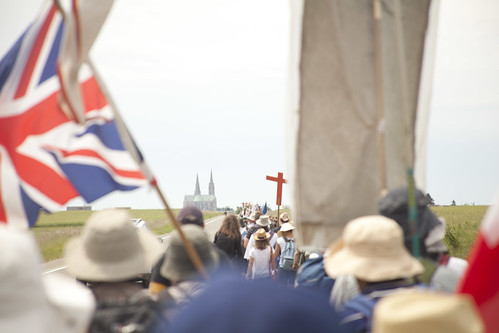
Remembering the Chartres Pilgrimage

IMG_8358
The British Chapter in sight of Chartres Cathedral, in 2014
The Chartres Pilgrimage would in normal circumstances have taken place this weekend. I should be able to make it next year. We must make it a year to remember!

And don't forget: with a bit of luck we should be able to have the Walsingham Pilgrimage this year. Book here.

My latest on LifeSite.

I have been four times on the Chartres Pilgrimage. It’s not a competitive sport, but I should add that only on two of these occasions did I manage to complete it — that is, to walk the entire distance from Notre Dame in Paris to the mighty Chartres Cathedral, more than 60 miles, in two and a half days.
It takes place over the weekend of Pentecost Sunday — Whitsun — with sometimes more than ten thousand pilgrims. Last year, for the first time for many years, it was not able to use Notre Dame because of the terrible fire there in April 2019. In 2020, it will be taking place only “virtually,” due to the coronavirus epidemic.
The participants are mostly young people, and many pilgrims come every year. Its cancelation is a great blow to them and to those hoping to experience it for the first time. Serious pilgrims are used to setbacks, however, and they will be back.
Read the whole thing.

Support the Latin Mass Society

Wednesday, May 27, 2020

Even fake 'water pistol baptisms' are disedifying

IMG_0001
A very un-socially-distanced baptism, back in the days of innocence.
The priest annoints the candidate.
My latest on LifeSite.

 Photographs have been proliferating of clerics of some kind aiming water pistols at babies in order to baptize them. Some of these seem to be fake news, inasmuch as they did the baptisms in the ordinary way but then staged the photo afterward. This makes a difference, but I’m not sure how much. Should clerics be clowning around in church after baptizing a baby? Again, there’s the photo of a priest wearing vestments using a water pistol to bless adults with holy water. If that was staged, it almost makes it worse.
Sometimes it is said that the era of the “clown mass” and other extreme examples of disrespect for the liturgy is over, but it would appear that its spirit lives on, among Catholics and non-Catholics alike. Those who published these photographs, and the people in them, clearly think this is all terribly funny, and that that is fine.
Before anyone suggests that the use of water pistols is a serious response to the coronavirus, let me be the thousandth person to point out this is not so. At the “asperges” before Mass people have been blessed at a distance for centuries, with a liturgical implement called an aspergillum; as for baptisms, it doesn’t need to be the priest doing it anyway. 
Read the whole thing.

Support the Latin Mass Society

Tuesday, May 26, 2020

The Anglican Bishops aren't having a good crisis

My latest on LifeSite.

There has been a fair amount of criticism of Catholic bishops over the period of the coronavirus epidemic, but if you want to put things in perspective, you only have to look at the bishops of the Church of England (Episcopalians). While Catholic priests up and down the land were optimising their churches’ live-streaming technology, Anglican clergy were forbidden to enter their own places of worship, even if these actually adjoined their homes. Their flocks have been treated to the sight of services celebrated in kitchens and living rooms instead. This utterly pointless ruling was roundly criticised, but the bishops stuck to it even over Easter, only finally succumbing to the pressure of common sense on May 5. What possible motivation could they have had for insisting that their clergy not go through the sacristy door into their empty and locked churches to celebrate the liturgy? 
Justin Welby, the Archbishop of Canterbury who thinks of himself as the successor of St. Augustine of Canterbury, who brought the Christian faith to England directly from Pope St. Gregory the Great, told us that it was to set an example. Referring to the government’s message about public health, he told the press that “by closing the churches, we make a powerful symbol of the need to listen to that message.”
I’m not someone who has called for people to flout the government’s guidelines, but going beyond them in this extraordinary way seems to me a powerful symbol of the Church of England’s worship of the idol of “health and safety.”
This isn’t the first time Welby has jumped on a bandwagon without engaging his brain.
Read the whole thing.

Support the Latin Mass Society

Wednesday, May 20, 2020

The mysterious teaching union that doesn't want to teach

My latest on LifeSite.

Britain’s teaching unions are decidedly unenthusiastic about the re-opening of schools as the coronavirus lockdown eases. Surprisingly, they aren’t keen on online learning, either. The National Education Union (NEU) has told its members not to live-stream lessons from their homes, engage one-to-one with pupils, or expect any input from parents. Their bald statement, directed to primary (junior) school pupils, “Teachers cannot be expected to mark work,” sounds like a parody of obstructive trade unionism from the 1970s.
It is a particularly puzzling attitude in the context of education. There has been a lot of talk of the harm done to the education of children by the closure of schools and how this will widen the gap between the educationally privileged and the educationally deprived. There has also been a lot of talk about the non-educational functions of schools. Apparently the role of schools is not just education, but the provision of childcare, especially for “key workers”; the surveillance of children in danger of domestic abuse; and the provision of nutritious meals. Given what is said about the nutritional value of much school catering, I can only assume that this last claim is made against a very low baseline.

Tuesday, May 19, 2020

Another chat with Fr McTeague: On Criticising Fellow Catholics

PSX_20190916_232244
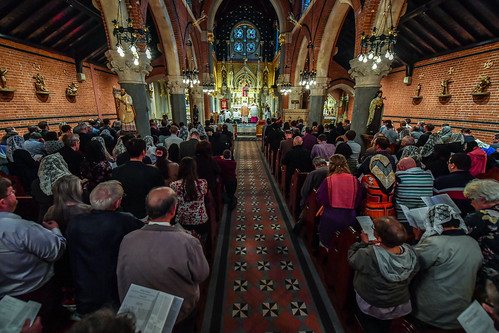
Spot the sinner! Can you see him? If there is one there, clearly this is no place for
respectable Catholics. Cardinal Burke celebrates Mass in Corpus Christi Maiden Lane, London.
Last evening I was interviewed again for The Catholic Current, a radio show hosted by Fr Robert McTeague SJ (a good one).

Our theme was an article I posted on Rorate Caeli and here, 'On Criticising Fellow Catholics'.

As regular readers will know I'm not against criticising people. My specific concern was the tendency on social media to divide Catholics into segments according to their views or preferred liturgy, and to make catty generalisations about them on the basis of isolated personal experiences: most often taking the form 'I went to that Mass once, and I felt uncomfortable because of what someone said to me afterwards'.

An important point here is that obviously there are sinners in the congregation and obviously the clergy and others should not chuck them into the street for breaking 'message discipline': nor yet lock them in the broom cupboard whenever a potential new recruit hoves into view.

You can listen to our chat here:

Episode Page:

Direct Audio Link:

Support the Latin Mass Society