 |
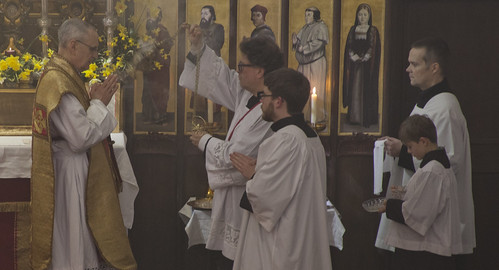
| An image from the Mass of the feast of St Gregory the Great, who threatened excommunication for anyone attempting to force Jews to convert to Christianity. |
Let Israel recognise in you the Messiah it has longed for;
may the Jewish people accept you [sc. Christ] as their awaited Deliverer [Latin: 'Messiah']
In the Bishops' Conference press release about the need to change the Extraordinary Form Prayer for the Jews in the Good Friday Liturgy, Archbishop MacDonald complained that by comparison with the 1970 Novus Ordo equivalent, the 2008 version 'reverted to being a prayer for the conversion of Jews to Christianity'. Other have noted, as problematic, that the title of the prayer in the Missal is 'pro conversione Iudaiorum' instead of, as in the Novus Ordo, simply, 'For the Jews'.
How are we to understand these complaints? Naturally, we must assume that spokesmen are being honest and are reasonably well-informed. What this is about, on those assumptions, is presentation, of controlling perceptions, above all by Jews. As I noted in the last post, the suppression of the more explicit language of conversion in the Novus Ordo cannot be explained theologically, since the explict language was retained in the Liturgy of the Hours published the year after the reformed Missal: 1971. Nevertheless, the Good Friday prayers have come to Jews' attention (why? as a result of briefing by whom?), the Liturgy of the Hours prayers have not, so - the argument must be - it will be possible to make progress in terms of Catholic-Jewish relations if we talk about changing the Good Friday Prayer and ignore the Liturgy of the Hours.