Showing posts with label Bullivant. Show all posts

Thursday, August 08, 2019

Review of Stephen Bullivant in Catholic Herald

I'm late posting this on here but my latest in the Catholic Herald is a review of Mass Exodus by Stephen Bullivant. It begins:

Was Vatican II in some way responsible for declining Catholic practice and “affiliation” (people calling themselves Catholics), or is this phenomenon a matter of trends beyond the Church’s control? Focusing on Britain and the United States, Professor Stephen Bullivant, a sociologist of religion at St Mary’s University, London, presents the evidence with precision, while still producing a highly readable book. The thesis of Mass Exodus is that the Church, like other ecclesial bodies, has clearly faced considerable headwinds since the 1960s as a result of wider social forces, but has also made things worse for itself.

Bullivant’s analysis revolves around three key sociological concepts. The first is the role of networks in nurturing belief, or “social network theory”. The denser the social network of believers, the more they are connected with each other (as opposed to non-believers), and the lower will be the rate of lapsation and disaffiliation. The Amish, for example, with their distinctive way of life and close-knit community, have a very low level of disaffiliation. Catholics were never like them, but up to the 1960s there was, to some degree, a “Catholic ghetto” in both the US and Britain where, in a hostile world, they had social support from fellow believers. The community was marked out by customs such as eating fish on Friday, distinctive forms of worship and spirituality, and interest in a common history, particularly of persecution.

Carry on reading.

Support the Latin Mass Society

Friday, July 19, 2019

Prof Bullivant on What Went Wrong after Vatican II

I'm going to be writing more about Prof Bullivant's new book, Mass Exodus, which examines the catastrophic decline of Catholic affiliation and practice since the Second Vatican Council, from a sociological point of view.

Here is a piece I have written for LifeSiteNews.

In a newly published book, Mass Exodus: Catholic Disaffiliation in Britain and America Since Vatican II, Professor Stephen Bullivant has explored in detail what went wrong with the Church after the Second Vatican Council, from the point of view of the sociology of religion. The sociological, as opposed to the supernatural, perspective has its limitations, but we should hear what it has to say.
I want to explore just one aspect of Bullivant’s argument (I heartily recommend the book for those interested in more). He introduces readers to the well-established theory of the “social network effect” in sustaining a world view. Simply put, if all your neighbors are Catholics, it is easier to remain a Catholic yourself. If you meet fellow worshipers from your parish in your workplace, in local shops, and in your leisure pursuits, if you read Catholic news sources, and if you are surrounded by Catholic devotional statues and holy pictures, the Catholic worldview will begin to seem not just one option among many, but the obvious way to look at things. Doubts can be answered or ignored. Going to church is just what everyone does. Examples of personal holiness and self-sacrifice for the Faith are easy to witness and to give.
Carry on reading.

Support the Latin Mass Society
Thursday, June 02, 2016

Stephen Bullivant's lapsation statistics: methodological problems

IMG_0338
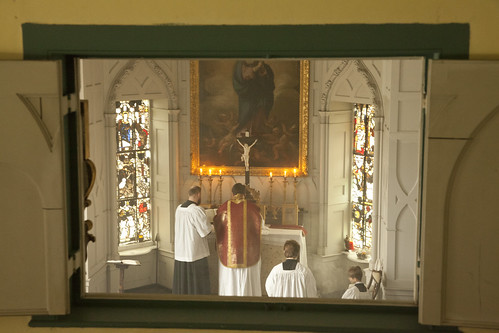
A window into what is going on in the Church.
Stephen Bullivant of the Benedict XVI Centre for Religion and Society has produced a study based on the British Social Attitudes Survey, focusing on the Catholic Church in England and Wales.

It is marred by some typographical errors, for example referring back to the wrong diagramme at one point, and saying 'somewhat under two in five [cradle Catholics] attends religious services once a week or more' (p14) when the figure is 17.1%. Thelittle video they've produced to go with it fails to explain what the percentages they are quoting are percentages of.

A general methodological point is we get individuals' views of whether they are Catholic, Anglican, or whatever, rather than any objective judgment based on belief and practice. An interesting result of this comes out with Baptists. For some reason Baptists are much less likely than Catholics and Methodists to say that they are Baptists if they aren't practicing. This means that the lapsation rate for Baptists is the highest of the groups identified: only 28.9% of cradle Baptists identify as Baptists. Conversly, the percentage of nominal Baptists who practice is also high: 58% go to church at least weekly, another 6% at least monthly. We've all met people who think of themselves as Anglicans, by contrast, even if their family has hardly set foot in church for generations. Accordingly, 51.7% of cradle Anglicans identify as Anglicans, but only 8.9% of self-identified Anglicans actually get themselves to a service once a week, with another 10% going at least once a month.