Showing posts with label Summorum Pontificum. Show all posts

Thursday, August 01, 2013

EF Masses on Sundays: translation and interpretation of Summorum Pontificum

IMG_4000
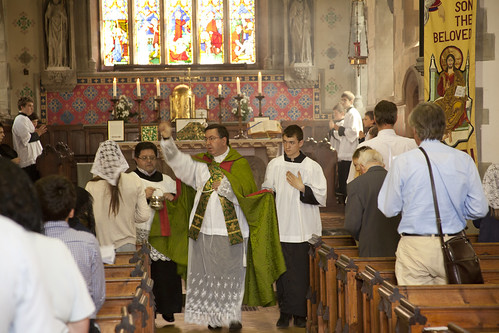
Asperges me: the ceremony of sprinkling with holy water, before a Sung Sunday EF Mass.
At the Summer School last Sunday, celebrated by Fr Andrew Southwell.
A question has arisen from an enquirer to the LMS and, after taking Canon legal advice, we have put a response on the website. It is about the exact meaning of Summorum Pontificum 5.2: does it restrict the number of EF Masses on a Sunday to just one, in a given church?

This may not seem a question of much practical import, but it is an interesting question of principle. Are there restrictions on the Traditional Mass which don't apply to the 1970 Missal? The answer, in our view, is that SP 5.2 is permissive, not restrictive.

Here is the central point of our response.

Does this place a restriction on the number of Extraordinary Form Masses which can be said on Sundays? The Vatican Information Service translation, on the EWTN website, gives this:

Celebration in accordance with the Missal of Bl. John XXIII may take place on working days; while on Sundays and feast days one such celebration may also be held.

At first glance this appears to place a limit on the frequency of EF Masses which does not exist for OF Masses. But this is not, in fact, accurate. Following the advice of the Latin Mass Society’s National Chaplain and Canonical Advisor, Mgr Gordon Read, we should observe the following.

First, the Latin is:
Celebratio secundum Missale B. Ioannis XXIII locum habere potest diebus ferialibus; dominicis autem et festis una etiam celebratio huiusmodi fieri potest.

'Etiam' means 'even'.  The MP does not use the word 'tantum' or 'tantummodo' which would clearly limit it to once only. The point being made here is that the EF can be celebrated on Sunday as well as on weekdays.

Canon 18 states that “Laws which prescribe a penalty, or restrict the free exercise of rights, or contain an exception to the law, are to be interpreted strictly” simply reproducing the text of canon 19 of the 1917 Code.  This is derived from the basic canonical principle contained in the Regulae Juris of Pope Boniface VIII, “Odia restringi et favores convent ampliari”, R. J. 15.  ‘Strictly’ means in a restrictive way whereas article 2.5 is granting a favour and so should be interpreted in a wide or generous way.

Second, the context is the provision of the Traditional Mass in response to a request from a group of Faithful (5.1). In the (admittedly unlikely) case that a single Mass on a Sunday is not sufficient to make provision for this group, then it would follow that a second Mass would be not only permissible but necessary.

IMG_1669 Third, this context also separates this clause from the situation of a traditional ‘personal parish’ or chaplaincy set up by a bishop, which is dealt with under Article 10. There is no reason to apply 5.2 to that situation.

Friday, February 19, 2010

PCED Clarification on the Motu Proprio

Late as I am I want to comment on the recent document from the PCED on the interpretation of the Motu Proprio Summorum Pontificum.

First, here is a summary of the main body of the document. You can see a scan of the letter, in Italian, on the NLM (where the translation also come from).

1. If there is no other possibility, because for instance in all churches of a diocese the liturgies of the Sacred Triduum are already being celebrated in the Ordinary Form, the liturgies of the Sacred Triduum may, in the same church in which they are already celebrated in the Ordinary Form, be additionally celebrated in the Extraordinary Form, if the local ordinary allows.

2. A Mass in the usus antiquior may replace a regularly scheduled Mass in the Ordinary Form. The question contextualizes that in many churches Sunday Masses are more or less scheduled continually, leaving free only very incovenient mid afternoon slots, but this is merely context, the question posed being general. The answer leaves the matter to the prudent judgement of the parish priest, and emphasises the right of a stable group to assist at Mass in the Extraordinary Form.

3. A parish priest may schedule a public Mass in the Extraordinary Form on his own accord (i.e. without the request of a group of faithful) for the benefit of the faithful including those unfamiliar with the usus antiquior. The response of the Commission here is identical to no. 2.

4. The calendar, readings or prefaces of the 1970 Missale Romanum may not be substituted for those of the 1962 Missale Romanum in Masses in the Extraordinary Form.

5. While the liturgical readings (Epistle and Gospel) themselves have to be read by
the priest (or deacon/subdeacon) as foreseen by the rubrics, a translation to the vernacular may afterwards be read also by a layman.

It is fair to say that all these points were already in the Motu Proprio, but (since clarification was requested), they needed reiterating. In particular, it is quite astonishing that point 3 needed making, but Twitter was filled with re-tweets on this point as if it were surprising. But Article 2 of the MP says that any priest may say a private Mass (Missa sine populo) without requiring any permission to do so, and article 4 clarifies that despite its confusing Latin name ('sine populo') people can actually attend these Masses. Furthermore, article 5 notes that scheduling public Masses requires only the permission of the priest in charge of the church or chapel. In other words, the two forms of the Roman Rite are exactly the same where permission to celebrate is concerned. (The same goes for the need for the priest to be 'idoneus' and not juridicially impeded.)

Point 2 is implicit in the Motu Proprio, though not explicit. Since the two Forms of the Rite are equally in the power of the Rector of a church or chapel, he may introduce one at a time formerly occupied by the other. If you think about it, you have to ask: why shouldn't he be able to do this?

Point 5 is the most interesting. It was a custom in certain places before the new Missal was introduced for a vernacular translation to be read by a layman after the priest had read or sung it in Latin. In some cases this was done simultaneously with the priest's reading in Latin. The ruling here makes allowance for this, on the condition that the Latin text be read by the priest first. It must be read, and it must be read first before anything else happens.

A great deal of confusion has arisen over the Motu Proprio Article 6, which says

In Missis iuxta Missale B. Ioannis XXIII celebratis cum populo, Lectiones proclamari possunt etiam lingua vernacula, utendo editionibus ab Apostolica Sede recognitis.

This led to some suggestions that it would be possible to use the lectionary of the 1970 Missal (which would lead to the use of the 1970 calendar as well); this is not supported by the text, however, and is now definitively ruled out by point 4 of the PCED's letter.

Another interpretation of the MP Article 6 was that the readings may read in the vernacular without them being read in Latin first. But that is not what the Latin says: Lectiones proclamari possunt etiam lingua vernacula means that it is possible to read them ALSO in the vernacular.

Unfortunately even the translation improved by Rorate Caeli and posted on their website fails to translate the 'etiam', as does the semi-official English translation provided by the Vatican Information Service on the Vatican website.

It is just possible that 'etiam' could mean 'even' (as in: 'on occasion'), but this is now ruled out by the PCED. The permission to have the translation read does not allow the Latin not to be read by the priest. The Latin texts of the epistle and gospel are part of the Mass.

That this should be so requires some explanation, which I propose to address in the next post.

Saturday, September 01, 2007

Translation problems in the Motu Proprio

Now that the dust is settling, after the publication of the Motu Proprio Summorum Pontificum, two serious errors in the English translation provided by the Vatican have been revealed.

Careless and tendentious translation at the Vatican is been an extremely serious problem, chronicled in detail by the famous blogger Fr Z. In the case of the MP, no 'official' translation has been provided, but the Vatican's 'unofficial' translation, from the Vatican Information Service, has naturally been the basis of commentary, and of the 'guidance' being offered by various bishops around the world. This can lead to errors, and of course even when an official translation appears, the Latin is the normative text, not the English or any other translation.

The two problems are these.
Article 5 secton 1: In paraoeciis, ubi coetus fidelium traditioni liturgicae antecedenti adherentium continenter exsistit, parochus eorum petitiones as celebrandum santam Missam iuxta ritum Missalis Romani anno 1962 editi, libenter suscipiat.

The Vatican translation: In parishes, where there is a stable group of faithful who adhere to the earlier liturgical tradition, the pastor should willingly accept their requests to celebrate the Mass according to the rite of the Roman Missal published in 1962...

The problem here is the phrase 'stable group of faithful'. The 'coetus fidelium' is to be 'continenter exsistet' - continuously present, ie not just passing through. (A separate article deals with the right of people passing through to the Traditional Mass: for funerals, pilgrimages etc..) Fr Z makes this point here: the word 'continenter' does not imply that the group must be of any particular size; a 'coetus' can be three people, including the priest, and it is this which would justify a pastor celebrating the Traditional Mass publicly.

Article 5, section 4: Sacerdotes Missali B. Ioannis XXIII utentes, idonei esse debent ac iure non impediti.

The Vatican translation: Priests who use the Missal of Blessed John XXIII must be qualified to do so and not juridically impeded.

The problem here is the word 'idoneus' implies only legal, rather than academic or intellectual, qualification. Just as a newly elected religious superior must be 'idoneus' to take up his or her position, so must a priest who is to say the Traditional Mass. While it would certainly not be fitting for a priest to say the Mass without proper preparation, and without knowing what he was doing, the Holy Father is not imposing a requirement for any formal qualifications (passing Latin exams etc.) by using the word 'idoneus'. Fr Z makes that point here.

The difficulty of translating 'idoneus' neatly has led Rorate Caeli, who adapted the English translation for its readers, to render the phrase simply 'must be idoneus'. Unfortunately, even their translation misses the first problem discussed above. Nevertheless, it is recommended because it puts the Latin and English in parallel columns.