Showing posts with label Tabernacle and Altar. Show all posts

Thursday, May 25, 2017

Eucharisticum Mysterium: blog post for the Catholic Herald

The Catholic Herald has published a post of mine on the 50th anniversary of one of the documents preparing the way for the Novus Ordo Missae. The highlight of the document is the evolving attitude to concelebration.

IMG_0131
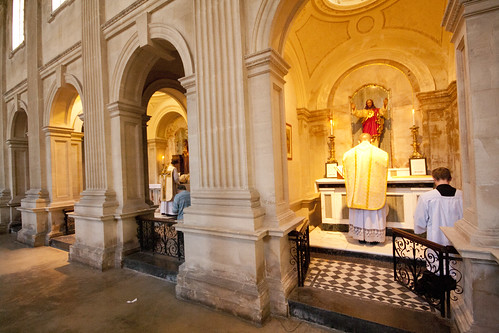
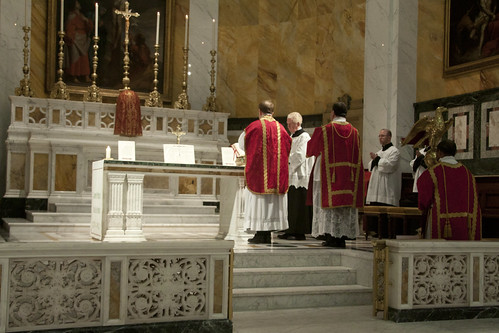
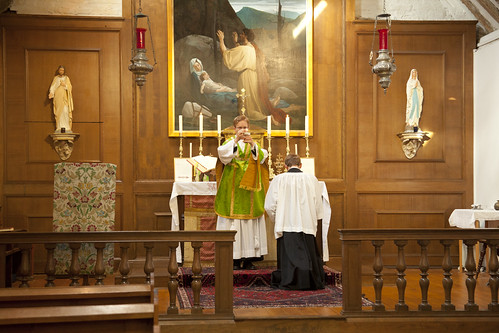
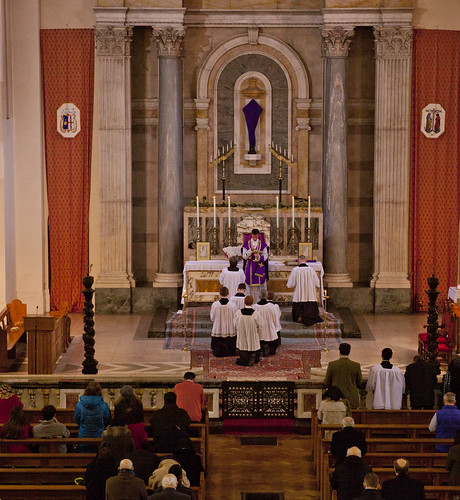
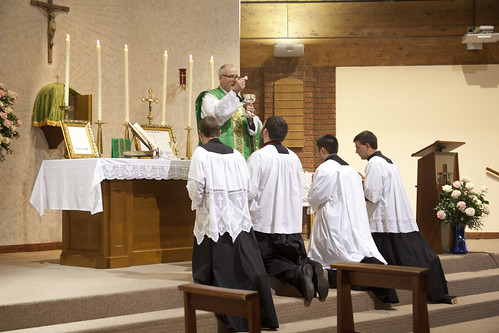
Simultaneous Low Mass at the LMS Priest Training Conference in Prior Park, 

Today is the 50th anniversary of the Instruction Eucharisticum Mysterium, signed by both the Prefect of the soon-to-be abolished Sacred Congregation of Rites, and the President of the Concilium, the temporary institution in charge of the liturgical reform. It now represents a fascinating snapshot of a fast-moving action sequence.

Go there to read it.

Support the work of the LMS by becoming an 'Anniversary Supporter'.

Wednesday, August 14, 2013

Loftus on Tabernacle and Altar

I have fallen seriously behind in my critiques of Mgr Basil Loftus' tiresome scribblings, because of the Summer School, Evangelium Conference, and on-going preparations for the LMS Walsingham Pilgrimage. But since I have been writing (in part in response to him) on Pius XII's views on Tabernacles and Altar, this letter of his in The Tablet, published on 3rd August, is too good - or bad - to miss.
IMG_1541
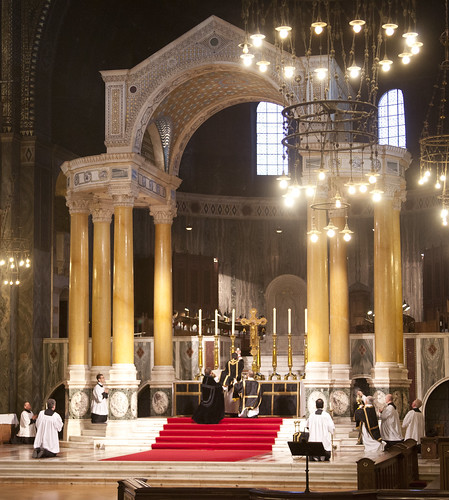
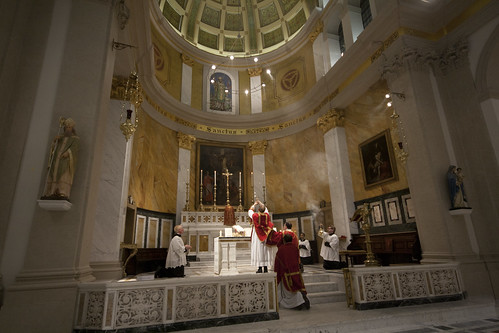
Annual Requiem for the Latin Mass Society in Westminster Cathedral
The Reservation of the Blessed Sacrament is the greatest single obstacle to the proper celebration of the liturgy in very many of our churches. Many were built as shrines to the reserved sacrament rather than as spaces for eucharistic assemblies, and the vast sanctuaries, keeping people at a “respectful” distance from the tabernacle, to which all eyes are drawn, easily become even more disproportionate when they are “extended … into the crossing or even the nave” (Parish Practice, 27 July). 

Daniel McCarthy’s splendid suggestions about the readoption of an ambo go a long way to resolving the problem of “a place for everyone”, but will only succeed if the concept of an ambo as an “empty tomb” is seen to trump that of an occupied tabernacle.

One of the consistent features of Loftus' output is that as well as being theologically wrong-headed, he makes the most ludicrous historical claims. Shrines to the Blessed Sacrament? It sounds quite nice, but it's not accurate.

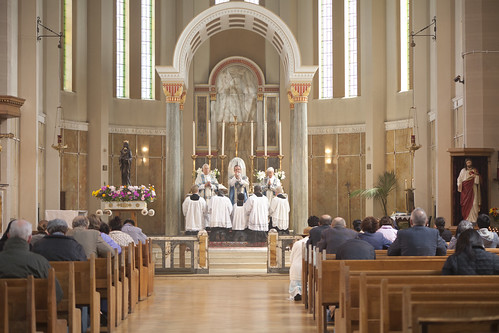
In cathedrals we have always had the Blessed Sacrament in a special chapel, where people can pray without distraction. Look at the High Altar in Westminster Cathedral (above), and the High Altar at another fairly grand church, such as Our Lady of Willesden (which like the Cathedral has a baldachino: a little roof over the Altar: below), and the presence of the tabernacle clearly makes very little difference to the design or architectural focus. Westminster Cathedral's High Alter clearly wasn't designed as a 'shrine to the reserved sacrament': He wasn't there. So on what basis does Loftus say that a place like Willesden was?

IMG_3485
LMS Pilgrimage to Our Lady of Willesden
The focus, in fact, is on the Altar of Sacrifice, and it focuses attention on the sacred Action at that Altar, the Mass - which is, if you really insist on the terminology, the focus and apex of the Eucharistic Assembly. The Altar of Sacrifice is joined to the tabernacle, when it is joined to the tabernacle, and this is appropriate because it draws out the connection between Our Lord in the tabernacle and Our Lord in the Mass - as Pius XII explained.

Moving down the scale of liturgical grandeur, we have side chapels which, again, have no tabernacles. All the architectural features remain, on a smaller scale, to frame and focus our attention on the celebrant and what he is doing.
IMG_2717
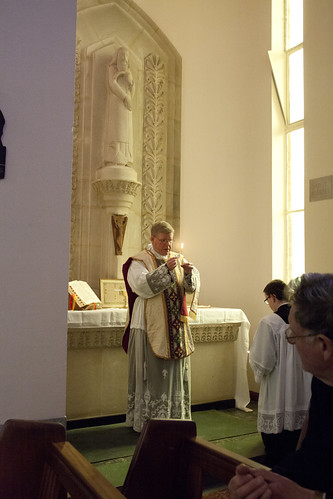
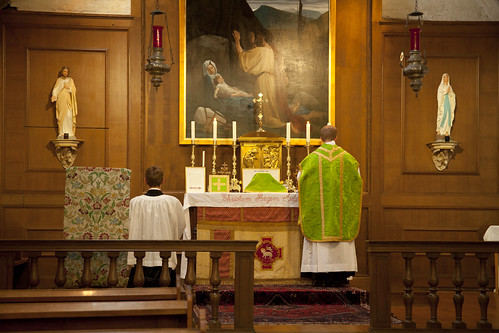
Low Mass at the LMS Training Conference in Ratcliffe College
One interesting and slightly strange modern phenonemon which I have encountered is the chapel without an Altar, and even exposition without an Altar; of course we are all used to seeing taberbnacles without an Alter anywhere near them, a biscuit-tin stuck on a wall. This reflects the liturgical modernist's desire to have as few Altars as possible, but the result is that it severs the connection between the Blessed Sacrament, the shrine, or devotional image, from the Mass, indeed from the liturgy. Does this reflect the insight of Vatican II, that the Liturgy is the Source and Summit of the Church's life?

IMG_7881
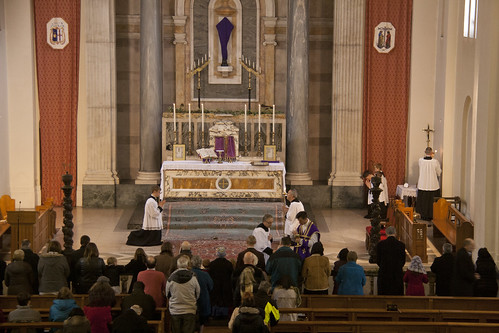
St Patrick's Soho Square: the subdeacon had to stand in the space behind the Communion Rail...
Oh but Loftus wants to end reservation altogether. He doesn't want us to be able to engage in contemplative prayer under the gaze of Our Lord in the tabernacle, like the peasant of Ars, who said to St Jean Vianney: 'I look at Him, and He at me.' Perhaps he doesn't even want people to have Communion on their deathbeds - it's not clear if a cupboard in the sacristy would be an acceptable substitute. It is hard to shed the idea that Loftus just doesn't like the Blessed Sacrament very much. He prefers the Empty Tomb. Well Our Lord didn't - He left it, after all. It is the tabernacle which He chooses to inhabit.

IMG_0003
...and kneel between the open Communion Rail gates.
I have other news for Loftus, however. The size of the sanctuary in older churches was not to keep people at a 'respectful distance' from the tabernacle. Anyone going into a small church, or the Blessed Sacrament chapel of a very big one, can see that a 'respectful distance' from the tabernacle in traditional church architecture is a couple of yards. No, these spaces were actually required for the celebration of Solemn Mass (and, in certain churches, for clergy or religious to sit in choir). Loftus may have forgotten how this works, but, while Solemn Mass is possible in a smallish church, 'forward Altars' which reduce the room for manoeuvre in the sanctuary can hamper things considerably, as the above photos of St Patrick's Soho Square show.

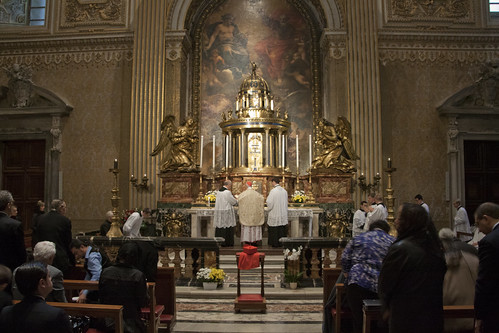
In the largest and grandest church in the whole world, St Peter's in Rome, what is deemed an appropriate distance between the Faithful kneeling in prayer and the tabernacle? See for yourselves: here it is, below.
IMG_8007
The Blessed Sacrament chapel in St Peter's Basilicia in Rome,
with Cardinal Castrillon saying Mass for the Una Voce General Assembly.

Tuesday, August 13, 2013

The Direction of Worship and the Tabernacle

IMG_3339
Fr Philip Harris celebrating the EF in a modern church, St Joseph's, Basingstoke
The issue of the relationship between tabernacle and altar, which I was discussing in my last post, has an added importance because of its implications for the direction of worship. In the words of the 1957 Decree Sanctissimam Eucharistiam:

In churches where only one altar exists, this cannot be constructed so that the priest may celebrate towards the people; but on that very altar, in the middle, a tabernacle for reserving the most Holy Eucharist should be located, constructed according to the norm of liturgical laws, entirely worthy in shape and size of so great a Sacrament. 

The legal status of celebration ad orientem before the Council was complicated since the Roman basilicas have free-standing altars at which the celebrant has always said Mass facing down the nave - East. They are arranged so the morning sun comes in through the great doors, something very striking to early morning visitors to St Peter's. The tabernacle, of course, as at other great churches, is in a special chapel, where private prayer is much easier.

The historical reason for this Altar arrangement is that the builders wanted to have the altar over the tomb of St Peter (and other shrines in other basilicas); in addition, the need for the celebrant to face East was clearly paramount. What it certainly wasn't, was some attempt to draw in the congregation by letting them see what was happening on the Altar, make eye contact with them and so on. Nothing visible was happening on the Altar when St Peter's was first built - there were no ceremonies during the Canon - the the people may well not have been able to see the priest anyway. Later, the priest was obscured by a forest of candlesticks and the Crucifix. It's all on the FIUV Position Paper on worship ad orientem.

All the same, celebration versus populum could not be forbidden in the Church, it was done all the time in St Peter's itself. What was, for practical purposes, holding the line when the liturgical maniacs went on the rampage after the First World War, was the obligation, in smaller churches, to have the tabernacle on the Altar. If the tabernacle was fixed to the Altar, celebration vs. pop. was impossible.

It is interesting to note that it is this, and not the theological rationale for ad orientem worship which has become so familiar from the writings of Pope Benedict and others, which is the focus of discussion in the two documents from 1956 and 1957 to which I have been drawing attention. It is particularly interesting to see Pius XII's emphasis on the symbolic importance of uniting Altar and tabernacle, since this was directly contradicted by the liturgical establishment after the Council - Mgr Basil Loftus, of course, is still running their argument, now looking distinctly dated.

As I mentioned in my last post, however, Pius XII appeared to create a get-out clause, in his 1956 Assisi Allocution.

The question of how the tabernacle could be placed on the altar without interfering with celebration facing the people admits of several different solutions. On these the experts will give their opinion.

What sort of solutions? The mind boggles. But boggle no more: it was actually tried out. Hat-tip to Rubricarius for the bizarre photograph below, an Altar from the United States in the late 1950s.


I must say that, looking at this, I can only say that in this experiment the hypothesis that the tabernacle could be fixed to the Altar 'without interfering with the celebration of the Mass facing the people' is tested to destruction. It can't be done. This cannot be described as an arrangement in which Mass facing the people is not 'interfered with'.

It is interesting to note that, as far as I can see, this is contrary to at least the spirit of Sanctissimam Eucharisitiam. This is not a situation in which the tabernacle has been put on the altar of a side chapel, and yet the Altar has been build for vs. pop. celebration. Pius XII had not had the chance to give any expert 'opinion' legal status.

On the other hand, it anticipates the ruling of the Instruction Inter Oecumenici in 1965.

91. The main altar should preferably be freestanding, to permit walking around it and celebration facing the people. ...

95. The Eucharist is to be reserved in a solid and secure tabernacle, placed in the middle of the main altar or on a minor, but truly worthy altar, or, in accord with lawful custom and in particular cases approved by the local Ordinary, also in another, special, and properly adorned part of the church.
It is lawful to celebrate Mass facing the people even on an altar where there is a small but becoming tabernacle.


In practice, of course, everyone could see how unsatisfactory built-in tabernacles on vs. pop. Altars were, and they soon adopted the alternative options.

I don't think it is a coincidence that neither Inter Oecumenici nor Sanctissimam Eucharistiam are on the Vatican website (though they are, of course, in the scanned on-line Acta Apostolicis Sedis, in Latin). The former is on the EWTN website and now the latter is on the LMS website. The way they contradict each other is more than a little scandalous, particularly with less than a decade separating them. Note that the option most directly contrary to Pius XII's firm argument, having the tabernacle on the wall without any Altar at all, is permissible only with the permission of the Ordinary. This nod to the fact that there is something grossly theologically problematic with this option, however, had no practical consequence, and this is the arrangement found in the great majority of Catholic churches around the country today. Contrast this with the demand of Sanctissimam Eucharistiam  when the tabernacle is not on the main Altar:

On an altar where the most Holy Eucharist is reserved, the Sacrifice of the Mass is to be habitually celebrated.

--------------

A similar argument, of course, can be made about the position of the crucifix. It is a long-standing principle of the ars celebrandi that the priest be able to raise his eyes to the Crucifix while saying Mass. The General Instruction of the Roman Missal says at least that there be a crucifix 'on or near' the Altar (308). There are, of course, various possible 'solutions' to this in relation to vs. pop. celebration. One was manifested in the 1960s fad for large, two-sided, crucifixes dangling from the ceiling, which the priest could see from the Altar; these peculiar things have, thankfully, mostly been coming down from churches over the last decade, if they've lasted that long; they were a pale reflection of the small number of magnificent historic examples which gave them their precedent, such as the one in Westminster Cathedral. Pope Benedict suggested, in The Spirit of the Liturgy, having a crucifix standing in the middle of the Altar between the celebrant and the Faithful. He tried this out when Pope, leading to what some wag on Pray Tell memorably called the 'caged celebrant' arrangement; Basil Loftus, not being blessed with a sense of humour, simply became incoherent with rage.


This is a good example of a principle of the liturgical reformers which has had endless unfortunate consequences. Clear arguments in favour of celebration ad orientem were not being put forward in the 1950s, but it was part of a liturgical system which was theologically coherent and worked practically. When celebration vs. pop. suddenly became desirable, it seems that every other liturgical principle had to be sacrificed. The attempt to tie oneself into knots to celebrate towards the nave and maintain the other principles carried, and still carries, the risk of making the Reform of the Reform crowd look silly.

The argument in the Pontiff Emeritus' The Spirit of the Liturgy is, in fact, that visual interference with vs. pop. celebration is not a problem because seeing the celebrant from the front is 'of no importance'; the 'Benedictine arrangement' is simply a step towards the celebration ad orientem. Now that the Pontiff Emeritus, and other scholars such as Fr Lang in his 'Turning towards the Lord', have given us overwhelming arguments for celebration ad orientem, there is no longer any excuse for these strange compromises.
IMG_0449
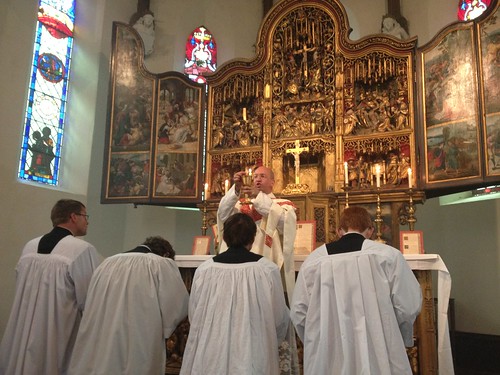
Fr Bede Rowe celebrating Mass for the LMS Pilgrimage to Walsingham, in the private chapel of Oxburgh Hall.
 

Sunday, August 11, 2013

So what did Pius XII really say about the Tabernacle?

IMG_4058
Low Mass at the Evangelium Conference.
I was taken a little to task by Rubricarius for responding to selective quotations of Pope Pius XII's 1956 Allocution to the Assisi Liturgical Congress by Mgr Basil Loftus, with some selective quotations of my own. The truth is, I hadn't read the full text: it wasn't available online.

I have now bought the English-language book of the proceedings of the Congress, and the relevant pages are now online on the Latin Mass Society website. Making this available (which is 'fair use' as far as copyright is concerned) is an important work for the Church. I have also commissioned a fresh translation of the Decree of the Sacred Congregation for Rites, Santissimam eucharistiam, which followed the Allocation and refers to it, and put a Latin-English parallel column version online as well.

Allocution: Decree. So now everyone has access to these two short but very interesting documents.

The Allocution is very interesting indeed; it is recorded in the Acta Apostolicis Sedis, so it is an official, magisterial document. Although at the beginning and the end Pope Pius XII makes a point of praising the Liturgical Movement, the contents of the Allocution is in fact a series of criticisms of worrying trends associated with it.

Against the confusion of roles of celebrating priest and congregation (clerical or lay):
When the consecration of the bread and wine is validly performed, the entire action of Christ himself is accomplished. Even if all that follows cannot be carried out there is still nothing lacking to the offering of Christ. When the consecration is completed, the “oblation of the Victim placed upon the altar” may be done and is done by the celebrating priest, by the Church, by the other priests and by each of the faithful, but this action is not the “action of Christ Himself through a priest sustaining, and acting in, His person.” In truth the action of the consecrating priest is the very action of Christ, who acts by His minister.
Against the attack on the Real Presence.
For them the essential content of the species of bread and wine as they stand is “Christ in heaven,” with whom the species have a so-called real, essential relation of containing and of presence. This speculative interpretation raises serious objections when it is put forward as completely sufficient, for the Christian sense of the faithful, the constant catechetical teaching of the Church, the expressions of the Council and particularly the words of our Lord, require that the Eucharist contain Christ Himself. The sacramental species are not Christ, even if they have a so-called essential relationship of containing and of presence with the substance of Christ in heaven. Our Lord said: “This is my body! This is my blood!” He did not say: “This is a sensible appearance which signifies the presence of my body and my blood.” Doubtless the sensible signs of a real relation of presence would be the sensible and efficacious signs of sacramental grace; but We are here concerned with the essential content of the “eucharistic species,” not with their sacramental efficacy. One cannot, then, admit that the theory of which We are speaking does full justice to the words of Christ, that the presence of Christ in the Eucharist means no more than this and that this suffices to be able to say in very truth of the Eucharist: “It is the Lord” (cf. John 21:7).
Against the view that the Tabernacle should be placed away from the Altar where Mass is celebrated.
It is not so much to the material presence of the tabernacle on the altar as to a tendency toward a lesser esteem for the presence and the action of Christ in the tabernacle that We would like to draw your attention. The sacrifice of the altar is considered sufficient, and the importance of Him who accomplished it is diminished. But the person of the Lord must occupy the centre of worship, for it is that which unifies the relations of the altar and the tabernacle and gives to them their meaning.

It is first of all by the sacrifice of the altar that our Lord makes Himself present in the Eucharist and He is in the tabernacle only as memoria sacrificii et passionis suae, a “memorial of His sacrifice and passion.” To separate the tabernacle and the altar is to separate two things which should remain united by their origin and their nature. 
Not much comfort for Loftus here. But here's the killer. The next sentences are:

The question of how the tabernacle could be placed on the altar without interfering with celebration facing the people admits of several different solutions. On these the experts will give their opinion. The essential thing is to have understood that it is the same Lord who is present on the altar and in the tabernacle.  

IMG_4066
'it is the same Lord who is present on the altar and in the tabernacle.'
I shall say more about this surprising assertion tomorrow.

Friday, June 28, 2013

Loftus: Pius XII wanted liturgical abuses. Really?

Strangely Mgr Basil Loftus' grinning face in The Catholic Times is still captioned 'Mgr Basil Loftus'. Hasn't the editor heard that Basil regards titles such as Monsignor as detestable flummeries? When can we look forward to seeing 'Mgr Basil Loftus'?
IMG_3486
The Tabernacle is firmly fixed to the Altar at Our Lady of Willesden, just as Pius XII wanted.
Today (30th June edition) he makes the argument that the even the most extreme and illicit liturgical excesses of today are in continuity with the liturgical movement, as represented by Fr Pius Parsch and as endorsed by Pope Pius XII.

Pope Pius XII put the icing on the liturgical cake when he told the all-important Internationla Congress of Pastoral Liturgy meeting in Assisi in 1955, that "the liturgical movement is a sign of the providential disposition of God for the present time as well as of the Holy Spirit in the Church."

Loftus is quoting selectively. In his allocution to the Assisi conference (in 1956), Pope Pius XII gave some stern warnings against the very excesses which Loftus is arguing he approved. To give just one example, the practice of Mass 'facing the people' was making an appearance in the mid 1950s. What does Pope Pius say about this, in this allocution?
IMG_3495
Infantilised laity? Fr Schofield distributes Communion at the Willesden Pilgrimage
It is one and the same Lord who is immolated on the altar and honoured in the tabernacle, and who pours out his blessings from the tabernacle.

What does this mean? It means that the Tabernacle should not be separated from the Altar. The following year Pope Pius XII signed off a Decree of the Sacred Congregation of Rites (Sanctissimam Eucharistiam) (1957) 4: ‘In churches, where there is only one altar, this cannot be built in such a way that the priest should celebrate facing the people

IMG_1482
The Tabernacle ajar during Communion at SS Gregory & Augustine's, Oxford: Loftus hates the practice of taking hosts for Communion from the Tabernacle, a practice which emphasises that it is 'the same Lord' in the tabernacle, as Pius XII said.

If the Altar is fixed to the tabernacle, it is obviously impossible for the priest to celebrate Mass from the far side of it. Did Pius XII approve of celebration versus populum? No he did not: he argued against it, he legislated against it. How could he make it any clearer?


Pius XII ended his allocution with a general note of caution: 'it is also our duty to forestall whatever might be a source of error or danger.'

The tensions within the Liturgical Movement, and the role of Pius XII, and also St Pius X and John XXIII, to reign in what was wrong with it, are steadfastly ignored by Mgr Loftus, who wants to present us with a single 'organic' development.

It is clear, therefore, that the post-conciliar implementation and further specification of the liturgical reform was not only mandated by Vatican II but was an organic continuation of a movement which Pius XII had enthusiastically backed for some 15 years before the Council even began.
     The whole of the post-conciliar liturgical reform of the Mass and sacraments, as well as of the breviary, is the true hermeneutic of continuity in reform.
     Both the Council and the post-conciliar implementations were no more or less than the fuller ripening of a fruit which had been maturing for 15 years before the Council and was then ready to be picked and enjoyed.
     The hermeneutic or interpretation of rupture is typified only by those movements in the Church which ignore that organic and harmonious liturgical growth...
IMG_2086
Another Tabernacle fixed to the Altar: at SS Peter & Paul, New Brighton, served by the ICKSP
     One facet of the 65-year-old Liturgical Reform Movement which must be preserved and further developed, perhaps above all others, is the accommodation of the liturgy to the common priesthood of all the bapstised. Attempts to undermine the participation of the whole People of God are sadly all too common when priests turn their backs on the people, or autocratically reimpose Latin. Translations which are coached in 'sacral' or 'hieratic' language are symptomatic of a retreat into some Old Testament kind of 'Holy of holies', where only the ordained or 'professional' priest knows what is going on - if even he does. There is no place for such a 'Holy of Holies' in Western Christianity, let alone in post-conciliar, liturgy. [sic] Likewise, opposition to women into the sanctuary [sic], refusal to admit lay-ministers of Holy Communion, and varied attempts to infantilise and individualise the People of God who approach Holy Communion in a united and adult manner, all conflict both with that common priesthood and with the unity of the whole People of God.'

I think that last bit must be about not making a scene when people want to receive communion on the tongue.

How can there be 'continuity' between John XXIII's insistence on the importance of Latin in 1962 (in Veterum Sapientia), and Vatican II saying 'Latin must be preserved' in 1963, on the one hand, and the villification of Latin promoted by Loftus? How can attempts to bring Latin back be in 'rupture' with the Council, and what went before it, which explicitly demanded that it be preserved?

IMG_1003
More infantilised laity.
How can the claim that 'lay ministers' (ie Extraordinary Ministers of Holy Communion) manifest the Priesthood of the People of God be in 'continuity' with forty years of official documents from Rome which have condemned this idea? Or with the Council, which doesn't mention the possibility of any such thing? The Instruction Redemptionis Sacramentum (2004) makes it very clear:

[151.] Only out of true necessity is there to be recourse to the assistance of extraordinary ministers in the celebration of the Liturgy. Such recourse is not intended for the sake of a fuller participation of the laity but rather, by its very nature, is supplementary and provisional.

IMG_1044
A modern chapel with the traditional Tabernacle / Altar arrangement: at the Oratory School.
I've written more about the difference between what the Council mandated and what was actually implemented here. But Loftus is not content with what was actually implemented officially - the legislation and official texts. He is talking here of liturgical abuses - practices which have been repeatedly condemned by the Church - or the wickedness of Papal initiatives such as the new translation of the Ordinary Form.

This is all quite dotty and harmless but for the fact that he is actually attacking his fellow priests: priests who are merely following the Church's liturgical laws, or are allowing the people to exercise their right to receive Communion kneeling and on the tongue. This is not harmless: it is serious. The madness of these articles has got to stop.
IMG_1045
Communion of the Faithful: 'in a united and adult manner'.