Showing posts with label Traditionis Custodes. Show all posts

Saturday, November 27, 2021

Response to Fr Ruff on Liturgical Polarisation

IMG_0070
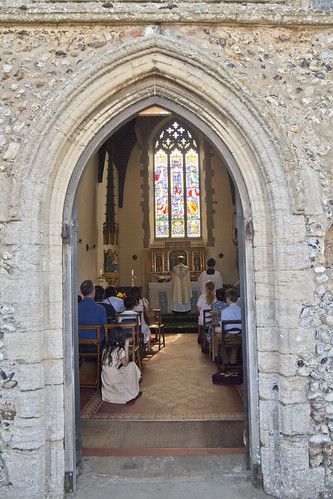
Mass for Vladimir Ashkenazy and family at Maiden Lane last week.

Cross-posted from Rorate Caeli.

Fr Anthony Ruff at the Pray, Tell blog tells us that the basic picture, in the debate about liturgy, is that

either one supports Vatican II and the reformed liturgy to the exclusion of the preconciliar liturgy, or one shows greater or lesser openness to the preconciliar liturgy, which seems to be equated with opposition to Vatican II.

He does not pause to explain what "opposition to Vatican II" might mean, but admits that not everyone falls into these two strictly opposed camps:

people who don’t fit neatly in either camp... [who] don’t see the preconciliar liturgy as particularly bad or harmful and don’t mind attending it at times.

Fr Ruff would like such people to realise

that the preconciliar liturgy is incompatible with the large advances made by the Second Vatican Council in ecclesiology and liturgical theology and inculturation and all the rest.

He gives the impression that he would like to see the Church become two armed camps snarling at each other from their trenches, with barbed wire, if not clouds of poison gas, marking out no-man’s land. But as for what these Vatican II "advances" might be, Fr Ruff does not say.

Friday, November 19, 2021

Letter in the Tablet: the value of the Old Mass

IMG_0271
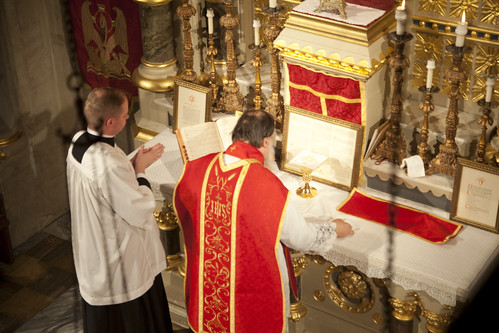
View from the choir loft at St Mary Moorfields, for the LMS' Easter Triduum 2018

I'm late with this, but I think it is worthy of a wider audience: part of a Letter in the Tablet from the 23rd October issue. All credit to them for publishing it.

Mr Wells' transformative liturgical experience sounds to me like one of the Masses organised in St Patrick's Soho Square and then in St Mary Moorfield's by Juventutem London before the lockdown, which were sponsored by the Latin Mass Society. (These continue, at the moment, in St Mary Magdalen, Wandsworth, in a slightly different format: 7pm on Fridays.) The organisers, including the then musical director Matthew Schellhorn of Cantus Magnus, should be reminded that their efforts were not without fruit.

On graduation I returned to my home parish where, for me, the post-conciliar vernacular Mass that had worked so well in the university chaplaincy seemed arid in a parish setting; perhaps the church building was too big for the new informality. Anyway, one evening I went to a Tridentine High Mass in central London, and what a difference: Gregorian chant drifting down from the gallery, the sacred ministers involved in the ritual of the Prayers at the Foot of the Altar, the gentle formalised approach of the whole service. 

And that is what I crave when I go to Mass. I have no wish to split the Church or to denounce the present Pope. But I would like to worship God in the way that best leads me to him. Is that too much to ask? 

IAN WELLS 

NOTTINGHAM


Support the Latin Mass Society

Wednesday, November 17, 2021

Response to Cardinal Cupich

IMG_2825
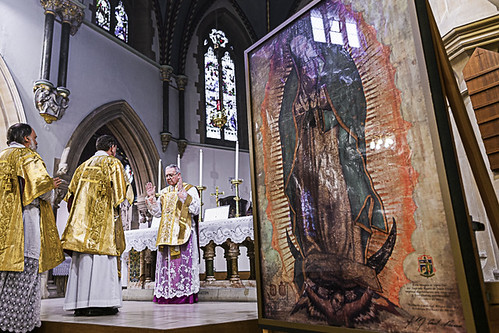
LMS Pilgrimage to Bedford (in reparation for abortion), to the 
Shrine of Our Lady of Guadalupe


Cardinal Cupich has published a defence of Traditionis Custodes in the Jesuit magazine America(An earlier article, on Pray Tell, finds a response from Matthew Hazell on Rorate Caeli here.) In this article he argues... well it is actually quite unclear what he is arguing. 

Is he suggesting the TC was a response to the failure of the SSPX to submit to the Holy See after Summorum Pontificum? In which case why are their privileges to give absolution and witness marriages in the old Rite not the target of the Holy See's restrictions, instead of the corresponding rights now denied to priests in good standing in the diocese of Rome?

Is he suggesting, instead, that the problem has been that people have been "promoting" the "antecedent liturgies"? But isn't that exactly what Pope Benedict XVI called for when saying that "it behooves us to ...to give them their proper place"?

Or is he arguing something quite different: that the very existence of an alternative form of the liturgy is a wound in the unity of the Church? In which case his complaint is less against the SSPX, or the Faithful who attend the Usus Antiquior under the bishops, but with Pope Benedict himself.

I have published a response in Catholic World Report. (America declined to let me respond.)

Cardinal Cupich begins the story with Archbishop Marcel Lefebvre, in “the early 1970s”. It is worth noting that by the time the SSPX became headline news, with its canonical suppression in 1975 and unauthorised ordinations in 1976, lay groups had been campaigning for the ancient Mass for more than a decade, and had achieved a symbolic, if limited, concession in Pope Paul VI’s Indult for England and Wales which was signed in November 1971, exactly fifty years ago. It was, similarly, the desire of the Faithful, not of SSPX clergy, which was recognised by Pope John Paul II’s world-wide indult of 1984, which does not mention the SSPX, and these Faithful who are again noted as a motivation for Pope Benedict’s Apostolic Letter Summorum Pontificum.

This is worth emphasizing because, although they share an attachment to the former Missal, the International Una Voce Federation (founded in 1965) and its member associations around the world, and the SSPX, are clearly distinct phenomena, and have suffered quite different fates in recent years. In 2016 Pope Francis gave priests of the SSPX special faculties to hear confessions, and in 2017 he made provision for them to officiate at marriage services. They still enjoy these privileges today. Priests serving the faithful within the structures of the Church, on the other hand, have just been forbidden to do either thing using the older books used by the SSPX in the very diocese of Rome. If Traditionis Custodes is motivated by disappointed hopes for “healing and unity” with the SSPX, it seems to have sadly mistaken its target.

Read it all there.

Support the Latin Mass Society

Tuesday, November 09, 2021

Vicar General of Rome attempts to ban the use of the 1962 Rituale Romanum

Cross-posted from Rorate Caeli.

Another document has come into the public domain, on Rorate Caeli, this time a letter from the Vicar General of Rome, Angelo, Cardinal de Donatis, implementing Traditionis Custodes, sent to the priests of Rome.

Much of it simply confirms the churches in Rome where the Traditional Mass can be celebrated. The strange bit is the third paragraph.

The motu proprio establishes that the “liturgical books promulgated by the Holy Pontiffs Paul VI and John Paul II, in conformity with the decrees of the Second Vatican Council, are the sole expression of the lex orandi of the Roman Rite” (art. 1, Traditionis Custodes) and that therefore it is no longer possible to use the Roman Ritual and the other liturgical books of the “ancient rite” for the celebration of sacraments and sacramentals (e.g., the Ritual for the reconciliation of penitents according to the ancient form). The use of the other Ordines, therefore, is currently expressly forbidden and only the use of the Missale Romanum of 1962 remains permitted.

There is no further explanation or argumentative support for this assertion in the letter.

Traditionis Custodes (TC) Article 1 says just this:

The liturgical books promulgated by Saint Paul VI and Saint John Paul II, in conformity with the decrees of Vatican Council II, are the only expression of the lex orandi of the Roman Rite.

As I have noted before, it is not easy to establish what TC Article 1 means. Nevertheless, I would make four points about its implications: noting that this is my personal view, about which I have not had long to reflect.

1. TC Art. 1 cannot be understood to mean that it is illicit to use the 1962 books as a whole, since the following articles go on to regulate the use of the 1962 Missale Romanum. It says nothing about the Rituale Romanum. To claim that this article "expressly forbids" the use of the older Rituale is therefore very strange.

Saturday, November 06, 2021

A response to the Letters between Westminster and the CDW

Letters between the Cardinal Archbishop of Westminster, England, Vincent Nichols, and the Prefect of the Congregation for Divine Worship, Archbishop Arthur Roche, have been made public, first on Gloria TV and then on the 1P5 blog.

Once this things are leaked there is no putting the genie back in the bottle. You can read there there.

I was fortunate to be able to compose a reponse to these letters in advance of their publication, which is included in the 1P5 post. For the record, here it is in full.

---------------------


Commentary on the Exchange of Letters between Cardinal Nichols and the Prefect of the CDW

Joseph Shaw


These two letters have been going around by email for some time, and it was inevitable that they would be published. They have been offered to 1P5 and since they are now going to be seen by everyone I can comment on them publicly. Some of the contents are a little technical and obscure, but none of it should surprise us, the basic message is positive, and it also gives us a chance to respond to arguments currently being developed to limit what we can do.

In his letter, Cardinal Nichols asks for clarification on a series of detailed issues from the Curial institution which now has authority in the area, the Congregation for Divine Worship (CDW). Archbishop Roche, the English Prefect of the CDW, replies, sometimes in a slightly vague way, since these are early days in the interpretation of Traditionis Custodes. Some things are not settled; others are not to be settled at all, but left to bishops’ discretion.

The most interesting questions are these.


Thursday, November 04, 2021

Traditions, Liberation, and Meaning

IMG_9885
St Teresa of Avila said she would be prepared to die for "the least of the 
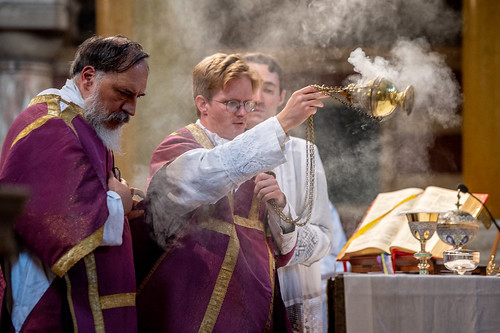
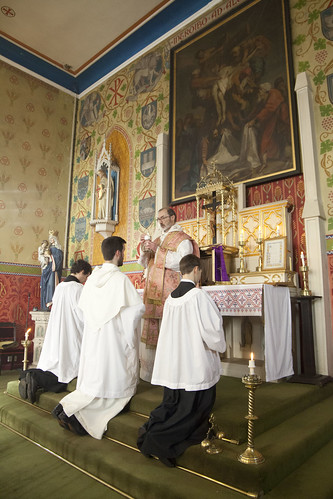
ceremonies of the Church". This is the "minor elevation": Corpus Christi, Maiden Lane.

My latest in the European Conservative.

I wish to place a recent development in the Catholic Church into the context of the wider cultural and political debate. The development is the publication, on 16th July, of a document called Traditionis Custodes, and an accompanying Letter to Bishops, by Pope Francis. These documents seek to restrict, and ultimately abolish, the celebration of the Church’s older form of liturgy.

This may look like an obscure internal dispute, but the Catholic Church, today and in terms her place in history, is large enough to be the arena for an important conflict. For the Church is not simply old: in a certain way it preserves the past. It is a feature of the Catholic worldview to take seriously, within certain limitations, her own past practices and to regard them as action-guiding, normative, for the present and the future. This has long been ridiculed by the Church’s opponents as a matter of doing the same thing as has always been done simply for the sake of it, even when the reasons for the original practice are no longer applicable or have been forgotten. Both the practice of treating tradition as normative, and the criticism of this as obscurantism, are very clearly on display in the history of the Catholic liturgy, though the Church’s legal system, theology, and many other aspects of her governance and culture could also provide examples. 

To give an example, there is a tradition in the Catholic liturgy that the priest, when saying the holiest prayers of the Mass, the Canon, inaudibly at the Altar, breaks the silence to say aloud a single phrase of the text he is reading: “nobis quoque peccatoribus” (“to us sinners, also”). In his 1949 The Mass of the Roman Rite, we are informed by the great liturgical historian Fr. Josef Jungmann SJ, who was also an advocate of reform, that in some century distant from our own this custom was established as a signal for some other liturgical functionaries to do something. Developments since that time have been such, however, that this signal is no longer necessary.

Jungmann’s proposal is in itself perfectly plausible. The question is whether it debunks the meaning of this custom as understood by the worshippers of later generations. Thus, St. Albert the Great points out that the priest’s raising of his voice serves to draw attention to his act of confession: a confession of unworthiness, on the part of the clergy, which is frequently underlined in this liturgical tradition.


Support the Latin Mass Society

Tuesday, October 26, 2021

New Book: From Benedict's Peace to Francis's War: Catholics Respond to Traditionis Custodes

A new book from Angelico Press, which includes short pieces by me, and by many very distinguished people as well! Get it from Amazon.co.uk or Angelico direct.

From Benedict’s Peace to Francis’s War: Catholics Respond to the Motu Proprio Traditiones Custodes on the Latin Mass 

Edited by PETER A. KWASNIEWSKI 
406 pages Paper (ISBN 978-1-62138-786-2): $22.95 / £18.00 
Cloth (ISBN 978-1-62138-787-9 ): $32.00 / £24.50 

An anthology of essays and articles by prelates and pastors, theologians and canonists, philosophers and cultural figures—including:  Cardinal Walter Brandmüller • Cardinal Raymond Leo Burke 
Cardinal Gerhard Müller • Cardinal Robert Sarah 
Cardinal Joseph Zen • Archbishop Thomas Gullickson 
Archbishop Carlo Maria Viganò • Bishop Rob Mutsaerts 
Bishop Athanasius Schneider • Msgr. Charles Pope 
Dom Alcuin Reid • Abbé Claude Barthe 
Fr. John Hunwicke • Michael Brendan Dougherty 
Ross Douthat • Edward Feser • Michael Fiedrowicz 
Peter A. Kwasniewski • Phil Lawler • Martin Mosebach 
George Neumayr • Joseph Shaw • and many others 

 Already on July 16, 2021, the reactions to Pope Francis’s severe restrictions on the traditional Latin Mass in Traditionis Custodes were like a river in full flood: articles, essays, interviews, podcasts—everywhere and from every point of view. An emotional, spiritual, intellectual dam had broken and the waters of discourse poured forth across the world. The sheer volume of writing occasioned by ­Traditionis Custodes is unlike anything seen in the history of papal documents—testimony to a neuralgic subject on which arguments proliferate and passions run high. The two-month period following the release of the motu proprio gave proof that the traditionalist movement was no fringe phenomenon, but something that had gained significant strength and sympathy during the relatively peaceful years from 2007 to 2021 (the “Pax Benedictina” to which the book’s title refers). The purpose of this volume is to gather in one convenient place some of the finest and most appreciated essays and articles published in the period from mid-July through September of this fateful year, 2021—not only from America and England (although these predominate), but also from other nations: France, Germany, Switzerland, the Netherlands, Italy, Spain, Argentina, Poland, Kazakhstan, and China. This book is not, and makes no pretense of being, a presentation of “both sides of the argument.” It offers a variety of critiques of this profoundly unwise and unpastoral decree, which suffers from incoherent doctrinal foundations, grave moral and juridical defects, and impossible ecclesiological implications.

Support the Latin Mass Society

Monday, October 25, 2021

Interview with InfoCatolica

IMG_0453
Procession to St Peters at the 2019 Summorum Pontificum Pilgrimage, Rome


The following interview with me has been published, in Spanish translation, on InfoCatolica. This is the English original.


1.       What does it mean to be president of the International Federation Una Voce?


The Federation an an umbrella group for lay Catholics attached to the ancient Latin liturgy of the Catholic Church. We do not exercise authority over our members, but they come to us for advice, and we represent their concerns in the Holy See and in the world-wide media.

The Federation’s members elect a Council, currently about 20 people from all over the world, and a President; the Council elects the Treasurer and Secretary and allocates other tasks to its members. Because of the geographical spread of councillors, we communicate mainly by email and have instituted regular Zoom meetings.

The President, generally with a colleague or two, usually travels to Rome once a year to meet Curial officials, clergy, journalists, and others, to keep up with what is going on. As Secretary I have been involved in such trips for some years, and it has been very interesting. As well as concrete information, one gets a feeling for the assumptions and habits of mind which govern the Holy See. This insight is reflected in the way we carry out all our work: whether we want to appeal to these assumptions in our representations to the Holy See, or to modify them, one needs to know what they are.


Wednesday, October 13, 2021

The Traditional Mass and Diversity

IMG_5108
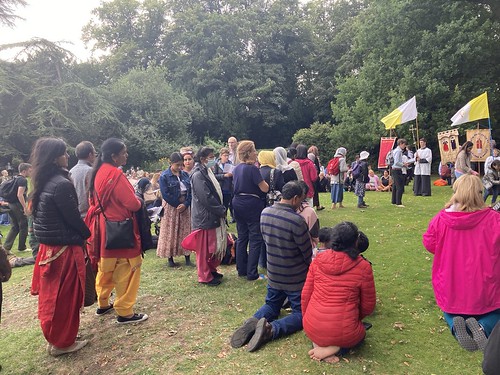
Venerating Our Lady of Walsingham at the end of the
LMS Walking Pilgrimage in August this year.

My latest on 1Peter5

In a recent article in the Illinois Times, Massimo Faggioli, a theology professor at Villanova University in Philadelphia, is quoted as follows, of a specific Traditional Mass location:

It’s not an accident that all of these Catholics at the old Mass are white, because one of the things that happened after Vatican II was an ‘inculturation’ of the liturgy. …The Latin Mass is white and European by its definition, because it’s a product of the Catholic Church of the 16th century. So, this is creating serious problems because it is never limited to the liturgy only, but it is always the first step to saying Vatican II was a disaster.

I would far rather ignore these childish accusations, but I fear that if they are repeated frequently enough without rebuttal they will become established as part of the liberal narrative about the Traditional Latin Mass. But in order to shoe-horn the movement for the ancient Mass into the role of the bad guys in some racially-charged political confrontation, Faggioli needs to distort the past and ignore the present. Let’s start with the past.

Read the whole thing there.

IMG_5107

IMG_5106

Support the Latin Mass Society

Thursday, September 09, 2021

Statement of the Religious Superiors (and Taylor Marshall)

Cross-posted on Rorate Caeli.

The Superiors General of the Fraternity of St Peter, the Institute of Christ the King Sovereign Priest, the Institute of the Good Shepherd, and a number of other Superiors General of priestly institutes and religious communities attached to the Traditional Mass (including three communities of women), have issued a joint letter in response to Traditionis Custodes. Here it is, on the FSSP website. It is addressed to the Bishops of France, not, as some have assumed, to the Holy See.

As befits such a document, it is carefully worded. In principle, Traditionis Custodes creates an impossible situation for the signatories. They are founded on the charism of the Traditional liturgy, and the Letter accompanying Traditionis Custodes tells us that it is the intention of the document that in the longer term this liturgy should entirely disappear. Furthermore, the justification for this given in the Letter is that the clergy and faithful (who are not distinguished) are detached in some sense from the unity of the Church.

The argument which needs to be made to the Bishops of France at this point is thus a delicate one. Negatively, it should be obvious that to strike a defiant attitude, to threaten disobedience to Traditionis Custodes or the Bishops, or to suggest that they might go over to the Society of Pius X, would serve to confirm the purported justification of Traditionis Custodes. It would be directly counter-productive. 

Wednesday, August 25, 2021

Contradictions among those defending Traditionis Custodes

IMG_9492
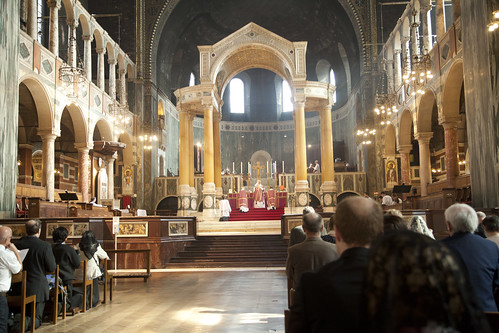
Final blessing at the High Mass in Westminster Cathedral;
Mass for the Latin Mass Society's AGM

My latest on 1Peter5: on some conflict among those who defend Traditionis Custodes.

It begins:

-----------------

Pope Francis has offered two reasons for wishing to bring celebrations of the Traditional Mass to an end: attitudes of some of the faithful which have become associated with this form of the Mass, and the idea that the unity of the Church requires a unity of liturgical rite. Accordingly, some of his defenders have focused on one of these points, and some on the other. Both are having difficulty explaining and justifying Pope Francis’ action.

Targeting the Innocent to Punish the Guilty?

I recently fisked an article by Michael Sean Winters which laid the blame for Traditionis Custodes (TC) on the people who like it, singling out the journalist Michael Brendan Dougherty. There is much wrong with Winters’ argument, but suppose he was right about Dougherty being a dangerous schismatic, what would be the significance of this? To be crass about it, who cares what some journalist thinks? If he were the head of an organization, clerical or lay, with serious popular support, which was closely associated with the TLM, that might indicate a wider problem, but as it is, it proves nothing at all.


As if realizing that he needed to widen his evidence base, towards the end of his article Winters brings in Martin Mosebach, accusing him of rejecting Vatican II without being able to quote him doing so, and the views of George Weigel, apparently unaware that Weigel has a long and distinguished history of gratuitouslyinsulting Catholics attached to the Traditional Mass. As a representative of the movement, he doesn’t really fit the bill. Nevertheless, that’s the best Winters can come up with.

Another problem with this approach is identified by Terrence Sweeney on the Where Peter Is blog, and in fact is acknowledged even by Winters himself: in Sweeny’s words, “Even if many are acting schismatically, this does not justify a restriction that affects those who attend the Tridentine rite but remain faithful.”

Read it all there.

Support the Latin Mass Society

Tuesday, August 24, 2021

Is Traditionis Custodes calling for more Latin?

DSC-213
High Mass in Westminster Cathedral for the Latin Mass Society.
Photo by John Aron

 Cross-posted from Rorate Caeli.

A number of American writers claim that Traditionis Custodes should spur priests to make their celebration of Mass more reflective of the liturgical tradition. Others commentators, including a number of bishops implementing it, apparently think the opposite.

Those in favor of the first interpretation can cite a couple of passages from the Letter to Bishops which accompanied Traditionis Custodes. Pope Francis quotes Pope Benedict complaining about liturgical abuses—“unbearable distortions”; later he remarks:

Whoever wishes to celebrate with devotion according to earlier forms of the liturgy can find in the reformed Roman Missal according to Vatican Council II all the elements of the Roman Rite, in particular the Roman Canon which constitutes one of its more distinctive elements.

The Roman Canon being Eucharistic Prayer I in the reformed Missal.

Tuesday, August 17, 2021

Michael Sean Winters attacks Michael Brendan Dougherty

DSC-147
Fr Henry Whisenant at Westminster Cathedral on Saturday; photo by John Aron

(I've put this on Rorate Caeli too now.)

Michael Sean Winters has written an attack, mainly on an article by Michael Brendan Dougherty (MBD), and it is interest to contrast MBD's sometimes artless sincerity and distress over Traditionis Custodes with Winters' manipulation of the facts and instrumentalisation of Pope Francis. For Winters Traditionis Custodes is not about the liturgy at all: it is an instrument of political power. This is what theology and spirituality has come down to for Winters and his little gang.

Winters' words in black, my comments in red.

-------------------- 

In the weeks following Pope Francis' Traditionis Custodes, the motu proprio rendering his decision to revoke the permissions to celebrate the traditional Latin Mass contained in the 2007 motu proprio Summorum Pontificum, there has been a great deal of wailing and gnashing of teeth by those who champion the old rite. Many of them have proven why Pope Francis was right to do what he did: The traditional Latin Mass had become an incubator for division. Schism is in the air along with the incense.

Top of the list is Michael Brendan Dougherty, of National Review, for an op-ed in the New York Times. Dougherty gets a lot wrong for someone who claims to be a journalist. He suggests that Gregorian chant only flourished after Summorum, but I worshiped at the Cathedral of St. Matthew the Apostle in Washington since 1985 and we had Gregorian chant at every 10 a.m. Mass. They also have it at St. Paul's Cambridge outside Boston. And St. Clement's in Chicago. And in lots of churches.

Great, so there were a handful of churches where they had a bit of chant in the Novus Ordo. I could name three in London, too. But what about the tens of thousands where there was no chant? The fact is a young Catholic from a Novus Ordo parish almost certainly has no idea what chant is, and it is overwhelmingly likely that if he ever encounters it in Mass, it will be with the TLM.

This is not some freak accident. Paul VI actually said 'We will lose a great part of that stupendous and incomparable artistic and spiritual thing, the Gregorian chant' (General Audience, 1969). And it came to pass.

The only expression of the Roman Rite?

IMG_9948
A Low Mass celebrated after the 2019
LMS Walking Pilgrimage to Walsingham,
in the Medieval Slipper Chapel.

I have become a contributing Editor of the blog founded by Steve Skojec, 1Peter5, and my first article for them has just published. It begins:

-------------

The practical fall-out from Traditionis Custodes will be making itself felt for some time to come. In some places it has already been devastating; in others, it appears it will be minimal. The theological fall-out, however, threatens a profound problem on a different plane. This arises from the claim made in Article 1 of the document, and repeated in the accompanying Letter to Bishops, that “the liturgical books promulgated by Saint Paul VI and Saint John Paul II, in conformity with the decrees of Vatican Council II, are the unique expression of the lex orandi of the Roman Rite.”

The official English translation which I have quoted is actually a poor rendering of the Italian expression, “l’unica espressione”, which means the only expression. The document is claiming that the only Missal which expresses the Roman Rite’s lex orandi, its “law of prayer,” is the reformed Missal.

The Church’s law of prayer, her lex orandi, must correspond to, and indeed determine, her law of belief (lex credendi): that was the claim of Prosper of Aquitaine when he coined the phrase in the 5th century. Prosper was making the point that if you want to know what people believe, then look at how they express themselves in prayer. If they genuflect at the reference to the Incarnation in the Creed, of if they kneel to receive Holy Communion, this tells you something: Arians will refuse to do the first, and Lutherans the second. A Missal is a “law of prayer” in the sense that it sets out a way for people to pray, and we would expect Catholic Missals to give a theologically correct law of prayer and Arian and Lutheran ones to give theologically erroneous ones. What, then, can it mean to say that the Roman Rite has only one law of prayer, and that this is the one expressed in a particular Missal, and not in another, in a document which allows both to be used in the Church?


Support the Latin Mass Society

Friday, August 06, 2021

'After Traditionis Custodes': Podcast

IMG_1261
Dominican Rite Mass in Holy Trinity, Hethe, 2019
Today we launch a new season of our Iota Unum podcasts, to publish weekly.

In the opening episode I give an hour-long talk on the implications of Traditionis Custodes.

In this presentation I address the question of whether the Traditional Mass has value, according to the Post-Conciliar Popes, whether it makes sense to think of it existing alongside the Novus Ordo, and how to understand the rejection of this possibility in Traditionis Custodes. And finally, where we go from here.

It can be found on various platforms, here it is on Spotify, on Podbean, and on the LMS website.

I have put down a long list of links to documents I refer to in this podcase in the shownotes, here.

Support the Latin Mass Society

Wednesday, August 04, 2021

German Professor criticises Traditionis Custodes

My latest on LifeSite.

Professor Helmut Hoping, Professor of Dogmatics and Liturgical Studies at the University of Freiburg, has written a strongly critical article on Pope Francis’s Apostolic Letter Traditionis Custodes, in the respected German newspaper, Frankfurter Allgemeine Zeitung (FAZ) on July 28. The article, in German, is unfortunately paywalled, but I have seen a translation.

Pope Francis claims in Traditionis Custodes that the reformed, post Vatican II Missal is the “only expression of the lex orandi of the Roman Missal” (not, as the official English translation had it, merely the “unique” expression). Hoping points out that in 2015 Pope Francis promulgated the Missal of the Anglican Ordinariates, Divine Worship, which describes itself as a “legitimate adaptation” of the Roman Rite, and that only last year, the Congregation for the Doctrine of the Faith published a decree on the Extraordinary Form, Quo Magis, which described it as a the “other form of the Roman Rite”. Somehow, between February 2020 and July 2021, the Holy See has radically transformed its understanding of what constitutes the “Roman Rite.”

Another oddity Professor Hoping points out in Traditionis Custodes is Pope Francis giving bishops the “exclusive” right to manage the celebration of the older Mass, he then commands them to “follow all the instructions of the Apostolic See,” setting out various limitations on what they may permit.

Hoping continues:

But it may not be quite so easy to put an end to the old Mass. It is appreciated by many because it protects [worshippers] against the personal creativity with which many priests today assemble the Mass, disregarding the norms of the Missal of Paul VI and the right of the faithful to a liturgy celebrated in accordance with the applicable Roman Rite. With its evolved ritual structure, the old Mass resists attempts to de-sacralize it. This makes it attractive to believers with a sense of the holiness, beauty and objectivity of Christian worship, including, increasingly, young people. Not that the renewed liturgy could not be celebrated worthily and according to the rubrics. However, it is often difficult to perceive, in parish Masses, their character as a sacred act (actio sacra). It was the promotion of this idea which was the object of the liturgical reform, which found its first expression in the Missal of Paul VI (1970).”

Read the whole thing there.

Support the Latin Mass Society

Monday, August 02, 2021

Ruff and Shaw on Traditionis Custodes and the Reform

Simultaneously with this post I publishing on Rorate Caeli a post consisting of nine questions, and the answers to these by Fr Anthony Ruff of the Pray Tell blog, and by me. It is also being published on the Pray Tell blog.

This was not a dialogue, but simply juxtaposes our answers to the same questions. I am grateful to Fr Ruff for the opportunity to take part in this exercise. Fr Ruff's answers, which are from a very different place from my own, are characterised by respect and charity, and give a coherent account of the reasoning of at least some of those who welcome Traditionis Custodes. This makes them interesting and useful to those who want to try to understand this position; I hope my answers will be useful to the readers of Pray Tell.

Here are some quotations from Fr Ruff which are worth pondering.

Thursday, July 29, 2021

A reply to JD Flynn's attack on Cardinal Burke

PSX_20190916_234633
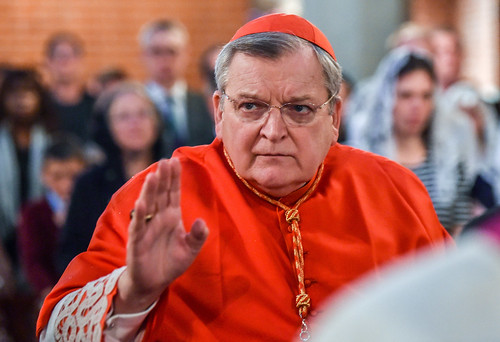
Cardinal Raymond Burke in London, celebrating Mass for the
Latin Mass Society in Corpus Christi, Maiden Lane 2019 (photograph by John Aron).

Cross-posted from Rorate Caeli.

In the Pillar, JD Flynn criticises ‘the siren voices calling for disobedience, or casting into doubt the authority of the Vicar of Christ’. He has earlier quoted Cardinal Raymond Burke, Bishop Athanasius Schneider, and Bishop Robertus Mutsaerts, but he leaves it to his readers to connect what he quotes them as saying with ‘calls for disobedience’ and ‘casting into doubt the authority of the Vicar of Christ’. This seems on the face of it a serious injustice, and a failure to give these individuals the respect due to their office and indeed to every Catholic, who has a right to his good name: see Canon 220.

For readers such as myself to be expected to examine the quoted remarks and look for possible support of these serious allegations is ridiculous and an invitation to uncharity. Flynn does not even give us a clue which of the three is implicated in these two alleged offences. Indeed, it might even be that Flynn would, if challenged, refer us instead to the unnamed others he vaguely refers to in the course of the article. However, the insinuation remains, it is serious, and it should be withdrawn.

Tuesday, July 27, 2021

Latin Mass: no hysteria. A reply to David Gibson

Cross-posted on Rorate Caeli.

Update: since writing this Crisis Magazine has published a useful study on the recent growth of the Tradition Mass in the Unites States.
----------------------------------------

On a the website of Sapientia, which claims to be 'exploring Faith, Culture, and Society', a film-maker (yes) called David Gibson has written to debunk what he calls the 'hysteria' about Pope Francis' Apostolic Letter Traditionis Custodes.

Here is a brief response to his main points, which he lists as three 'misconceptions': 

First, the pope has not prohibited priests from saying Mass in Latin

Unlike under the other points, Gibson is unable to illustrate this with any quotations or links to people saying what he alleges supporters of the Traditional Mass are saying. Perhaps someone should point out to him that these Catholics are actually acutely aware of the difference between 'banning the Traditional Mass' and 'banning the Latin Novus Ordo': rather more sensitive than he is, in fact.

His debunking of what no-one is saying is backed up by an unintentionally amusing quotation:

“If you like the Latin Mass, you can keep the Latin Mass, because the Missal of Paul VI is the Latin Mass,” Adam Rasmussen, an adjunct professor of theology, wrote at the blog Where Peter Is

Monday, July 26, 2021

Traditionis Custodes: a disaster for interreligious dialogue and ecumenism

My latest on LifeSiteNews.

A key passage:

If [Fr Thomas] Reese [on NCR] is concerned about ecumenism and interreligious dialogue, then he is faced with a different kind of problem. Traditionis Custodes has set the Church’s relations with other religions back fifty years, and it is difficult to see how they will recover.

On interreligious dialogue, defined as discussions aimed at greater mutual understanding between the Church and non-Christian religions, the Apostolic Letter and the polemic being produced by Fr. Reese and others in its support is saying that a genuine engagement of the religious instinct is impossible through worship in a sacred language, using chant, complex ceremonies, elaborate vestments, and so on. That, as they say, is a point of view. But it is a point of view incompatible with taking seriously the search for God represented by Islam, Judaism, Hinduism, Buddhism, the Jain religion, Shamanic religions, and indeed practically any non-Christian religion you could mention. Sacred languages are found in all the major non-Christian religions — Hebrew, Sanskrit, and Classical Arabic most obviously — and sacred music, ritual, and clothing, in practically all of them.

How are Catholic interreligious dialoguers going to face their non-Christian friends the next time they meet? “It okay”, they might say. “It is only our own traditions which we fear and loath: We think yours are wonderful!” How credible is this going to be?


Support the Latin Mass Society