Saturday, October 08, 2011

Attacks on the 1969 Mass

I have just blogged about Dom Sebastian Moore OSB complaining about 'calix' being translated 'chalice'; in the background is the issue that the Roman Canon actually says 'praeclarum calicem' - 'precious chalice' - and the translation Fr Moore prefers simply ignored the 'precious' bit and use the most prosaic word possible to render 'calix'. It similarly ignored the 'holy and venerable hands' which, in the Roman Canon, comes next.

What is at the bottom of this is, as I have said, an attack on the Roman Canon itself: the most important liturgical prayer of the Latin Church. The text of the new Novus Ordo missal is not an immediate issue for me or the Latin Mass Society, but the Roman Canon certainly is.

Fr Andrew Cameron-Mowat SJ is pulling the same trick, and it is clear this time. He likes the old translation of

'Domine non sum dignus ut intres sub tectum meum, sed tanto dic verbo et sanabitur anima mea'

simply as

'Lord I am not worthy to receive you, but only say the word and I shall be healed.'

The new translation says

'Lord I am not worthy to receive you under my roof, but only say the word and my soul shall be healed.'

His arguments evade the fact that the words 'under my roof' are simply a translation of the Latin words 'sub tectum meum'. Leave aside, for a moment, the issue of whether we want a more explicit reference to Matthew 8:8, or if that is too complicated, or indeed whether the faithful are too stupid to understand difficult words like 'soul'. The question is: do you want a translation of the Mass at all? The 1973 text simply does not translate the words 'sub tectum meum'. As a translation, it is a failure.

With that in mind, we come back to Cameron-Mowatt's arguments. These aren't arguments about felicity or fidelity of translation. They are arguments that this ancient Mass text (as Cameron-Mowatt observes, this particular Latin text is unchanged from the 1962 Missal) was liturgically defective, and that the 1973 translation was an improvement, not in style but in substance. It is interesting to see that he says that the text may have been appropriate in the context of a liturgical practice in which the faithful received communion only infrequently, so it would not have been defective in 1570, but was in 1970. (His argument as to why that is does not seem very clear to me, but let it pass.)

Obviously the 1969 Mass text, what was called the 'Missa Normativa' at the time, in Latin, was reformed in the context of the modern practice of frequent communion, and retained the full version of this particular text, including 'sub tectum meum'. Fr Cameron-Mowatt thinks that this was a mistake.

From time to time traditionalists are asked: do you attack the 1969 Mass? Do you accept its theological merits? Speaking for myself, and as a matter of LMS policy, the answer is: our concern is to do as the Holy Father has requested, which is to give a place of honour in the Church to the 'riches' represented by the Church's ancient liturgical tradition, not to engage in polemics about the reformed Missal. But here is someone, Fr Cameron-Mowatt SJ, who really is attacking the theological aptness of the Missa Normativa, and doing so from a liberal direction. Less explicitly, Fr Sebastian Moore is doing the same thing, and so are a whole gang of liturgists on the 'Pray Tell' blog and elsewhere, who are kicking up a stink about the new translation. In their view, clearly, Bugnini and his collaborators who put together the Latin text of the Novus Ordo got it badly wrong.

They were wrong to include the phrase 'pro multis'; they were wrong to include 'praeclarem calicem' (and maybe even the whole Roman Canon, as an option); they were wrong to include 'sub tectum meum' and to use the word 'anima' (soul); and so on in case after case. They were wrong in precisely those cases, I suppose, that they retained elements of previous editions of the Roman Missal in the new one. Insofar as there was continuity, there was error.

I begin to feel sorry for Archbishop Bugnini. Who is going to speak up for him, I wonder? But the bigger picture is that these liturgists are attacking the entire liturgical tradition of the Latin Church, even as represented by the post-conciliar editions of the Roman Missal. This is a fact which should be exposed.

(Pictures: Christ hearing the petition of the Centurion to heal his servant, by Veronese; Archbishop Annibale Buggnini.)

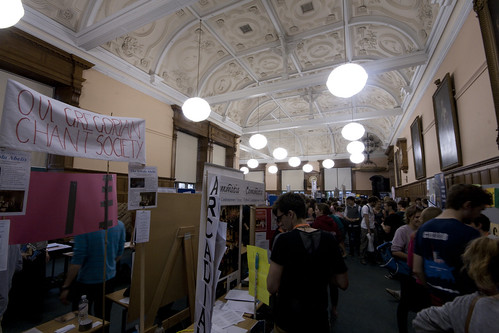
Schola Abelis at Freshers' Fair

We have finished Freshers' Fair and are now auditioning prospective singers. Please pray for a successful year for the Schola Abelis, the OU Gregorian Chant Society!

IMG_0168

Friday, October 07, 2011

Is the Roman Canon vulgar?

This is a question posed, by implication, by Dom Sebastian Moore OSB, in a letter published in The Tablet last weekend (1st October).

The substitution of the word “chalice” for “cup” in the Eucharistic Prayer has already been noted. The unconscious vulgarity of this change, at the most dramatic moment in the whole liturgy, is horrifying, as though the dignity of the word “cup” were not upheld by the hands that held it and passed it round, and to “improve” on this is to make of another good word a genteelism which betrays the mentality of the translator – and three times! It confirms all that we now know, thanks to The Tablet’s preparatory articles, about the process whereby this translation was arrived at.

(Dom) Sebastian Moore OSB
Downside Abbey, Somerset


(That's his photo, from his blog.) They have published my reply:

Dom Sebastian Moore repeats yet again in your letters pages (1st October) the suggestion that the use of the word 'chalice' in the new translation of the Missal is wrong. It would be astonishing if he or anyone could seriously claim that 'he took the cup' is an accurate translation of 'accipens et hunc praeclarum calicem in sanctas ac venerabiles manus suas'. If the authors of the Roman Canon had wished to avoid what Fr Moore regards as 'vulgar' they would certainly not have used such flowery language, and substituted a more prosaic word like 'poculum' ('cup') for 'calix'.

It is clear that Fr Moore and your other correspondents are not objecting to the new translation at all, but to the Latin original. This has been used continuously by the Roman church since the time of Pope St Gelasius I, who died in the year 496. Alas, I think the consultation period may have closed.

Yours faithfully,

Joseph Shaw

Chairman, The Latin Mass Society

It makes no sense to suggest that the elevated language of the new missal translation is wrong but the even more elevated language of the original Latin is ok. As well as its frequent doubled adjectives ('holy and venerable') and other poetic tricks the Latin makes free use, for example, of archaism, which has not been allowed in the translation, exotic foreign words, and words only ever used in the context of Christian Latin. If the new translation is vulgar, the Roman canon must be utterly bourgeois.

The idea that only 'nobly simple' things avoid vulgarity, which rejects with disgust not only the Roccoco but the Gothic, which prefers the monotone to the melisma, is thankfully a fad passing away with Fr Moore's generation. It is small minded, petty, and parochial. What person of taste can tolerate only one style, and one, indeed, of only a handful of artists working in only a few decades corresponding to the formative period of their own lives?

Fr Moore's generation had their fun razing irreplaceable altars and dynamiting exquisite churches which they were incapable of understanding. He should allow the painful work of restoration go on without further interference.

Wednesday, October 05, 2011

Mgr Pozzo on the importance of the 'Old Rite'

Ht Fr Tim

Full transcript (in English translation) of the interview Mgr Pozzo has given here.

"Because the ancient rite of the Mass makes explicit and highlights certain values and certain fundamental aspects of the liturgy that deserve to be maintained, and I am not speaking only about the Latin or Gregorian chant, I am speaking about the sense of mystery, of the sacred, the sense of the Mass as a sacrifice, the real and substantial presence of Christ in the Eucharist and the fact that there are great moments of interior recollection, interior participation in the divine liturgy. All these are fundamental elements which are particularly highlighted in the ancient rite of the Mass. I am not saying that these elements do not exist in the Mass of Paul VI's reform, but I am saying that they are highlighted much more and this can enrich even those who celebrate or participate in the ordinary form of the Mass."


Fr Tim notes in parenthesis:
(The expression in the first sentence is "la Messa nel rito antico" - "Mass in the old rite" would be simplest literal English translation. This expression, used by the Secretary of Ecclesia Dei, has also been used by Pope Benedict. It is not a naughty expression.)

Sunday, October 02, 2011

Letter of the week, from the Catholic Herald

There are some good letters in the Catholic Herald this weekend; this one I thought worth re-typing to make it available to a wider audience. The Editors have given it the title: 'I am a tortured liberal but I am hoping for more Latin in the liturgy.'

Sir,

I write as a "tortured liberal" Catholic ("progressive" on most of the predictable issues). Yet I recently found myself joining both the Latin Mass Society (LMS) and the Association for Latin Liturgy (ALL), in exasperation at our bishops' response earlier this year to Universae Ecclesiae, following that made to Summorum Pontificum in 2007.

Apparently, current provision of the Extraordinary Form (EF) needs no expansion and curriculum pressure in seminaries precludes accommodating the requested formation in Latin and the EF. Is this really the "generous" welcome these documents ask of our hierarchy?

I have concluded that it is only by supporting organisations such as the LMS and the ALL that the Holy Father's explicit wish to restore and extend the use of Latin in the liturgy has any hope of making progress. These bodies' EF and Ordinary Form Masses, other services, with the courses in chant, formation for priests, servers and faithful in the Mass and the Latin language, all seem to chime with the current liturgical renewal and reinforcement of Catholic identity agenda. Indeed, one might expect our dioceses to be undertaking such initiatives.

I recently attended two EF Masses at St James's, Spanish Place, after an absence of nine or 10 months. I estimate that the congregation had doubled in that time, comprising a wide range of age, class and ethnicity: someone is clearly doing something right here.

The Tablet's coverage of World Youth Day in Madrid noted that the Pope celebrated most or all of his Masses in Latin, but that his youthful congregations were largely unable to deliver their responses. His Holiness seems to expect young Catholics to cope with the liturgy in Latin, so I wonder what strategies the Hierarchy has in mind to enable them to do so.

At the time of Summorum Pontificum Pope Benedict expressed the hope that the two forms of the Roman Rite would come to "learn from each other". I would like to know how it is planned to take this cross-fertilisation process forward in England and Wales.

The English and Welsh bishops have a stated view (from 1966) on the position of Latin in the post-conciliar Church: "Every encouragement should be given to reciting or saying the Ordinary of the Mass in Latin ... definite steps must be taken to see that knowledge of the Latin Mass is not lost... The use of Latin will be encouraged in the new Mass as it has been in the old; Latin expresses the nature of the Church as international and timeless."

How do our current bishops prosecute this agenda?

Peter Mahoney

Saturday, October 01, 2011

Rosary Crusade of Reparation, October 8th

“You have seen Hell where the Souls of poor sinners go. To save them, God wishes to establish in the World Devotion to my Immaculate Heart. If what I say is done, many Souls will be saved and there will be peace.” Our Lady’s Words to Lucia 13th July 1917

The 27th Annual National Rosary Crusade of Reparation
Saturday 8th October 2011
Assemble by 1.45 pm outside Westminster Cathedral (Ambrosden Avenue)
Nearest Underground: Victoria
Procession to Brompton Oratory, Brompton Road, London, SW7
Nearest Underground : South Kensington

Led by:
The Rt. Revd. Monsignor
Keith Newton

Protonotary Apostolic
and Ordinary of
The Ordinariate of
Our Lady of Walsingham

Procession with the statue of Our Lady of Fatima to Brompton Oratory praying the Rosary en-route

Consecration to the Sorrowful and Immaculate Heart of Mary

Scapular Enrolment

Solemn Benediction

End about 5.00 pm (Anticipated Mass of Sunday at 6.00 pm)

Spiritual Director: the Revd. Ronald Creighton-Jobe, Cong. Orat.

For Information Contact:
Francis Carey (01494) 729223 — Mathias Menezes (020) 8764 0262 or 07950 384515

or by post: 27 First Avenue, Amersham, Bucks., HP7 9BL

Web: www.rosarycrusadeofreparation.blogspot.com

Public Procession of Reparation for Sins Committed Against The Immaculate Heart

Friday, September 30, 2011

Our Lady of Walsingham and the doves

I am catching up with the blogs (having been away from proper internet access for a while) and I don't want to let this post by the Reluctant Sinner to pass without comment, since it relates to Walsingham, to which I've been on pilgrimage recently myself.

It seems that, in a remarkable parallel to events surrounding the crowning of the shrine image of Our Lady of Fatima in Portugal, when the shrine image of Our Lady of Walsingham was crowned in 1954 two white doves settled on the statue and remained perched there for its journey from the site of the Holy House and Abbey in Walsingham to its permanent home in the Slipper Chapel. It was captured by Pathe News on film.

This is not a very big miracle; we might call it a consolation. If we take it seriously at all it is a mark of divine favour, certainly not one of dogmatic authority but there it is, for each person to judge as he sees fit. I think it is interesting not only as an endorsement of the restored cultus and shrine of Our Lady of Walsingham but in connection with the coronation of the statue itself, undertaken by special mandate of the Holy Father, Pope Pius XII, on the Marian Year he had declared. The involvement of Popes and of our own bishops in approving, commending, and honouring shrines is something of great importance; it is not an irrelevant rigmarole. We don't make our own religion, it is in union with our bishops and the Pope and in continuity with past generations.

Other officially crowned statues of Our Lady I have seen include the statue of Our Lady of Consolation at West Grinstead in Sussex, which I think was the first such statue in England, Our Lady of Caversham outside Reading and of Our Lady of Willesden in London. There are Latin Mass Society pilgrimages to each of these; the one to Willesden is coming up (29th October). It would be good to see a list of officially approved shrines in the Catholic Directory; there seems to be no published list of them.