Saturday, August 09, 2014

LMS Pilgrimage to the Wirral

IMG_9605

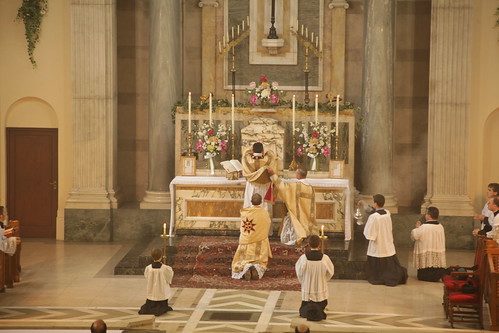
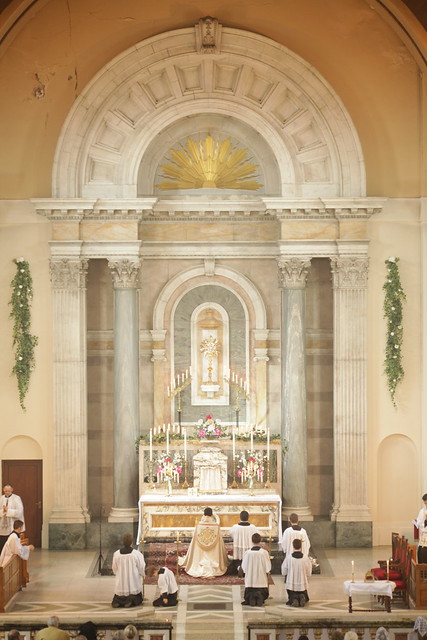
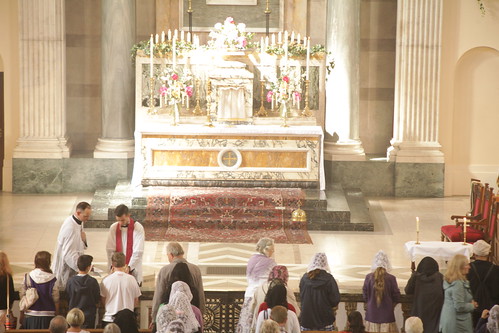
Last Saturday the Latin Mass Society held its first pilgrimage to the Shrine Church of SS Peter & Paul & Philomena. We had a truly splendid Mass in this splendid church: high Mass with polyphony, with the help of singers and servers from the St Catherine's Trust Summer School, followed by a spiritual talk from Canon Montjean, the Shrine Custodian, a tour of the church, Benediction with their famous monstrance, and veneration of their relic of St Philomena.

IMG_9647

The celebrant at Mass was Canon Thermed; he was assisted by Fr Simon Henry, from the Diocese of Liverpool over the Mersey, as deacon, and the Rev Mr Alex Stewart, a seminarian with the Fraternity of St Peter, who comes from the area, as subdeacon. Canon Amaury Montjean was in choir.

IMG_9653

The monster monstrance being raised into position by its special lift, two above, and on its throne, above. Below, we are venerating the relic of St Philomena. If this causes the modernists a burst blood vessel, so much the better.

IMG_9683

Support the work of the LMS by becoming an 'Anniversary Supporter'.

Friday, August 08, 2014

Summer School 2014: report

IMG_9537

We had a brilliant Summer School this year, organised by the St Catherine's Trust: a week with 30 children and nine staff, with classes, activities, a quiz, a play, and trips to local places of interest, including SS Peter & Paul and St Philomena in the Wirral, which I'll blog about separately.

  IMG_9410

We had High Mass nearly every day, thanks to the presence on site of Fr John Hunwicke and Fr Richard Bailey, were were directing the Latin Course which runs in parallel with the School. We also had Br Stephen Morrison on the staff of the Summer School: this is his diaconal year, and he's deacon in the picture above. The subdeacon is a member of the Oratorian community in Birmingham, who was on the Latin Course.

IMG_9472

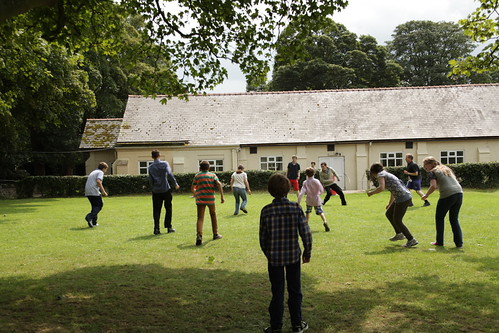
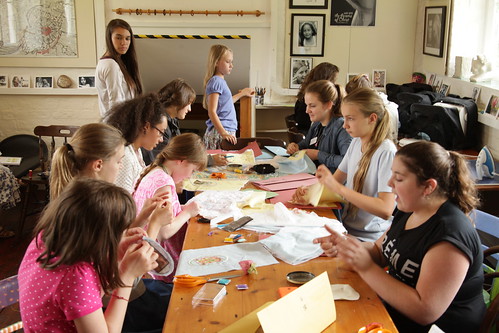
The Summer School is a huge amount of fun. Numbers have gone up and down over the years, but this year we had thirty children, more than the last two years. What is really important, however, is the effect on the students: over a week we aim to create a Catholic community, united in our studies, which range from the obvious catechetical stuff to history, philosophy, Latin, and history, in our recreation, such as the football above, in our artistic endeavours, including the always popular sewing, and the production of a radio play, and of course in our worship.

IMG_9465

As well as daily Mass, always sung, we have sung Compline each evening and Rosary in the morning.

The Franciscan Retreat Centre at Pantasaph is a great venue. The chapel in by A.W. Pugin. The Friars are very friendly and helpful. And above all it has a Catholic atmosphere. I write that with some feeling having had many Summer Schools in non-Catholic venues; coming to Pantasaph has been a huge boon.

IMG_9552

The equivalent dates next year will be Sunday 26th July 2015 to Sunday 2nd August 2015. Thanks to the generosity of our benefactors, including the Latin Mass Society, we do not charge a fee. If you have or know of Catholic children who could benefit from this unique experience, don't let them miss out. Make a note of the dates now!

Support the work of the LMS by becoming an 'Anniversary Supporter'.

Thursday, August 07, 2014

Does Islam need the Enlightenment?


IMG_9206
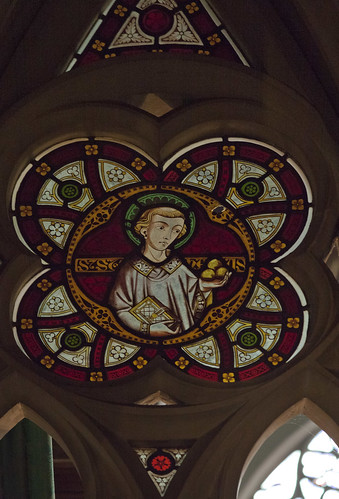
St Stephen
It is natural to progressives in the West to say that the problem with Islam is not that it is a false religion based on a fraudulent revelation - the distinction between a true and a false religion is impossible for them to make - but that it is simply 'backward'. It needs to go through the process which Christianity went through to make Christianity harmless. That, at any rate, is the view taken by the subeditor on the UCANews site.

Fr Michael Kelly SJ, the head of UCANews.com, is given the hopeful headline and subheading:

Waiting for an Islamic reformation
Will the Muslim world follow the same historical arc as the West?


Fr Kelly seems to get cold feet about this idea as soon as he starts to write. He concedes, first, that the Reformation (by which he and the headline writer mean not the Catholic Reformation but the Protestant Revolt) in Europe was not the end, but the start, of the dreadful wars of religion; second, that the later history of Europe hasn't exactly been a picnic; and third, that Islam had its own 'Reformation' with the split between the Sunnis and Shias, which created the potential for internecine carnage, just as the European one did.

But he wants to salvage something from the Whig view of increasing light and decreasing superstition and violence, so he comes up with this.

Islam had its reformation very soon after the prophet's death when the basic division between Shias and Sunnis occurred. But there has never been any equivalent of the Enlightenment, the French Revolution or the US Declaration of Independence that shaped what rationally operating Western political states inherited.
It is nice that he understands the French Revolution as the practical political manifestation of the Enlightenment. Was this, then, the start of a new era of peace and stability? An era in which

Europe and the US became civilized, started to develop and respect the rule of law and saw better ways of resolving disputes than killing opponents the hard way.
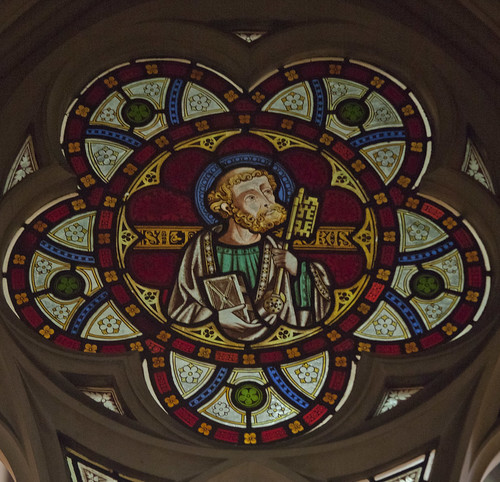
IMG_9207
St Peter
Or was it not, rather, the beginning of a bloodbath which engulfed the whole of Europe, and indeed many countries beyond, for a generation? Wikipedia estimates 3.5 million people died in the Napoleonic Wars, after perhaps 56,000 had died in the Terror and up to a quarter of a million in the War in the Vendee (here).

What do they teach in history lessons in those Jesuit seminaries?

It is indeed interesting to compare the effects of Enlightenment ideas with those of Catholicism, when it comes to living in harmony with others. The key idea of the former, in its revolutionary incarnation, was formulated by Jean-Jaques Rousseau. He thought that we could all be self-governing, by the simple expedient of agreeing heartily with the state's every law and policy, and wanting to do exactly what we were being told to do. He declared that political disagreement can never be legitimate, a matter of reasonable people taking different views; no, disagreement was always the result of people being irrational, ignorant, or selfish, and the role of the state is to 'force men to be free'. This is the basis not only of the French Revolution, but of the theory of re-education found in Communism, and still lurking beneath the surface in progressive thinking in the West today.

Rousseau's idea that there could be internal, as well as external, barriers to true freedom, is of course correct. Sinful habits often lead to self-destructive behaviour, and we can also agree with Rousseau that we should do what we can to help people trapped in a way of looking at the world which leads to harm for themselves and others. The problem is that the rejection of Original Sin by Rousseau and his followers makes the remedies extreme and vindictive. There is no compassion for the sinner: he must be bludgeoned into submission or exterminated. Furthermore, the Rousseauist expects to see a wonderful flowering of the human spirit when wrong-thinking is taken away, and becomes more and more desperate to find people to blame for spoiling things when this doesn't happen. If things aren't going well, it must be the fault of the libertycides of the Reign of Terror, of the saboteurs and counter-revolutionaries of Soviet Communism, or of the Jews in Nazi Germany. It can't be the fault of the progressives, the avant-garde, the Party, because by definition they have their thinking right.

The Church, on the other hand, does not expect to be able to convert everyone right away. Nor does she expect everyone to agree on complex practical questions, and does not find diversity of customs intolerable. When difficulties arise, she directs her children to consider their own sinfulness. Her compassion for the pagan and the sinner does not lead her to use coercion and extermination, for while the innocent must be protected from the criminal, the criminal's conversion is ultimately a work of the Holy Ghost. The reality of Original Sin forces Catholics to be realistic about creating paradises on earth, and humble about their own moral state. And as Fr Kelly hints, the Church as a supranational institution, can serve to promote peace between nations, as well as within them.
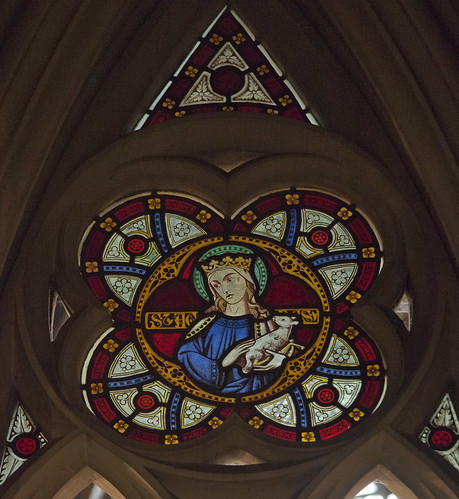
IMG_9208
St Agnes
The problem in the Middle East is not a religion which lacks the pacifying effects of the Enlightenment. Even less is it a problem of religion in and of itself. If they want to understand what is going on, progressives inside as well as outside the Church will have to start making distinctions between one religion and another.

Photos: roundels of stained glass from St Edmund's College, Ware.

Support the work of the LMS by becoming an 'Anniversary Supporter'.

Wednesday, August 06, 2014

Video on Mass 'ad orientem'

Following the FIUV Position Paper on Liturgical Orientation, some of the arguments are summarised in this short video produced by the Latin Mass Society.
Support the work of the LMS by becoming an 'Anniversary Supporter'.

Tuesday, August 05, 2014

LMS Walsingham Pilgrimage: reminder

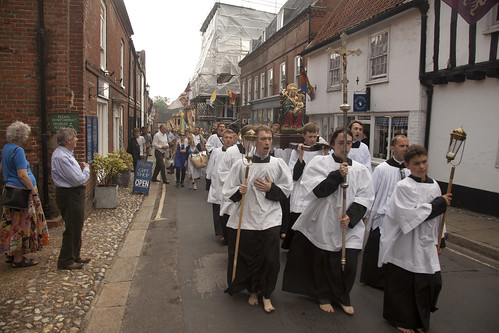
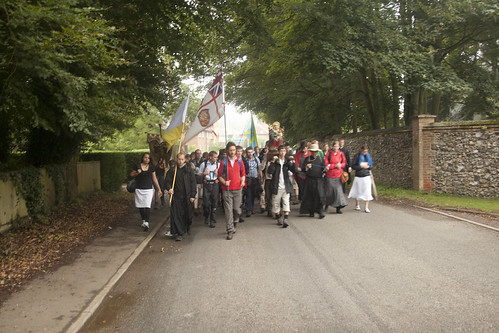
Booking is still open for the Ely to Walsingham walking pilgrimage organised by the Latin Mass Society. Don't leave it to the last minute!


Pope Francis, Evangelii gaudium: “Journeying together to shrines and taking part in other manifestations of popular piety, also by taking one’s children or inviting others, is in itself an evangelizing gesture”. Let us not stifle or presume to control this missionary power!
(Internal quotation from the Latin American Bishops' Aparecida Document)

  IMG_4476

The dates: pilgrims gather in Ely on the evening of Thursday 21st August, and walk Friday, Saturday, and Sunday (24th) morning, when we have a High Mass in the Shrine at 2pm. For those staying an extra night, there is another Mass, in the Slipper Chapel, on Monday morning.


The Pilgrimage is for the Conversion of England. And how England needs it!

Loads of photos of last year's pilgrimage can be seen here.

IMG_4339

Support the work of the LMS by becoming an 'Anniversary Supporter'.

Monday, August 04, 2014

Lace Making Course: this Sat in Oxford

Two day bobbin lace course

The Guild of St Clare has block booked a lace training course at The Fibreworks, Oxford
 on the 9th and 16th August, 10am to 2pm. Places are limited but we do have two spare at the time of writing! The Fibreworks' expert tutor, Liz Baker, will be introducing us to this intricate art, and we will use perle cottons to make a lace bookmark. The cost is £40 per person for both days. The Fibreworks is located on the Cowley Road, Oxford- details on where to park are here. Please email lucyashaw@gmail.com for more details or to book a place.


Support the work of the LMS by becoming an 'Anniversary Supporter'.

Saturday, August 02, 2014

LMS at the Dome of Home

Today we had a great pilgrimage to the shrine church of SS Peter & Paul & St Philomena, which is looked after by the Institute if Christ the King Sovereign Priest.


We came up from Pantasaph in North Wales with the St Catherine's Trust Summer School.


I'll blog properly later. But if you weren't there, you missed out! We had Solemn Mass, a splendid Benediction, and venerated a relic of St Philomena.


- Posted using BlogPress from my iPhone