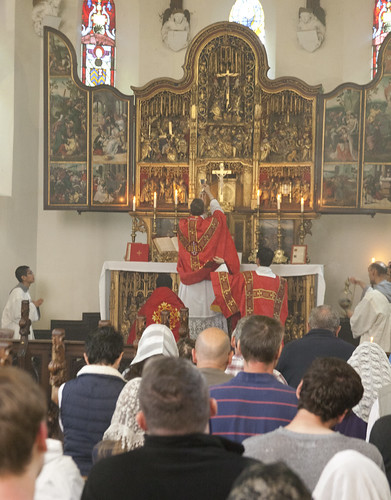
This is a very frightening time for faithful Catholics. As the teaching of the Church is questioned, we look for something to hold onto. But today's crisis is not about the denial of doctrinal formulas, so much as the evacuation of their meaning.
Pompous and boring as he is, Mgr Basil Loftus is an excellent illustration of the process. He avoids denying the classical formulations of the the truths of faith, but he evades their meaning. He creates a little structure of obfuscation which allows him to assert something in practice the opposite of the truth. Christ rose from the dead, but - says Loftus - he wasn't physically present after the resurrection, and the empty tomb is just distracting. Marriage is indissoluble, but a valid marriage can 'die'. Christ is in the Blessed Sacrament in some sense, but mercy requires us to hand out Communion like sweets, to everyone.
It isn't very convincing, but it doesn't need to be. The self-contradictory statements of today's liberals aren't the sort of thing which could sustain a living faith, or even the false faith of a false religion. That isn't what they are for. Their purpose is to allow people who did believe the truth to cease to do so with the minimum of heartache. That is the real danger, when these sorts of statements gain some kind of official recognition.
At the time of writing the precise outcome of the Synod is impossible to predict, but suppose it combined the annulment reforms we've already has with some of the ideas about 'mercy' vigorously floated by quite a few influential people, what would that mean? It would mean that the teaching of the Church that marriage was between one man and one woman, that the marriage between Christians was sacramental, and that it was indissoluble, would be proclaimed in some footnote or other to be unchanged. And yet for the sake of the marginalised, the victims, those unhappy people banging on the gates of mercy and justice, people will be able to write their own annulment decrees and, if they prefer not to do that, they will be able to remarry and receive Communion if they express (or can be taken to express) regret for past (if not present) sins. The Church's teaching will make no difference to the way we live. It will be as if it did not exist.
Observe the parallel. The teaching on the Real Presence, on Transubstantiation, has not been changed by the Church. But suppose we didn't hear about it in catechism classes or in sermons because that language is 'difficult', and suppose it were not reflected in the liturgy by any signs of reverence. What would happen? It is not that lots of people would adopt the incoherent position: that Christ is fully and substantially present in the Blessed Sacrament
but that we don't talk about it and shouldn't genuflect or think twice about picking it up in our fingers. No: the problem is that the ordinary Catholic in the pew will stop believing it altogether, while a bunch of 'conservative' Catholics will tell us that there is no problem, really there isn't, because the traditional formula has never been contradicted formally by the Church, and, gosh, looky here, there's a footnote in this long document on the Vatican website in Hungarian which implies it is still true.
The situation just described is alarmingly close to the reality we have been living through for the past 40 years. There are, in fact, still signs of reverence in the Novus Ordo, for those priests who observe the rubrics; there has even been something of a revival of popular interest in the Blessed Sacrament, for reasons which I won't go into here. The massive loss of faith in the Real Presence among even church-going Catholics, then, has come about as a result of an
only partial victory by the liberals. And so has the massive rate of divorce among Catholics.
A complete victory, at least for now, does not include an explicit repudiation of the traditional doctrinal formula, because the libereals want to keep with them the 'conservative' Catholics who will accept everything short of that. A complete victory, at least for now, means the complete eradication of the teaching's practical implications, without the denial of the formula. If we really believe in the indissolubly of marriage, it will naturally make a difference to the way we live. If it makes no difference, if it is prevented from making a difference, then, human nature being as it is, we will soon cease to believe it.
To return to the question of the title of this post, what are faithful Catholics presented with this situation, who want to remain faithful to the truth, to remain faithful
to? Repeating the classical formula of the doctrine will not be enough, because it will be (semi-)officially regarded as compatible with a life, a practice, which gives the lie to the classical forumula as classically understood.
Staying faithful means not just talking the talk, but walking the walk. It means avoiding the accusation made by the prophets of the Old Testament, and again by Our Lord, of the lukewarm: not that they deny God, oh no. Rather, as Our Lord says, quoting Isaiah (29:13):
This people honour me with the lips, but their heart is far away from me.
Populus hic labiis me honorat, cor autem eorum longe est a me. (Mat 15:8)
His first hearers would immediately remember remember the
next words of Isaiah:
they have feared me with the commandment and doctrines of men.
timuerunt me mandato hominum et doctrinis.
Are we going to follow the doctrines of men and honour God only with our lips?
This has implications for our private lives, but it must be more than that as well: our faith must be manifested publicly. As I've noted before on this blog, although the issue of marriage is supremely an issue for the laity, it is faithful priests and bishops who are going to be between the hammer and the anvil with the proposed new practices. Our faith as laity may find its public expression in our support for them.
Support the work of the LMS by becoming an '
Anniversary Supporter'.