 |
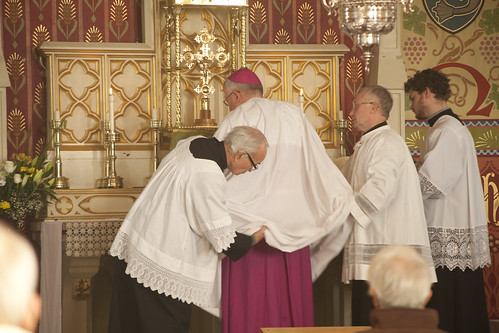
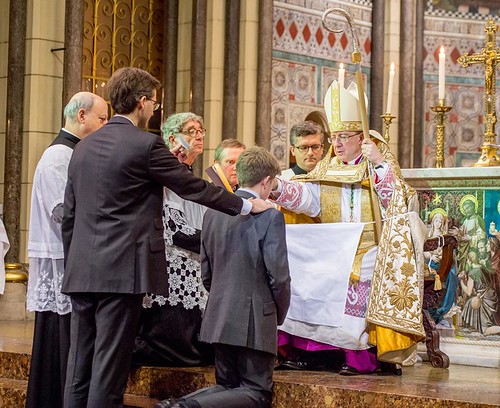
A young man being made a soldier of Christ, at the Traditional Confirmation ceremony
organised by the Latin Mass Society in London. |
The first post in this series is here.
The Church is enriched by all sorts of organisations and movements, many of them doing good work. I have just argued that in response to the current crisis Catholics of good will should rally to the banner of the Traditional Mass, and the movement which supports it. Why? What is wrong with all the other organisations and movements in the Church, and indeed one’s own geographical parish?
The advantages the Traditional movement has in the current crisis are both tactical and strategic; I shall give two examples of each. Consider the tactical ones first.
The recent history of the FFI and the Order of Malta illustrate two important tactical realities. One is that the Traditional Mass is a de facto rallying point for orthodoxy on a wide range of issues. (This has been the fear of opponents of the ancient Mass from the beginning.) The other is that internal divisions, including divisions about the liturgy, provide both an excuse and a point of leverage for attacks on an organisation (/ group / parish). It follows from these two undeniable facts that the Traditional movement has an obvious advantage. It is by definition united around this banner of orthodoxy.
Yes, it is possible for people not committed to orthodoxy to like the Traditional Mass, and yes, it may be—and has been—possible to find or foment divisions in an organisation theoretically committed to the Traditional Mass. I do not claim that particular elements of the Traditional movement are invulnerable. They are simply better off, in these respects: they are more united, and they are united, furthermore, around something with a strong connection with orthodoxy.
The second tactical advantage is that the Traditional movement is not dominated by any one organisation: the blogs, priestly Institutes, lay groups, periodicals and so forth all exist among a good number of others of their kind. The suppression of one or another would not be the same kind of disaster as is the suppression of the FFI or the Order of Malta, because resources and support can be transferred between them far more easily than between non-traddie conservative organisations. Traditional groups are not interchangeable, but the fact that they support the Traditional Mass is a decisive reason for nearly everyone who supports them, to support them, and these supporters are, normally, already very familiar and friendly with other Traditional Catholic groups and organisations, and would be highly likely to find another group to support instead, were their current favourite to disappear. The orthodox Catholics who support the Order of Malta (as with other worthy conservative bodies) do so for all sorts of complex reasons, and if the Order were, for practical purposes, to disappear, they would be scattered to the four winds. As a force for good the Order would be gone, and no similar organisations would be proportionally strengthened. This is not a criticism of the Order, but in the current crisis it is a disadvantage.
As noted in the last post, this fact means that, in fact, traditional groups are to this extent less likely to be suppressed, because they present somewhat less tempting targets. In the same way, no Traditional group has amassed huge resources which could be taken away from the movement as a whole by a strike on that one group. Their resources come from their supporters, and their supporters, if necessary, would go elsewhere within the movement.
Next, for the strategic reasons.
The first strategic reason is this. As the cases of the FFI and the Order of Malta illustrate, internal struggles over teaching and liturgy are endemic within conservative Catholic organisations, and within the broadly understood ‘conservative Catholic movement’, if we want to call it that. The tactical consequence, of offering an opening to the enemy, has already been noted. The strategic consequence is that this makes them a terrible front in the war in which to invest resources, not just because of this tactical vulnerability, but because so much of one’s efforts will be spent on internal, organisational conflict.
You might say: these internal battles need to be fought. Well, that is a judgement each person needs to make on the spot. The organisation at issue may be in a great position to make a valuable contribution to the struggle if only X, Y, and Z internal battles are won by the good guys, and that may be a realistic prospect. In my experience such prospects are never as rosy as one imagines. Nevertheless, if you really judge that to be so, good luck to you, but remember this: while this battle is going on, the efforts going into the internal battle are not going into the apostolate. They are not doing the work the organisation is supposed to be doing. In the meantime, you are helping to keep an organisation afloat which may be doing bad things as well as good ones. And finally, in my experience internal battles are disproportionately exhausting and demoralising, whereas work ad extra can be very rewarding and energising.
The second strategic reason is that the connection between orthodoxy and the Traditional Mass is not accidental: it is profound. The texts and ceremonies are beautiful expressions of the Faith, emphasising our need for penance and grace, acknowledging the role of Our Lady and the Angels and Saints, reiterating the message of the Gospel (not just the nice bits), and encouraging participants into the most profound, contemplative, engagement in the prayer of the Church.
There is more to it even than this, however. As I have written before, the ancient liturgical tradition is inseparably linked to the power and prestige of the Church’s past: of the Tradition. Attacks on the teaching of the Church have to deal with the fact that this teaching (if genuine) was upheld by the Fathers, Doctors, and Popes of the past. The success or failure of these attacks ultimately depends on whether Catholics today regard the past, the Tradition, as having real force. It is for this reason that the liberal attack on the teaching of the Church in the 1960s had to be preceded by an attack on the liturgy, because the ancient liturgy is, as we might call it, an efficacious sign of our continuity with our Catholic predecessors. It both symbolises it and makes it real. You cannot for long love the Fathers and Doctors and Popes of past centuries, and hate the liturgy which they celebrated, treat with contempt the words they used in addressing God, and claim that they were trapped in a liturgical form which excluded all real participation. They stand and fall together.
In a word, if we are serious about restoring to Catholics a lively orthodoxy, a real attachment to the teaching of the Church, then giving them the impression that it was all invented by Vatican II and Pope St John Paul II is a truly terrible idea. A real attachment to the teaching of the Church has to come from a sense of continuity in the Faith handed down from the Apostles. That sense is nurtured by the Traditional Mass. Promoting the Traditional Mass is not an optional extra in restoring orthodoxy. It is the fundamental means by which alone it can be achieved.
Support the work of the LMS by becoming an '
Anniversary Supporter'.