|
| Sunday shoes. |
I have just finished reading 'The Banished Heart' (2nd ed, 2010), by the idiosyncratic Australian academic, Geoffrey Hull, an interesting but, in my view, a flawed book. I hope to write a review of it somewhere. A side-issue is a footnote Hull wrote on p321, referring to the problem of noisy children and infants in church. I want to take violent exception to this, but I should emphasise that this is only a footnote, and hasn't determined my overall judgement of the book (and shouldn't determine anyone else's).
The background is that this chap likes going to the Traditional Mass. He's just written that at the Ordinary Form there can be a problem of children making a distracting noise during Mass. Cue a footnote: Note 2.
A true sign of the times, this problem is by no means restricted to the Novus Ordo. One of the many crosses Western Catholics must bear today is the ghettoization of the immemorial liturgy. Deprived of a normal psychological structure and ethos, Latin Mass centres fatally attract a lunatic fringe, including fanatical young couples of bohemian temperament and a robust sense of entitlement who are given to losing themselves in pious meditation at Mass while their offspring tyrannize the congregation with noise and fidgeting that is not occasional but constant. The simultaneous presence of responsible parents who charitably refrain from bringing babies to church services and whose older children are impeccably behaved in cold comfort, given that in any duel between silence and noise the latter is always the victor.
Does Hull have children of his own? No. (Silly question, perhaps.)
My sympathy for Hull's sensitivity to noisy youngsters disappeared rather abruptly when I read the words '
responsible parents ... charitably refrain from bringing babies to church.' Hull thinks it irresponsible and uncharitable to bring babies to church: the sensitivity, or lack of it, of parents to the noise their babies make, and their ways of dealing with it, are beside the point. Babies should not be there at all.
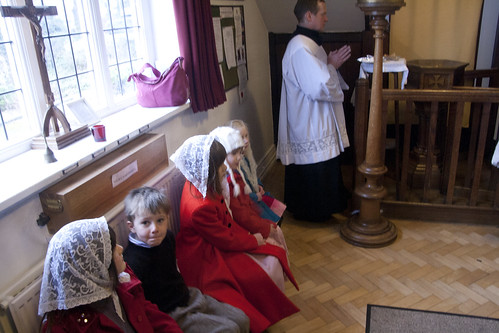 |
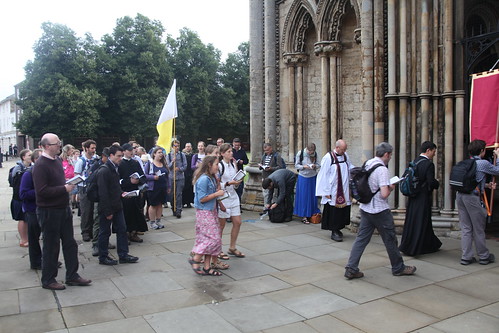
| Children at a traditional Baptism |
Adding to the sheer weirdness of his little rant about babies is that he apparently thinks that it only applies to the Latin Rite. Or did he just fail to put two and two together, when he included in a list of deplorable Latinisations to be noted in Eastern Catholic Churches, the fact that '
Ukrainians outside Europe no longer give Holy Communion to babies after their baptism' (p300).
Right. So Ukrainian Catholics not only may but should take their babies to church; Latin Rite Catholics who do the like are being irresponsible and uncharitable. Well - lead me to the nearest Ukrainian Catholic church!
What people like Hull need to get into their heads is that taking babies to Mass is not some self-indulgent habit like chewing gum or failing to recycle their tins which parents can be encouraged to break. Parents take their babies to Mass for one overwhelming reason, to which the rest of the discussion has to make way.
THEY. CAN'T. LEAVE. THEM. BEHIND.
Who is going to look after the babies, Dr Hull, if parents gaily go off to church without their under-5s? Does he imagine we all have nursery maids? (Who work on Sundays?) Bearing in mind that he is talking about the Traditional Mass, even a married couple who were prepared to go to different Masses to fulfil their Sunday obligation, which is itself problematic, would almost never be able to find two EF Masses near them at different times on a Sunday.
 |
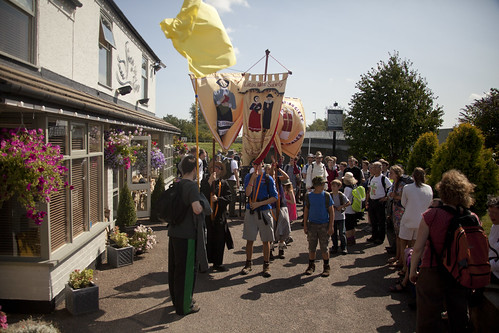
| And another one. |
And how does Dr Hull imagine that the 'impeccably behaved' older children he has observed got that way? The normal and reliable route to such good habits is their attending Mass frequently, with both their parents, from the very earliest age. Hull is deluding himself if he imagines you can take a 6-year-old who has never been into a church before to Mass, and expect him to know how to behave. You can't reap where you haven't sown.
I believe, in fact, that parents have an advantage in the Extraordinary Form in teaching their children to behave, and I was delighted to read this the other day, from a self-professed non-trad
who has started going to the Traditional Mass.
Besides which, my two-year-old was way better-behaved than he has been at the Novus Ordo, and I’m sure that’s because he picked up on the reverent and serious silence, rather than looking at a guy his grandfather’s age rocking out on a guitar and thinking “aw man, it’s party time up in here!”
The same goes for the parents themselves: whatever their previous experience and habits, parents who start going to the Traditional Mass are encouraged to take their crying or over-excited children outside, not by dirty looks from the likes of Dr Hull, or for that matter by hectoring by priests, but by the atmosphere generated by the liturgy itself. It is not just an empty phrase to say that 'the liturgy is a school of prayer'.
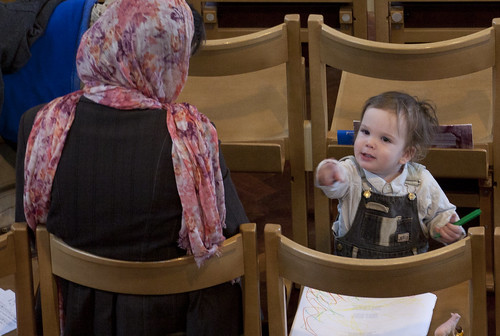 |
| I think he may have spotted Dad in the choir loft. |
A note to childless Mass-goers. First of all, it is a huge advantage if both parents are present; one can take a child outside while the other stays with the remaining children. Pity the parent with a small child, or children, in Mass on his or her own. Second, it is mistake to take a child out of Mass with too small a provocation, because taking him (/her) out (and trying to bring him back in) is itself somewhat disruptive, and the ultimate point is to teach the child to be quiet in Mass, and not to teach him that he'll be allowed outside to play if he makes any kind of noise. I'm afraid that, if you want the butterfly, to some extent you have to put up with the caterpillar.
Judging from my own experience, the level of noise generated by a family goes in waves over time according to the ages of the youngest children. Small babies are usually (not always) easy to deal with. It is when the start to crawl and walk that they become harder, they can't understand why they can't wander about at will. By the age of three or four you can get them at least to whisper their demands, complaints, and mutual recriminations to you. And then you can start explaining what is going on, get them to cross themselves, stand for the Gospel, look at the Elevation, and so on. But by then, of course, there may well be another newborn baby on the scene.
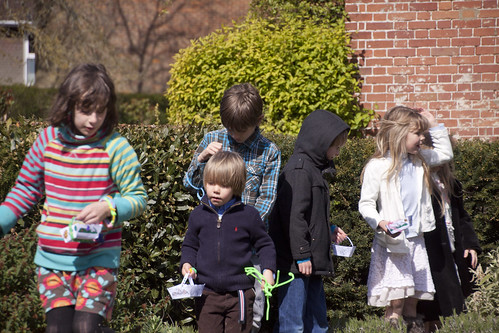 |
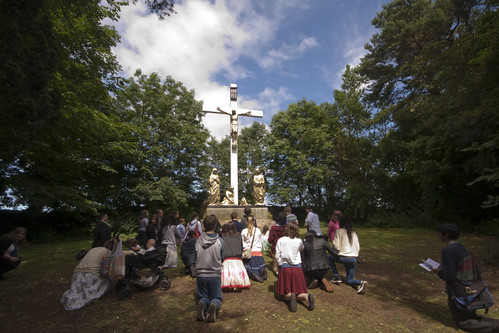
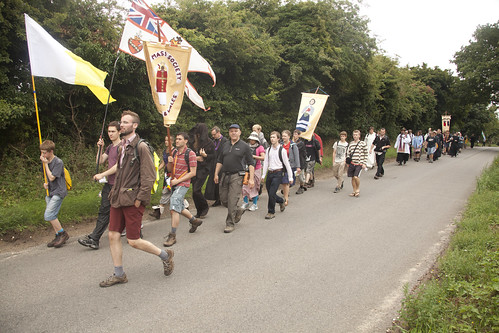
| Children at the Family Retreat. They all came to Mass too, obviously. |
And this is the reality of family life. You don't have to be 'fanatical' or 'bohemian' to be living with a child under five for a decade - three children spaced with 3-year gaps will do the trick. And over a decade, life has to go on. You have to go to Mass, and you have to do it as a family. You have to address the spiritual needs of the older children, which includes a liturgical catechesis. And you have to have a spiritual life of your own.
It is not a prison-sentence, it is a wonderful, hugely rewarding time. But while it is perfectly reasonable for other Mass-goers to expect you to do something about a child who is being seriously disruptive, parents equally deserve understanding and support, while they train their children how to behave in church. You can drive them out of Mass, Dr Hull, but only if you want to be a member of the last generation of Catholics.
Finally, here is a description of how a Catholic family deals with a small child from one of my favourite authors,
Fr Bryan Houghton. The narrator of the book is a cradle Catholic; Houghton himself was a convert, so it is not his own experience he is talking about, but what he had observed as a priest in the pre-Conciliar period, of the way small children were dealt with in Mass.
I learnt to say my prayers at my mother's knee -- and I still say the same ones each night. But I learned to pray when I was dragged off to Mass on Sundays. Something was altered with Mummy and Daddy. They did not talk to each other or even look at each other. Mummy usually fiddled with a Rosary. Daddy thumbed intermittently a Garden of the Soul which one of my nephews still uses. My eldest sister, Gertrude, who became a Benedictine nun, knelt bold upright with her eyes usually shut. As I looked around it was the same with all our other relatives and neighbours. What was most unusual was that nobody paid the slightest attention to me. Even if I pulled Mummy's skirt, she just gently pushed me away. I once tried to climb on Daddy's back; he lifted me off and put me under the seat. That, too, was strange: although I was in my Sunday best, I was allowed to crawl about the floor provided I did not make a noise. Funny little boy that I was, I realized perfectly well that something was up.
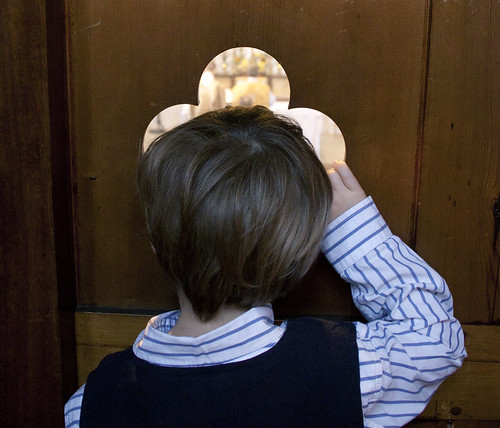 |
| Looking at the action of the Mass from the Choir Loft |
Over there at the altar was Father Gray, a stern old man. I used to hide in the lavatory when he came to visit us. He was dressed in brightly coloured clothes and looked like a fat butterfly. Most of the time he said nothing. He was looking the other way and paid as little attention to Mummy and Daddy as they paid to me.
I do not think I was a particularly precocious child but I was certainly very young when I tumbled to the fact that all these people were praying without saying prayers, as I did. Children are imitative: I too wanted to pray without saying prayers. I opened up to my sister Gertrude. "Just sit quite still, like a good boy," she said. "You are too small to kneel. Keep your hands still as well, on your thighs. Try not to look round and keep your eyes shut if you can. Then just say 'Jesus' under your breath, slowly but constantly. I'll prod you when you say 'Thou art my Lord and my God' and you can say it with me."
That, mutatis mutandis, is I suppose how we all learned to pray. The point I am getting at is that the Mass itself was our school of prayer. It was there that we learned to be self-effacing, detached, recollected and to adhere to the Divine Presence. It was also as Mass that the simple faithful practise prayer throughout their lives. They may have known little theology but they prayed as theologians often do not. Moreover, the simplest of them attained to heights of prayer and sanctity far beyond me.
Mitre and Crook (1979) pp168-9
Update: It is interesting to read of the participation of children in the liturgy of the Old Testament: thus. We frequently see references to 'everyone', and 'from the least to the greatest'; it is not immediately clear if this included small children. But the Chronicler makes it unambiguous:
2 Chron 20:13: 'And all Judah stood before the LORD, with their little ones, their wives, and their children.'
'Omnis vero Iuda stabat coram Domino, cum parvulis et uxoribus et liberis suis.'