Saturday, January 11, 2014

Transferred Holy Days, 3: the obligation

IMG_6065
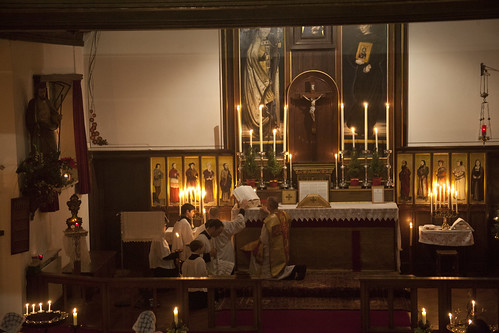
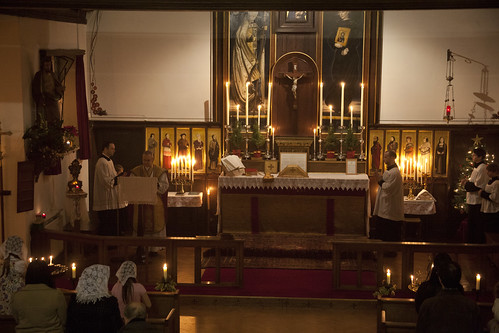
The celebrant at Epiphany solemnly proclaiming the dates of the movable feasts of the year. 
One of the arguments made in the Position Paper on Holy Days published by the Una Voce Federation is that having a formal precept, an obligation to attend Mass, makes it easier for people to attend Mass.

It is simple, really. If it is impossibly difficult, for any reason, to get to Mass on a day of precept, you don't commit a sin if you don't go. It is not an obligation which causes anyone a real problem. On the other hand, the precept is useful not only in establishing good habits and stimulating our devotion, but in dealing with those in authority over us. Employers, school and college superiors, prison governors, and all kinds of state entities will, very naturally, take a request to make some kind of provision to allow a Catholic to attend Mass on a particular day more seriously if the Catholic says that it is a matter of religious obligation, and not just a matter of personal preference.

Sometimes employers, those organising school timetables, and the rest will find it impossibly difficult to allow Catholics to go to Church on a particular day. That's life: no one is going to hell for that reason. But when there is something which can be done to make it possible, which is, say, mildly inconvenient, they will do it if it is important for the Catholic, and not if it is not important. I'm simply assuming these individuals are reasonable human beings. How are they going to judge what it is important, and what isn't? The best thing to show them is a list of Days of Obligation issued by the officially recognised religious authorities for one's faith, in this case the Bishops of England and Wales.

It is not, however, just a matter of being reasonable. The law has something to say about this as well. In the European Convention on Human Rights, Article 9 reads as follows:
1. Everyone has the right to freedom of thought, conscience and religion; this right includes freedom to change his religion or belief and freedom, either alone or in community with others and in public or private, to manifest his religion or belief, in worship, teaching, practice and observance.
2. Freedom to manifest one’s religion or beliefs shall be subject only to such limitations as are prescribed by law and are necessary in a democratic society in the interests of  public safety, for the protection of public order, health or morals, or for the protection of the rights and freedoms of others.

This applies not only to government bodies but private persons, such as employers. In applying this article, courts distinguish obligatory and non-obligatory ‘manifestations’ of a religion.

Thus, the English Courts have ruled that Sikhs have the right to wear the ‘Kara’, a bracelet,[1] and female Muslims a Hijab,[2] at school. In the latter case the Courts ruled explicitly that the Hijab can be considered as a ‘requirement’ of the Muslim faith. By contrast, a Christian who wished to wear a cross with her uniform lost her case against her employer,[3] although this was later overturned by the European Court of Human Rights (in September 2012). The English Courts based their decision, in part, on the fact that ‘there is no mandatory requirement of the Christian Faith that a Christian should wear a Crucifix.’[4]  Again, in finding against a Marriage Registrar who refused to register same sex Civil Partnerships, the Court of Appeal based its decision in part on their finding that ‘her view of marriage, ...was not a core part of her religion.’[5] Though the factual basis of these findings can be questioned, the fact remains that Courts do take into account whether any particular practice of religion is a ‘requirement’ of the religion or is merely a personal religious practice.

To summarise, in removing religious obligations from Catholics, the bishops are not making our lives as Catholics easier. Those obligations never bound to the point of making life seriously difficult. No, the bishops are making our lives harder: it makes it harder for us to live the devotional life we want to.


[1] The dispute between a Sikh schoolgirl, Sarika Singh, and Aberdare Girls’ School in South Wales: Watkins-Singh, R (on the application of) v Aberdare Girls’ High School & An or [2008] EWHC 1865(Admin) (29 July 2008)
[2] Begum v Denbigh High School [2006] UKHL 15
[3] Nadia Eweida, who was sacked by British Airways for wearing a cross on her uniform in 2006, lost her Employment Tribunal and subsequent Appeal case, where she alleged Religious Discrimination and breach of Human Rights: Eweida v British Airways Plc [2010] EWCA Civ 80 (12 February 2010). This was overturned by the European Count of Human Rights in Eweida and Others v. The United Kingdom - HEJUD [2013] ECHR 37 (15 January 2013).
[4] Chaplin v Devon & Exeter NHS Trust, ET Case No: 1702886/2009, and Eweida v British Airways [2010] EWCA Civ 80
[5] Ladele v London Borough of Islington [2009] EWCA Civ 1357

IMG_6071

Friday, January 10, 2014

Transferred Holy Days, 2: the dates

IMG_6063

 The dates of the Church's major feast days are in no way random. They have deep historical and cultural roots, and immense theological significance. The Church uses the calendar to teach us things, and the means she employs include the intervals between feast days.

Thus, most obviously, the Ascension is 40 days after Easter. 40 is the time of waiting we find in the Old and New Testament. Moving the feast of the Ascension not only obscures this, but mucks up the interval between the Ascension and Pentecost: nine days, a novena of preparation for the Holy Spirit to descend.

Corpus Christi is on a Thursday after Easter because it recalls the mystery of Maundy Thursday. The symbolism is destroyed if it is moved to Sunday.

Epiphany is the Twelfth Day of Christmas: it can't be moved without damage to all the cultural associations this has. It is the primary feast of Christmas for many Oriental Churches. It was celebrated on 6th of January by the Emperor Julian in the year 360. This is pretty well as far as detailed records go back for many aspects of the liturgy. To move it is surely an act of barbarism.

SS Peter and Paul, 29th June, which gets shunted to Sunday if it falls on Saturdays and Mondays, is not only extremely ancient but it a vital link with the Orthodox. Bl Pope John Paul II used to celebrate it with the Ecumenical Patriarch.

All Saints suffers the same fate despite the fact that it is inseparably related to Halloween before it and All Souls after it.

Perhaps we should be grateful that the other Holy Days of Obligation listed in the Code of Canon Law are not days of precept in England and Wales, so we can at least celebrate them on the days the universal Church has established for them.

The Octave Day of Christmas, 1st Jan: it would obviously be absurd to celebrate the Octave on a day other than the Octave, the eighth day. It would equally be absurd to move it away from a public holiday. In Catholic countries, feasts important in the nation's spirituality are frequently public holidays. Here we have a tailor-made public holiday, and it is still too much to suggest we go to Church to celebrate the feast, whether we call it the Circumcision or the Feast of Our Lady Mother of God.

The Immaculate Conception, 8th December, is exactly nine calendar months before the Feast of the Birthday of Mary, 8th September. How cool is that? The feast also represents an English contribution to the development of the calendar; it spread to the Continent from England (and other places) in the 12th century. It was called the 'Conception of Mary' until the dogma was defined in 1854.

The Assumption, 15th August, has been celebrated on that day since 7th century, and is a public holiday in Catholic countries around the world.

The Feast of St Joseph (Spouse of the Blessed Virgin Mary), 19th March, is seven days before the Feast of the Annunciation ('Lady Day') on 25th March.

In all these cases, of courses, these are the dates the Holy Father celebrates the feasts in the Vatican. Is it really too much to ask that Latin Rite Catholics in England be allowed to celebrate the most important feasts of the calendar in union with the Pope?

On the business of moving feasts from Saturdays and Mondays, it would surely be better, if the Bishops honestly think we are too feeble to attend Mass two days in a row, to remove the precept without moving the celebration of the feast itself, so those who want to and are able can attend Mass on the traditional day, and the sequence of Sundays is not disrupted unnecessarily. This is what they do in the United States, for example.

However, as I shall argue tomorrow, the precept itself is important.

IMG_6064
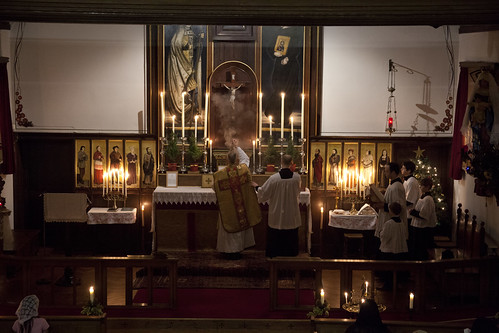
All kneel at the point in the Gospel of the Epiphany where the Magi kneel to the Christ child.

Thursday, January 09, 2014

Transferred Holy Days: 1st of a short series

IMG_6050
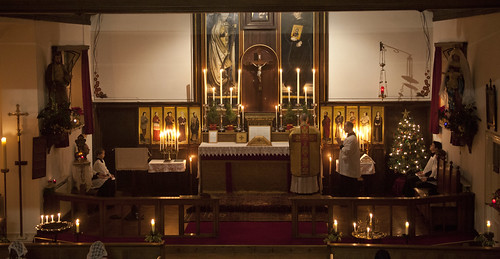
Mass of the Epiphany in SS Gregory & Augustine's, Oxford

Back in 2006 (remember that? seems an age ago) the bishops of England and Wales moved the celebration of the feasts of the Epiphany, Ascension, and Corpus Christi to Sunday. That leaves only SS Peter and Paul, the Assumption, All Saints, and Christmas Day, as non-Sunday Holy Days of Obligation in England and Wales.

Corpus Christi and the Ascension traditionally fall on Thursdays: Corpus Christi because it recalls Maundy Thursday, and the Ascension because it is 40 days after Easter Sunday (take note, Mgr Basil Loftus, it didn't happen on the same day). All the other days are on fixed dates, and can fall on any day of the week. Under the rules in England and Wales, if they fall on Saturday or Monday they are, again, moved to Sunday, with the sole exception of Christmas. This means that in some years Days of Precept all but disappear.

For example:
In 2009 SS Peter & Paul (29th June) fell on a Monday;
the Assumption (15th August) fell on a Saturday,
the feast of All Saints (1st November) fell on a Sunday.
The only day one needed to go to church apart from Sundays was Christmas Day.

In 2014 SS Peter & Paul (29th June) will fall on a Sunday and All Saints on a Saturday, leaving only the Assumption alongside Christmas as Days of Obligation.

The result is that the very concept of a Holy Day of Obligation, a 'Day of Precept', other than Sunday, has become as unfamiliar to many Catholics as days on which you can gain a plenary indulgence.

It is fair to say that this decision by the bishops has been the most unpopular that I can remember. It has been pointed out that the Days of Precept in the week were a unique opportunity for the celebration of the mysteries they mark in Catholic schools, where many of the pupils of course do not attend Mass on Sundays, even if nominally Catholic. Again, the moving of these feasts from their traditional days not only tears away the historical Catholic associations of the date, but in many instances takes us out of line with many non-Catholic churches (notably Lutherans and Anglicans), in some cases with the Orthodox (whose celebration of Epiphany eclipses Christmas itself), and even with popular culture. In 2010 the Church in England and Wales did not celebrate All Saints the day after Halloween. Because it was a Monday. The mind boggles.

The exception of course is with Masses celebrated according to the Extraordinary Form. Although the matter needed some clarification from the Roman authorities, what the Bishops' action has done is to remove the obligation to attend Mass on these days 'moved to Sunday' for whatever reason. So you can still go to Mass of the Epiphany on the 6th January, for example, if you find a church celebrating the Traditional Mass.

As well as seeking the clarification which allows this, the Latin Mass Society has made representations to the Bishops of England and Wales seeking the reinstatement of the obligation to attend Mass on the traditional dates. We have also pointed out the problem of moving feasts to Sundays if they fall on Saturdays and Mondays. Additional arguments for the traditional dates, and the obligation to attend Mass on those dates, can be found in the FIUV Position Paper on the subject, available here. In the next couple of posts I will say more about the importance of the dates, and about the importance of the precept: the obligation to attend Mass,

I hope all readers of this blog will say a quick prayer for wisdom on the bishops' part when they discuss this again after Easter this year.

IMG_6060

Wednesday, January 08, 2014

A Churching and Baptism in Oxford

IMG_1906

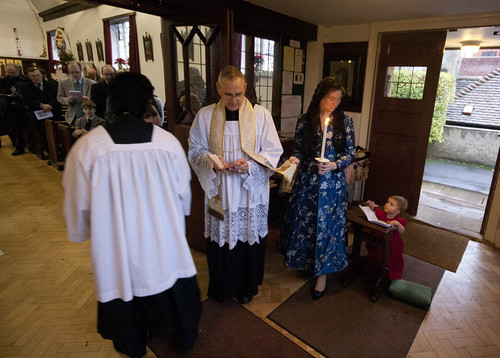
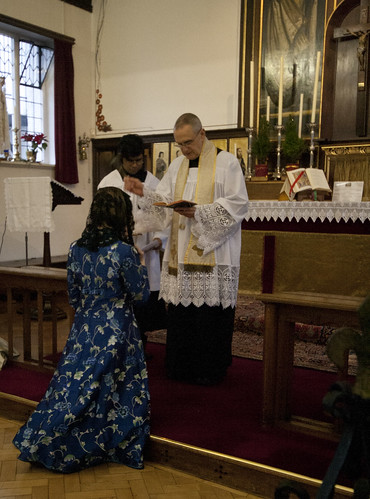
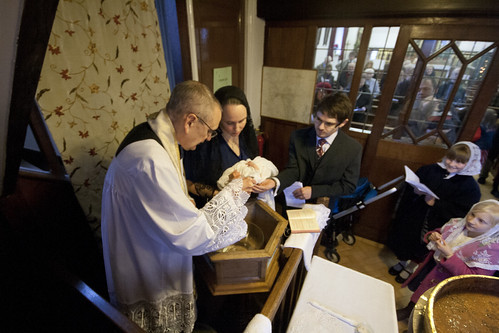
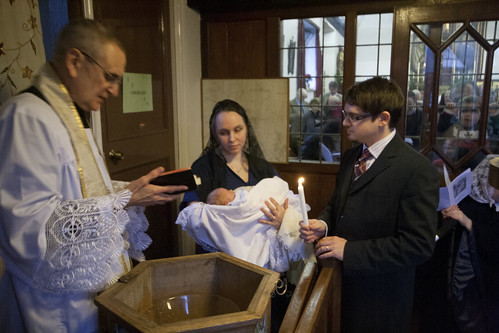
The 'Churching' is the Blessing of a Mother after Childbirth. After some prayers she is led into the church by the priest's stole, holding a lighted candle.

IMG_1910

At the Altar rails she is blessed with holy water.

IMG_1914

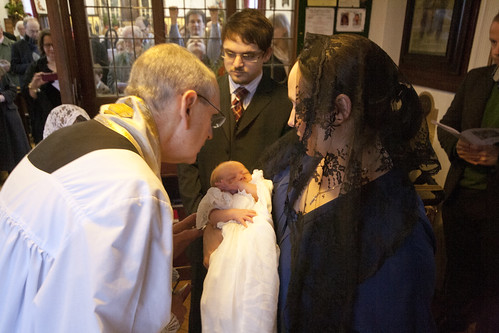
Again, the Baptism ceremony starts by the door: the baby has to be led inside. He is held by the Godmother, not the mother; the Godparents make the responses for the baby.

Before the baptism proper there are various ceremonies, including breathing on the candidate, symbolising the coming of the Holy Ghost.

IMG_1918

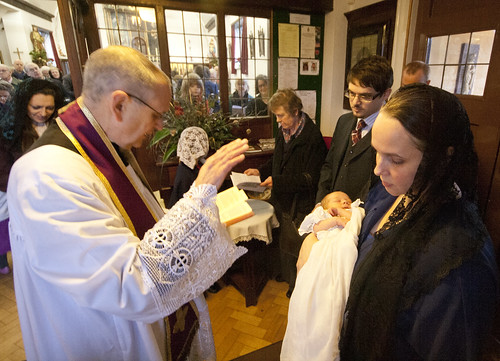
This is one of the exorcisms.

IMG_1921

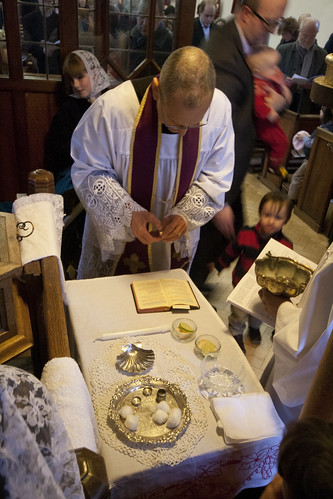
The ceremonies include annointings with two kinds of oil; the priest has the traditional lemon and bread to cleanse his finders after each one.

IMG_1927

The baptism itself.

IMG_1931

The candidate gets a lighted candle and a white linen garment.

IMG_1935

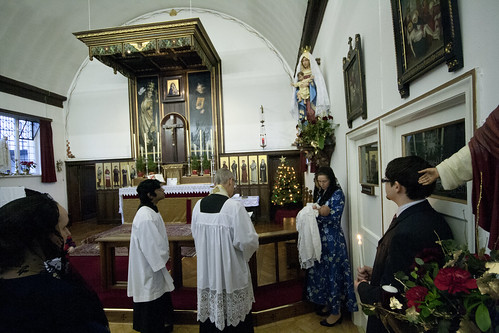
Finally, a paraliturgical ceremony of presenting the newly baptised baby to Our Lady. The little side Altar is occupied by the Nativity Scene, so the mother took the baby to the statue of Our Lady.

Thou who through holy baptism hast granted thy servant remission of sin and newness of life, cause the light of thy countenance, Lord, to shine ever in his heart. Keep the shield of his faith unscathed against every assault of his foes; keep clean and unblemished the garment of incorruption that he has put on; by thy favour keep unbroken upon him the seal of the Holy Ghost; and as thou art rich in mercy, deal gently with him and with us. Amen.

Saturday, January 04, 2014

Evangelii gaudium 5: the bureaucratic attitude

IMG_4214
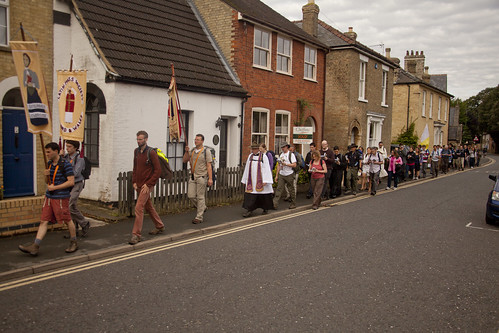
A Catholic charity at work. The LMS Walsingham Pilgrimage in Ely.

Yesterday I quoted Pope Francis:

279. Sometimes it seems that our work is fruitless, but mission is not like a business transaction or investment, or even a humanitarian activity. It is not a show where we count how many people come as a result of our publicity; it is something much deeper, which escapes all measurement.

This is linked to a number of other passages. For example, speaking of society as a whole:

239.  We do not need plans drawn up by a few for the few, or an enlightened or outspoken minority which claims to speak for everyone. It is about agreeing to live together, a social and cultural pact.

The concern of a state agency or secular NGO is to get as many units of welfare delivered as efficiently as possible. There is something to be said for this approach, obviously, particularly in emergencies. But when a Catholic is confronted by a person in need, he is confronted by a person: a creature made in the likeness of God, about whom Christ will say 'as you treated one of these, you treated Me.' This has the result that Catholic agencies are often - and always should be - characterised by the development of human relationships, conversations, personal warmth. A prime example of this is given by Bl Teresa of Calcutta, Mother Teresa, and (among other things) it infuriated some of her critics, like the late Christopher Hitchens. She would spend hours talking to just one person. Was this the misallocation of resources? This kind of resource, 'talking to Mother Teresa', isn't something which can be rationed out in life-preserving mouthfuls to thousands, it is something which, under providence, she gave with total selflessness to those with whom she happened to be confronted. 


Is this kind of thing going to solve the world's social problems? We don't know the good God will draw from it. But in human terms, no: these problems will not be solved without the involvement of the state, because they derive from fundamental economic and social issues created and sustained by laws, regulations, and policies controlled by the state. That the Church can't solve these problems is no criticism of the Church, it is just the nature of things. What we can do is to bring Christ to people, whether it be by addressing spiritual poverty directly, or by giving a tramp a smile as well as a bowl of soup.

The contrast between state efficiency and charitable human warmth is well worn theme. In creating the National Health Service, Anuerin Bevan famously said 'I would rather be kept alive in the efficient if cold altruism of a large hospital than expire in a gush of warm sympathy in a small one.' The small hospitals he had in mind were the ones created often by private philanthropy which the new NHS closed down in the hundreds. (The NHS inherited 2,800 hospitals from its predecessor institutions in 1948; today, for a vastly bigger population, it has 2,300.) Since then every charity has been exposed to the temptation to ape the cold altruism of efficiency, and Church institutions have often succumbed to this. In practice, of course, the efficiency can be lost along the way, leaving only the coldness.

Related to this is another problem Pope Francis has picked out: of Catholics and Catholic institutions losing their Catholic identity.

79. At times our media culture and some intellectual circles convey a marked scepticism with regard to the Church’s message, along with a certain cynicism. As a consequence, many pastoral workers, although they pray, develop a sort of inferiority complex which leads them to relativize or conceal their Christian identity and convictions. This produces a vicious circle. They end up being unhappy with who they are and what they do; they do not identify with their mission of evangelization and this weakens their commitment. They end up stifling the joy of mission with a kind of obsession about being like everyone else and possessing what everyone else possesses. Their work of evangelization thus becomes forced, and they devote little energy and very limited time to it.

80. Pastoral workers can thus fall into a relativism which, whatever their particular style of spirituality or way of thinking, proves even more dangerous than doctrinal relativism. It has to do with the deepest and inmost decisions that shape their way of life. This practical relativism consists in acting as if God did not exist, making decisions as if the poor did not exist, setting goals as if others did not exist, working as if people who have not received the Gospel did not exist. It is striking that even some who clearly have solid doctrinal and spiritual convictions frequently fall into a lifestyle which leads to an attachment to financial security, or to a desire for power or human glory at all cost, rather than giving their lives to others in mission. Let us not allow ourselves to be robbed of missionary enthusiasm!

We all know about the Catholic charities which want to get government grants, or grants from secular-minded charitable trusts, and gradually change both their policies and their names to play down their Catholic identity: indeed, 'a Catholic charity' becomes one with a 'Catholic ethos', then a 'Catholic heritage', and then it gets forgotten altogether, even if it lingers in the pages of the Catholic Directory for a few more years out of sheer habit. It is clear what they are getting: money ('financial security'), contracts, a seat on various committees set up by the government. What are they losing? Their whole raison d'etre. Because these institutions were not set up as organs of the state, but as ways of reaching out in Catholic charity to those in need, and this means reaching out as Catholics. 

Friday, January 03, 2014

Evangelii gaudium 4: Activism and spiritual poverty

IMG_3636
This and the other photos: the SCT Summer School 2013
A neglected aspect of the Holy Father's Exhortation Evangelii gaudium is his condemnation of activism and of a bureaucratic attitude.

46. Going out to others in order to reach the fringes of humanity does not mean rushing out aimlessly into the world. Often it is better simply to slow down, to put aside our eagerness in order to see and listen to others, to stop rushing from one thing to another and to remain with someone who has faltered along the way.

199. Our commitment does not consist exclusively in activities or programmes of promotion and assistance; what the Holy Spirit mobilizes is not an unruly activism, but above all an attentiveness which considers the other in a certain sense as one with ourselves. This loving attentiveness is the beginning of a true concern for their person which inspires me effectively to seek their good.

IMG_3837

279. Sometimes it seems that our work is fruitless, but mission is not like a business transaction or investment, or even a humanitarian activity. It is not a show where we count how many people come as a result of our publicity; it is something much deeper, which escapes all measurement. It may be that the Lord uses our sacrifices to shower blessings in another part of the world which we will never visit. The Holy Spirit works as he wills, when he wills and where he wills; we entrust ourselves without pretending to see striking results.

The heresy of activism is part of the heresy of Americanism, and was condemned by Pope Leo XIII in Testem Benevolentiae Nostrae (1899): 

'This overesteem of natural virtue finds a method of expression in assuming to divide all virtues in active and passive, and it is alleged that whereas passive virtues found better place in past times, our age is to be characterized by the active. That such a division and distinction cannot be maintained is patent-for there is not, nor can there be, merely passive virtue.'

In that context it manifested itself with a mistrust of the contemplative religious life, which was slow to root itself in North America. Those infected by Americanism were inclined to see contemplatives as useless to the Church. The late Fr Paul Crane recounted an anecdote of an American army chaplain in World War II, in Italy, who, when told a community of Italian Carmelites were starving, refused to help them, with the words 'What have they ever done for anyone?' 

IMG_3745

An unbalanced emphasis on 'active' virtue, notably that directed towards social problems, is not what Pope Francis has been promoting in his concern for social justice. When the Church addresses social problems, she does not do so as a 'humanitarian NGO' does: Pope Francis has made this very clear. Nor is the Church a branch of the public sector, carrying out programmes of social improvement - however worthy these may be. What does this contrast, between the Church and other bodied, mean?

One part of the contrast Pope Francis has been underlining is that the Church is always concerned with the worst kind of poverty, spiritual poverty. As he said to the diplomatic corps:

'But there is another form of poverty! It is the spiritual poverty of our time, which afflicts the so-called richer countries particularly seriously. It is what my much-loved predecessor, Benedict XVI, called the "tyranny of relativism", which makes everyone his own criterion and endangers the coexistence of peoples.'

This is obviously something the Church is uniquely well suited to address. It should not be forgotten, of course, that there is a connection between material and spiritual poverty in the West. Although the poor in developed countries are materially better off than the poor in poor countries, the destruction of working class communities and culture, and the disastrous social and educational experiments to which they have been subjected, means that they are particularly badly off in terms of contact with the kinds of social and cultural resources which could address spiritual poverty. Mother Teresa expressed it this way:

'The greatest disease in the West today is not TB or leprosy; it is being unwanted, unloved, and uncared for. We can cure physical diseases with medicine, but the only cure for loneliness, despair, and hopelessness is love. There are many in the world who are dying for a piece of bread but there are many more dying for a little love. The poverty in the West is a different kind of poverty -- it is not only a poverty of loneliness but also of spirituality. There's a hunger for love, as there is a hunger for God.'

The tyranny of relativism, hunger for God, loneliness: these not seem closely connected but they are. An attitude of relativism, which is now the official ideology of the educational establishment, serves as a lens of cynicism through which to look at everything. Anything lacking cynicism is ridiculed as naive. Cynicism is safe, cool with the gang; it means you'll never be taken in. Sadly, it also makes it impossible to take any truth or any relationship seriously. The products of modern education, except to the degree that they can free themselves from this, are condemned to lonliness from people and from God by a horror of being thought gullible. They have been innoculated against Christ.

The best way to address this is by education, and the best time to address it is with children. This is why the kind of work done most characteristically by traditionalist groups, schools and summer camps and catechism for children, is very much to the point. Given the chronic lack of material resources in the traditional movement, I don't think trads have anything to be ashamed of in this regard. Wherever there are trads gathered together there is a ferment of work going on related to education and spiritual development. I wish this were so in the rest of the Church.

The SCT Summer School, supported by the Latin Mass Society, is free at the point of delivery: no one is turned away. The dates this year are 3-10th August.

Another project of the Latin Mass Society this year is sponsorsip of some places are the Roman Forum Lake Garda conference; we will also be having another one-day conference of our own in London. Watch this space for more details.

IMG_3917

Another part of the contrast between the Church and the public sector or the humanitarian NGO, is that of mindset, even when the Church is engaged in directly addressing material poverty, as with a homeless shelter or a soup kitchen. I will address this in the next post.

Wednesday, January 01, 2014

Evangelii gaudium 3: open and closed worship

As I quoted in my last post, Pope Francis has written, in his Exhortation Evangelii gaudium, that a parish must not be 'a self-absorbed cluster made up of a chosen few.' (28)

The second idea I want to put forward in relation to these remarks of Pope Francis is about open and closed forms of worship. What I mean derives from the different conceptions of participation characteristic of the traditional and the reformed liturgy. In the traditional liturgy we participate by uniting heart and soul with the offering at which the priest officiates. We do this mostly in silence, our prayer stimulated and focused by the ceremonies, chants and so on of the liturgy, which lend themselves so well to contemplative engagement. The usual understanding of 'active participation' following the Council has it that it helps participation if the Faithful are saying and doing things: making responses, carrying up the gifts at the Offertory, reading the readings, leading bidding prayers, distributing Communion and so on. This idea is not the teaching of the Church; on the contrary it has come under a lot of criticism from Bl. Pope John Paul II and Pope Benedict XVI. Nevertheless it has been very influential, and one can see the results. Pope John Paul II felt it necessary to underline the point that one can participate by listening to a reading, and not just be reading it (aloud, at the lectern) oneself:

'Worshipers are not passive, for instance, when listening to the readings or the homily'.

If that needed saying, then heaven help us. (See the Position Paper on Participation here.)

My point is this. A liturgy which has been shaped by the second understanding of participation is one which is closed to outsiders. The person who comes in from the street (if only because he is on holiday), who doesn't know the responses, isn't on the Extraordinary Minister of Holy Communion Rota, etc. etc. has no way of participating in this liturgy. He becomes what liberal critics of the Traditional Mass call a 'dumb spectator.' Sometimes proponents of this kind of liturgy are aware of the problem and try to meet it by having 'greeters' at the entrance, shoving various books and flyers into your hand as you go in, inviting you (at small week-day Masses particularly) to come and stand hand in hand round the Altar at the Consecration, and so on; again, English-speaking tourists, they worry, should not have to mingle with the natives when they go to Mass. For anyone not weirdly extroverted, this can be a very trying, not to say humiliating, experience, as if one turned up at the wrong dinner party and the host and other guests tried to treat you as a old friend when you'd never met them before. What is quite out of the question, in this kind of liturgy, is that you should engage with it at your own pace, on your own level, in prayer. Prayerful contemplation is simply not allowed: it will be interrupted within a few minutes, and you'll get funny looks.

The opposite is the case with the Traditional Mass. You are, essentially, left alone, but left alone united with the community in the act of worship. You may have things given to you to help you follow the Mass, there may even be responses (especially at a sung Mass), but no one will think you odd if you just look at what is happening on the Alter in prayerful silence. And for the Canon, that is what everyone is doing. You are drawn in: it may be to something unfamiliar, if contemplative prayer is unfamiliar, but it is something which you can do your own way. It is not a Procrustean bed; you can make of it what you will.

This is open worship: in a very practical, sociological sense it is open to everyone who turns up. This has always been a very Catholic attitude: as the sociologist Anthony Archer pointed out, people were never turned away from Mass because they are in their work clothes. But we have lost something of this in the modern parish, where so often everyone else can appear to be on first-name terms.

In a more abstract sense the Traditional Mass is open because of the universality of Latin. This was the major argument in favour of Latin at the time of the reform, and Bugnini acknowledged it, saying only that universality would have have to be emphasised in some other way. But it hasn't been. Every modern parish is in a bubble far more impermeable to outsiders than that surrounding the different Rites and Usages of the Middle Ages. You can read the words of a 14th century pilgrim, Margary Kempe, about experiencing the liturgies of Jerusalem, Germany, Rome, of the Franciscans and her own Sarum Rite, and she appreciated everything and was excluded nowhere. Not once in her travels does she complain about the liturgy. A modern Catholic can't go to the next parish without coming back with a litany of grumbles.
IMG_4039
Just come in and make yourself at home.
To return to the theme of the last post, what of the people who attend the Old Mass? Those not familiar with Traditional Catholics may think of them as an inner core, an elite within an elite, in the Church. In fact there are many in traddy congregations who are rather marginal Catholics, students who don't always make it to Church, new converts, people who are finding out about the Vetus Ordo for the first time, people in complex personal circumstances, married people with children whose spouses don't attend, and those unable to receive Communion. The Traditional Mass, in many cases, is what keeps them going, spiritually. It doesn't do so because it affirms them as members of some artificial, closed, 'community', it does so because it facilitates their participation in the Church's eternal offering of worship to God.