Thursday, March 20, 2014

Trip to Lanherne

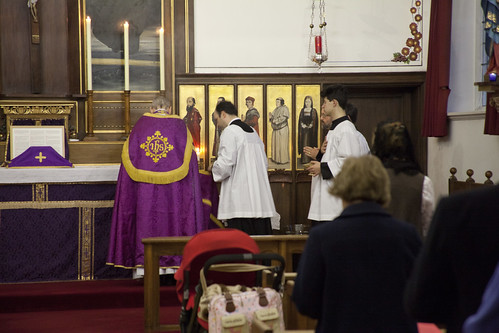
IMG_6264
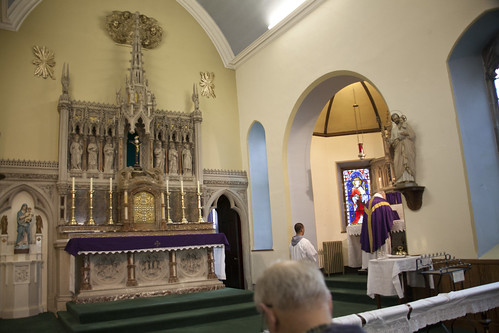
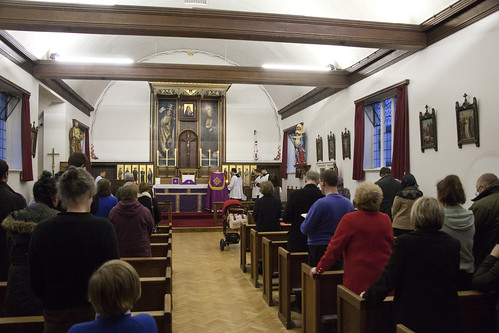
Mass on Sunday: the Sisters are behind the grill and net curtain on the left.

I take a brief break from my ongoing series of posts to put some photos of my recent (and first ever) trip to Lanherne Convent: that is, the former Carmel now occupied by a community of the Contemplative branch of the Franciscan Sisters of the Immaculate.

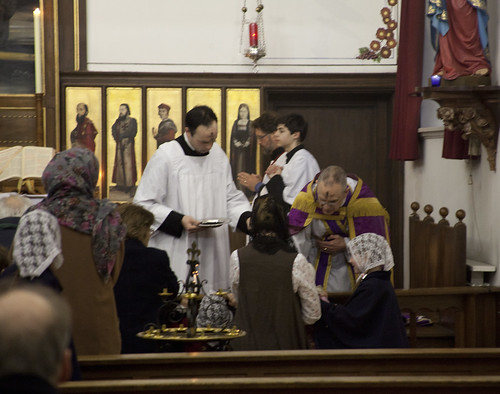
IMG_6280
Venerating a relic (the cranium) of St Cuthbert Mayne, a local saint.
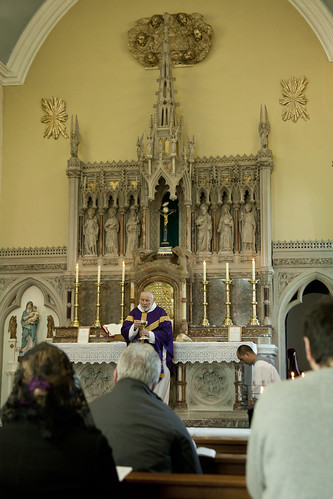
I arrived late for the regular Sunday morning Mass, and was able to go to a early morning weekday Mass on the Monday morning. These were both Low and were said by the chaplain, Fr George Roth FFI.

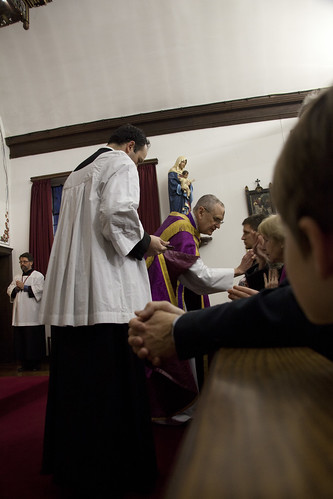
IMG_6343
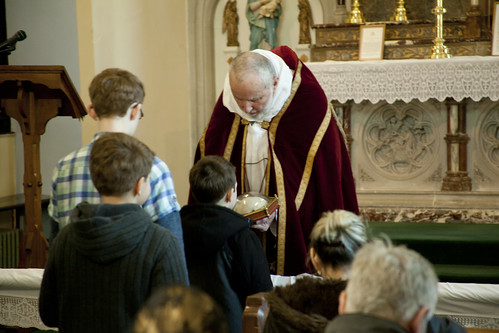
Mass on Monday: the Sisters are now directly facing the Altar, and the laity looking side-on.

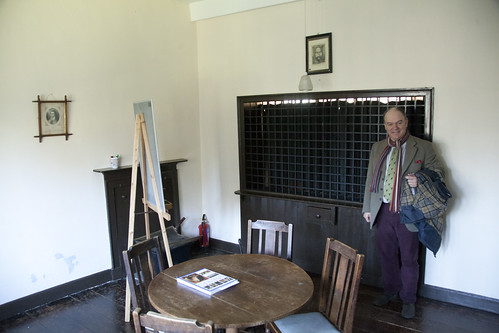
The convent is rather large, but not easy to see from outside. And, obviously, I couldn't go inside. I did speak to the Superior in the 'Speaker Room', with the double grill.

IMG_6324
The convent glimpsed from the back.
It was very edifying. Lanherne Convent is in the village of St Mawgan, near the north coast of Cornwall. It is very remote, but today oddly well connected by air, being close to Newquay International Airport.

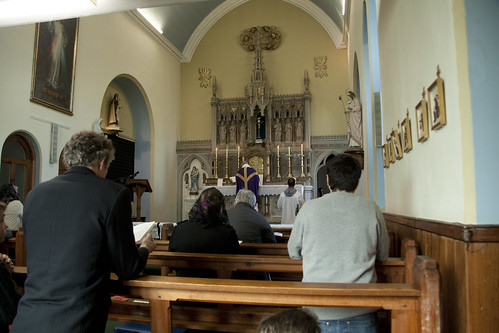
IMG_6281

 More photos.

Donate to the Friends of Lanherne here.

Wednesday, March 19, 2014

Orthodoxy and the Traditional Mass, Part 1

IMG_6267
Low Mass at the convent chapel of Lanherne
Yesterday I blogged about criticising the Pope. I pointed out that, as far as the established groups of traditional Catholics are concerned, Traditional Catholics are not the most likely group to criticisise the Pope, but among the least. Sure, there are Ultramontanists who say the Pope's lightest word is a new revelation, but that is actually heresy, and is hardly an example to follow. Apart from them, liberals criticise the Pope incessantly, and down the years many conservative Catholics have found themselves doing the same thing. Traditional Catholics have always shown enormous restraint. (To see an example, read the books of Michael Davies.)

Having cleared the ground of the idea that Traditional Catholics are disloyal, I am going to do a short series on the relationship between the Traditional Catholic movement and Orthodoxy.

There are people who like the Extraordinary Form, but have heterodox theological views. There are, of course, many people who are orthodox in faith who don't even know about the Traditional Mass, or know about it but don't particularly seek it out. It is nevertheless an observable phenomenon that Traditional Catholics tend to very orthodox, and, conversely, that heterodox thinkers within the Church tend to dislike the Traditional Mass. Indeed, Cardinal Ratzinger commented on the latter fact, linking hatred of the Vetus Ordo to dissent specifically about the sacrificial nature of the Mass.

I want to mention two reasons for this linkage, and one important consequence of it.

The first reason is, as with Cardinal Ratzinger's example, the texts of the Extraordinary Form emphasise a lot of the teachings which the most popular heresies of our day reject. This has now been set out at scholarly length by Lauren Pristas: if you don't want to believe this, buy her book about the reform of the Collects. The old collects, many of them being very old indeed, make repeated and very clear points about our need for grace, for example. The Holy Father is absolutely right to worry about Pelagianism in the Church - Cardinal Ratzinger, again, remarked that the texts of the Novus Ordo were open to Pelagian intepretation. But there are many such issues, the Real Presence, the reality of the Devil (another favourite topic of Pope Francis), even the theology of marriage (in the Nuptial Blessing), and the importance of penance and the intercession of the Saints.

The second reason is that the Traditional Mass represents continuity. It is is logically possible to accept the validity of the ancient Mass and reject the validity of the ancient teaching of the Church, or to reject the Mass and accept the teaching, but unless you have some strange and complicated reason to do either thing it is incongruous.

So here's the consequence. Liberals tend not only to dislike the Traditional Mass personally, but oppose anyone having access to it. This is something which is puzzling, but there is an explanation. They find the texts about grace and penance and the intercession of the saints embarrassing, not only for themselves but for the whole Church. They want them wiped from the Church's collective memory. But more deeply, they want to deny the continuity of the Church. They are opposed to the idea that anything worthwhile can be found in the Church's past. If they do look at the past, they prefer to look at isolated bits and pieces from the distant past, with which there is no lived continuity.

The reason is that in order to deny the Church's teaching you have to stop people appealing to the teaching and also to the lived experience of Catholics over recent centuries up to Vatican II. The recent centuries are the most useful, often, because they were struggling with the same problems as us: 'natural' theories of education, the theory of evolution, critical methods of interpreting the Bible, contraception, divorce, secularism. The liberals want to cut us off most of all from those parts of the Magisterium which are most useful. They want to destroy the prestige and authority of this teaching by ridiculing the Mass which went with it.

To be continued.

Saturday, March 15, 2014

Photos of Ash Wednesday

I've been having trouble with my computer, which particularly impeded my photographs. So I have a bit of a backlog. Here are some photographs of the Sung Mass we had for Ash Wednesday. It was extremely well attended, in the church of SS Gregory and Augustine in Oxford. It was celebrated by Fr John Saward and accompanied by the Schola Abelis. The photos are unusual (for me) since I (with the whole schola) was in the nave, not in the choir loft.

IMG_6216

This is a boring photograph. You can't see the priest blessing the ashes. Actually, that make it rather interesting: this is how it has always been. We don't need to see it: it is between the priest and God. It is an example of the emphasis on 'ritual efficacy' in the EF: the words make an objective difference to the ashes, the effect on the congregation is secondary. Being able to see the blessing of the palms on Palm Sunday is an innovation of 1955.

IMG_6219


IMG_6222

IMG_6227

Friday, March 14, 2014

Tolerating the Unacceptable: Same Sex Marriage, Part 2


In my last post I noted that the idea of 'tolerating' what we cannot 'accept', in relation to remarried divorcees, is not terribly satisfactory, since it creates a situation in which there are 'really' married Catholics, and 'tolerated' co-habiting Catholics. It has already been pointed out that if this 'toleration' is given to those in invalid marriages, then it would not seem logical or just not to extend it to cohabiting couples who have not attempted to enter any kind of legal marriage, and to polygamists. Even at the level of a pragmatic pastoral policy, it looks as though it may create more problems than it solves.


On the other hand, applying this to Same Sex Marriage (SSM) looks very attractive indeed, from the point of view of avoiding a confrontation with secular values. Without such a strategy the clash will be extremely difficult to manage: I emphasise this because it is important to understand the attraction of this proposal. The media has a well-established narrative, 'the Catholic Church hates gays'. Gay couples already make a point of presenting themselves for Holy Communion, identifying themselves with rainbow sashes to avoid any possible misunderstanding, in order to test the discipline. With SSM the sashes will be less necessary; the presentation of people in a public state of sin for Communion will happen every day; they will wear wedding rings, change their names, and call each other 'husband' or 'wife'. Many, many priests will give them Communion, out of what they will call 'compassion'. The Church's discipline will be the focus of ferocious pressure by lobby groups on the look-out for continuing discrimination against gay couples, discrimination which in practice denies them the full rights of marriage. It will take another step or two of legislation to make this a legal problem for the Church, but it is certainly going to be a political, social, and pastoral problem, a running sore in fact which will make it impossible for the Church's positive teaching about any subject, let alone marriage, to gain a hearing.

So let's not underestimate the problem. The proposed solution is glorious in its simplicity. If the Church chooses to 'tolerate' what it cannot 'accept', priests will be able simply to ignore the legal marital status of those coming up for Communion. We will all be able to pretend SSM does not exist. After all, Pope Francis has just said

Secular states want to justify civil unions to regulate different situations of cohabitation, pushed by the demand to regulate economic aspects between persons, such as ensuring health care. It is about pacts of cohabiting of various natures, of which I wouldn’t know how to list the different ways. One needs to see the different cases and evaluate them in their variety.

Sax Sex Marriage does not, after all, necessarily imply an immoral sexual relationship. Perhaps they just want to avoid inheritance tax. 

But in fact this is beside the point. The same is true of those in illicit heterosexual unions, and there are ways of dealing with this without always insisting the couple obtain a legal divorce or even separate: they can undertake to live as 'brother and sister'. The status of a public sinner can be dealt with privately with a priest. The problem we are faced with is where the couple have no intention or desire to affirm before the priest that they are not in an immoral sexual relationship, but on the contrary want this relationship to be accorded public recognition by adopting the terminology and legal status of heterosexual marriage.

What would be the effect of the Church adopting the 'toleration' strategy? At the moment Canon 915 of the Code of Canon Law states:

Those who have been excommunicated or interdicted after the imposition or declaration of the penalty and others obstinately persevering in manifest grave sin are not to be admitted to holy communion.

To allow the 'toleration' strategy to be officially permissible, the second half of this canon would have to be expunged, or an indult created to waive it. Those in illicit marriages are 'obstinately persevering in manifest grave sin': sex outside marriage is grave, the public legal status of marriage makes it manifest and obstinate.

Such an indult, say for 'exceptional' cases, or leaving it more explicitly to the 'judgement of the pastor', without (we will be told) changing the Church's teaching on the Indissolubility of Marriage, might either lift the canon-legal obligation on priests to refuse Communion, or, even more easily, make that obligation completely unenforceable. The latter would no doubt be enough for practical purposes: as far as the public policy of the Church is concerned, as understood by the world's media, the prohibition on gay couples receiving Communion will have been lifted.

The problem, however, is that while the Supreme Legislator (the Pope) can always, in principle, change Canon law, he cannot change the Divine Positive Law or the Natural Law. Even if the canonical obligation were lifted completely, the moral obligation on priests, from these sources, would remain.

The key passage here is from St Paul (I Cor 11:27-29):

Whoever, therefore, eats the bread or drinks the cup of the Lord in an unworthy manner will be guilty of profaning the body and blood of the Lord. Let a man examine himself, and so eat of the bread and drink of the cup. For any one who eats and drinks without discerning the body eats and drinks judgment upon himself.

This passage from St Paul's First Letter to the Corinthians is divine revelation, and the facts it reveals about the nature of the Eucharist are facts established by Our Lord when He made the Eucharist: they are facts of Divine Positive Law. Our Lord made the Eucharist in such a way that it is beneficial only to those not in a state of mortal sin. This cannot be changed by the Church.

This means that it is wrong for a priest to give Communion to a person known to be a sinner, other things being equal. This follows from the priest's nature and vocation to care for the souls of the Faithful: to be indifferent to them would be a dereliction of duty. This is another fact, of course, of Divine Positive Law, related to the establishment of the Sacrament of Holy Orders.

Why, then, do priests not refuse Communion to those known only to them to be sinners? Because to do this would cause scandal to anyone else present, and would harm the good name of the sinner. These considerations have great weight in the Tradition. But when the sinner is 'notorious', scandal would be caused by giving the Communion. Notoriety, in short, allows the priest to exercise mercy and pastoral concern.

What is being proposed, therefore, is that the Church sacrifice the souls of these sinners for the sake of a better media image. Such a sacrifice is wrong on the basis not of Canon Law but of Divine Law. Any priest who knowingly gives Holy Communion to a public sinner is committing a grave sin, regardless of what Canon Law may say.

This means that the proposed policy is a disaster. But even from the public relations point of view another disaster looms, from a factor which liberals consistently ignore in such cases. That is that not all priests, and perhaps not all bishops and cardinals, will go along with this merciless policy. This may or may not be a high percentage, but it is perfectly clear that there will be a group of hold-outs significant enough to provide ammunition for the media and the gay lobby. What will happen to those priests?

We have a good idea of what will happen, because we have seen closely parallel cases. The bishop and the relevant people in the Curia will say, when asked, that these priests are not obliged to do this; perhaps even that they are not following guidelines. Catholic commentators, including many priests and even bishops desperate not to be tarred with the same brush, will be on hand to describe these priests as extremists and homophobes, unrepresentative of the Catholic Church in the 'era of mercy'. Since these priests will not be able to appeal to the Church's official disciplinary documents to support the claim that they are under a religious obligation to do what they are doing, it is very easy to see them coming under legal threat. Stripped of the (limited) legal and social protection of religious freedom, they will be accused of acting out of malice towards homosexuals. It is not difficult to imagine them ending up in prison, the condemnations of fellow Catholics ringing in their ears.
Thursday, March 13, 2014

Tolerating the Unacceptable: Same Sex Marriage: Part 1

Thinking about Cardinal Kasper's paper on reforming the Church's approach to the pastoral treatment of Catholics who have remarried after divorce, I have been very puzzled about the idea of 'tolerating what we cannot accept'.

At first glance it hardly seems satisfactory to say to remarried divorcees, who have been unable to get an annulment, even through a process which has been made less formal and legalistic, that their union is 'unacceptable', that is, adulterous, but that they can receive Communion anyway. We would be making these people into second-class citizens, excluded, if not from Communion, then from Confession, since they do not repent of their adultery, and from the Sacrament of Marriage, inasmuch as they cannot celebrate their new marriage in Church. This hardly seems like a good way to restore them to the sacramental life of the Church, and it hardly seems a status which they would relish. After all, these individuals have made a decision which presumably seems to them, subjectively, as their best option. Liberals who ignore the need either to form one's conscience or actually to resist temptation will tell us that they are, in fact, 'in good conscience', and justified in the 'internal forum'.

However, it occurs to me that this pastoral strategy may have another application: Same Sex Marriage (SSM). As SSM becomes established throughout the world, the Church is going to be increasingly confronted with those who, up until now, were simply private sinners - like everyone else - but are now public sinners, having taken on a public, legally binding, quasi-marital status, implying a sexual relationship. If a civil marriage after divorce, when the spouse is still alive and the first marriage is not annulled, is a public statement of an on-going adulterous relationship, one which the Church cannot (under the present rules) ignore, a Same-Sex Marriage is a public statement of an even more serious moral problem. 

SSM presents a particular difficulty because there is no equivalent of annulment, something which could in principle regularise the union. No matter how debased the annulment process becomes, no-one is ever going to be able to claim that a Same Sex Marriage is sacramentally or naturally valid in Catholic terms. It will always be something the Church cannot accept. But if we establish a concept of 'tolerating' what we cannot 'accept', then it would seem we have a way forward. We can, at least, make a major concession to the individuals involved. A concession which, in its practical effect, would allow us to ignore the ramifications of Same Sex Marriage as far as Communion is concerned, and carry on treating those taking part in such unions as if they had not done so, but were still just private sinners, like everyone else, and aren't wearing wedding rings.

The suggestion may seem timely, in the immediate wake of SSM legislation in a large number of countries. If the Church does not come up with some work-around quickly, priests will be faced with applying the current rules to an increasingly significant number of people. If they do that, it will look very much, from a secular perspective, as though people are being refused Communion solely on the grounds of their sexual orientation. After all, they are no less 'married' than a heterosexual couple, according to the law of the land. And the Church as a whole will be forced into a situation in which, instead of being able to proclaim the beauty of marriage, she will have to spend all her time defending a disciplinary penalty directed at a particular group, who simply want to establish some public recognition of their love.

I will explain some of the disastrous ramifications of this solution tomorrow.

Wednesday, March 12, 2014

More on the Roman Forum this Summer

The Summer Symposium takes place 30 June – 11 July 2014: now with added Patrimony

The Roman Forum's Summer Symposium, in the idyllic setting of a small town on Lake Garda in Italy, is a truly unique event: 11 days of talks and social activities, with daily Traditional Sung Mass, with some of the leading intellectuals of the Traditional Catholic movement: Dr John Rao, Christopher Ferrara, Mgr Ignacio Berrairo, and the President of the FIUV (and a long-time associate of the event), Mr James Bogle. For the first time, it the roster of speakers will include Fr John Hunwicke.

The programme has now been confirmed. You can see it here.

The Latin Mass Society is sponsoring two young people to attend the Symposium; these places have now been taken up. We have also sponsored the attendance of a young musician, Andrew Cichy, to lead the choir for the daily Traditional Mass which is a feature of the event.

Here's a nice plug from Michael Voris.

Tuesday, March 11, 2014

Silence in the Traditional Mass: video

Building on the FIUV Position Papers published on Rorate Caeli last year, we at the Latin Mass Society have started a series of short videos to introduce the issues in a very simple way. Having tackled Septuagesima (a position paper on this is in preparation), I can now present a video on Silence in the Liturgy.

The original posting of this paper on Rorate Caeli on this can be seen here. The Position Paper itself is only 1,600 words, plus footnotes. You can download a pdf here; see the whole set of publishes papers here.


The series of Position Papers is ongoing, I will be posting the next one, on the Pax, on Rorate Caeli in a couple of weeks.