Saturday, March 29, 2014

Prof de Mattei to join Roman Forum Summer Symposium

I've bloged about this here; I have just been told that the well-known traditional Catholic historian, Roberto de Mattei, will be giving a talk at the Symposium.

------------

We are very happy to announce that Professor Roberto de Mattei (Professor of Modern History and the History of Christianity at the European University of Rome; author, most recently, of The Second Vatican Council---An Unwritten Story), will be delivering one of the papers at the Roman Forum Summer Symposium in Gardone Riviera (June 30th-July 11th, 2014). Please see the attached for the full faculty and program.

     There are six excellent young men and women between the ages of 18-25 still in need of support for the summer program. Please think of supporting one of them! ($1,700 per candidate)!

Friday, March 28, 2014

Orthodoxy and the Traditional Mass, 3: making the heart burn


Mass for the Epiphany as SS Gregory & Augustine's, Oxford

I have talked so far in this series about how those attached to the Traditional Mass tend to be orthodox in doctrine, and those opposed to the teaching of the Church often have a particular hatred of the Traditional Mass. This is not a coincidence, because an important part of the liberal strategy in the 1960s was to destroy the sense that what the Church had done and taught for centuries had value. Only in this way could the attack on the Church's teaching on issues like contraception - which on the face of it have nothing to do with the liturgy - be successful.

In this final post in the series I want to point out another aspect of the connection between the Extraordinary Form and orthodoxy. This is that the ancient Mass not only attracts people who are orthodox, but it creates and sustains communities which are orthodox, and it helps people become orthodox. I have seen on numerous occasions people who discover the Traditional Mass, becoming attached to it, learning more about it, and going on to learn more about their Faith, gradually freeing themselves from the attitudes and beliefs of the wider society, and of Catholic liberalism, which are opposed to the Faith.

No doubt this happens with 'conservative Novus Ordo' Masses, but my own experience is that this is more marked with the Traditional Mass, and it is not hard to explain why this should be so. As I explained in the last post, if you want to get Catholics to take seriously the teaching of the Church over the centuries, it is essential to free them from the contemptuous polemic against the liturgical practices which the Church had over the centuries. Furthermore, learning about the Traditional Mass puts you in touch with Catholic authors, of all periods of history, who are passionately committed to the teaching of the Church and to the apostolate.

But there is something else as well. The ancient liturgy itself, to use a favourite phrase of Pope Francis, 'makes the heart burn'. He is paraphrasing the account in Acts of the disciples who met Jesus after the Resurrection on the road to Emmaeus. Afterwards they said to each other: 'Did not our hearts burn within us?' One of the interesting things about the story is its liturgical character: the disciples recognised Jesus 'in the breaking of bread'.

There are many things which can give people a sense of euphoria, and if you want to feel a bit giddy and superb alcohol and drugs are probably what you are after. What we are talking about is something different. It is not a sense of human community, or the impression made by human achievements, even if these have real value (for example, artistic value). It is the sense of God's presence in the liturgy. This may be accompanied by spiritual consolation, but it is also compatible with a feeling of spiritual aridity, just as some of the great mystics had visions during times of great dryness. You may be able to see God is there even if you don't have a warm and fuzzy feeling.

This is especially important because we
need the liturgy to sustain us most of all during periods of dryness. If our experience of God in the Mass depends on the generation of a certain mood, then it won't happen if we are feeling a bit tired, depressed, or are suffering grief. It can and does happen in the Traditional Mass because of the objective nature of what is happening: precisely because it does not depend on us, because the ceremonies and prayers are about making something happen on the Altar, something which makes Jesus Christ present in our midst whether we feeling pious or not.

The combination of this objective, ritual efficacy with beauty of the furnishings, music, and of the texts, or with a moment of personal spiritual breakthrough, can have an electrifying effect, and it is a striking feature of many conversion stories from before the reform, many of those discussed, for example, in Joseph Pearce's Literary Converts. Converts today tend not to talk so much about the liturgy, unless it is to admit (as former Anglicans often do) that bad liturgy kept them out of the Catholic Church for a time. Perusing this book about a pilgrimage to Compostella, which was clearly a deeply significant spiritual experience for the young Catholic author, I was astonished to read that when he finally arrived and went to Mass in the great Basilica, it was an anti-climax. You just don't hear that in parallel accounts from before the liturgical reform.

In the Extraordinary Form the liturgy is still playing its customary role in conversions. Here's an example, from the website of the Archdiocese of Miami. 'It all clicked' says one young man, raised to be anti-Catholic, seeing the Traditional Latin Mass. I was particularly interested in this article because the young lady quoted, a former atheist, had the following experience in SS Gregory & Augustine's in Oxford:

When she heard Latin hymns coming from the choir loft, Tavakoli said, it felt like “hearing angels on high.” She was mesmerized. “It truly is extraordinary,” she said. “There is something beautiful and sacred about this form of the Mass.”

To cite individual cases, of course, shows that something is possible, not that it is typical or widespread. Statistics on these matters do not exist, and comparisons would be very difficult. It is easier to generalise from identifiable movements, made up of identifiable groups, and here a few things are obvious. The Traditional Movement, made up of the congregations attached to the Traditional Mass, is characterised by couples open to children (and therefore large families), by converts and 'reverts' as well as cradle Catholics, by zeal for pro-life causes, and by an astonishing number of vocations. There are eleven young men from England and Wales currently in the seminaries of orders and institutes devoted to the Traditional Mass. Those who wish to minimise the number of people who attend the Traditional Mass will merely succeed in making the number of vocations per thousand worshipers even more stratospherically high than it is.

The Traditional Mass draws people to the Church. It draws us further towards a serious attitude towards tradition - obviously - and so to orthodoxy. It draws us towards forms of spirituality which are both realistic and fruitful. It sustains us through the crises of life and gives us the motivation to apply ourselves in the Lord's vineyard in a thousand different ways. In short, it works.

Sadly, it is today available regularly in fewer than forty churches in England and Wales. It has not been tried and found wanting. For the most part, it has not been tried.

You can hear Joseph Pearce talking about the Traditional Mass and conversion at the LMS One Day Conference on May 24th. The theme is the Traditional Mass and Evangelisation.

Thursday, March 27, 2014

Chesterton Conference in Beaconsfield on Saturday

I'm happy to pass on information about this conference which is happening on Saturday, for the benefit of anyone not coming to the LMS York Pilgrimage!
Chesterton enthusiasts will also be interested in the Latin Mass Society One-Day Conference featuring the Chesterton biographer Joseph Pearce, and other great speakers, on 24th May.
--------------------
Top-notch speakers from home and around the world will be discussing the writings and thoughts of this extraordinary man. The emphasis this year will be upon his suggested personal virtues, and will discuss his spiritual message for us. Program runs from 09.15 to 17.00 
Attendance by ticket. - Open to All. 
Entry on the day may be possible - subject to not being oversubscribed – but booking is recommended to avoid disappointment. TO BOOK EMAIL: chestertoninthechilterns@ntlworld.com
(£10 or £16.50 if you want lunch)

9.15 – 9.45am Registration and Coffee.
9.45am Welcome and Introduction - Martin Thompson.
10.00 – 10.45am GKC ……….Who ! - Dale Ahlquist – President American Chesterton Society.
10.45 – 11.00 Break.
11.00 – 11.30am Encounter and Turning Point - Fr Spencer Howe.
11.30 – 12.00 ‘A Religion of Little Things’ – Martin Thompson.
12.00 – 12.30pm View from Over the Channel - Dr Marco Semarini – President Italian Chesterton Society followed by Lunch.
2.00 – 2.45pm  Wholeness and Holiness - Dr Dermott Quinn.
2.45 – 3.15pm Chesterton & Sanctity - Tessa Caldecott.
3.15 – 3.30pm Tea.
3.30 – 4.15pm Quizzical Questions on Saints -Fr John Udris.
4.15 –4.45pm Question & Answers – All.
5pm -      Conference closes – Visit Chesterton’s Grave and/or tour of St Teresa’s with reference to Chesterton.
6pm Mass   - for Gilbert Keith Chesterton at St Teresa’s. (OF anticipated Mass of Sunday)

Wednesday, March 26, 2014

York Pilgrimage on Saturday 29th March


Don't forget one of the Latin Mass Society's major events is taking place this Saturday, the annual Pilgrimage to York in honour of St Margaret Clitherow, the Pearl of York. She was martyred, on the feast of the Annunciation, by being crushed to death, while pregnant, after refusing to testify at her trial for the crime of harbouring priests.

Mass is on Saturday, 29th March 2014, at 1:30pm, in St Wilfrid's. This is easy to find as it is opposite York Minster. It is the church where a new Oratory of St Philip Neri is being established by Fr Richard Duffield, who has been at the Oxford Oratory for many years. 

After Mass there will be a procession to the site of the martyrdom, and back to to St Wilfrid's for Benediction. The procession won't be as long as in previous years, when it went on to the English Martyrs church.


Monday, March 24, 2014

The Manner of Receiving Communion

The FIUV Position Paper on this subject - how we receive kneeling and on the tongue in the Extraordinary Form, and why - I published a while ago on Rorate Caeli. Like all the position papers, excluding the footnotes I kept it down to less than 1,600 words. Here's a 4 minute video on the subject.


Saturday, March 22, 2014

Orthodoxy and the Traditional Mass, 2: connecting with the past


In the prelude to this series, I addressed the accusation that Traditional Catholics are uniquely disloyal to the hierarchy. This, in fact, is the opposite of the truth. In the following post I noted that not only do those attached to the Traditional Mass tend to be orthodox, but there is an extraordinary hatred of the Traditional Mass among many radicals opposed to the teaching of the Church. In this post I want to expand on that.

Anne Roche Muggeridge, in her book The Desolate City, explains the way that the 'revolutionary' party in the Church gained dominance in a short space of time in the 1960s, in light of a parallel with revolutions in the secular sphere. Borrowing a phrase from a secular historian (Peter Shaw, no relation!), she talks about 'the rituals of the revolution':

'These rituals are designed to diminish the power of existing authority by destroying its mystique during a process in which the symbols that inspire awe are mocked and degraded in "reversed ceremonies of legitimacy". The mocking reversal of sacred symbols serves as a psychological preparation for a transference of allegiance.'

She goes on to discuss the shocking liturgical abuses, and parodies of the liturgy, which took place in the 1960s, particularly in the context of get-togethers of dissenting priests, but in many parishes too. In order to destroy the allegiance of the Faithful to the old doctrines, the liberals subjected them to the ritualised mockery of the most holy and important symbols of the old order. Of course, this did not stop in the 1960s, but it had a special importance in that decade because almost the whole Catholic population had to be brought round from a strong habitual attachment to the old ways to an attitude at least of non-resistance to the revolution the liberals wanted to push forward, of which the keynote issue was the rejection of the Church's teaching on contraception.

The end result was less, of course, than the 1960s radicals wanted. The interesting point for us now is the connection this reveals between the liturgy and orthodoxy. For practical purposes there are no references to the Church's teaching on contraception in the Traditional Mass. That wasn't the liberals' problem with it. They wanted to destroy the prestige of the ancient Mass because they wanted to destroy the prestige of the Church, since the Mass is the holiest thing the Church possesses. To express this in another way, they, like all revolutionaries, wanted to destroy the prestige of the past. 

The ancient Mass is not simply a well put-together liturgy, cleverly combining this element with that one. It is something which has developed over many centuries, slowly enough to enable us to participate in a meaningful way in the spiritual atmosphere of the preceding generation of Catholics, and the one before that, and so on for many centuries. It is the product of the Church in a very deep way: not of a committee, even at some distant time in the past, but of the prayer and practice of innumerable Popes, Doctors and Saints, and ordinary priests and lay people as well. We all know instinctively that, despite identifiable changes made in the decades up to 1962, it is essentially very, very, old, and that this age is not the age of a pot-shard dug out from an ancient rubbish-tip where it has lain forgotten, but of a great public building or city square walked over and worked and lived in every day since its construction until today. And this lived-in age makes it venerable, worthy of respect.

The liberals of the 1960s needed to destroy this connection with the past, because they wanted to establish a new theology. The promulgation of the Novus Ordo Missae at the end of the decade restored a degree of stability to the liturgical scene, but of course a lot of damage had already been done, and even at its best the new liturgical settlement was a striking break with the past.

What I want to draw from this is the usefulness of the Traditional Mass for Catholics who want to promote orthodoxy, and the disaster a rejection of the Traditional Mass is for them. The polemic against the Traditional Mass, which is still heard today, is that it was 'all wrong': it 'excluded the people', it made them 'dumb spectators', the theology, even, was misguided. If we allow that polemic to stand we are saying that the Church was wrong about her most intimate inner life, the shared liturgical life of the Christian community. It may be logically possible to say that she was wrong about that and right about all the doctrines, but, as I said in the last post in the series, it is incongruous. I can now go a little further and say, from the point of view of psychology, it is incredible: it is, almost, impossible to believe.

It is not that people are incapable of distinguishing doctrine from liturgy, or are ignorant that the liturgy of the mid 20th century was not identical to that celebrated by the Apostles. It will amaze many neo-conservatives to hear this, but Catholics are not that stupid. It is, rather, that the institution they want us to believe in doctrinally also brought us this ancient liturgy. If the liturgy is rubbished, then the Church is rubbished. The Church loses her credibility. If you lose your credibility, you don't lose it selectively: people say, 'if he was deluded or a liar about that, I won't believe anything he says any more.' That's what the liberals wanted people to say about the Church, and to a tragically large extent they succeeded.

The conclusion for practical purposes is a simple one. If we want to promote orthodoxy in doctrine in the Church, we have to reverse the process the liberals undertook in the 1960s: we have to reconnect people with the ancient liturgy, restore the prestige of this liturgy, convince people again of its value. Only by doing this will we get them to accept the authority of the succession of Councils and the ancient Creeds and the Scriptures: the authority, in short, of the Church's continuous life over many centuries, or, even more briefly, of the past.

The neo-cons' constant harping about the difference between unchanging doctrines and potentially changeable liturgy has done nothing, over the decades, to reverse the collapse of orthodox belief in the Church. The connection between the liturgy and the faith cannot be so easily shrugged off. If we want people to believe in what the Church teaches we have to allow them to believe in the Church, and that means rejecting the idea that the Church was dumbly devoted to liturgical nonsense for fifteen or more centuries. The last word can be left to Pope Benedict (Salt of the Earth):

A community is calling its very being into question when it suddenly declares that what until now was its holiest and highest possession is strictly forbidden and when it makes the longing for it seem downright indecent.

IMG_6359
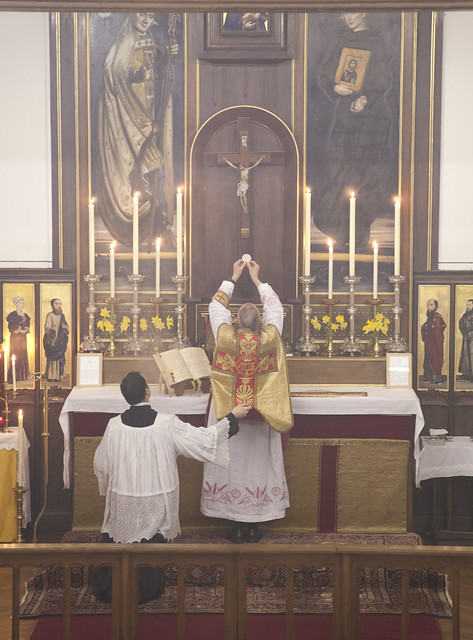
The Elevation, under the gaze of St Gregory the Great and St Augustine of Canterbury.
Patronal Feast of St Gregory & St Augustine's Church, Oxford.

Friday, March 21, 2014

Congratulations to Bishop McMahon!

IMG_2650

Bishop Malcolm McMahon of Nottingham (not be confused with Bishop Thomas McMahon of Brentwood, who is nearing retirement), is to be the new Archbishop of Liverpool.

Bishop McMahon is a Dominican, and was the first Ordinary (as opposed to Auxiliary Bishop), to celebrate the Extraordinary Form in his diocese. He did this in the Dominican church in Leicester, Holy Cross, some years ago. Since then he has celebrated Mass for the Latin Mass Society during last year's Priest Training Conference at Ratcliffe College, near Leicester. More photos here.

His appointment, following that of Fr Robert Byrne as an Auxiliary Bishop in the Archdiocese of Birmingham only a few days ago, is an indication that involvement with the Traditional Mass is not a black mark on one's record under Pope Francis.

IMG_2670