Friday, September 08, 2017

What Rees-Mogg could have said

Every Catholic politician from Parish Councillor up needs to have a rehearsed answer to the 'bloody questions' of today, just as the Jesuits and seminary priests of penal times had a rehearsed answer to the 'bloody question' of penal times (viz.: if the Spaniards invaded to topple Queen Elizabeth, who would you support?).

Today's 'bloody questions' are these:

Is gay sex a sin?

Would you force a woman pregant from incestuous rape to continue with the pregnancy?

The thing about such questions is that they are framed in a slanted way, but if you refuse to answer, it will look not only weasally but also a tacit admission that you hold the most unpopular views possible. In answering them, you have to try to reframe it, but you have to do this in a few words, before you get interrupted. You have about ten seconds, and each ten-second statement must make sense on its own.

I don't claim to be an expert on media engagement - though I have been in the hotseat a handful of times. The point of this post is not to criticise anyone who has no time to think under pressure, but to make some suggestions about how we can think about these things when we do have the chance: in advance.

So, Mr Shaw, is gay sex a sin?

Thursday, September 07, 2017

Why Rees-Mogg is wrong

The knives are out for Jacob Rees-Mogg MP for saying that, as a Catholic, he opposes Same Sex Marriage (SSM) and abortion in all circumstances, in this TV interview. I agree and support him, but I feel I must qualify the way he expressed himself, not on a matter of mere technical accuracy but in relation to questions of fundamental importance.

First, he repeatedly notes that he accepts Church teaching, and this is why he opposes these two things. Since many non-Catholics agree with him, today and in the past, this seems a curious way of talking. It seems to be an implicit appeal to religious freedom, and this is indeed how the debate about his comments is now playing out in the media: the question has become 'can Catholics lead political parties, or hold important government positions?' The argument for answering that question in the affirmative is 'religious freedom'. We shouldn't exclude people from positions just because of their religious affiliation. Rees-Mogg and other Catholics should be allowed their eccentric views because those views are part of being Catholic.

Wednesday, September 06, 2017

LMS Brinkburn Pilgrimage: this Saturday

Brinkburn Priory, a Medieval monastic house dissolved in the 16th century and later re-roofed, hosts an annual pilgrimage organised by the Latin Mass Society.

Saturday 9th September, 12 noon,
Brinkburn Priory
Longframlington, Morpeth, Northumberland, NE65 8AR

Fr Michael Brown, our Chaplain in the North of England, writes:

The annual Mass at Brinkburn Priory will take place on Saturday 9th September at 12 noon. This will be the twenty-third and last. The choir Antiphon will be singing the Missa L'homme arme' by Guillaume Dufay with the motets Benedicta et venerabilis by Byrd and Parsons Ave Maria. We will also have a Gregorian chant group led by David Edwards. I`m hoping the Mass will be a Solemn High celebration but am still trying to confirm the sacred ministers.
This looks like being the last pilgrimage Mass in Brinkburn, because of 'health and safety' concerns about candles and incense. See Fr Brown's post for more.

Support the work of the LMS by becoming an 'Anniversary Supporter'.

Tuesday, September 05, 2017

What's wrong with Yoga? Part 2

IMG_0862
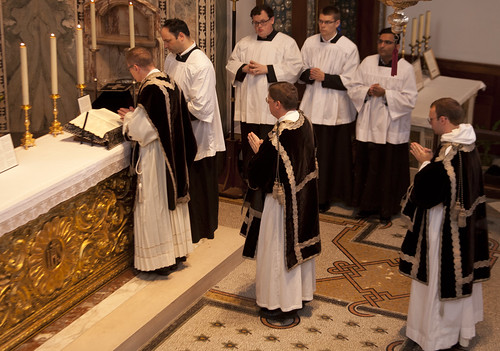
Liturgical prayer: a High Mass of Requiem
In the first post of this pair I explained that Yoga, as typically experienced today in the West (and, for that matter, elsewhere in the world) is not helpfully described as an ancient practice, as a specifically Hindu practice, or as a practice with a basis in a single Indian philosophical tradition. It is is, unfortunately for our purposes in trying to dissent and assess it, too new and too complex for such generalisations.

What can one say, then, about Yoga and the Faith? Are Catholics wrong to feel uncomfortable, as they sometimes do, with Yoga being presented as something for people of 'all faiths and none', to take place in the parish hall like a cake-making demonstration?

I think the easiest way for Westerners to think about Yoga is as related to the New Age. Yoga is such a huge movement that it has a distinct identity from the New Age; also the physical exercise side of Yoga claims to be scientific and medical, and (at least to a degree) is genuinly so. But on the other hand, Yoga derives from many of the same attitudes and aspirations as the New Age, and fits it very comfortably with it. The New Age is full of attempts to use techniques to transcend and to heal; Yoga is one such technique.

Monday, September 04, 2017

What's wrong with Yoga? Part 1

Physical Culture: from Wikipedia Commons
I have been doing a bit of thinking and reading about the New Age, and a talk at the Roman Forum in Gardone this year stimulated me to do more of each about the phenomenon of Yoga: a talk by the Swedish academic Clemens Cavellin, which is available on his website here.

Yoga is one of those hot-button issues which arouses strong feelings in Catholic social media, and as much of the discussion is not very well informed, I thought I'd try to inform it a little.

Before my full assimilation into traddie-land I did a bit of Yoga myself for a few years; accordingly I have my own impressions of the general atmosphere and attitudes of Yoga classes, books, and personal practice. However it must be said that my experience was fairly superficial; I never entered any inner circle of Yoga adepts. The spiritual aspects of Yoga was part of the reason I stopped: I got fed up with being told to say 'Om', for example. Another was doubts about its physical efficacy. I don't deny the health benefits, but there is a natural tendency in Yoga to want to advance to the more perfect performance of more difficult postures, and, in short, become really really bendy, and while being a bit bendy is probably a good idea, I don't think it is particularly beneficial to be really really bendy. However, I'm not qualified to comment further on that.

In this post I want to talk about the philosophico/religious presuppositions of Yoga, or rather why it is so difficult to talk about such presuppositions. Having cleared this ground, in the next post I'll say what I think can be said about Yoga as a phenomenon, and its relationship with the Catholic Faith.

Friday, September 01, 2017

Epiphany and Ascension restored to their proper days

IMG_9920
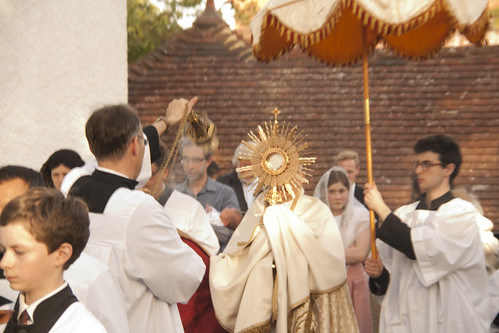
Corpus Christi Procession in Oxford: on the correct day
As I've noted before, the 2006 decision of the Bishops Conference of England and Wales to celebrate Ascension, Corpus Christi, and Epiphany onthe nearest Sunday in the Ordinary Form is the most unpopular one I can think of in my experience. Letters in the press and blog posts criticising it appear year after year. The few who defended the decision when it was first made long ago gave up trying to respond. It is good to see the bishops are big enough to recognise that they made a mistake, although it is also true that there has been a big turnover of the Conference in the last eight years, and ironically enough today's announcement is accompanied by the news of the death of Cardinal Cormac Murphy O'Connor, the architect of the original decison: requiscat in pace.

Here is the Bishops' Decree. We can now set our sights on restoring Corpus Christi to its proper date, and reversing the decision of 1984 to move the celebrations of all the Holy Days to Sunday when they fall on a Saturday or a Monday (except Christmas). At any rate, it seems we'll have a few more years to advertise the fact that if you want to attend Corpus Christi on its 'particular day' (as the CDW expresses it) you'll have to go to the Traditional Mass.

Irreversible reform? Me in the Catholic Herald this weekend

This weekend the Catholic Herald has a cover story about the Traditional Mass' appeal to young people, by Matthew Schmitz.

Accompanying this is a shorter piece by me on Pope Francis' remarks, made in a speech to a group of Italian liturgists, that the 'reform' is 'irreversible'.

It is not available online, so you'll need to look out for a paper edition. Here's a taster.

Pope Francis’s recent address on the liturgy – about which he has hitherto said little – was striking for its conventionality. In almost every respect, the Pope’s speech hews to the official,  post-Vatican II line. It emphasises the continuity of the post-conciliar reform with the efforts of Pius X and XII; it praises the reform for its “vitality”; it condemns liturgical abuses (“deformations”); and it calls for an end to liturgical conflict. 

But it has raised eyebrows for its rejection of the possibility of revisiting the “decisions” of the reform in light of its “inspirational principles: an explicit rejection of the “Reform of the Reform” project, which seeks to go back to the Council documents and do the reform again, better. This should be no surprise. In the official mindset, the reform was perfect and was marred only by liturgical abuses. Liturgical progressives should note that the account of the liturgy which follows is entirely traditional, focusing on the altar, the Sacrifice of the Mass, and the Priesthood of Jesus Christ, not even mentioning the Last Supper, the Mass as a shared meal or the liturgy as an affirmation of community. 

Support the work of the LMS by becoming an 'Anniversary Supporter'.