Thursday, November 30, 2017

The Psychology of Traditionalism

2009 06 27_2815_edited-1
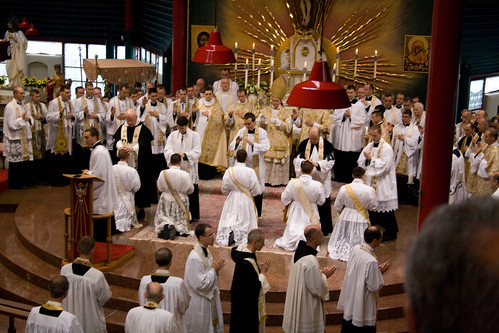
Ordinations for the Fraternity of St Peter in Wigratzbad in 2009
Guide to this series:
The Psychology of the Rigid Personality
The Psychology of Military Incompetence
The Psychology of Ecclesiastical Incompetence
The Psychology of Traditionalism

Before my series of posts about Norman Dixon's Psychology of Military Incompetence, I'd been writing about Mgr Basil Loftus, who exemplifies the attitude that respect for rules indicates a conformist, 'anal', weak-ego individual. This inference enables him, and many others, to conclude that theological and liturgical conservatism and traditionalism manifests a kind of 'rigidity' incompatible with pastoral effectiveness.

I have shown what is wrong with this argument in general terms. It is a truism that people with weak egos and an unhealthy fear of failure will be risk-averse, and will seek the approval of their peers and superiors by conforming. In the post-conciliar situation, however, this approval is not forthcoming to conservatives and traditionalists in mainstream Catholic or non-Catholic institutions: it is, rather, given to those who toe the liberal line. It is rather remarkable that Loftus and his like have not noticed this, but as I have observed that classical presentations of the psychological theory they draw from, including Norman Dixon's, are prone to confuse the risk-taking non-conformism of a person with a strong ego and moral courage, with the liberal violation of traditional norms, and with the norm-violation of the merely self-indulgent.

Wednesday, November 29, 2017

The psychology of Ecclesiastical Incompetence

IMG_0705
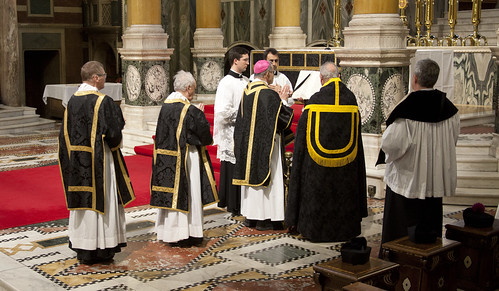
Bishop Mark Jabale at the LMS Annual Requiem in Westminster Cathedral
Guide to this series:
The Psychology of the Rigid Personality
The Psychology of Military Incompetence
The Psychology of Ecclesiastical Incompetence
The Psychology of Traditionalism

The reason I've been writing about Norman Dixon's theory of 'rigid' personalities and military incompetence, is that the Church has certain interesting parallels with the military. The Church is hierarchical and authoritarian; the Church's training institutions are places where people can enjoy the predictability of institutional life (particularly in religious communities) and the rewards of conformism. It is inevitable, therefore, that the Church, like the army, will attract conformists, and that good superiors in both cases must be on the look-out for those whose conformity to the necessary discipline of the institution hides a debilitating lack of self-confidence. Priests lacking in self-confidence will be useless in the field, so if they don't gain the necessary maturity they must be weeded out. Things will go very wrong if, on the other hand, the conformists gain the upper hand. In that scenario it is the self-confident ones who will be weeded out, and pastoral effectiveness will suffer across the board.

The tensions just described are built into the nature of things, and so the psychology of the use of authority in the Church, and especially in seminaries, could remain constant, in certain ways, through the Vatican II revolution. Institutions which had been taken over by conformists under the Old Regime could change their theology without, necessarily, changing their psychological dynamic, for the New Regime. Liberals might think that their 'let-it-all-hang-out' ideology had banished the authoritarianism/ conformism pattern of the past, but it didn't: it simply meant that instead of conformism meaning slavish adherence to late 19th century neo-scholasticism and the ruthless weeding out of liberals, it now meant slavish adherence to Hans Kung and his friends and the ruthless weeding out of conservatives. And indeed, since the products of such a system were priests who were conformists first, and conservatives or liberals second, a change of ideology would not even necessarily require a change of personnel.

I put forward these theoretical observations as a way to interpret certain historical patterns. Not all Catholic seminaries and communities were or are the same; nor were all the products of these institutions the same, with people bucking the trend in both good and bad ways. Nevertheless, I think few will dispute generalisations such as the following:

Tuesday, November 28, 2017

The Psychology of Military Incompetence

The last stand on the retreat from Kabul (Wikipedia)
Guide to this series:
The Psychology of the Rigid Personality
The Psychology of Military Incompetence
The Psychology of Ecclesiastical Incompetence
The Psychology of Traditionalism

In my last post, I described part of the theory of the 'anal personality' widely used by psychologists of the 1960s and 1970s, and to an extent both before and after. Stripped of its Freudian explanatory basis (which is a lot of outdated and indeed laughable stuff about potty-training), the theory says that people with a 'weak ego' and a fear of failure will seek the approval of superiors and peers by conformism and playing it safe. This is not so much a theory, in fact, as a statement of the obvious.

I described how this observation has been applied in a one-sided way, by looking for conformism solely in terms of strict adherence to traditional rules. If attention is fixated upon this specific model of conformism, then it can seem inconceivable that a person opposed to traditional morality or social forms could be a conformist. This is the state of mind of seminary rectors, for example, who see theological or liturgical conservatism in seminarians as prima facie evidence of a weak ego, which would in turn indicate that the seminarians in question would be incapable of the flexibility of mind necessary for pastoral work.

This also seems to be the way that Pope Francis thinks. I don't want to pick him out, however: this is a very widespread attitude among senior clerics of his generation. The situation in seminaries and religious communities is beginning to change as a result of the retirement of this generation.

Monday, November 27, 2017

The Psychology of the 'rigid' personality

Guide to this series:
The Psychology of the Rigid Personality
The Psychology of Military Incompetence
The Psychology of Ecclesiastical Incompetence
The Psychology of Traditionalism

I've been reading Norman Dixon's 1975 classic, The Psychology of Military Incompetence. It has many insights, and also many flaws; one point of interest in reading it today is to see how psychology was done in the 1970s.

I was stopped in my tracks by one passage, a quotation (p254). It is from Peter Kelvin, The Bases of Social Behaviour, 1970. He is talking about the 'authoritarian' personality. (Elipses are Dixon's.)

These tendencies reflect on a type of individual who needs to feel that his environment is highly predictable ... he needs to know where he stands; and so he fastens on to norms: he does not 'let himself go', for fear of where this might lead; he looks to authority as a guide ... [He also] relies very heavily on stereotypes in [his] perception of the social environment. Moreover, the stereotypes used by an authoritarian personality tend to be very clear-cut, and the characteristic infelixibility of this personality leads to relative inability to modify the stereotype once it has been formed.

This is a concise characterisation of what progressives, in the Church and outside it, in the 1960s and 1970s, thought was wrong with their opponents. It also seems to match what Pope Francis has in mind when he talks about 'rigid' people. We don't have to imagine that he ever read Kelvin: these ideas which were widespread when the Holy Father was at an impressionable age.

Sunday, November 26, 2017

Loftus on sacrality

IMG_0874
A glimpse of something a bit different from the everyday world.
In my last post on the egregious Catholic Times columnist Mgr Basil Loftus, I noted his hatred of the Reform of the Reform and of the Traditional Mass. This hatred extends to the Ordinariate liturgy as well, to which he referred on 7 July 2013:

How can we tolerate, let alone encourage, alternative and extraordinary forms of worship within the parameters of the Catholic Church, whether in the extraordinary form of Mass or in personal ordinariates, where the ‘clamour’ or pomp now rightfully being expunged from the Church lingers on? At the moment this is only a question. It may well soon become a real problem.

This aggressive attitude alternated for a time with expressions of a live-and-let-live philosophy, which of course has for the most part been Pope Francis' own, on liturgical matters. In his more recent columns, however, Loftus has taken a more consistently hostile view of all liturgical developments which aim at what we might call a resacralised liturgy. The 2011 translation of the Ordinary Form is an example upon which he constantly harps; others include the 'Benedictine arrangement' of candles on the altar when the priest celebrates 'facing the people' (i.e. the traditional 'big six' candles, plus crucifix, obscuring the people's view of the priest); the use of Latin; the non-use of Altar girls; the Traditional Mass; and above all the celebration of Mass ad orientem, with the priest and people facing the same way, east.

Saturday, November 25, 2017

Update on Mgr Loftus

IMG_9886
Eat your heart out, Basil. That's Archishop Malcolm McMahon of Liverpool with the FSSP
in Warrington, about to ordain two of their men priests.
I've not been blogging about Mgr Loftus recently; he is terribly repetitive and I've said pretty well everything which can usefully be said, while other issues have arisen. However, since the big push I made about him in March 2015 a few observations may be of interest to my readers.

Long-term readers may recall that at that time I prepared a dossier of his jems, and I didn't keep this document to myself. Reviewing my ever-growing paper archive of his columns since then, it is clear that this had some effect. Mgr Loftus must have been given some kind of warning by person or persons of authority, whether it be bishops or the Editor of the Catholic Times in which his screeds are published. So my project was not a waste of time.

Friday, November 24, 2017

Prayers for Advent and Christmas: Booklet


If you want to mark Christmas as a spiritual, and not merely bodily, feast, then buy this booklet of traditional prayers for the season, compiled mainly from the Raccolta, the old manual of indulgenced prayers.

My particular favourite is a Novena from the 16th to the 24th 'of any month', in honour of the nativity. It obviously has special appropriateness in December, and maintains the spiritual character of the busiest part of Advent.

The LMS on-line shop has a big range of Catholic items for Christmas: cards, advent calendars, nativity scenes, books and gifts. Go and have a look!

And if you are a member, don't forget to log in to get your 5% discount.

From the booklet's contents page:

CONTENTS
A Note on Indulgences
Pious Exercises
Prayers in Honour of the Nativity of Our Lord

Novena
Sequence of Prayers
Prayers for the Feast of Christmastide
The Nativity of Our Lord
The Circumcision & The Holy Name
The Epiphany
The Holy Name of Jesus
Litany
Other Prayers
Prayers From Other Sources
Blessing of the Advent Wreath
Alma Redemptoris Mater
Prayers Before the Crib
The Holy Innocents

Support the work of the LMS by becoming an 'Anniversary Supporter'.